Glossary
Father's Day Facebook Ads
Father's Day Facebook ads are paid Meta ads built around the third Sunday in June. Plan them by reading rival ads and buyer signals, then ranking three angles as tests.

By Sachit Sharma, CEO & Founder · Updated 23 Oct 2026
On this page
- 01Definition
- 02Introduction
- 03What are Father's Day Facebook ads and how do they differ from posts?
- 04What did 90 Father's Day Meta ads lead with?
- 05Who is buying, and what do US shoppers plan to give?
- 06How do you score Father's Day angles?
- 07Which gates apply, and how do you run the three tests?
- 08How Deepsolv handles it
- 09Example
- 10Related terms
- 11Frequently asked
What are Father's Day Facebook ads?
Father's Day Facebook ads are paid ads bought through Meta's ad system that present a product as a gift for a father, stepfather or father figure.
Key takeaways
- Plan your ads by scoring angles on customer evidence, rival crowding and proof, then test the top three.
- Discounts were the most common angle (10 of 54 advertisers in a June 2026 sample), but no angle counted covered more than a fifth of them. The "dad needs nothing" and "before you knew" hooks each appeared in 4.
- Write to the gift-giver. In NRF's 2026 survey, 45% planned a gift for a father or stepfather, 25% for a husband and 13% for a son.
- Any shipping-time promise needs a reasonable basis that you can ship within the stated time, under the Federal Trade Commission (FTC) mail order rule.
Introduction
Discounts were the most common opening in 90 Father's Day Meta ads, but only 10 of 54 advertisers used one, so most rivals lead with something else.
That spread is useful. It shows which angles are crowded and which are open, and checking costs nothing before the first test is paid for. A rival's visible ad shows what they ran, not what sold (see the Meta Ad Library entry), so treat each angle as a candidate rather than an answer.
The holiday leaves little time to learn. In the one-week sample, two-thirds of dated ads began June 19 to 21; ads that started earlier fall outside the window, so this does not show when rivals launch. In the National Retail Federation's (NRF) 2026 survey, 25% of celebrants planned a gift for a husband and 13% for a son, so some buyers are partners or parents. This is an inference, since NRF reports recipients, not buyers.
This entry defines the term, shows what 90 real ads led with, and gives a scoring sheet that turns that into three ranked tests.
What are Father's Day Facebook ads and how do they differ from posts?
A Father's Day post is free and reaches mostly followers. An ad is paid and aimed at audiences you choose. Congress set the holiday on the third Sunday in June in 1972 (U.S. House of Representatives, History, Art & Archives). Father's Day falls on June 20, 2027.
What did 90 Father's Day Meta ads lead with?
Discounts led: 10 of the 54 advertisers in the sample opened on a sale, a percentage off or a code, more than any other angle coded.
The data is 90 ad cards from a public Father's Day ad gallery, covering ads running June 14 to 21, 2026 (listed in Sources). The cards come from 54 advertisers. Each advertiser was coded by hand under every angle its copy uses, so rows overlap and do not sum to 54.
Two advertisers appear in two rows, so the four named angles cover 21 distinct advertisers and the other 33 fall outside them.
The set mixes US, global and Indian advertisers. Of the 54, 15 were classified as US or global brands from their names, ad copy and prices: Jolie, Laundry Sauce, Cumin Co., VITURE, MUD\WTR, MANSCAPED, Forge Men, Mamma Mia Covers, INKBIRD, True Classic, Quince, Expedia, Nike, Dior and TUMI. Of those 15, 4 led with a discount, and none used the delivery-speed or "before you knew" frames. All 5 delivery-speed advertisers are Indian quick-commerce or fast-delivery brands (Zepto, Blinkit, Swiggy Instamart, Flipkart Minutes and Myntra).
One frame crossed categories. A clothing brand wrote "Before you knew what style meant, he was already making sure you had the best." A health insurer used the same frame, pairing "what insurance meant" with "what Dad meant." The same sentence shape sold a polo and a policy.
Of the 81 cards with a start date, 54 (67%) began June 19 to 21 and 9 began June 14 to 16. Ads that started before June 14 fall outside the window, so these dates do not show when rivals launch. One week and one season make this a prompt for tests, not proof of what sells. Reading rivals is best started in spring.
- Angle
- Sale, discount or code
- Advertisers (of 54)
- 10
- Angle
- Delivery speed ("gift fast")
- Advertisers (of 54)
- 5
- Angle
- "Dad says he needs nothing" or "skip the same old gift"
- Advertisers (of 54)
- 4
- Angle
- "Before you knew X, he already Y"
- Advertisers (of 54)
- 4
- Angle
- Other angles, or none of these four
- Advertisers (of 54)
- 33
Who is buying, and what do US shoppers plan to give?
In NRF's 2026 survey, 45% of celebrants planned a gift for a father or stepfather, 25% for a husband, 13% for a son and 10% for a brother. Shoppers could pick several recipients, and NRF reports recipients, not buyers. The share for a father or stepfather was 48% in NRF's 2025 survey.
The same survey (7,914 consumers, April 30 to May 6, 2026, margin of error 1.1 points) found planned gifts of greeting cards (60%), clothing (58%), a special outing (55%) and gift cards (52%). Average planned spending was $226.58. NRF's 2024 survey put it at $189.81, so by simple arithmetic ($226.58 minus $189.81, divided by $189.81) it rose 19.4% in two years.
Some people find the day painful, so avoid copy that assumes every reader has a living father (The Big Issue, 2024).
How do you score Father's Day angles?
Score each candidate angle out of 8, drop any that fail a gate, and test the top three. This is a scoring model, and the weights are a recommendation.
Scoring an angle out of eight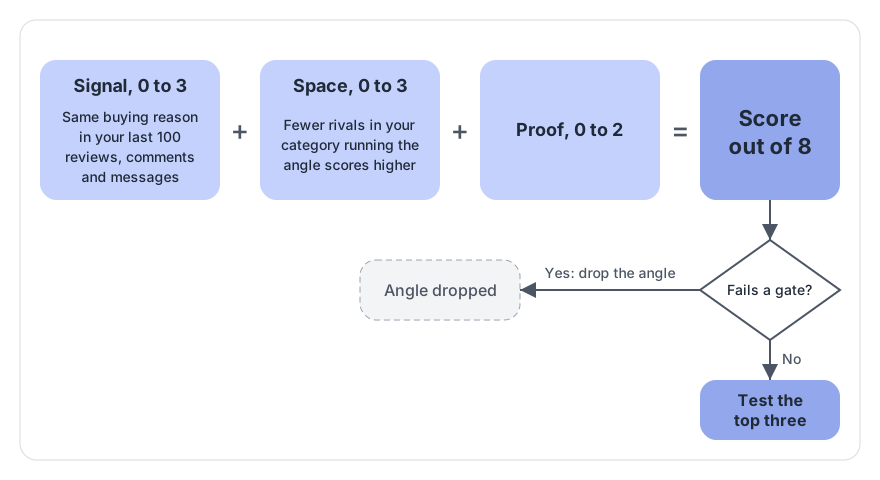
Score = Signal (0 to 3) + Space (0 to 3) + Proof (0 to 2).
- Signal: read your last 100 reviews, comments and messages (review mining shows how). Count those giving the same buying reason. 10 or more scores 3, 5 to 9 scores 2, 1 to 4 scores 1, none scores 0.
- Space: count rivals in your own category running the angle. Under 3 scores 3, 3 to 5 scores 2, 6 to 9 scores 1, 10 or more scores 0. On this mixed US, global and Indian sample, discounts would score 0 and the other three angles 2; recount in your own category.
- Proof: count real reviews, photos, prices or stock numbers you can show in the ad. Two or more scores 2, one scores 1, none scores 0.
Which gates apply, and how do you run the three tests?
Gates (pass or fail):
- You can ship every order placed by the date the ad implies. The FTC requires a reasonable basis for any shipping claim, a 30-day default if you state none, and consent or a refund after a delay. Pass if stock on hand plus carrier cut-off dates cover every order you expect by the cut-off date; fail if you cannot show that.
- Every claim has support you can produce. Pass if each claim maps to a file or page you can open; fail otherwise.
- The copy does not presume a living father. Pass if no line states or assumes the reader's father is alive; fail if one does.
Run each of the top three as one test: change only the angle and hold the format, offer and audience. Write two hooks (opening lines) per angle. Put each in an ad creative brief and size the spend with the creative-test budget calculator.
How Deepsolv handles it
We built our Creative Intelligence platform for the step the sheet above does by hand (our page on Meta creative intelligence platforms explains the category). It combines ad-performance data, competitor activity, customer signals and past ad learnings into ranked weekly test plans and execution-ready creative briefs for Meta advertising teams.
In a personalized demo, our founding team shows how we track competitor ads, break them into hooks, messaging, offers, formats and visuals, and read objections from comments and reviews. For pricing, see Deepsolv integrations, API and agency pricing or ask when you book a demo.
Example
Take an angle where 12 of your last 100 reviews give the same buying reason (Signal 3), 4 rivals in your category run it (Space 2) and you have one real review photo to show (Proof 1). It scores 3 + 2 + 1 = 6 out of 8. If it also passes the three gates, it stays in the running for one of your three tests.
Frequently asked
Sources
- 1.NRF, Father's Day spending to hit record $27.9 billion (June 10, 2026)
- 2.NRF, Father's Day spending to reach record $24 billion (2025)
- 3.NRF, Father's Day spending to total $22.4 billion (2024)
- 4.FTC, Business guide to the Mail, Internet, or Telephone Order Merchandise Rule (edited January 2025)
- 5.U.S. House of Representatives, History, Art & Archives, Father's Day becomes a national holiday
- 6.The Big Issue, Father's Day grief and opt-out emails (June 16, 2024)
- 7.Father's Day Meta ad gallery (90 ad cards), ads running June 14 to 21, 2026