

TL;DR
We publish ranked weekly test plans and use tailored workflow pricing for paid-social teams and agencies. As of 17 September 2026, we do not publicly document native Slack or Notion delivery, a ranked-plan API, webhooks, export formats, automation bridges, or per-client billing units. This page shows what is confirmed, what to request in writing, and how to scope an eight-client agency quote.
Deepsolv Integrations, API, and Agency Pricing
With Meta averaging 3.58 billion daily active people across its family of apps in December 2025, a weekly creative decision needs to reach the people who will actually make it happen.
Deepsolv integrations, API, and agency pricing currently have a simple public answer: we publish ranked weekly test plans and quote the platform around each team’s workflow, but we do not publicly document native Slack or Notion delivery, a ranked-plan API, webhooks, export formats, automation bridges, or per-client price units. Confirm those terms in writing.
Below, we distinguish verified product facts from delivery assumptions, map the information an agency should preserve, and show how to scope an eight-client quote without guessing.
What Do Deepsolv Integrations, API, and Agency Pricing Include?
We help Meta growth, creative, and agency teams turn market activity, customer signals, authorised account performance, and past experiments into ranked decisions about what to test, improve, or stop. Our publicly described output is a ranked weekly plan with decision-ready briefs, not a published connector catalogue or developer platform. See our current product features for the workflow scope.
As of 17 September 2026, our public product materials describe the ranked-plan workflow and tailored commercial scoping. They do not state that a Slack, Notion, API, webhook, file export, or automation-platform connection is included with a particular plan. That distinction matters because a useful workflow is not the same as a guaranteed handoff method.
| Delivery Method | Native | API | Webhook | Export | Automation Bridge | Plan Required | Public Status |
|---|---|---|---|---|---|---|---|
| Slack Ranked-Plan Delivery | Not publicly documented | Not publicly documented | Not publicly documented | Not publicly documented | Not publicly documented | Not stated | Confirm in writing |
| Notion Database Or Page Delivery | Not publicly documented | Not publicly documented | Not publicly documented | Not publicly documented | Not publicly documented | Not stated | Confirm in writing |
| Ranked-Plan Programmatic Access | Not applicable | No public endpoint documentation | No public event documentation | No public format documentation | No public connector documentation | Not stated | Confirm in writing |
| Multi-Client Agency Billing | Not applicable | Not applicable | Not applicable | Not applicable | Not applicable | Tailored quote | Billing unit not publicly stated |
The practical rule is simple: treat every “not publicly documented” entry as a question for a live demonstration and a written order form, rather than as a yes or no inferred from another product category.
Can Slack or Notion Receive Our Ranked Test Plans?
We know why this question comes up. A ranked plan only changes performance when the creative lead, media buyer, and client owner can see the hypothesis, evidence, owner, and due date without rebuilding the decision in another tool. Our decision record is designed to preserve that logic through the testing cycle.
We do not currently publish a statement confirming that Slack can receive scheduled plan summaries, alerts, owners, priorities, or dashboard links. We also do not publish a statement confirming that Notion can receive database records, page updates, status changes, or evidence links. Agencies should ask us to demonstrate the exact handoff required for their operating rhythm.
What Should a Slack Demonstration Show?
Ask us to show the actual destination channel, sending schedule, plan summary, user mentions, links, retry behaviour, and client-account label. A screenshot of a message is not enough if the agency needs recurring Monday delivery, owner assignment, or source-level traceability.
What Should a Notion Demonstration Show?
Ask us to show whether a plan creates or updates a page or database record, which properties can change, who owns edits, and what happens when a recommendation is archived or revised. Also confirm whether each client’s workspace permissions remain separate.
Which Fields Must Survive Any Handoff?
Any approved delivery route should preserve the decision context, not just a headline. This proposed map is an agency handoff contract, not a claim that a native mapping is currently available.
| Decision Field | Slack Summary | Notion Record | API Or Export Field | Agency Rule |
|---|---|---|---|---|
| Client Account | Client Label | Client Relation | client_account | Keep accounts isolated |
| Rank | Ordered Item | Number | rank | Preserve weekly order |
| Hypothesis | Message Body | Title Or Body | hypothesis | Retain original wording |
| Status | Status Label | Select | status | Use controlled values |
| Priority | Priority Flag | Select | priority | Do not infer from rank |
| Owner | Mention | Person | owner | Name one accountable owner |
| Evidence | Link Or Summary | URL And Source Block | evidence_url | Keep proof attached |
| Due Date | Reminder | Date | due_date | Preserve time zone |
| Source URL | Deep Link | URL | source_url | Retain provenance |
For the decision record behind those fields, our creative-test memory keeps the reasoning, evidence, and outcome connected across weekly reviews.
Does Our Ranked-Test Plan API Have Public Documentation?
We do not currently publish a ranked-test-plan API reference, endpoint list, authentication method, rate limit, webhook catalogue, or export format. If your agency requires programmatic delivery, ask us for the applicable technical scope before you buy, rather than treating a general platform capability as an API commitment.
That boundary does not make the decision workflow less useful. It makes implementation planning more honest. Our role is to connect evidence to a next creative decision and keep the reason for each recommendation attached to the work.
Our privacy policy describes encryption at rest and in transit, controlled access, role-based access controls, tenant-level data separation, and security-event logging. It does not, by itself, establish an exposed API, token format, webhook signature, audit-history feature, support SLA, or implementation timetable. Review our privacy policy for the current published security and retention terms.
| Technical Question | Publicly Documented Answer | What An Agency Should Confirm |
|---|---|---|
| API Endpoints | No public ranked-plan reference | Read, write, and export paths |
| Authentication | No public API authentication method | Token lifecycle and access scope |
| Rate Limits | No public limits | Daily, monthly, and burst thresholds |
| Webhooks | No public event catalogue | Events, retries, signing, and replay |
| Exports | No public file format | CSV, JSON, PDF, ownership, and retention |
| Automation Bridges | No public connector catalogue | Supported tools and plan eligibility |
| Audit History | No named public feature | Event visibility and retention period |
Our creative intelligence workflow is built to make the next creative decision explainable, even when an agency does not need a custom technical handoff.
How Would Monday Ranked-Test Delivery Work?
A useful Monday plan begins before Monday. We recommend agreeing on client scope, source coverage, decision owners, and the one creative variable each test will answer. Meta’s own testing guidance recommends holding other factors steady and allowing at least 14 days when sufficient data is needed, which is why a plan should record the control and decision rule, not merely a new idea.
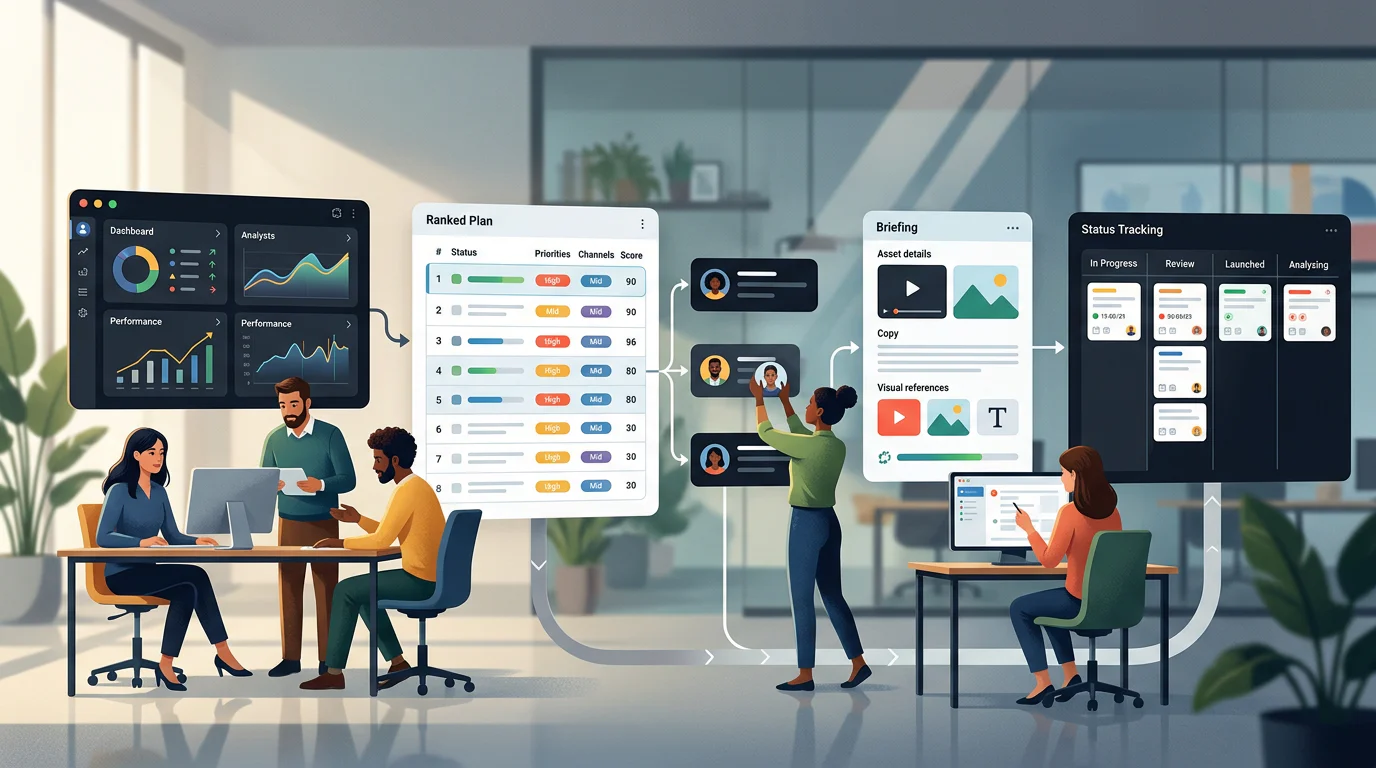
The right delivery surface depends on the team’s confirmed workflow. A direct product view can retain decision context, a channel can improve visibility, a shared workspace can support editing, and programmatic access can enable custom automation. The availability of each route should be confirmed during implementation.
- Confirm the client accounts, connected sources, owners, and measurement rules before the weekly review.
- Produce a ranked plan with the hypothesis, evidence, owner, priority, due date, and source URL.
- Deliver the plan through the agreed and demonstrated surface.
- Record who accepted, revised, deferred, or rejected each recommendation.
- Keep the test result and decision reason attached to the original recommendation.
- Use the next review to compare planned work with completed tests and retained learning.
| Delivery Surface | Visibility | Editing | Automation Potential | Governance | Confirmed Public Availability |
|---|---|---|---|---|---|
| Our Product Workflow | Full decision context | Product-specific details to confirm | Details to confirm | Product access controls | Ranked plans publicly described |
| Slack | Fast channel visibility | Summary-level collaboration | Delivery method to confirm | Workspace permissions | Not publicly documented |
| Notion | Shared pages and records | Collaborative editing | Record updates to confirm | Workspace and page permissions | Not publicly documented |
| API Or Export | Custom visibility | System-controlled | Highest potential | Schema and token controls to confirm | Not publicly documented |
For the decision behind each card or message, use a clear test framework so a handoff does not disconnect the hypothesis from its outcome.
How Much Does an Eight-Client Agency Setup Cost?
We use tailored pricing because an agency’s real scope is more than a client count. The number of brands, ad accounts, connected sources, users, implementation work, support expectations, and delivery requirements can change the commercial shape of the engagement. Our published buying route is a tailored conversation, rather than a public self-service price card, as explained in our current agency workflow.
That means we cannot honestly publish a numeric monthly total for eight client accounts from the information currently available. We do not publicly state a per-seat, per-brand, per-client-account, per-ad-account, usage, onboarding, support, or overage rate. Our pricing statement confirms that we scope platform access to the team and workflow.
What Is the Reproducible Cost Formula?
Monthly agency total equals the platform quote, plus any seat additions, client-account additions, connection additions, usage overages, support charges, and the monthly share of any onboarding charge. The formula is reproducible only when each billing unit and included allowance appears in the quote.
What Should the Eight-Client Quote List?
Ask us to list the included and additional amount for every commercial unit. If a unit is not listed, do not assume it is unlimited, included, or billed separately.
| Cost Unit | Public Rate | Eight-Client Quote Requirement |
|---|---|---|
| Platform Access | Tailored quote | Monthly or annual amount |
| Seats | Not publicly stated | Included seats and additional-seat terms |
| Brands | Not publicly stated | Included brands and additional-brand terms |
| Client Accounts | Not publicly stated | Included accounts and additional-account terms |
| Ad Accounts And Sources | Not publicly stated | Included connections and excess terms |
| Usage And Overages | Not publicly stated | Unit, allowance, rate, and cap |
| Onboarding | Not publicly stated | One-time fee, deliverables, and timing |
| Support | Not publicly stated | Included tier, response terms, and price |
Which Terms Matter Most to Agencies?
The most important commercial question is whether every client gets a distinct, governed decision record without unexpected connection or support costs. Ask us to name the billing unit, the included quantity, the overage trigger, and the approval needed before extra charges apply. For current commercial terms, see our pricing guide.
Put Deepsolv into Your Monday Test Planning
Deepsolv helps paid-social agencies turn scattered client evidence into a clear decision about what to test next. In a working session, we can review the eight-client structure you actually manage, identify the accounts and sources that matter, and show the decision record your creative and media teams need each Monday. We will also make the commercial conversation concrete: delivery route, user access, client isolation, implementation work, support, and every billing unit that affects the quote. Bring one recent test plan, the owners who use it, and the destination where work must appear. We can map the handoff, identify what needs to be demonstrated, and show how evidence remains connected to the next brief. Our aim is a practical, recorded workflow rather than a generic platform tour, so the people approving scope can see precisely what will happen each week. If your agency needs fewer disconnected updates and stronger creative decisions, start with Deepsolv.
FAQs on Deepsolv Integrations, API, and Agency Pricing
These answers reflect our public documentation as of 17 September 2026. Contact us when your agency needs a written scope for delivery, technical access, pricing, or governance.
Does Deepsolv Integrate with Slack or Notion?
As of 17 September 2026, we do not publicly document native Slack or Notion integration for ranked test plans. Confirm delivery, fields, permissions, and eligibility directly.
Does Deepsolv Offer an API for Ranked Test Plans?
We do not publish ranked-plan API endpoints, authentication, rate limits, webhooks, or export formats. Request a technical demonstration and applicable contractual terms before buying directly.
How Much Does Deepsolv Cost for Eight Client Accounts?
We use tailored workflow pricing, not a public rate card. Eight-client totals depend on quoted platform access, accounts, connections, seats, usage, onboarding, support, and overages.
What Security and Retention Terms Are Publicly Documented?
Our policy describes encryption, role-based access, tenant separation, and security-event logging. It retains customer data for six months after termination by default, unless agreed otherwise.