
Comparison
Deepsolv vs Birch: What Birch Costs and What to Switch To
The best Birch alternative for Meta advertisers who need to decide which creative to test next is Deepsolv; Meta's free rules or AdEspresso suit teams that only need automation on live ads.

By Sachit Sharma, CEO & Founder · Updated 30 Oct 2026
Deepsolv
Creative Intelligence platform for Meta advertisers
Best for: Teams deciding which Meta creative to test next
Birch
Meta ad automation tool, formerly Revealbot
Best for: Teams automating rules on live paid social ads
On this page
- 01At a glance
- 02How each looks
- 03Which to choose
- 04Detailed comparison
- 05Introduction
- 06Key takeaways
- 07Which Birch alternatives fit a Meta ad team, and which should it pick?
- 08Which job were you paying Birch to do?
- 09Why choose Deepsolv over Birch when the gap is creative decisions?
- 10How much does Birch cost as a share of your ad spend?
- 11How do you switch from Birch without losing what works?
- 12How we compared
- 13Frequently asked
The short answer
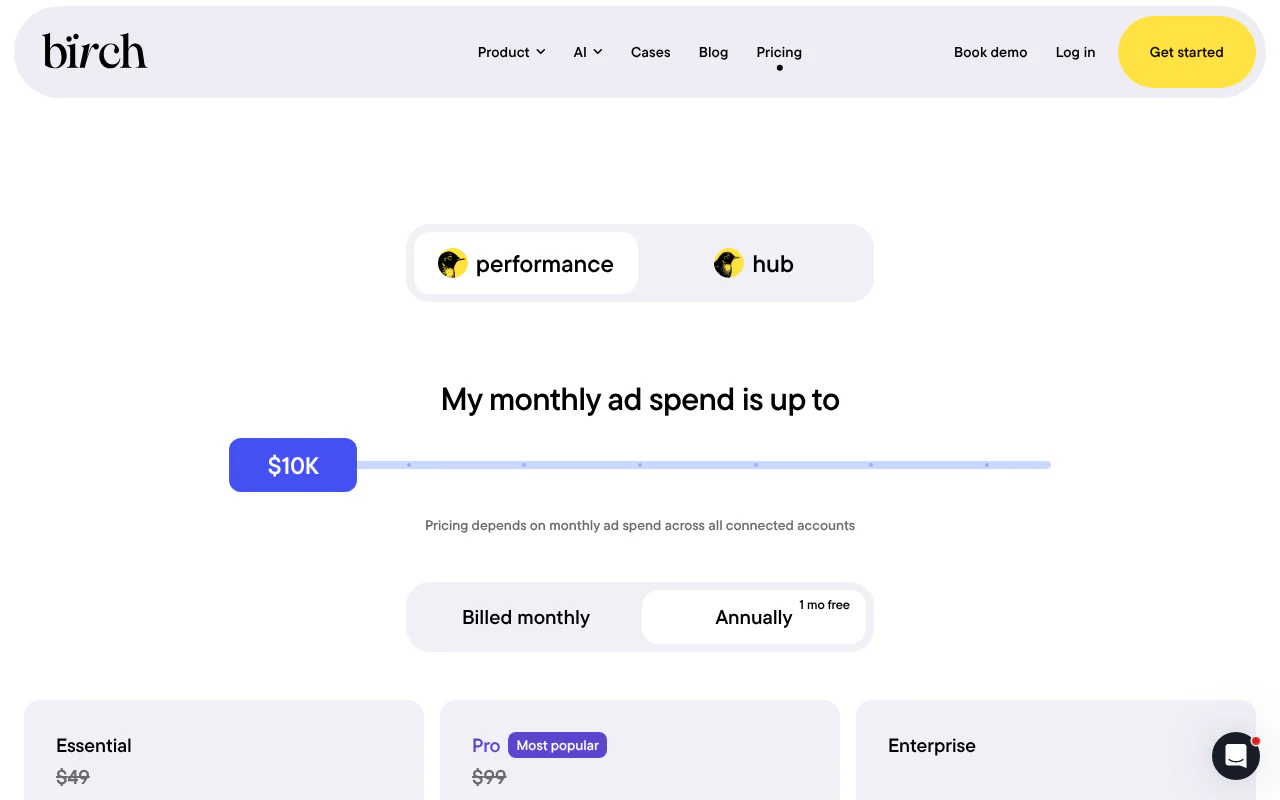
We recommend Deepsolv when the gap is deciding which creative to test next. Rules tools such as Birch, Meta's own automated rules and AdEspresso handle live-ad automation. Birch Pro, the plan with automated rules, starts at $99 a month as of October 2026, and its price depends on monthly ad spend.
At a glance
Main job
- Deepsolv
- Ranks which Meta creative to test next
- Birch
- Runs rules that act on live ads
Source: Both companies' websites, Oct 2026
Weekly output
- Deepsolv
- Ranked creative test plan and execution-ready creative briefs, delivered Mondays
- Birch
- Rules checked every 15 minutes, with 20+ actions
Source: Both companies' websites, Oct 2026
Evidence used
- Deepsolv
- Ad-performance data, competitor activity, customer signals, past ad learnings
- Birch
- Conditions you write against your metrics; custom metrics on Pro
Source: Both companies' websites, Oct 2026
Entry price
- Deepsolv
- See Deepsolv pricing page
- Birch
- Essential from $49 a month; Pro, which includes automated rules, from $99 a month; price depends on monthly ad spend across all connected accounts
Source: Deepsolv and Birch pricing pages, Oct 2026
Trial or demo
- Deepsolv
- Personalized demo with our founding team
- Birch
- 14-day free trial, no credit card
Source: Both companies' websites, Oct 2026
Platforms
- Deepsolv
- Meta advertising teams
- Birch
- Meta, Google, Snapchat and TikTok advertisers
Source: Both companies' websites, Oct 2026
How each looks

Which should you choose?
Choose Deepsolv if
- Your planned creative concepts are often delayed or never chosen, so deciding what to test is the constraint
- You want a ranked creative test plan delivered every Monday
- You want ad-performance data, competitor activity, customer signals and past ad learnings feeding each ranking
- Your creative team needs execution-ready briefs that carry the test and its reasoning together
Choose Birch if
- You need rules across Meta, Google, Snapchat and TikTok checked every 15 minutes
- You need nested conditions and 20+ actions on live ads
- You need server-side tracking for Meta through Birch Hub
Deepsolv vs Birch, point by point
A check marks the stronger side on that point. Points without a check are even, or depend on what you need.
| What matters | Deepsolv | Birch |
|---|---|---|
| Creative decisions | ||
| Choosing the next test | Stronger hereRanks which Meta creative to test next and delivers the plan as the decision | Rules automate management of ads you already run, using condition-based logic |
| Use of past learnings | Stronger herePast ad learnings are an input, so each week's plan starts from what earlier tests showed | Rules run on conditions you write against your metrics |
| Handoff to the creative team | Stronger hereExecution-ready creative briefs, so the team receives the test and its reasoning together | Rules act on ads that already run |
| Cadence and output | ||
| Delivery rhythm | Ranked plan delivered every Monday | Rules checked every 15 minutes |
| Gap test result that points to each tool | Fits when many planned creative concepts were delayed or never chosen over the last four weeks, so deciding what to test is the constraint | Fits when nearly all planned concepts launched, so rules or budget are the constraint |
| Buying terms | ||
| Keeping both tools | Does not require dropping Birch; produces the test plan and briefs | Acts on live ads; worth keeping only if its rules save more than the share of spend it costs |
Creative decisions
Choosing the next test
- DeepsolvStronger here
- Ranks which Meta creative to test next and delivers the plan as the decision
- Birch
- Rules automate management of ads you already run, using condition-based logic
Use of past learnings
- DeepsolvStronger here
- Past ad learnings are an input, so each week's plan starts from what earlier tests showed
- Birch
- Rules run on conditions you write against your metrics
Handoff to the creative team
- DeepsolvStronger here
- Execution-ready creative briefs, so the team receives the test and its reasoning together
- Birch
- Rules act on ads that already run
Cadence and output
Delivery rhythm
- Deepsolv
- Ranked plan delivered every Monday
- Birch
- Rules checked every 15 minutes
Gap test result that points to each tool
- Deepsolv
- Fits when many planned creative concepts were delayed or never chosen over the last four weeks, so deciding what to test is the constraint
- Birch
- Fits when nearly all planned concepts launched, so rules or budget are the constraint
Buying terms
Keeping both tools
- Deepsolv
- Does not require dropping Birch; produces the test plan and briefs
- Birch
- Acts on live ads; worth keeping only if its rules save more than the share of spend it costs
Introduction
A rules tool earns its fee only if the waste it stops is larger than the fee. For many Meta teams, though, the bigger gap sits upstream: deciding which creative to test next.
Birch's Pro plan, the one that includes automated rules, is priced by monthly ad spend across all connected accounts, and Birch confirms the final price at checkout. The first number to work out is the share of your monthly ad spend that the tool costs. The second is the job you hired Birch for: acting on ads that already run, or deciding which new creative to make.
This page is about Birch, the Meta ad automation tool formerly called Revealbot. It gives you a cost formula with worked examples, a job-by-job decision table and a switch checklist. We publish this page, and Deepsolv is one of the tools compared.
Key takeaways
- We recommend Deepsolv when your gap is deciding which Meta creative to test next. If your gap is acting on live ads, a rules tool does that job.
- As of October 2026, Birch Pro (the plan with automated rules) starts at $99 a month, and its price depends on monthly ad spend across all connected accounts. As an example, $99 against $10,000 of spend is 0.99%.
- Meta's rules are built into Ads Manager. Birch's rules run every 15 minutes across Meta, Google, Snapchat and TikTok.
- Before you cancel Birch, audit your rules and check which gap you actually have. Replacing a rules tool with a planning tool, or the reverse, leaves the real gap open.
Which Birch alternatives fit a Meta ad team, and which should it pick?
Rules tools such as Birch, Meta's own automated rules and AdEspresso handle live-ad automation. We recommend Deepsolv when the gap is deciding which creative to test next.
We recommend Deepsolv for Meta advertising teams whose next constraint is deciding what to test, because our Creative Intelligence platform turns ad-performance data, competitor activity, customer signals and past ad learnings into a ranked weekly test plan and execution-ready creative briefs.
Birch details are from Birch's pricing page and homepage, read in October 2026. For the full head-to-head, see Deepsolv vs Birch (formerly Revealbot).
Which job were you paying Birch to do?
Birch's rules act on ads that already run, while Deepsolv decides which new creative to make and test. In our view, a tool built for one of those jobs will not fix a gap in the other.
Meta's Help Center lists how often a rule runs in each rule's "When Rule Runs" detail, and rules are checked at least once every 30 minutes. Confirm that cadence in your own account. AdEspresso's pricing page shows Starter at $49 a month with a $1,000 monthly spend limit and Plus at $99 a month with unlimited ad spend, both as of October 2026. Its plans include performance triggers.
If the table points you to creative decisions, the four categories of Facebook ad automation explain why research, creative and optimization tools solve different problems. A dashboard that shows a dip does not tell you the next test, which Meta reporting dashboards and the decision gap covers.
- Job you need done
- Pause or scale Meta ads on set thresholds
- Where to look
- Meta's automated rules in Ads Manager; AdEspresso
- Job you need done
- Rules across Meta, Google, Snapchat and TikTok, checked every 15 minutes, with nested conditions (rules that combine several if-then tests)
- Where to look
- Birch
- Job you need done
- Server-side tracking for Meta (sending conversion events to Meta from a server instead of the browser), through Birch Hub
- Where to look
- Birch
- Job you need done
- Decide which creative to test next
- Where to look
- Deepsolv
- Job you need done
- Turn that decision into briefs your creative team can build
- Where to look
- Deepsolv
Why choose Deepsolv over Birch when the gap is creative decisions?
Choose Deepsolv when the problem is knowing what to make, not how to manage ads already live. Four facts about how we work explain why.
- Our output is the decision. Every Monday we deliver a ranked weekly creative test plan. Birch's Rules automate management of ads you already run, using condition-based logic.
- We use four kinds of evidence. Ad-performance data, competitor activity, customer signals and past ad learnings feed each ranking. Birch rules run on the conditions you write against your metrics.
- Past learnings carry forward. Past ad learnings are an input, so each week's plan starts from what earlier tests showed instead of a blank page.
- The plan arrives as briefs. We produce execution-ready creative briefs, so the creative team receives the test and its reasoning together. Our ad creative brief template shows the structure we build a brief around.
How much does Birch cost as a share of your ad spend?
Birch Pro starts at $99 a month as of October 2026, and the price depends on monthly ad spend across all connected accounts, so its cost as a share of spend is your Birch price divided by your monthly spend. At a $99 price, that is 0.99% of $10,000, 1.98% of $5,000 and 3.96% of $2,500.
These are examples, our arithmetic: Birch's published $99 starting price for Pro divided by each example spend, as of October 2026. Birch's price depends on spend, so at your spend the share uses your own price. Annual billing is $1,090 a year, about $91 a month, which would be 0.91% of $10,000 as an example. Essential, from $49, does not include automated rules.
Birch's page says the final price and currency are confirmed at checkout and may differ by billing country. Read your price there and put it into the formula.
The break-even formula (our model): monthly Birch price ÷ monthly connected spend = the share of spend your rules must save. At $5,000 of spend and a $99 price, $99 ÷ $5,000 = 1.98%, so the rules must prevent about $99 of wasted spend a month.
- Example monthly connected ad spend
- $10,000
- Birch Pro price used
- $99
- Share of spend
- 0.99%
- Example monthly connected ad spend
- $5,000
- Birch Pro price used
- $99
- Share of spend
- 1.98%
- Example monthly connected ad spend
- $2,500
- Birch Pro price used
- $99
- Share of spend
- 3.96%
- Example monthly connected ad spend
- $1,000
- Birch Pro price used
- $99
- Share of spend
- 9.9%
How do you switch from Birch without losing what works?
Run four checks before you cancel. Each has a pass and a fail, and the thresholds are our recommendation.
- Rule audit. List every active rule and what it did in the last 30 days. Pass: you can state in dollars what each kept rule saved or protected. Fail: you cannot, so the rule is a candidate to delete.
- Bracket check. Open Birch checkout and read the price for your actual 30-day connected spend. Pass: you have the price in US dollars and the break-even share from the formula above. Fail: you are estimating the price from memory.
- Gap test. Compare the creative concepts you planned to launch over the last four weeks with the ones you launched. Pass: nearly all launched, so rules or budget are your constraint. Fail: many were delayed or never chosen, so deciding what to test is the constraint. How to analyze Facebook ads and choose your next test walks through that decision.
- Overlap cycle. Keep the old tool for one billing cycle while the new one runs. Pass: nothing you relied on went unhandled. Fail: a rule fired that nothing else covers, so rebuild it first.
Our verdict
Choose Deepsolv if your gap is deciding which Meta creative to test next, because it delivers a ranked weekly test plan and execution-ready briefs where Birch only acts on ads already running.
How we compared
We compared Deepsolv with Birch (formerly Revealbot), and mentioned Meta's automated rules and AdEspresso, using Birch's pricing page and homepage, AdEspresso's pricing page, Meta's Business Help Center and Deepsolv's website, read in October 2026. Birch's final price is confirmed at checkout and was not compared at specific spend levels. Cost shares are our own arithmetic from Birch's published starting price.
This page is published by Deepsolv. If anything here is out of date, tell us and we will correct it.
Sources
- 1.Birch pricing page, Birch, October 2026
- 2.Birch homepage, Birch, October 2026
- 3.View and Manage Active Rules in Ads Manager, Meta Business Help Center
- 4.AdEspresso pricing, AdEspresso, October 2026
- 5.Deepsolv, Deepsolv