Facebook Ad Automation Has Four Different Product Categories

TL;DR
Facebook ad automation is four different categories: research finds observable evidence, generation creates variants, analytics and decisioning rank the next test, and execution makes campaign-side changes. Compare tools by the output your team lacks, then use our decisioning workflow when the question is what to test, improve or stop.
The word automation hides four separate jobs
As of September 2026, Facebook ad automation tools should be compared by the output a team needs next, not by whether a vendor uses the word automation. The four outputs are research evidence, creative variants, ranked decisions, and campaign-side actions.
A research product helps a team see and organise inputs. A generation product makes more assets. An analytics and decisioning product prioritises the next test, improvement or stop. An execution product carries an already-made decision into campaign management.
The practical consequence is simple: a tool that makes 50 new variants cannot answer whether any of those variants deserve production. A tool that changes a budget cannot establish which creative hypothesis the team should test first.
A tool’s category comes from the action it produces
The map below uses documented workflow roles. Products can span adjacent work, but the comparison stays useful only when each product is placed by its primary output.
| Category | Documented action | Output to expect | Workflow role |
|---|---|---|---|
| Research | Observe, search and save ads | Evidence and references | Research platform |
| Generation | Generate text, images, video and ad creative | Assets and variants | Creative-generation platform |
| Analytics and decisioning | Combine performance, competitor and customer signals with past experiments | Ranked test, improve and stop decisions | Our creative decision workflow |
| Execution | Audit, prepare, launch, manage and adjust campaigns | Campaign-side actions | Campaign-automation platform |
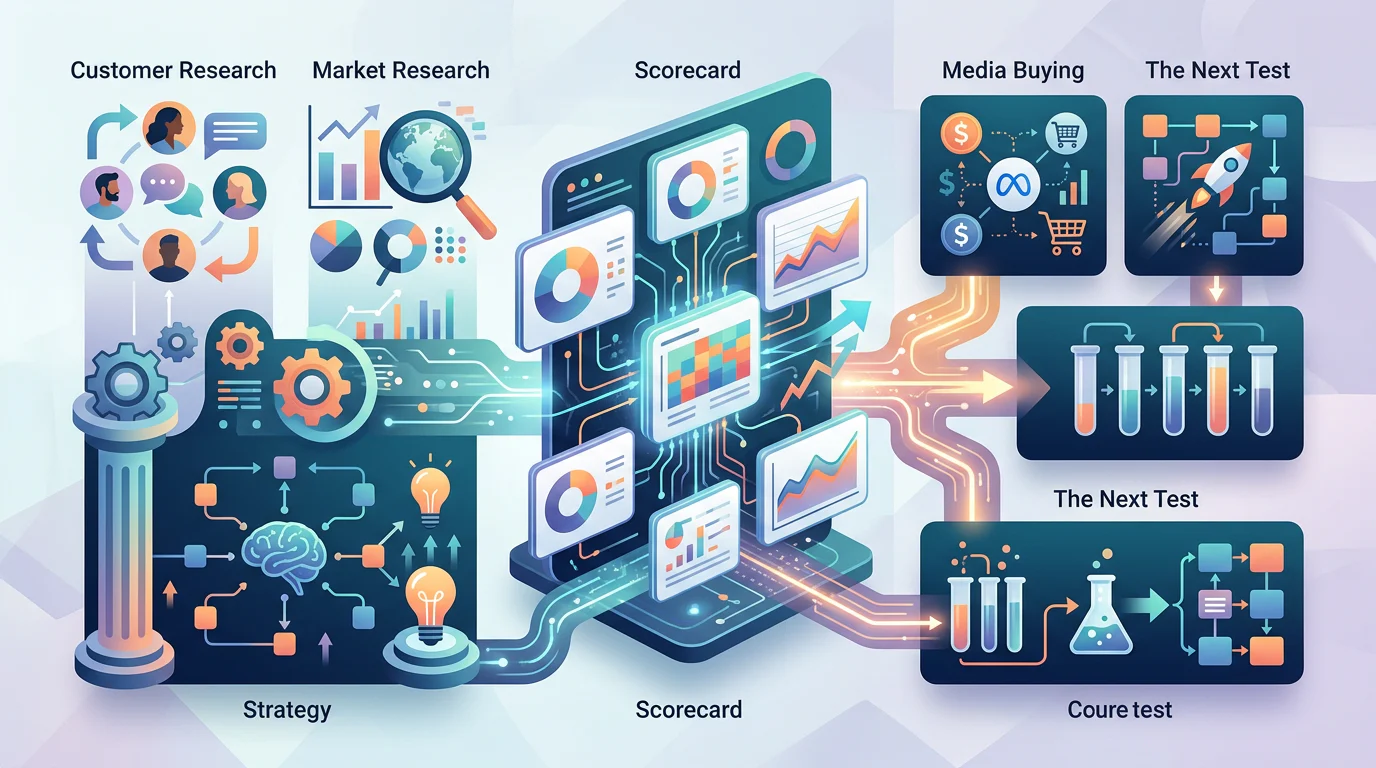
The paid-social creative workflow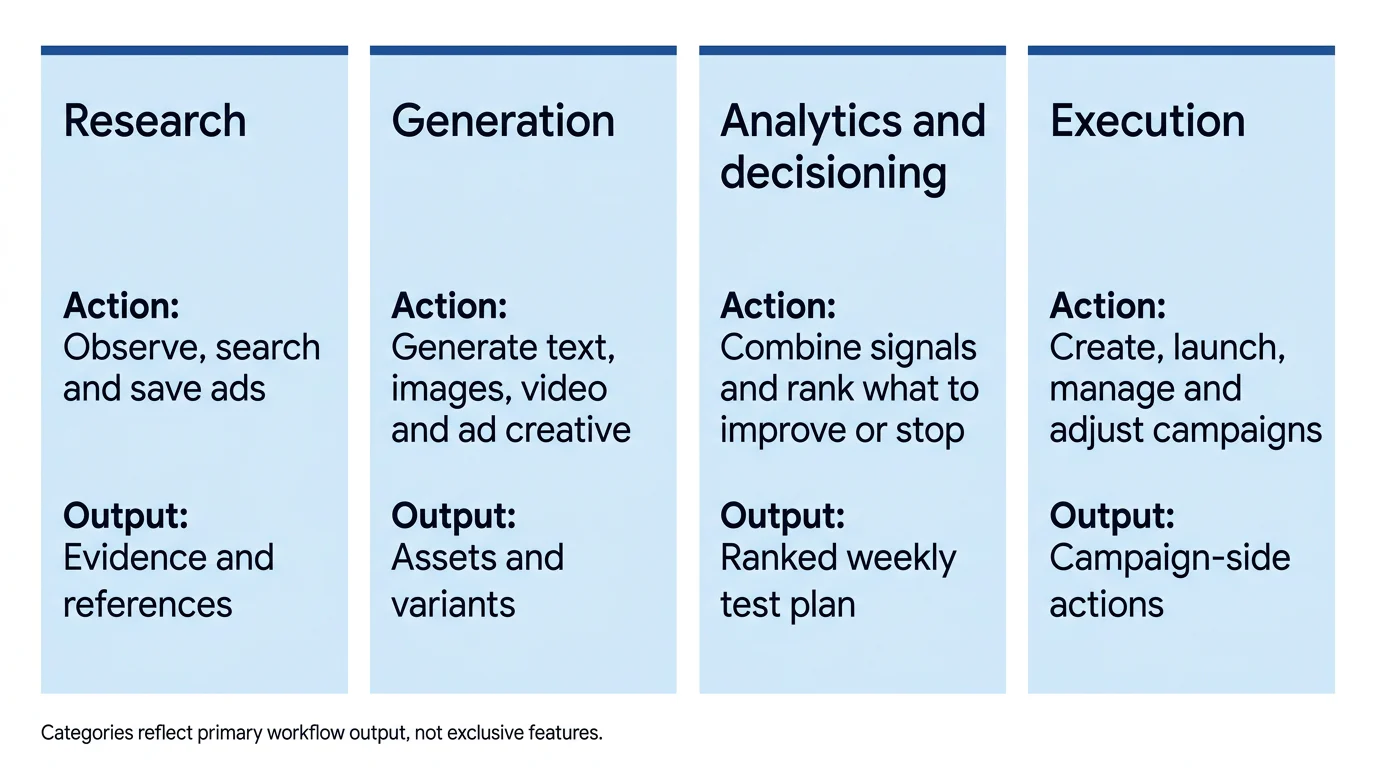
Verdict: our decisioning workflow wins for Meta teams that have ideas and data but need a defensible answer to what should be tested, improved or stopped next. We turn competitor activity, customer feedback, authorised account performance and past experiments into a ranked weekly test plan. See how our product features support that decision.
Our workflow is not the right fit when the team has already chosen the action and only needs automated campaign changes. In that case, the execution category wins. It is also not the right fit when the immediate constraint is producing a high volume of new assets, which is the generation category’s job.
Research creates hypotheses, not proof
Meta’s Ad Library documentation describes a searchable view of current ads across Meta technologies. Its available records include the ad creative, Page name and ID, delivery dates, and placements.
Those observable fields make research useful for identifying messaging, formats and changes worth investigating. They do not establish the commercial result of an ordinary ad. Treat an observed competitor pattern as a reason to write a testable brief, then judge the test with your own account evidence. For that distinction, see what a Meta Ad Library can and cannot show.
Choose the missing layer before buying another tool
First, write the stalled question in operational language. Examples include: Which competitor patterns deserve a brief? How do we make more variants? Which idea should receive the next test budget? Which campaign action should run when a threshold is met?
Second, select the category that produces the answer, not the category with the longest feature list. Third, give one team member ownership of the handoff. Research should become a brief, generation should become a controlled variant set, decisioning should become a ranked queue, and execution should become a recorded account action.
Use the difference between creative analytics and test planning when dashboards are producing observations but not a next action. Use a creative test capacity planner when the team needs to decide how many prioritised tests it can actually produce and evaluate.
Keep reading


Frequently asked
Research returns evidence such as observable ads, themes and references. Generation returns new text, images, video or creative variants. A team can pass research into generation, but that handoff does not change which output is missing.
No. Meta's Ad Library makes current ads, creative content, delivery dates and placements observable, but those fields do not establish commercial results for ordinary ads. Treat visible ads as evidence for a hypothesis, not proof of a winning strategy.
Use decisioning when the team cannot yet name the next worthwhile hypothesis, improvement or stop. Use execution automation when the decision is already made and the bottleneck is launching, managing or adjusting the campaign-side action.
No. We turn performance, competitor activity, customer signals and past experiments into ranked creative decisions. Teams that need high-volume asset production or automated media buying should choose those workflow categories for those jobs.
Turn evidence into the next test
See how we build a ranked weekly creative test plan for Meta growth teams.
Book a demo