Glossary · Meta creative intelligence
Meta Ad Library

By Sachit Sharma, CEO & Founder · Reviewed 26 Sept 2026
Also called Facebook Ad Library or Meta Ads Library
What is Meta Ad Library, and what data does it show?
Meta Ad Library is Meta’s ad-search interface for finding ads currently running across Meta technologies by advertiser or keyword. It reveals visible creative, the associated Page, delivery dates and where an ad appeared. The Library is a transparency and research surface, not a dashboard of ordinary commercial advertisers’ business results.
Key takeaways
- Search by advertiser or keyword after choosing a location and ad category.
- Record creative, Page identity, delivery dates and placements as market observations.
- Allow for Meta’s stated 24-hour lag when checking for newly visible ads or edits.
- Use a visible competitor ad to form a hypothesis, then validate the hypothesis with your own account data.
The default view is an observation layer
Meta’s Ad Library documentation directs users to search ads currently running across Meta technologies by keyword or advertiser. The same documentation specifies additional history for political or issue ads and region-specific history for EU and UK delivery.
Meta’s Ad Library API documentation identifies the common observable fields as creative content, Page name and ID, delivery dates, and where an ad appeared. It separately limits spend, impression and demographic fields to specified categories and delivery regions.
- Ad scope
- Ads currently running across Meta technologies
- Time coverage
- Current ads
- Additional documented information
- Creative content, Page identity, delivery dates and placements
- Ad scope
- Social issues, elections or politics
- Time coverage
- Past seven years worldwide
- Additional documented information
- Spend range, impression range and demographic reach information
- Ad scope
- Ads delivered in the EU
- Time coverage
- Past year
- Additional documented information
- Estimated total impressions, targeting and reach demographics, plus advertiser and payer information
- Ad scope
- Ads delivered in the UK
- Time coverage
- Past year for ads run after 1 July 2025
- Additional documented information
- Estimated total impressions and targeting and reach demographics
A visible creative becomes a hypothesis, not a verdict
A commercial ad can reveal a message, offer, format or placement that deserves investigation. It cannot establish the advertiser’s private ROAS, CPA, revenue, profitability or conversion quality.
A competitor-research workflow guide can turn that boundary into an operating habit: capture the observation, compare it with customer and account context, then write the next test. If the immediate need is collecting examples rather than deciding what to test, see Ad Spy Tool: Meaning and the Difference Between Monitoring and Intelligence.
Worked example: make one decision from a dated observation
A Monday search finds a competitor’s new commercial creative. Record the copy, Page, delivery date and placement, then repeat the search 24 hours later because Meta says new ads and edits can take that long to appear.
The decision is not to copy the ad. Write one hypothesis, name one creative variable, set one success measure and define one stop-or-scale condition for your own account. That produces a testable brief instead of an unsupported claim about competitor performance.
A record turns browsing into a test
A visible ad can create a test hypothesis, but it cannot supply the competitor result needed to prove that hypothesis. The useful handoff is from a dated observation to a defined test in your own account.
The evidence-to-test sequence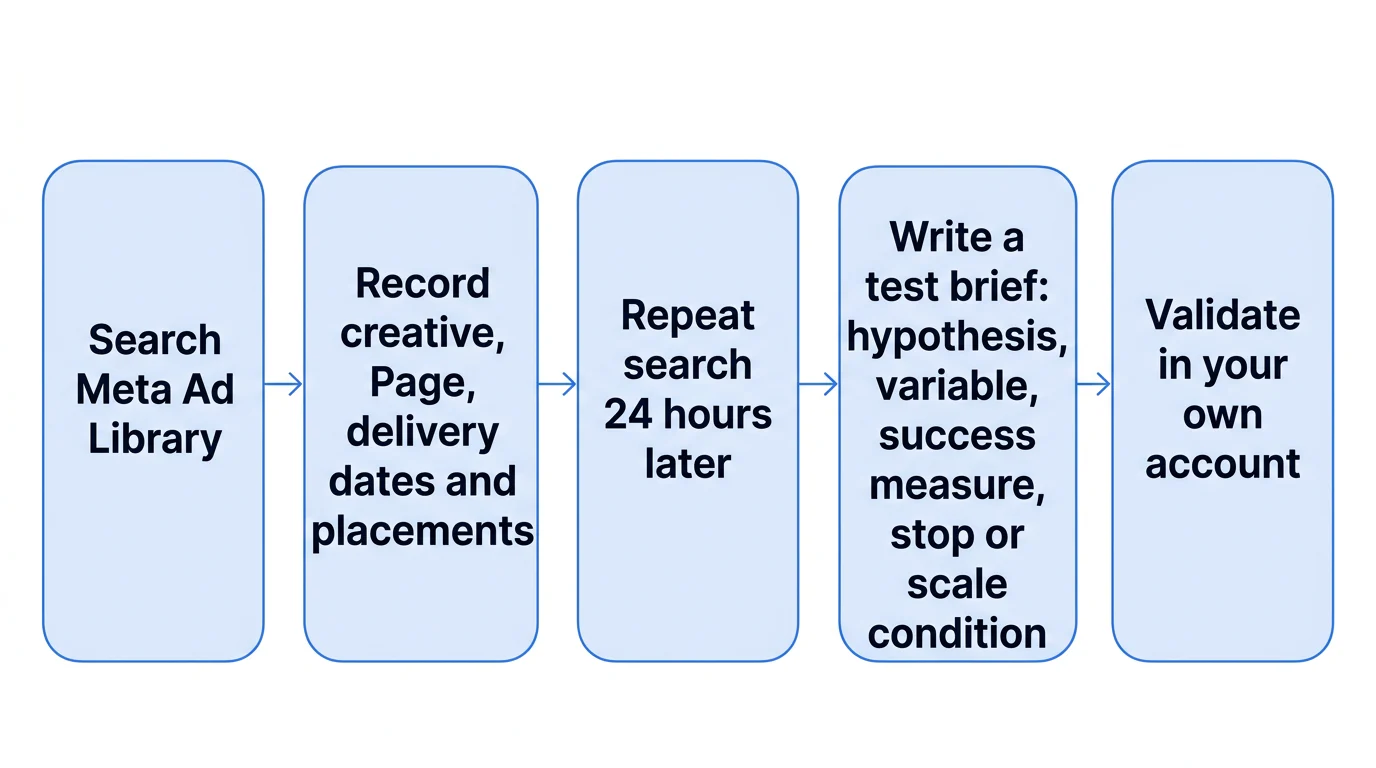
Example
A team sees a new competitor video, records its copy, Page, delivery date and placement, then checks again 24 hours later. The team turns the observed message into one hypothesis for its own account, rather than treating the visible ad as proof of a profitable competitor result.
Sources
- 1.Ad Library, Meta, 2026
- 2.Meta Ad Library API, Meta, 2026
Frequently asked
Meta Ad Library is used to find ads currently running across Meta technologies and inspect observable details such as creative, the associated Page, delivery dates and placements. It is useful for researching messaging, offers and formats that are visible in a market.
Meta Ad Library does not establish ordinary commercial advertisers’ ROAS, CPA, revenue, profitability or conversion quality. Meta documents spend ranges, impression ranges and demographic reach information for ads about social issues, elections and politics, with separate UK and EU disclosures.
Meta says an ad can appear in Ad Library within 24 hours of its first impression, and changes or updates can also take up to 24 hours to appear. A missing result can therefore reflect timing as well as the selected location or category.
A Meta Ad Library result can show that a creative is visible and provide observable market context, but it cannot prove that the advertiser is profitable or that the creative will work for another account. Use the observation to form a hypothesis, then measure the result in your own account.
Need a ranked next-test decision?
We combine competitor activity, customer signals, historical performance and past experiments into a weekly test plan.
Explore our workflow