Glossary · Creative intelligence
Ad spy tool

By Sachit Sharma, CEO & Founder · Reviewed 26 Sept 2026
Also called ad intelligence tool, competitor ad research tool or ad library tool
What is an ad spy tool?
An ad spy tool is software that searches public ad libraries or indexed advertising databases to show competitor ads and observable details, such as advertiser, creative, format, and dates shown. It supports discovery and monitoring; it does not, by itself, show a competitor’s conversions, return on ad spend, or profitability.
Key takeaways
- Treat an ad's visible status and dates as a research lead, not evidence that the ad is commercially successful.
- Choose the source by platform, because coverage, retention, and displayed fields differ across Meta, Google, and TikTok.
- Track changes over time when you need to distinguish a one-off observation from a recurring competitor pattern.
- Use competitor research to create an original test, then judge it with your own performance and customer evidence.
Quick facts
- Meta update window
- Meta says ads and updates appear in Ad Library within 24 hours.
- Meta policy-ad archive
- Meta retains social-issue, election, and political ads for seven years.
- Google public view
- Google's Transparency Center searches active ads from verified advertisers.
- TikTok coverage
- TikTok's Commercial Content Library currently covers the EEA, Switzerland, and the UK.
- TikTok retention
- Qualifying TikTok ads are stored for one year after their last view.
Public ad libraries are useful, but their scope changes by platform
The Meta Ad Library, Google Ads Transparency Center, and TikTok Commercial Content Library expose different advertising records. Meta says ads and updates appear within 24 hours of a first impression, while TikTok says ads generally appear within 24 hours of campaign initiation. Google focuses its Transparency Center on active ads from verified advertisers.
- Library
- Meta Ad Library
- What you can observe
- Currently running ads across Meta technologies, plus certain policy-ad archives.
- Important boundary
- Meta retains social-issue, election, and political ads for seven years.
- Library
- Google Ads Transparency Center
- What you can observe
- Active ads, advertiser, region, last date shown, and format.
- Important boundary
- The public search is for active ads from verified advertisers.
- Library
- TikTok Commercial Content Library
- What you can observe
- Paid ads, including active or paused ads, with dates, reach ranges, and targeting summaries.
- Important boundary
- Coverage currently applies to ads available in the EEA, Switzerland, and the UK; qualifying ads are stored for one year after their last view.
Monitoring is a record, not a verdict
Monitoring means returning to the same competitor or category over time and recording observable changes: a new offer, a different format, or a change in active status. That record can reveal what is being tested in public.
The public fields documented by the platforms describe delivery and transparency information, not a competitor's first-party conversion results or profitability. A decision-maker should therefore treat a visible pattern as a hypothesis, then test an original response with evidence from their own account.
Intelligence adds the context needed to choose
Creative intelligence joins market observations with first-party performance, customer feedback, and historical experiments. The output is not a larger swipe file. The output is a prioritised decision about what deserves a test and what should be skipped.
At Deepsolv, we combine competitor activity, customer signals, ad performance, and past creative learnings into a ranked weekly test plan.
Worked example: from a visible offer to an original test
A growth team sees a competitor's active Meta ad promoting a new offer. Meta says an ad and its updates can appear in the Ad Library within 24 hours of a first impression. The team records the offer and checks the public record again after that window.
If the message remains visible, the team does not assume it is profitable. It compares the observed offer with its own conversion results and customer objections, writes an original creative angle, and evaluates the new test against its own success criteria.
Research the pattern, not the protected expression
Use ad research to understand a pattern, such as an offer structure, audience objection, or format choice. Do not treat a competitor's creative as free production material. The U.S. Copyright Office explains that copyright can protect original expression even though ideas themselves are not protected, and its fair-use guidance says the analysis is case specific.
Any claim in a new ad needs its own support. The Federal Trade Commission's advertising guidance says advertising claims must be truthful, non-deceptive, fair, and evidence-based.
The three levels of evidence
Public libraries make competitor advertising easier to observe. Monitoring preserves those observations over time. Creative intelligence adds the evidence required to choose an original next test.
From visible ads to a test decision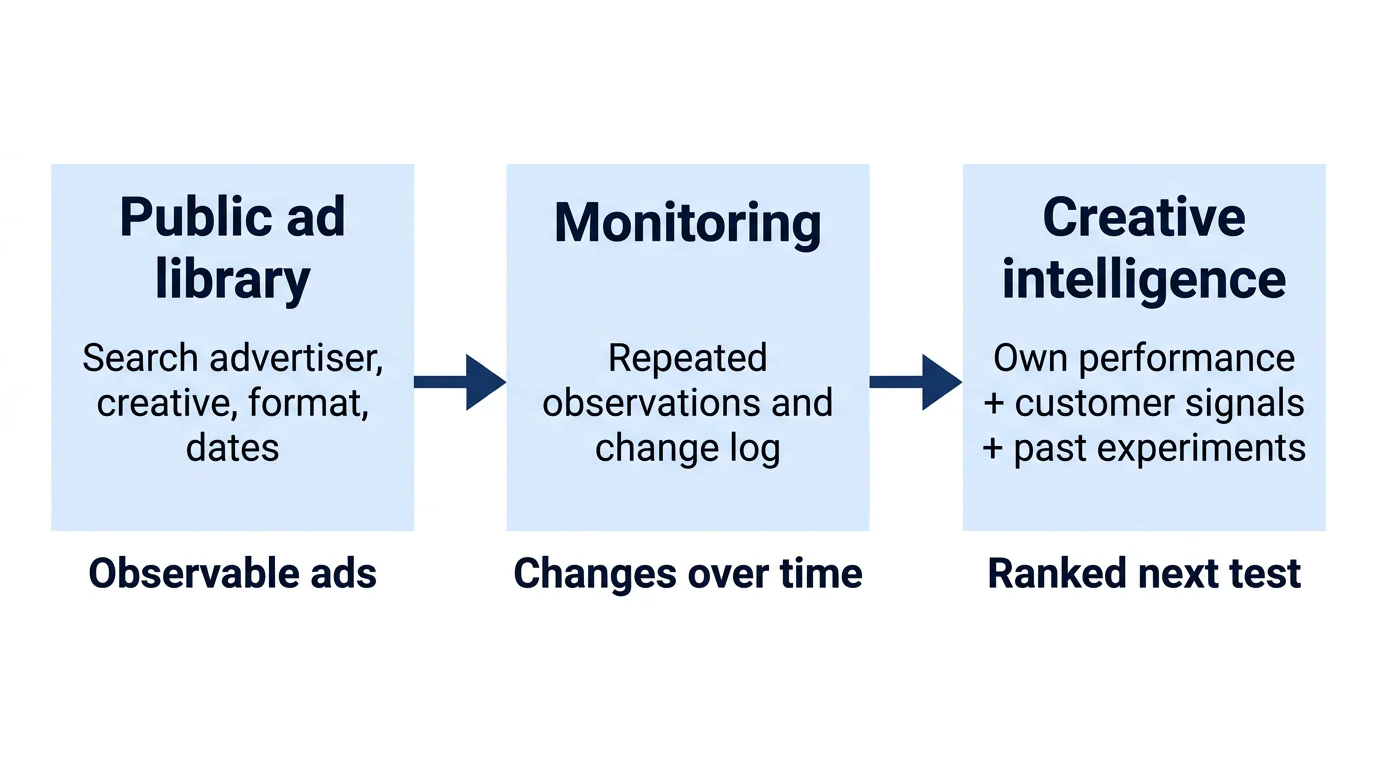
A visible ad is a useful signal, but it is not a verdict on what caused a commercial outcome.
Example
A team records a newly visible competitor offer, checks for changes after Meta's 24-hour update window, and then uses its own conversion data and customer feedback to decide whether an original variation is worth testing.
Sources
- 1.Ad Library, Meta, 2026
- 2.Announcing the launch of the new Ads Transparency Center, Google, 2023
- 3.Commercial Content Library, TikTok, 2026
- 4.Copyright in General, U.S. Copyright Office, 2026
- 5.Advertising and Marketing, U.S. Federal Trade Commission, 2026
Frequently asked
Using publicly available ad libraries for research is different from copying a competitor's work. The U.S. Copyright Office says copyright can protect original creative expression, while the FTC says advertising claims must be truthful and supported by evidence. Use observed patterns to develop original creative and substantiate every claim you publish.
No. A long-running or active ad can justify closer research because it shows observable delivery over time, but public-library information does not provide the competitor's conversion results, return on ad spend, margin, or profitability. Treat longevity as a hypothesis to test against your own evidence.
Ad monitoring records what changes, such as new creatives, formats, offers, or active status. Ad intelligence uses those observations alongside a brand's first-party performance, customer feedback, and prior experiments to prioritise what to test, improve, or stop.
Turn competitor signals into a ranked next test
See how we connect market signals, customer evidence, and past creative learnings.
Explore our features