
Visible Ads Are Not Proof. Build Testable Meta Competitor Briefs
Monitor Meta competitor signals, capture the evidence and turn recurring category patterns into a ranked brief your team can test.

By Sachit Sharma, CEO & Founder · Reviewed 18 Sept 2026
- 24 hours
- Meta says new ads and updates generally appear in Ad Library within this period.
- 15 experiments
- A Facebook advertising study found observational methods often did not reproduce randomized effects.
- 70,000+ advertisers
- A randomized study examined the value of offsite conversion optimisation on Facebook and Instagram.
Meta Ad Library, 2026
Marketing Science, 2019
Marketing Science, 2024

In brief
Meta competitor research should produce a hypothesis to test, not a claim that a rival’s ad is profitable. Deepsolv monitors category signals alongside customer feedback, ad performance and past experiments to create ranked creative decisions for Meta teams.
From market signals to a brief your team can test
Monitor category signals
Track competitor messaging, angles, offers and formats side by side across the category.
- Competitor messaging
- Creative angles
- Offers
- Formats
Capture usable evidence
Keep visible ad activity connected to the details that can support a creative hypothesis.
- Creative content
- Copy
- Placement
- Delivery date
Compare recurring patterns
Separate an isolated ad observation from a pattern worth bringing into the test queue.
- Category view
- Customer signals
- Ad-performance context
- Past experiments
Write the next-test brief
Create ranked decisions about what to test, improve or stop, with drafted hooks, scripts and statics.
- Hypothesis
- Creative variable
- Success measure
- Stop or scale condition
Where we work
- Consumer brands
- Paid-social agencies
- Meta growth teams
- Creative teams
Competitor research is useful when it creates a test
Meta’s Ad Library makes currently running ads searchable by advertiser or keyword, with new ads and updates generally appearing within 24 hours. That makes messaging, angles, offers and formats useful market evidence, but not a readout of a competitor’s commercial results.
Meta’s Ad Library API documentation lists spend and impression fields for issue, election and political ads, not ordinary commercial ads. A visible commercial ad can inform a hypothesis, but it cannot establish a rival’s ROAS, revenue, CPA, targeting or profitability.
Deepsolv turns that boundary into a working process for Meta growth teams. It monitors competitor messaging, angles, offers and formats side by side, then combines those observations with customer signals, ad-performance context and previous experiments to rank what the team should test, improve or stop. For a deeper look at the operating model, see how competitor-ad tools track scaled angles.
A brief needs evidence and a way to be wrong
A testable creative brief should name the observed pattern, the hypothesis, the creative variable, the success measure and the condition for stopping or scaling. That structure keeps a category observation from becoming an unsupported claim about what will work.
The distinction matters because a 2019 Marketing Science study found that observational methods often did not reproduce randomized advertising effects across Facebook experiments. Use competitor research to decide where to learn first, then use your own account data to decide what earned another round.
From visible ad to recorded learning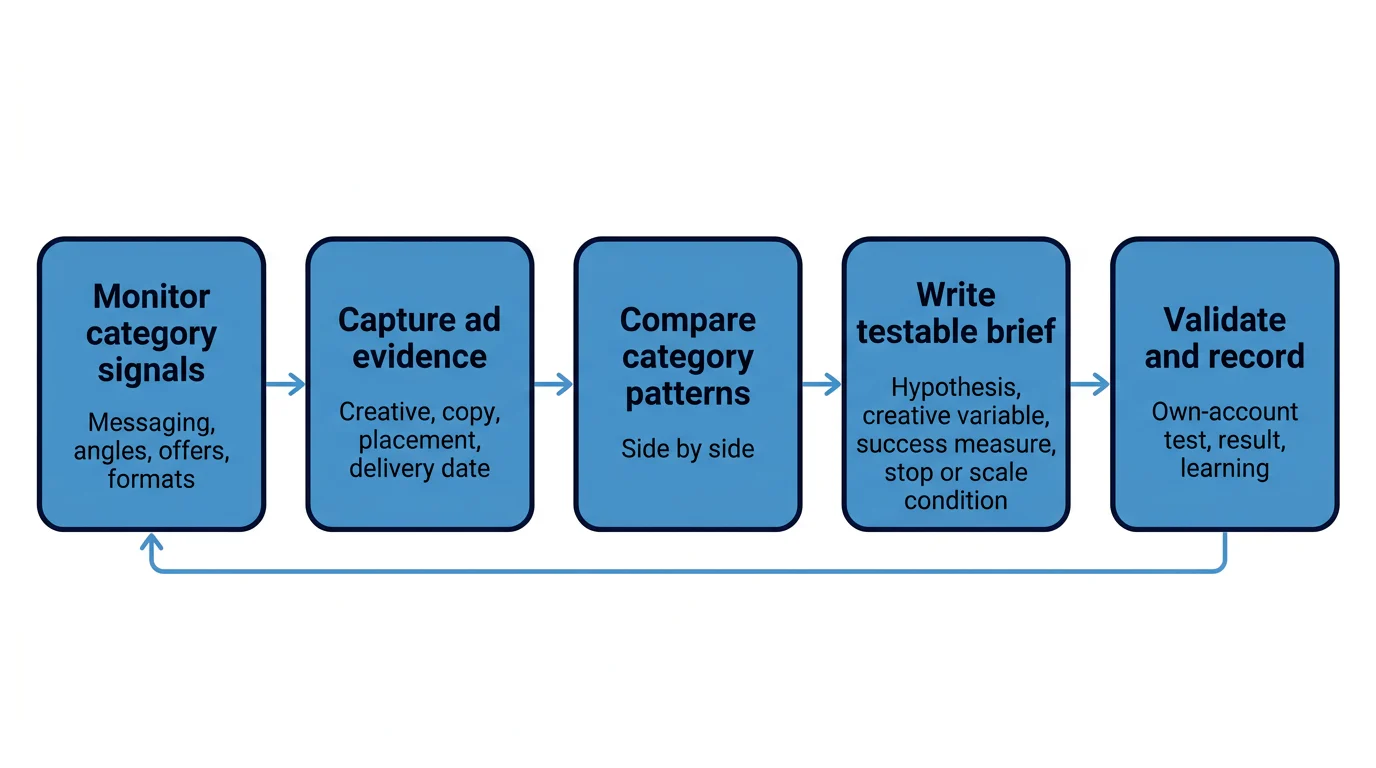
What Deepsolv gives your team
Deepsolv is built for teams that already have creative work to make, but need a shared decision about which hypothesis deserves the next production and media test.
It is not a fit for treating competitor activity as proof of performance, or for teams looking only for a broad swipe file without a test-decision workflow. Use a Meta creative test queue to prioritise the work, then apply a practical stop policy once the test is live.
Keep reading



Frequently asked
No. Competitor ads can reveal active messaging, offers, formats and repeated themes, but they do not reveal a rival’s private revenue, ROAS, CPA or conversion quality. Use them to form hypotheses, then validate those hypotheses in your own account.
A testable creative brief should identify the observed pattern, state the hypothesis, define the creative variable, name the success measure and set a stop or scale condition. Those fields give a creative team direction without pretending the outcome is already known.
Meta Ad Library can show currently running ads and observable details such as creative content, page identity, delivery dates and placements. It is useful for researching category activity, but ordinary commercial-ad searches do not establish competitor performance or profitability.
Deepsolv is for consumer brands, paid-social agencies and Meta growth or creative teams that need to prioritise what to test, improve or stop. It is designed for teams that want competitor activity, customer signals and prior learning connected to a ranked decision.
Turn category evidence into your next Meta test
See how Deepsolv can help your team move from scattered creative signals to ranked decisions.
Book a demo