
Competitor Ad Tools for Tracking Scaled Angles
Compare competitor ad tools for tracking scaled angles by coverage, history, evidence limits, pricing, alerts, and first-party test workflow.

High-volume ecommerce teams have both a research problem and a measurement problem. In a 15-test analysis, Meta found that certain Reels video conditions produced a 34.5% lower cost per result than image ads, which illustrates why format needs internal validation.
Competitor ad tools for tracking scaled angles work best when they retain dated creative records, classify hooks and offers, identify repeated variants, and compare changes over time. Public libraries reveal visible ads, but not a rival’s ROAS or conversion rate. We use their signals to form better hypotheses, then validate them against customer evidence and authorized first-party results.
Below, we compare the useful source systems, explain what their signals can prove, and show how to turn a monitored pattern into a defensible test.
What Separates an Ad Archive from Competitor Intelligence?
An ad archive is useful when someone needs to find a visible creative, copy its destination URL, or save a reference. It becomes limiting when the question changes from “What is live?” to “What changed this month, which offer is recurring, and what should we test next?”
Meta makes active ads publicly searchable through its ad library, but its seven-year retention rule applies to political, electoral, and issue ads. For commercial research, a current visible ad is an observation, not proof of a complete public history or a performance outcome.
We separate the work into three layers:
- Ad Search: Finds a visible ad, advertiser, creative, and destination.
- Competitor Monitoring: Rechecks a defined watchlist, records dates and regions, and flags material changes.
- Creative Intelligence: Connects those observations with audience evidence, past tests, and a next action.
That last layer is where a research feed becomes operational. Our continuous tracking workflow keeps source records, versions, and evidence limits together so a team can challenge a recommendation before producing another variation.
Which Competitor Ad Tools for Tracking Scaled Angles Fit Your Stack?
The right stack depends on the decision your team needs to make. Official tools are strong free discovery sources, while a decision workflow earns its place when it reduces manual reconciliation and connects visible market movement to work inside your account.
Google’s center covers Search, Display, Gmail, and YouTube, and lets users filter advertiser records by date and targeted location, according to Google documentation. That makes it useful for checking public search copy and video formats, but it does not reveal a competitor’s conversion ledger.
| Source System | Signal Depth | Channels | History And Alerts | Angle And Offer Treatment | First-Party Connection And Output | Verified Pricing |
|---|---|---|---|---|---|---|
| Meta Ad Library | Visible creative and advertiser records | Meta | Active commercial visibility, no native monitoring alert | Manual classification | No connection, raw references | Free |
| Google Ads Transparency Center | Advertiser, format, region, and date signals | Search, Display, Gmail, YouTube | Date-filtered public records, no native monitoring alert | Manual classification | No connection, raw references | Free |
| TikTok Commercial Content Library | Creative, dates, reach range, and targeting summary | TikTok, EEA, Switzerland, UK | One year after last view, source updates can lag | Manual or workflow-applied classification | No connection, regional ad records | Free |
| Deepsolv | Public observations plus authorized customer and account context | Confirmed source scope during onboarding | Timestamped workflow records and monitoring alerts | Hooks, offers, formats, and audience tensions | Ranked test plan, briefs, scripts, and decisions | Tailored quote |
Use the first three rows for evidence collection, not for performance claims. Use our library comparison when your team needs a clearer distinction between raw discovery, organized research, and conversion-connected creative decisions.
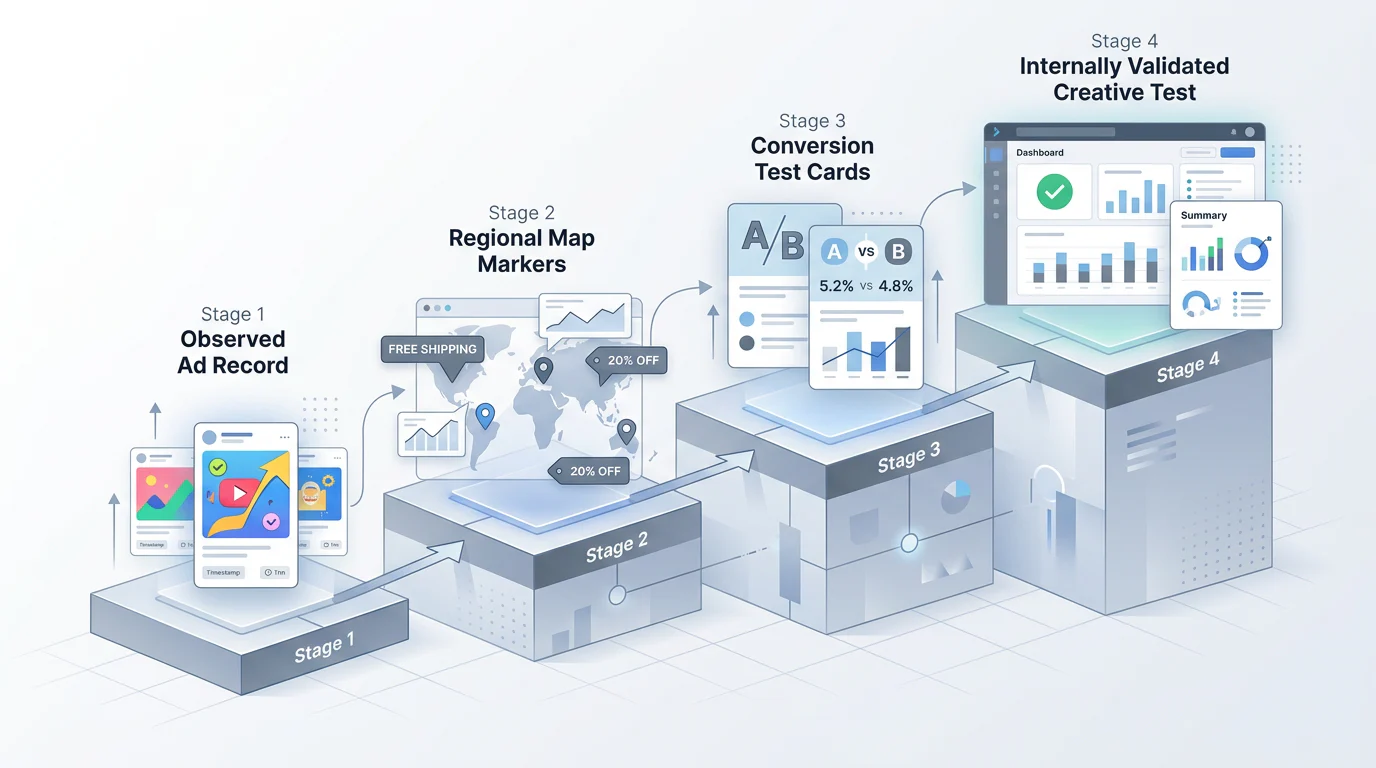
How Can You Tell Whether an Angle Is Being Scaled?
No public tool can see a competitor’s internal budget rules, conversion rate, or profit margin. What it can show is whether a creative family persists, gains variants, changes its offer, or appears across more formats and regions.
Start with Observable Scaling Signals
A useful monitoring record looks for repeated evidence, not one striking ad. Prioritize these patterns:
- Longevity: The same creative family remains observable across repeated checks.
- Variant Count: Several executions carry the same audience tension, promise, or offer.
- Relaunches: A familiar creative family reappears after an absence.
- Placement Breadth: A pattern moves from one format or surface into several.
- Change Frequency: New hooks, CTAs, offers, or landing pages appear around one angle.
These signals are directional. They tell us where to look, not what is profitable.
Separate Observations from Inference
A rigorous workflow labels what was seen and what it may mean. This prevents a team from calling a visible pattern a winner before it has earned that conclusion.
| Evidence Level | Required Record | Safe Claim | Recommended Action |
|---|---|---|---|
| Observed | Source, region, timestamp, and creative version | “A new offer variant appeared” | Add to watchlist |
| Corroborated | Repeated observations and clear creative-family match | “The angle is being actively iterated” | Add to research queue |
| Internally Validated | Public pattern, customer evidence, and authorized test result | “This hypothesis improved our result under stated conditions” | Consider internal scaling |
Use Internal Tests for Proof
A competitor signal is a hypothesis generator, not a causal result. The most useful question is whether our audience, proof, landing page, and offer can support a distinct version of the same strategic idea.
Our market signal guide helps teams keep that boundary clear. We reserve performance language for our own controlled results, where the variable, metric, and decision rule are documented before launch.
How Do You Track Hooks, Offers, and Landing Pages over Time?
A screenshot loses most of the context needed for a decision. We preserve the source, country, language, first observation, last observation, creative-family identifier, destination page, and each meaningful change.
TikTok states that eligible library records can appear within 24 hours of a first view or update, and remain available for one year after last view under its stated regional scope.
For each creative family, we classify:
- Hook: The opening claim, visual tension, or attention device.
- Audience Angle: The customer tension, desired outcome, or objection addressed.
- Offer: The price frame, bundle, discount, guarantee, urgency, or trial.
- Proof: Reviews, product demonstration, comparison, ingredient, expert, or result claim.
- Format And CTA: The execution type and requested next step.
- Landing-Page Match: Whether the destination continues or weakens the ad’s promise.
Regional tracking matters because a translated line, local payment message, or country-specific bundle may be a localized version rather than a new strategy. Our angle tracking framework helps teams compare versions without flattening important market context.
How Do You Turn a Pattern into a Test?
The useful output is not a longer slide deck. It is one decision-ready test that gives a creative lead, media buyer, and analyst the same understanding of what was observed, what is inferred, and what will prove or disprove the hypothesis.
Capture the Evidence
Start with a defined watchlist and a repeatable collection cadence. Save the creative, source URL, region, timestamp, placement, destination, and visible offer before discussing strategy.
Translate the Pattern
Describe the transferable idea rather than copying the execution. “A proof-led comfort claim for first-time buyers” is a testable pattern. A copied script, testimonial, visual layout, or brand-specific phrase is not.
Validate the Audience Hypothesis
Compare the observed tension with authorized reviews, comments, DMs, support issues, and prior test outcomes. Google’s auction reports include six auction metrics, but those metrics describe competitive visibility in your auctions, not a competitor’s conversion performance.
Write the Test Card
Give every test one primary learning question, a control, one changed variable, a conversion metric, guardrails, an owner, and a decision rule. Our test prioritization workflow ranks that card against the rest of the weekly queue, including failed or fatigued ideas that should not return.
Why Deepsolv Fits This Workflow
We built Deepsolv for ecommerce growth teams that have enough creative references but not enough confidence about what deserves production next. Our workflow brings permitted competitor observations together with approved customer feedback, historical test learnings, and authorized account performance. Instead of asking your team to trust an unexplained score, we preserve the source, region, version, customer tension, evidence limit, and proposed test in the same decision record. That gives paid social, creative, and insights teams a practical way to discuss a pattern without confusing it with a competitor result. We help you turn a monitored hook, offer, or format into one controlled hypothesis, then remember the outcome so old failures do not re-enter the queue as new ideas. We designed it for the weekly meeting where a decision must be owned, not merely admired. Review the scope and tailored quote with us, then book a demo.
FAQs on Competitor Ad Tools for Tracking Scaled Angles
Can Public Tools Prove a Competitor’s ROAS or Profitability?
No. Public records show creative, dates, and selected metadata, but they do not expose attribution settings, conversion counts, margin, spend allocation, or profitability for any advertiser.
Is a Long-Running Ad Proof That an Angle Is Scaling?
No. A long runtime is a reason to investigate, not proof of performance. Inventory, awareness goals, regional changes, and operational choices can all produce persistence.
How Often Should Teams Collect Competitor Changes?
Collect source records on a documented cadence, account for platform latency, and hold a weekly decision review. The right frequency depends on competitors, regions, and creative volume.
Do These Tools Connect Findings to Conversion Metrics and Briefs?
Official libraries are discovery sources. We connect permitted competitor observations with authorized performance, customer feedback, test memory, and a ranked brief, while keeping evidence limits visible.
What Should Teams Verify Before Paying for a Tool?
Before purchase, confirm regional coverage, source history, latency, alerts, permissions, output format, setup responsibilities, and how pricing details are scoped for your team in practice today.