
Creative Analytics Is Not a Test Plan, Here’s the Missing Layer

TL;DR
Creative analytics is evidence, not a test plan. A Meta team needs a separate decision layer that ranks the next test, defines the changed variable and decision rule, then records the result for the next cycle.
The chart is evidence, not the decision
Creative analytics tells a team what happened and may suggest why. A test plan does different work: it chooses one next action from competing possibilities, makes the test runnable and preserves the result.
The practical distinction is simple. A report can show that a creative had a lower CPA or a higher CTR. It cannot, by itself, decide whether the next production slot should refresh the hook, change the offer, address an objection or leave the concept alone.
As of September 2026, Meta’s own guidance describes analysis through customisable columns, breakdowns and reports. Those are useful reporting outputs, but they are not a ranked production decision. Meta’s 2026 Ads Manager guidance explains how teams use those views to inspect performance and demographic differences.
Five outputs should not be collapsed into one meeting
Treat these as separate handoffs. The person who can explain a performance pattern is not necessarily the person who can rank the opportunity against the production queue. The person who writes the brief also needs a decision rule that makes the outcome useful to the next team.
Five Outputs That Turn Evidence Into Action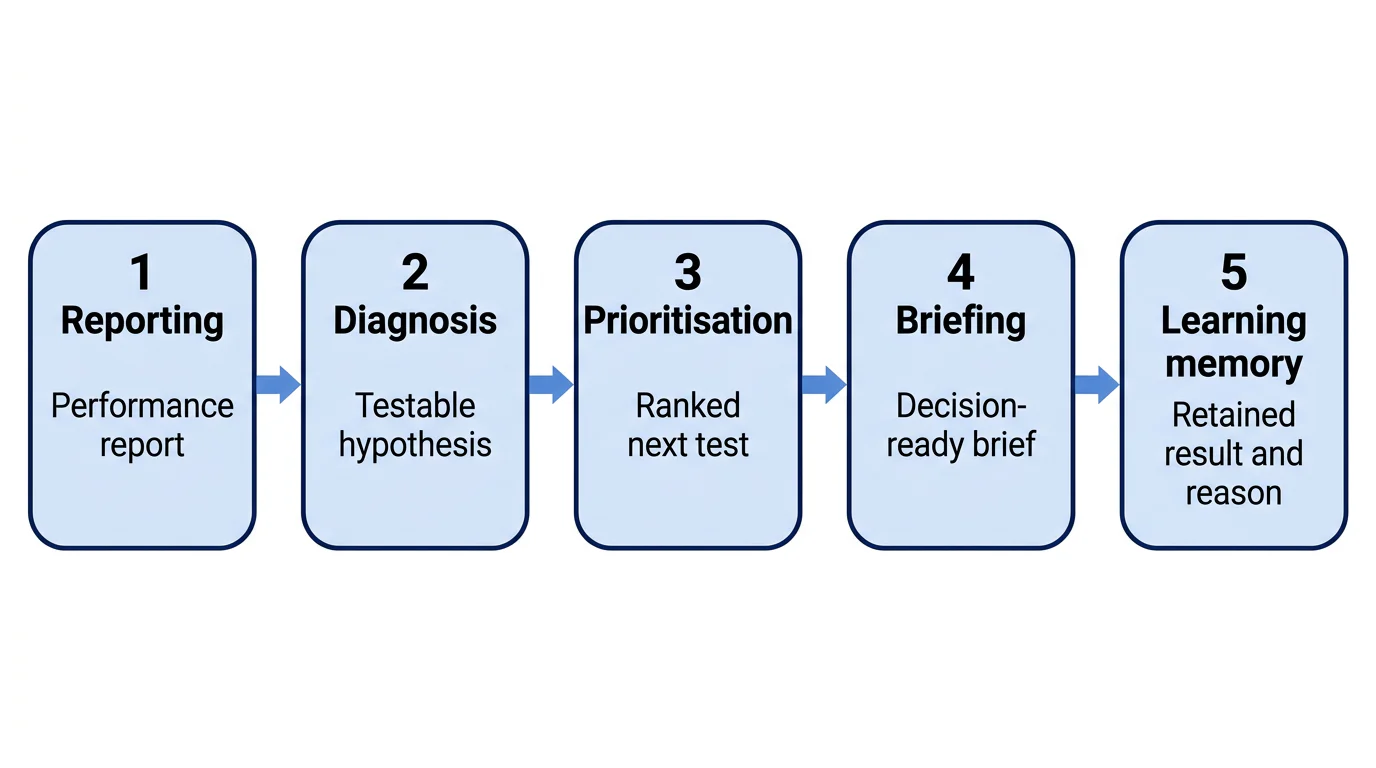
| Stage | Required output | Question it answers |
|---|---|---|
| Reporting | Performance report | What happened by ad, audience, placement or period? |
| Diagnosis | Testable hypothesis | What could explain the result? |
| Prioritisation | Ranked next test | Which hypothesis deserves the next slot and why now? |
| Briefing | Decision-ready brief | What changes, who owns it and how will it be judged? |
| Learning memory | Retained result and reason | What should the next decision avoid repeating or build on? |
Make the test card carry the decision
A useful test card separates observation from proof. Start with the observed signal, then write the hypothesis it creates. A visible competitor ad can inspire a hypothesis, but it does not prove that the message will produce profitable outcomes for your brand. Use Meta Ad Library guidance to keep observable market activity separate from your account’s result data.
The card should then name the changed variable, required asset, comparison, owner, success metric and scale, iterate or stop condition. That structure prevents a vague instruction such as “make more like the winner” from becoming a production brief.
Meta recommends A/B testing to determine impact when testing Reels strategy. Meta’s 2026 Reels guidance supports the broader operating point: performance observation is not the same as a controlled test decision. For a practical queue, use a Meta creative test queue and agree the stop policy before production begins.
Use a ranked plan when prioritisation is the bottleneck
We turn competitor activity, customer signals, authorised account performance and documented past experiments into a ranked weekly test plan for Meta growth teams. Our briefs can draft hooks, scripts and statics, but our primary job is deciding what to test, improve or stop before a team commits production time and spend.
We keep public competitor observations separate from first-party outcome evidence. We also retain what worked, failed and why, so a new request can start from the team’s prior decisions rather than from a fresh set of screenshots. Explore our creative-decision workflow when the missing handoff is between insight and the next committed test.
Keep reading



Frequently asked
No. Creative analytics reports or explains patterns in performance, while a creative test plan chooses a specific next experiment, names the variable to change, assigns an owner, defines a success measure and records the eventual decision.
A Meta creative test brief should state the hypothesis, the single variable being changed, the asset to produce, the comparison or control, the owner, the success metric, the review point and the scale, iterate or stop condition.
No. Competitor ads can reveal observable messages, offers, formats and delivery dates, but they cannot establish another advertiser’s private CPA, ROAS, margin, customer quality or causal lift for your account.
Turn this week’s signals into one ranked next test
See how we connect market context, customer signals, account performance and past experiments into a decision-ready weekly plan.
Book a demo