
Meta Reporting Dashboards Show the Dip, Not the Next Test

TL;DR
Meta reporting dashboards leave teams unsure what to test because a metric change is evidence, not a hypothesis or a production decision. Turn each important signal into a decision record with evidence, one hypothesis, an owner, a confidence-ranked priority, and a defined learning rule.
A changed metric is evidence, not a creative decision
A report can tell a team that CTR fell, CPA rose, ROAS weakened, or an ad may be fatiguing. None of those readings answers the operational question that follows: which creative idea should the team test, who owns it, and what would the test teach?
Meta's Ad Library lets researchers search ads currently running across Meta technologies by advertiser or keyword. Meta says an ad and subsequent changes can appear there within 24 hours. That makes visible market activity useful context, but it does not turn a competitor's ad into proof of its profitability or a ready-made brief for your brand.
The practical distinction is simple: a dashboard records an observation. A decision record connects that observation to the next accountable experiment.
Give every important signal a six-part handoff
The handoff below turns reporting into a test decision without pretending that a single metric explains performance. It also gives creative and media teams a shared record to revisit after the test.
| Field | What the team records | What it prevents |
|---|---|---|
| Metric signal | The specific change worth investigating, such as a CTR, ROAS, CPA, fatigue, conversion-rate, or add-to-cart-rate pattern. | A vague request to refresh everything. |
| Evidence | The account pattern, relevant customer signal, competitor context, and any similar prior test. | Treating a visible ad or one metric as proof. |
| Hypothesis | One message, hook, format, or offer the team believes could change the outcome. | Testing several creative variables at once. |
| Owner | The creative or media decision-maker responsible for moving the test forward. | A recommendation that has no next action. |
| Priority | A confidence-ranked place in the current test queue. | Giving every idea the same urgency. |
| Expected learning and rule | What result would support, revise, or retire the hypothesis. | Repeating a weak angle without learning from it. |
A reporting meeting needs a record that leaves with work assigned and a reason to revisit the result.
A useful report must leave with a decision record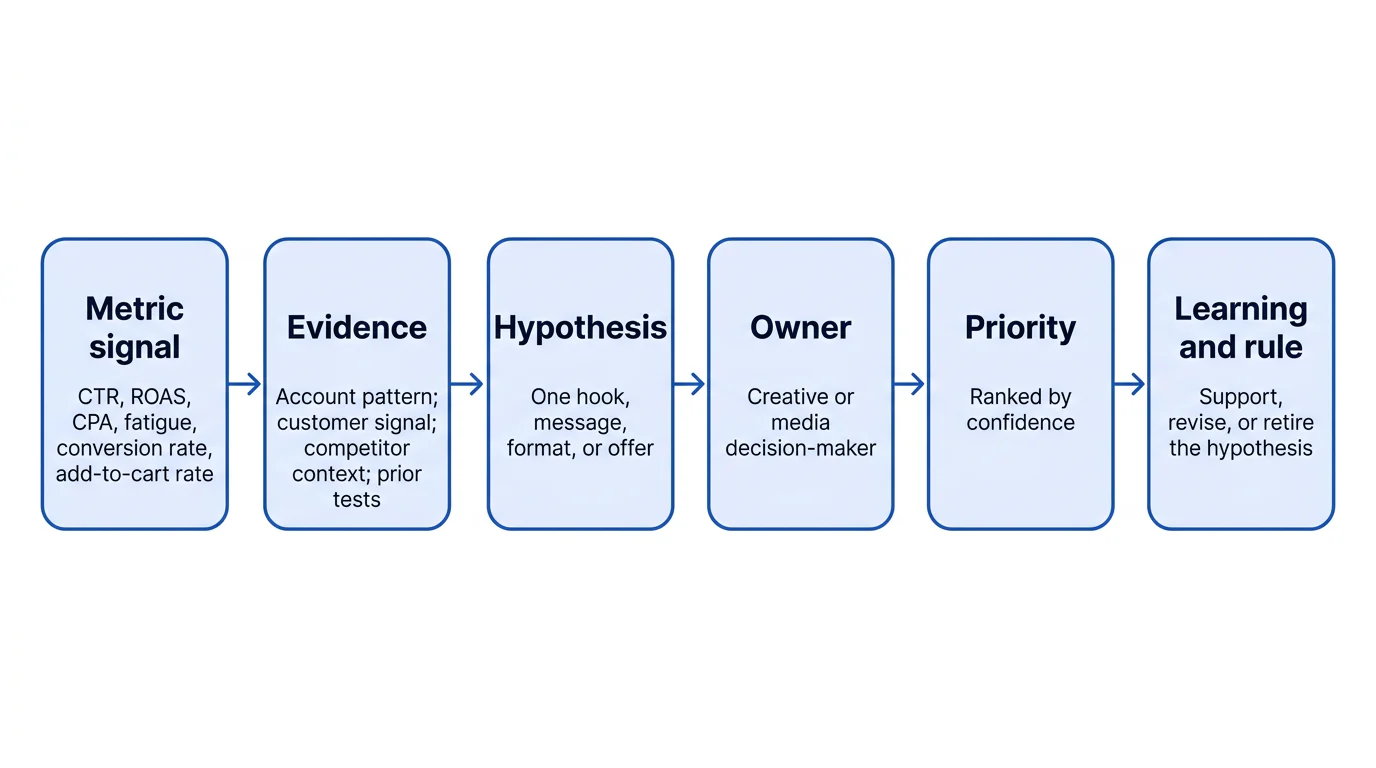
Keep dashboards for the jobs they do well
A dashboard wins when the team already knows the question it needs answered. It can centralise metrics, provide recurring stakeholder views, and make a decision already in progress easier to monitor. It is the right tool for communication and observation.
A test-planning layer wins when the report ends with competing interpretations, an unranked set of ideas, or no agreed owner. The missing work is not another chart. It is the judgement that joins evidence to a hypothesis, a priority, and a measurable learning rule.
Creative analytics is not a test plan explains the difference between analysing an existing creative result and deciding what belongs next in the queue. A clear Meta ad test stop policy then gives the team a way to retire ideas that have earned deprioritisation.
Where we take the work after reporting
We combine competitor activity, customer signals, historical ad performance, and past experiments to produce a ranked weekly plan for what to test, improve, or stop. We rank the plan by confidence every Monday, retain what worked and failed as brand memory, and support decision-ready briefs so the next test has a clear starting point.
Pricing is tailored to the team and workflow in scope. Our platform is for Meta growth, performance, creative, and agency teams that need a ranked next-test decision. It is not a replacement for a dashboard when the only need is reporting, and it is not a production-first service for teams whose only constraint is making more image, video, or copy variants.
See our product features to examine how the ranked weekly workflow moves from signals to a creative decision.
Keep reading



Frequently asked
A Meta ads dashboard can show that a result changed, but it does not automatically establish why it changed, which creative variable deserves a test, who should act, or what result would change the team's view. Those decisions need an explicit handoff after reporting.
A useful creative test recommendation includes the metric signal, inspectable evidence, one falsifiable hypothesis, a named owner, a priority rule, and the learning or stop rule. That structure prevents a team from turning every weak metric into an unranked list of new assets.
No. Competitor ads can supply context for a hypothesis, such as a visible message, offer, or format, but they do not prove profitability or causality for another advertiser. Meta Ad Library is most useful as a research input that must be checked against first-party results.
A reporting dashboard is enough when the team already knows which metrics matter, which action follows each threshold, and who interprets the results. It is especially useful for stakeholder communication, recurring reports, and monitoring a decision that has already been made.
Bring one recent Meta report to a working session
We can show how competitor activity, customer signals, historical ad performance, and past experiments become a ranked weekly creative test plan.
Book a demo