Which Meta Creative Intelligence Platform Connects Research and Testing?


TL;DR
At Deepsolv, we connect observable competitor patterns with authorized account performance and documented test decisions, while keeping external inspiration separate from causal evidence. This guide compares platform paths, data requirements, and decision records, then shows how teams can choose, test, and value a connected Meta creative workflow.
Which Meta Creative Intelligence Platform Connects Research and Testing?
Meta says new ads and edits generally appear in its public library within 24 hours, making competitor research useful for seeing what is visibly active in a category. That speed does not make a visible ad proof of revenue, profitability, or causal performance.
A Meta Creative Intelligence Platform connects research and testing only when it organizes observable competitor patterns, analyzes your own creative performance, and converts both into a documented test decision. Ad-library access supports inspiration, while account analytics explains internal outcomes. A connected workflow keeps external signals distinct from controlled-test evidence.
We compare the capabilities that matter, the platform paths that fit different teams, and the records that turn creative activity into reusable learning.
What Makes a Meta Creative Intelligence Platform Connected?
Research and testing are adjacent jobs, not the same job. Research helps a strategist or creative lead spot angles, offers, formats, and messages worth investigating. Testing helps a growth or media team decide whether a defined change earned another round of production and spend.
| Competitor Intelligence Requirement | Testing-Strategy Requirement |
|---|---|
| Search observable ads, formats, offers, and delivery dates | Connect authorized account data to creative outcomes |
| Monitor recurring category patterns | Tag hooks, copy, visuals, formats, offers, and CTAs |
| Form a hypothesis worth testing | Set a control, success metric, and decision rule |
| Capture source evidence | Retain test outcomes and the reason for each decision |
| Output: Worth Testing | Output: Scale, Revise, Stop, Or Retest |
A public ad can show that a message exists in market. It cannot show the advertiser’s private CPA, customer quality, margin, attribution method, or lift. We treat a visible pattern as the beginning of a brief, then use a fair control to learn whether the pattern works in the account that will fund it.
That distinction matters because observational data can be persuasive without being causal. A 2019 study covering 15 Facebook field experiments, 500 million user-experiment observations, and 1.6 billion impressions found that observational methods often did not reproduce randomized effects.
Which Capabilities Actually Connect Research and Testing?
A useful comparison does not ask which platform has the longest feature list. It asks whether each capability helps the next decision move cleanly from external observation to first-party evidence, then into a planned test and retained learning.
| Platform Type | Competitor Discovery | Historical Monitoring | Own-Account Analysis | Element Tagging | Testing Support | Next-Test Planning | Commercial And Team Fit |
|---|---|---|---|---|---|---|---|
| Meta Ad Library | Yes | Manual | No | Manual | No | No | Public research surface |
| Research Workspace | Yes | Usually | Usually not | Usually | Brief handoff | Usually manual | Best for research-led teams |
| Creative Analytics Platform | Limited | Owned-ad history | Yes | Yes | Analysis support | Varies | Best for reporting-heavy teams |
| Experiment Or Campaign Operations Platform | No | Test history | Yes | Varies | Yes | Varies | Best for execution-led teams |
| Our Connected Decision Workflow | Yes | Documented market and test history | Authorized performance inputs | Yes | Decision-ready briefs | Ranked weekly plan | Best for teams needing one accountable path |
Research Coverage and Historical Monitoring
Research quality depends on what can be verified. The official library can surface current creative, Page identity, placements, and delivery dates, while teams need their own monitoring process to distinguish a one-off observation from a recurring category pattern.
We recommend checking historical depth, refresh timing, source coverage, and whether each saved example keeps its original evidence link. A research tool without that provenance becomes a swipe file, not an auditable input to a creative decision.
Creative Taxonomy and Account Evidence
Tags matter only when they are consistent enough to compare. We use a practical taxonomy across hook, messaging, offer, format, visual treatment, creator style, opening frame, product proof, and call to action, then connect those labels to owned performance and test records.
A tagged dashboard can reveal a pattern, but it cannot establish why the pattern occurred. For a fuller workflow comparison, see our testing-tool comparison.
Collaboration, Exports, and Limits
A connected workflow also needs operational clarity. Buyers should ask who can see account-level evidence, how client data stays separated, what sources can be connected, what gets retained, and whether exports or programmatic handoffs are documented in writing.
We scope our workflow around the team, source coverage, account connections, and implementation needs. We do not treat an undocumented integration, export format, API, or pricing unit as included simply because a broader feature category sounds similar.
How Should Competitor Ads Shape a Creative Test?
Competitor ads should shape the question, not settle the answer. If several advertisers repeat a problem-first hook, a format, or an offer structure, that can justify learning whether the underlying customer tension matters to your audience.
Start with a Pattern, Not a Prediction
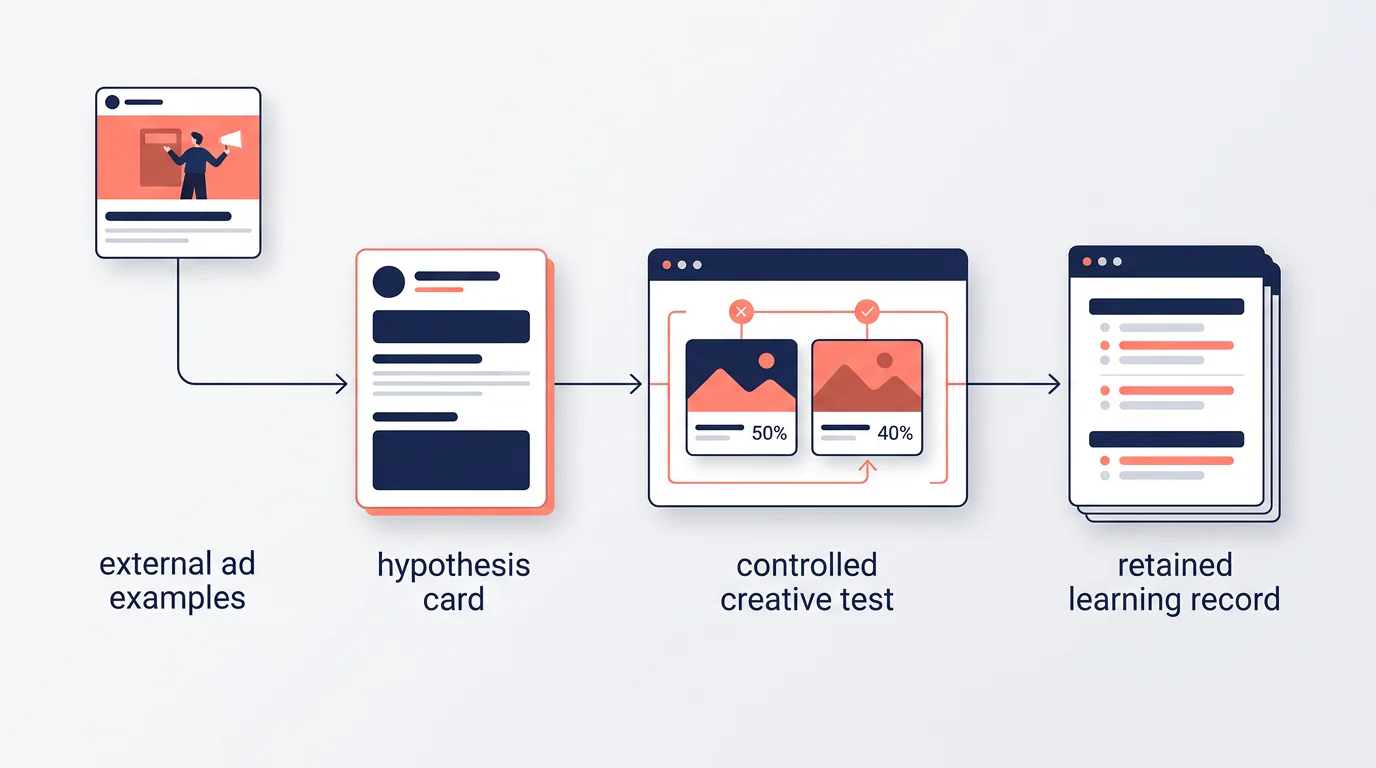
We start with a documented observation: what appeared, where it appeared, how often a related pattern recurred, and why it could address an audience need. We then write one claim that can be wrong, such as whether a problem-first opening improves qualified conversion compared with the current control.
That turns research into a competitor brief, rather than a claim that another advertiser has found a profitable winner.
Change One Meaningful Variable
A fair test declares the changed element before production starts. It may be the hook, visual opening, proof point, offer, CTA, or format. Wherever possible, the team keeps the audience strategy, landing page, optimization event, placement approach, and attribution window stable.
Meta’s analysis of 15 split tests found that a defined Reels treatment delivered 5% lower cost per result and 11% higher conversion rate on average. The useful lesson from that Meta test analysis is not that every vertical should copy the format. It is that a documented treatment should be tested against a clear comparison.
Preserve the Decision, Not Just the Result
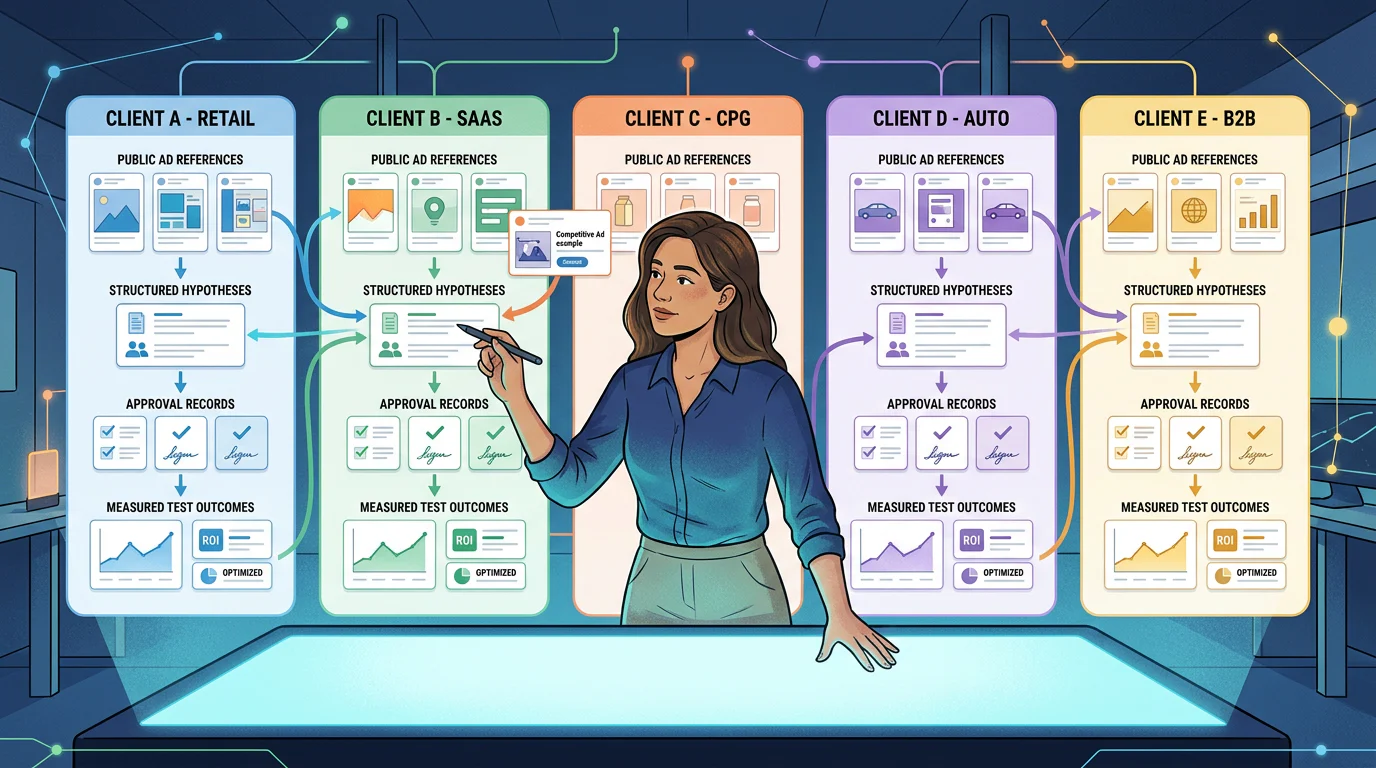
A result without its original hypothesis is difficult to reuse. We keep the source signal, control, variant, conditions, metric, outcome, uncertainty, and next action together so the next review can distinguish a weak concept from weak execution or an inconclusive read.
Which Path Fits Your Team and Budget?
No credible universal spend threshold determines which platform a team should buy. Team structure, test frequency, data maturity, and the cost of repeating a bad decision matter more than a generic revenue band.
| Team Path | Best When The Bottleneck Is | Suitable Team Types | What To Prioritize |
|---|---|---|---|
| Research-Led | Weak briefs or scattered market evidence | Early DTC, early SaaS, strategy teams | Observable patterns, source links, and hypotheses |
| Testing-Led | Unfair comparisons or unclear performance reads | Mobile gaming, growth teams, performance marketers | Controls, measurement, and stop rules |
| Connected Workflow | Repeated difficulty choosing what to test next | In-house DTC, mature SaaS, agencies | Shared evidence, ranked decisions, and learning retention |
Research-led teams should start by improving the quality of their questions. Testing-led teams should focus on controls, comparable conditions, and a visible decision rule. Teams with recurring creative queues need both, because they cannot afford to rediscover the same lesson every week.
For DTC brands, that often means connecting category movement to conversion context. For SaaS teams, it means separating attention signals from qualified pipeline outcomes. For mobile gaming, it means preserving fast creative learnings without confusing high-volume variation with a valid result. Agencies also need clear account separation and a repeatable test queue for each client.
Pricing should be compared only where the current terms are documented. We use a tailored quote because seats, accounts, sources, implementation, and support requirements vary by workflow. Before buying any platform, require written terms for user limits, client or ad-account limits, archive depth, usage caps, and the handoff method. Teams that test frequently should also define a shared stop policy, so a platform does not become another place where ambiguous work stays open indefinitely.
That rule should be visible before launch rather than reconstructed after a result. It should name the primary metric, guardrail metric, decision date, and owner, so opinions do not replace the original experiment design. Use our testing framework to make those conditions reviewable.
How Do You Calculate the Value of a Connected Workflow?
We calculate value from decisions improved, not from a promise that a platform automatically creates better ads. The worksheet should use the team’s own labor costs, test costs, historical results, and conservative assumptions about what portion of a projected benefit will actually materialize.
| ROI Input | Calculation |
|---|---|
| Analyst Hours Saved | Hours avoided × loaded hourly cost |
| Tests Avoided | Avoided tests × average production and media-test cost |
| Decisions Improved | Additional profitable decisions × conservative incremental contribution |
| Learning Retained | Repeat mistakes avoided × estimated repeat-test cost |
| Net Monthly ROI | Total estimated benefit − monthly platform cost |
Start with a low, medium, and high realization case rather than one optimistic total. We also recommend auditing the last quarter of tests to find repeated concepts, abandoned evidence, and decisions that were reopened because the original context disappeared. That audit becomes the baseline for test memory.
First-party data quality can materially affect advertising outcomes. A 2024 randomized study of more than 70,000 Facebook and Instagram advertisers found median cost per incremental customer rose from $38.16 to $49.93 when offsite optimization data was lost, a 31% increase in the reported median. That randomized evidence supports investing in trustworthy owned measurement, not claiming a guaranteed return from any single workflow.
Use our ROI calculator with finance-approved inputs, then compare the result with the documented platform cost and implementation scope.
Put Deepsolv into Your Next Meta Test
At Deepsolv, we built the decision layer for Meta teams that have plenty of creative inputs but need a defensible answer to one question: what should we test next? We bring observable market patterns, permitted customer signals, authorized account performance, and past experiment records into one reviewable path. Our role is not to claim that a visible ad has already won or to replace the people who approve strategy, creative, and media spend. We help those people see the source, hypothesis, changed variable, success metric, and stop or scale condition before production starts. That gives DTC brands, SaaS teams, mobile gaming marketers, and agencies a clearer handoff from research to decision. In a working session, we can map the evidence your team already has, identify the missing controls, and show the record that preserves each learning. Start your next decision with Deepsolv.
FAQs on Meta Creative Intelligence Platform
What Is the Best Platform for Meta Creative Intelligence?
Choose a connected platform when selecting the next test is your bottleneck. Compare evidence separation, account-data access, controls, retained learning, ownership, and implementation scope carefully.
Can Competitor Ads Prove Which Creative Will Work?
No. Public ads reveal messages, offers, formats, and recurring patterns, but cannot reveal private conversion quality, profitability, targeting, or causal lift. Test your own hypothesis.
Which Creative Testing Tool Fits Meta Teams?
Research-led teams need stronger briefs and public observation. Testing-led teams need controlled comparisons. Teams managing recurring creative queues benefit from a connected decision workflow together.
What Should Teams Verify Before Buying?
Verify how data is authorized, what history is retained, how elements are tagged, who can collaborate, and whether exports, pricing, and client limits are written.
How Does Deepsolv Pricing Work?
We price through a tailored quote because scope, connections, sources, and implementation needs vary. Ask us to document included users, accounts, support, and delivery terms.