
Review Mining for Meta Ad Angles Your Team Can Test
Permissioned customer language, human-reviewed claims and a measurable Meta creative decision.

By Sachit Sharma, CEO & Founder · Reviewed 19 Sept 2026
- 5M+
- reported comments moderated by Brandy
- 27+ hours
- reported average weekly time saved across select brands
- 100K+
- reported leads captured across select brands
Deepsolv Brandy, 2026
Deepsolv Brandy, 2026
Deepsolv Brandy, 2026

In brief
Review mining is useful when it turns customer language into a permissioned, reviewable hypothesis instead of a sentiment score or a copied quote. Deepsolv connects approved feedback to a specific Meta creative test, its metric and the learning that follows.
What the workflow gives your Meta team
Permissioned feedback intake
Connect approved business assets and preserve the context behind each usable signal.
- Comments, replies and business conversations in agreed scope
- Source type, account, ad or content ID and timestamp
- Permission context attached before analysis
- Personal chats and unrelated private content excluded
Objection and question clustering
Turn repeated, relevant customer language into a ranked set of creative opportunities.
- Tags for intent, objection, question and desired outcome
- Noise filtering for spam, duplicates and isolated complaints
- Ranking by frequency, relevance, recency, severity and testability
- Evidence count and reviewer status retained
Claims and policy review
Route risky language to people who can decide whether it belongs in an ad.
- Human review for ambiguous or regulated themes
- Safety, health and reputational-risk checks
- Customer wording reviewed before it becomes proof
- Unsupported promises excluded from production
Test cards and learning memory
Give creative and media teams a decision they can launch and evaluate.
- One primary creative change
- Source-linked evidence and risk flag
- Primary metric and campaign context
- Measured result and updated guidance
Pricing and implementation
Core access is scoped to the team and workflow.
- Pricing: tailored quote
- Scope: team, account connections and source coverage
- Implementation requirements confirmed in the workflow discussion
- Brandy free trial: 7 days
Where we work
- Performance and growth teams running Meta ads at scale
- Creative teams choosing the next hooks, formats and angles
- Paid-social agencies managing recommendations across client accounts
What customers say
We save 30+ hours a week and didn’t need to hire.
Deepsolv turns questions in comments and DMs into leads.
Brandy keeps our ad comments clean.
Customer language is an input, not a claim
A review, comment or DM can reveal a price objection, proof gap or unanswered question. It does not prove that a new ad will improve results. Deepsolv keeps customer signals separate from performance outcomes, then uses the signal to form a testable creative hypothesis. See how customer signals become copy.
Start with feedback your business is allowed to analyse
The workflow begins with connected business assets and the permissions required for the agreed scope. Each record keeps source type, account, content or ad ID, timestamp and permission context, so the team can inspect why a recommendation exists. Unconnected accounts, personal chats and unrelated private content stay outside the workflow.
Repeated evidence earns a creative test
Deepsolv removes unnecessary personal details, tags the remaining feedback, and filters spam, copied replies, isolated complaints and other noise. Themes are assessed from repeated language across independent people, placements and time periods, then ranked on frequency, commercial relevance, recency, severity and testability. Use the Meta comment decision framework when a question, objection or claim needs an explicit next action.
Human review protects the claim
Ambiguous, regulated, safety-related and reputationally risky themes require human review. Customer wording is also reviewed before it becomes public proof, because the FTC says advertisements and endorsements must be truthful, non-deceptive and supported by appropriate evidence. A customer testimonial is not substantiation for an objective product claim. FTC advertising guidance
Five steps keep feedback connected to the result
The output is not a list of insights. It is a test card with one primary creative change, a primary metric, evidence, risk flag, confidence and an outcome that can update the next recommendation. Choose a fair creative test control.
From feedback to a fair test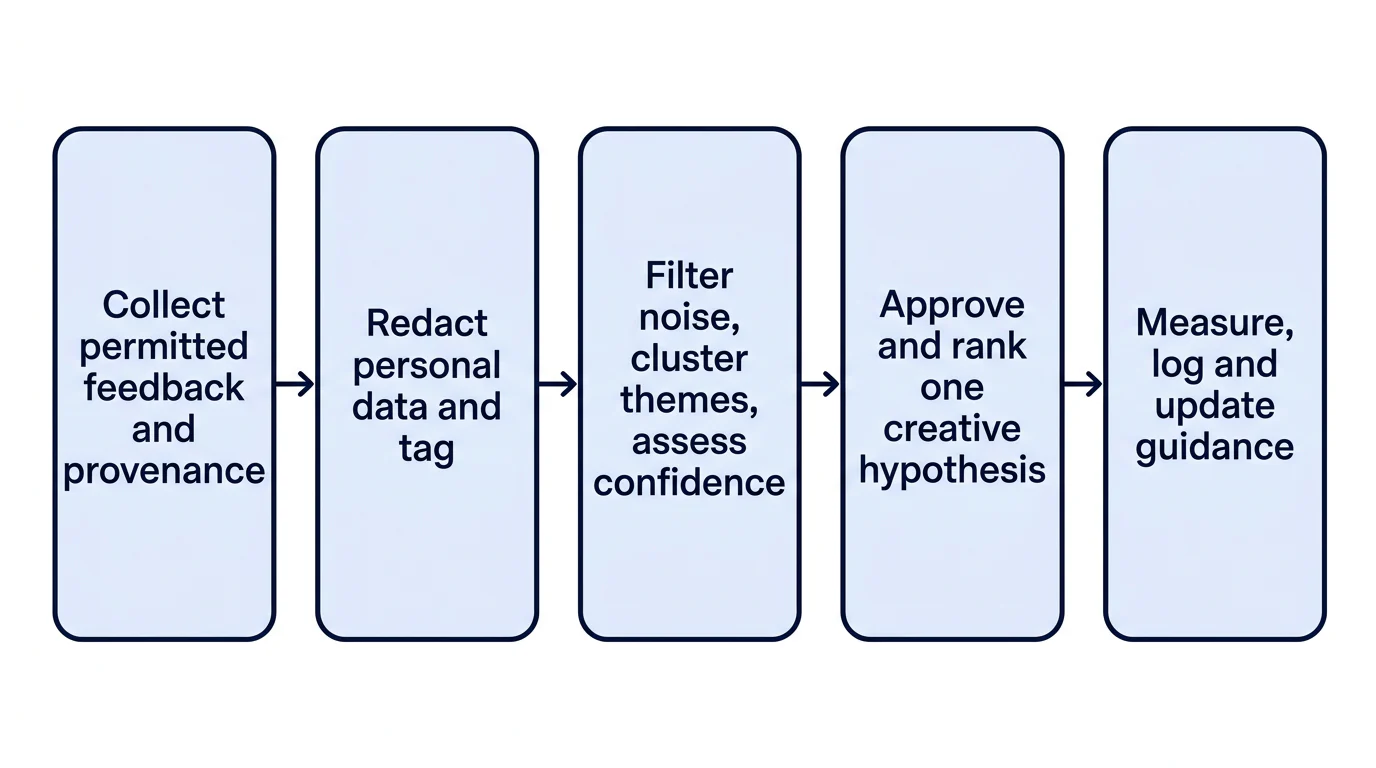
When review mining is not enough
Review mining is not a substitute for authorised account performance data or a controlled launch. It is also the wrong tool for private conversations outside the connected business account, unsupported promises, or a conclusion based on a memorable one-off comment. A controlled test, with a clear comparison and measurement plan, determines whether an angle deserves to be reused.
Keep reading



Frequently asked
No. Deepsolv starts with feedback from connected business assets that the business is permitted to access for the agreed workflow. It excludes unconnected accounts, personal chats and unrelated private content, while retaining permission context and source provenance for authorised review.
No. A repeated objection can justify a hypothesis, such as testing approved proof or a clearer opening, but it does not establish causation. Deepsolv keeps feedback separate from performance evidence and uses a controlled launch to determine whether the proposed creative change improved the selected outcome.
Human review is required when a theme is ambiguous, potentially regulated, related to safety or health, vulnerable to misinterpretation, or likely to create reputational harm. Review is also required before customer language becomes a proof point, so an appealing quote does not become an unsupported advertising claim.
A useful test card names the approved theme, anonymised evidence, proposed creative change, risk flag, confidence, primary metric and expected outcome. After launch, the record retains the hypothesis, controlled variable, campaign context, measured result and guidance on whether to reuse, revise or stop the angle.
As of September 2026, Deepsolv scopes core access through a tailored conversation based on the team and workflow. The discussion can cover account connections, source coverage and implementation requirements so the feedback-to-test workflow matches the way the team actually operates.
Turn customer feedback into next week’s test plan
See how Deepsolv connects approved customer language, creative decisions and measured outcomes.
Book a demo