


TL;DR
We explain how creative analysis tools turn campaign results, customer feedback, competitor patterns, CRM context, and past experiments into attributable ad-copy drafts. Our workflow uses a shared messaging taxonomy, evidence-linked briefs, transparent ranking, and controlled measurement so performance teams can test stronger ideas without mistaking a predictive score for proof.
How Creative Analysis Tools Turn Signals into Copy
Performance teams need more than a dashboard that names a winner. Google Ads lets teams choose an 80% default interval when evaluating experiments, a useful reminder that measured uncertainty belongs beside every creative decision.
Creative analysis tools turn customer language, competitor patterns, campaign results, CRM context, and past experiments into ad-copy drafts by retaining each source record, tagging its messaging role, and ranking testable variants against explicit evidence. Predictive scores can prioritize a test, but only a controlled measurement loop can show whether copy actually converts.
This guide explains the signal pipeline, the messaging taxonomy that preserves attribution, the brief that constrains generation, and the measurement loop that prevents failed ideas from returning as recommendations.
What Signals Should Creative Analysis Tools Collect Before Drafting Copy?
A reliable system begins by collecting evidence with enough context to be useful later. We treat first-party campaign performance as the outcome layer, customer feedback as language and objection evidence, CRM data as audience and value context, historical experiments as causal learning, and public competitor ads as market context.
We do not blend those sources into one generic “insight” score. Each source answers a different question, which is why our customer signal guide keeps observed customer language separate from campaign outcomes.
| Source | Freshness | Granularity | Strength | Limitation | Access Method |
|---|---|---|---|---|---|
| First-Party Campaign Results | Delayed, not instantaneous | Campaign, ad set, ad, conversion action | Connects copy to measured outcomes | Attribution settings and sparse volume can distort interpretation | Authorized platform API |
| Customer Feedback | Near-real-time to periodic | Comment, review, ticket, call theme | Preserves actual pains and objections | Can be self-selected or unrepresentative | Authorized CRM, helpdesk, or review export |
| Competitor Ads | Current active ads | Ad-level copy and format | Reveals category language and repeated angles | Does not reveal conversion performance | Public ad-library search |
| CRM Data | Scheduled refresh | Lead, customer, lifecycle segment | Connects messaging to qualification and value | Requires consent and governance | Authorized CRM connection |
| Historical Experiments | Updated at test close | Hypothesis, variable, control, result | Preserves what was actually tested | Weak tests should not become “learning” | Experiment log or export |
Campaign data should retain the ad ID, date range, audience, spend, conversion action, attribution setting, and creative version. Conversion reporting can provide conversion metrics by campaign and conversion action, but it can also return empty rows when metrics are zero. That is why a system should label missing volume as uncertainty, not as failure.
Public ads are useful for scanning category hooks, offers, formats, and repetition. They are not evidence that an angle converted. Meta’s ad library makes active ads observable, while leaving the advertiser’s actual outcome data private. We use that distinction to keep competitor patterns in the hypothesis queue rather than the proof column.
How Does a Messaging Taxonomy Keep Every Draft Attributable?
Signals become useful when every record has a consistent place in the messaging model. Without a shared taxonomy, a comment, an ad headline, a test result, and a CRM note remain disconnected artifacts. With one, we can trace a draft back to the evidence that shaped it.
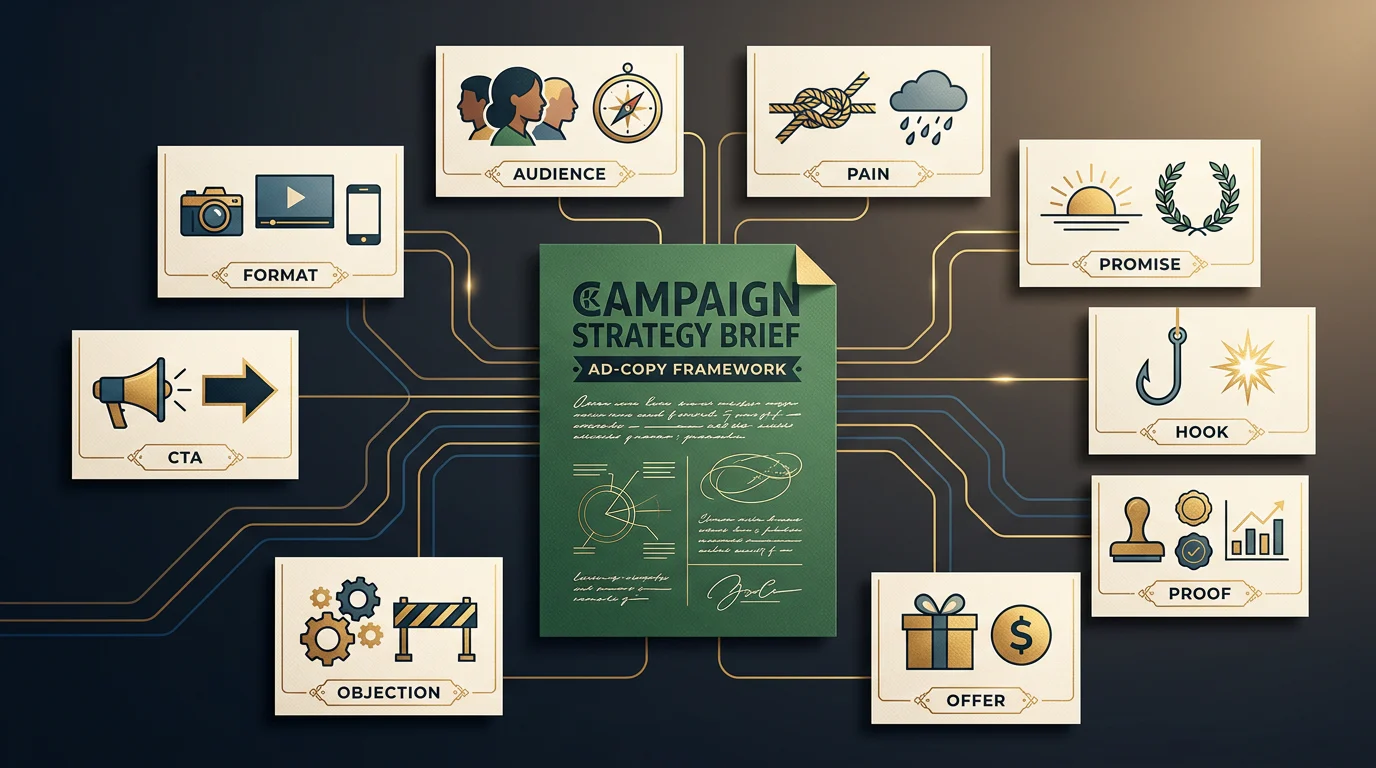
| Messaging Field | What It Captures | Valid Evidence | Unsafe Shortcut |
|---|---|---|---|
| Audience | Who the message is for | CRM segment, campaign targeting, feedback context | Assuming every customer has the same need |
| Pain | Friction or unmet need | Repeated feedback, support themes, research | Treating one comment as universal |
| Promise | The benefit offered | Product facts and approved positioning | Converting a wish into a claim |
| Hook | The opening attention device | High-performing copy or a testable hypothesis | Calling a familiar phrase a proven winner |
| Proof | Reason to believe | Approved substantiation, verified product evidence | Using testimonials as proof of every objective claim |
| Offer | Commercial incentive | Current promotion and eligibility rules | Reusing an expired offer |
| Objection | Reason not to act | Comments, reviews, support issues, sales calls | Ignoring volume or audience context |
| CTA | Requested next action | Funnel stage and conversion goal | Using one CTA for every stage |
| Format | Placement and creative structure | Channel requirements and creative history | Assuming cross-channel equivalence |
Preserve the Original Record
We keep a record ID, source type, date, audience context, exact excerpt, and permission status with every tagged signal. That lets a strategist inspect the language behind a pain or objection instead of trusting a summary. Our comment analysis workflow is designed around this step because feedback is most valuable when its context survives.
Separate Proof from Sentiment
Customer language can suggest what people want, fear, or misunderstand. It cannot automatically substantiate an objective product claim. The FTC policy requires advertisers to have a reasonable basis for objective claims before dissemination, so our briefs separate approved proof from promising but unverified language.
Connect Attributes to Outcomes
A tagged hook or offer can be linked to an ad version and downstream performance, but the system must retain channel, audience, date, control, and test variable. That makes it possible to see correlation without pretending that every repeated phrase caused a conversion. The shared taxonomy gives the team one stable vocabulary for comparing ads, comments, and experiments across the full learning loop.
How Do Tools Turn Evidence into Copy Drafts?
The workflow moves through retrieval, pattern extraction, generation, predictive scoring, and evidence-based ranking. These are different jobs. When they are merged into one opaque result, teams lose the ability to challenge the recommendation.
Retrieve Relevant Records
Retrieval finds records that match the proposed audience, product, channel, date range, and messaging field. For a purchase objection, that may mean recent customer comments, support themes, and historical tests from the same funnel stage. For competitor analysis, it means public patterns with clear source dates, not private performance assumptions.
Extract Patterns Without Calling Them Facts
Pattern extraction groups recurring hooks, pains, promises, and formats. It should display source count, recency, channel, and disagreement. A repeated phrase can be a useful test candidate, but it becomes a finding only when the measurement design supports it. We use our evidence-led planning approach to make that boundary visible.
Generate from a Constrained Brief
Generation should receive the audience, approved promise, allowed proof, brand voice, prohibited claims, offer, CTA, format, and one declared test variable. That constraint prevents a new variant from changing its hook, promise, offer, and CTA at once. Google’s test guidance makes the same practical point: changing several variables makes it hard to identify which one drove the outcome.
A useful brief also states what the system may not say. We include prohibited claims, unsupported superlatives, audience exclusions, compliance flags, and the exact control ad. The result is not “write better copy.” It is a bounded hypothesis that a performance team can launch and evaluate.
How Should Teams Rank and Test Copy Variants?
Ranking should decide what to test next, not declare that a draft will win. We rank variants by evidence quality, business fit, recency, novelty, channel fit, and uncertainty. A transparent rubric gives the team a reason to disagree productively before money is spent.
| Ranking Criterion | Decision Question | What The System Exposes |
|---|---|---|
| Outcome Fit | Does the variant support the agreed conversion action? | Goal, funnel stage, and conversion action |
| Evidence Strength | Is the angle supported by attributable records? | Source IDs, dates, and evidence type |
| Experiment Quality | Can the test isolate one changed variable? | Control, treatment, and test variable |
| Recency And Channel Fit | Does the evidence match this current placement? | Channel, format, audience, and recency |
| Novelty | Is the variant distinct from old tests and current repetition? | Similar past variants and market overlap |
| Compliance Risk | Does the language exceed approved proof? | Prohibited claims and review flags |
| Uncertainty Penalty | Are results sparse, delayed, or conflicting? | Volume, confidence, conflicts, and exclusions |
Use Business-Verified Weights
We set weighting only after the team verifies what matters most for the account. A lead-generation program may weight qualified leads above clicks, while a purchase program may prioritize conversion value. The system should show those weights, rather than hiding them behind a single score.
Show Reasons for Exclusion
A lower-ranked draft needs an explanation too. It may rely on stale evidence, conflict with current customer feedback, lack supporting conversion volume, duplicate a failed hypothesis, or exceed brand constraints. That record matters because it stops the same weak idea from returning under slightly different wording.
Test Against a Fair Control
We recommend one meaningful variable per test, a stable control, and a declared success metric. Our test control guide helps teams avoid calling a result “copy learning” when the audience, bid, format, and offer also changed.
Google advises teams to run many experiment types for at least four to six weeks when results are still unavailable or undecided. When there is not enough volume, we label the result inconclusive and preserve the hypothesis instead of manufacturing a winner.
How Do Results Improve the Next Copy Decision?
The learning loop closes only after launched copy returns to the same evidence system that produced it. We attach the variant ID, control, audience, channel, date range, conversion action, attribution setting, spend, and outcome to the original brief. That makes future retrieval more useful because it includes failed hypotheses as well as successful ones.
Conflicting signals deserve to remain visible. Customer feedback may favor a reassurance promise while conversion data favors a speed promise. Rather than averaging them into an empty middle, we create two discrete testable variants and preserve the disagreement. Our test prioritization system helps turn that queue into a weekly decision.
When a test has low volume or channel context does not match, we keep the source record but lower its rank. A metric from one placement is not automatically evidence for another. The same is true of late-arriving conversions, which should be compared only within an equivalent measurement window and attribution setting.
Before a failed result returns to planning, we inspect whether the test was capable of answering its question. We check that the conversion action matched the business goal, the control remained stable, the changed variable was clear, the audience was comparable, and delayed outcomes had time to arrive. If those conditions did not hold, the result remains a record of execution, not a reusable conclusion. If they did hold, its failure becomes useful negative evidence that narrows the next draft queue.
We also preserve the learning from failure. A good archive records what changed, why the team tested it, which evidence supported the idea, the confidence of the result, and why the hypothesis should not be repeated. Our creative testing memory keeps unsuccessful tests available to future planning, so new drafts do not recycle old failures under slightly different wording.
How Deepsolv Turns Signals into Testable Copy
At Deepsolv, we help performance teams turn a growing archive of ads, comments, tests, and conversion outcomes into a weekly decision queue. Our approach keeps the trail visible: the source language behind an angle, the audience it concerns, the control it challenges, and the result that changes its priority. That matters when a promising hook has little conversion volume, when channel behavior conflicts, or when an old winner is being proposed again. We do not ask teams to trust an unexplained score. We help them inspect the evidence, see uncertainty, preserve failed hypotheses, and choose a single, measurable next test. If your paid-social process still moves from scattered screenshots to broad brainstorming, we can help you build a repeatable learning loop that keeps creative decisions connected to results without losing the context that makes attribution credible across every test. Book a Deepsolv demo
FAQs on Creative Analysis Tools
Can Creative Analysis Tools Prove New Copy Will Convert?
No. Historical performance can prioritize a variant, but different audiences, channels, offers, and bids mean prediction remains a hypothesis until controlled measurement confirms an outcome.
What Customer Feedback Should Inform Ad Messaging?
Use feedback that identifies recurring needs, objections, desired outcomes, and exact language. Retain source dates and audience context, then separate customer sentiment from objective-claim substantiation.
How Should Competitor Ads Influence Copy Tests?
Public ads reveal active messaging, formats, and category repetition. They cannot reveal conversion outcomes, so we use them as hypothesis context, never proof of performance.
What Happens When a Copy Test Is Inconclusive?
Mark the result inconclusive, retain the hypothesis and evidence, then extend, redesign, or deprioritize the test. Do not treat an underpowered result as a winner.