Meta Creative Test Planning: Prediction vs. Performance Evidence
Use Meta creative test planning to rank ideas with AI, early signals, and conversion evidence, then decide what to launch, revise, stop, or scale.

By Sachit Sharma, CEO & Founder · Updated 11 Oct 2026

In brief
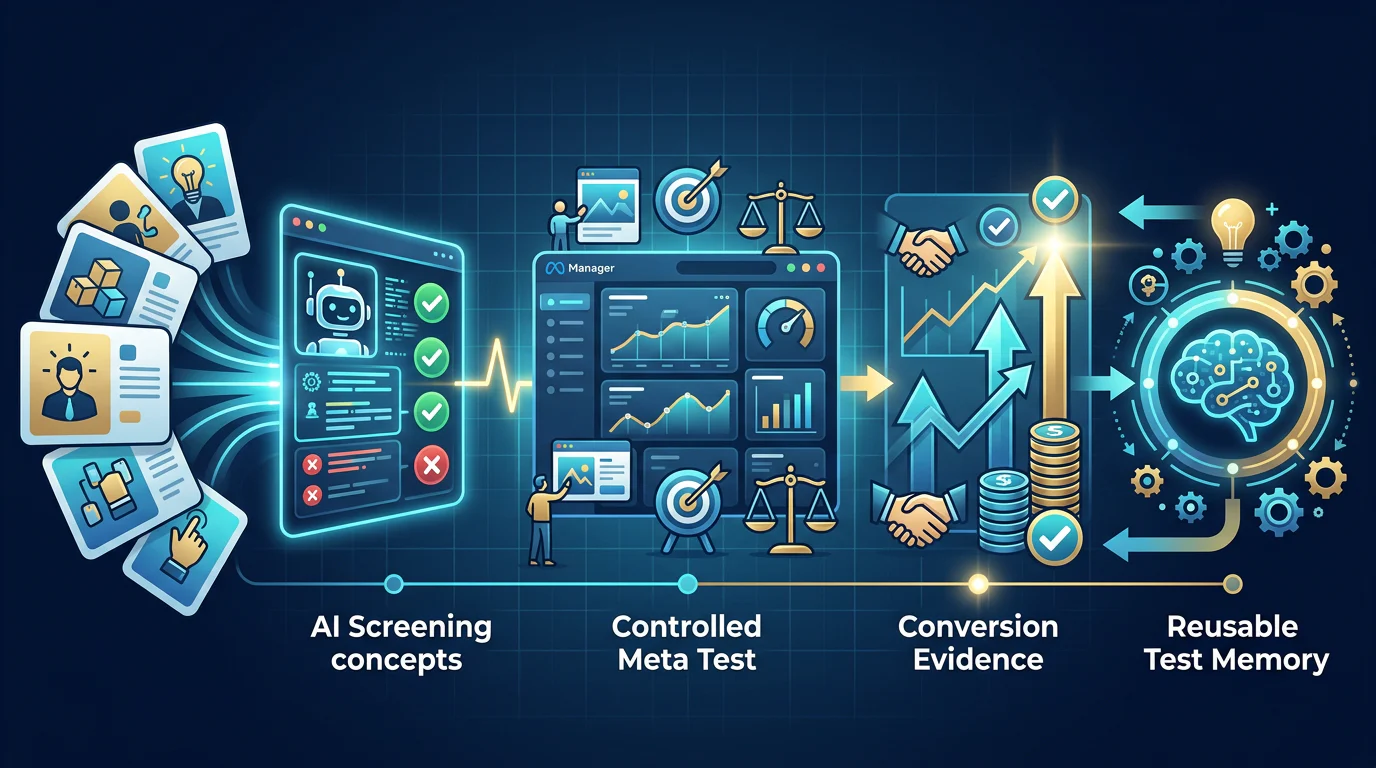
We use Meta creative test planning to rank ad concepts with AI, explicit uncertainty, early in-market signals, and account history. Predictive scores screen hypotheses, while controlled conversion evidence directs scaling, stopping, revision, and the next weekly test. We also show the test card, fairness rules, evidence ladder, and memory that make each decision explainable.
In this article
- 1Can Meta Creative Test Planning Predict Which Creative Will Work?
- 2What Predictive Scores Can Assess
- 3Why Observed Evidence Has More Authority
- 4How We Use the Score
- 5How Should Performance Teams Rank Weekly Creative Tests?
- 6How Do We Run a Fair Meta Creative Test?
- 7Hold One Variable Constant
- 8Pass a Technical Preflight
- 9Set Rules Before Reading Results
- 10Which Signals Diagnose Performance, and Which Evidence Decides?
- 11What Should a Creative-Test Memory Retain and Explain?
- 12Build Your Weekly Plan with Deepsolv
- 13FAQs on Meta Creative Test Planning
Creative decisions get difficult when a winning Meta ad fades before the next brief is ready. A major creative meta-analysis synthesized 878 effect sizes, reinforcing that originality alone is too thin a basis for a media decision.
Meta creative test planning cannot reliably know which ad will win before it runs. We use AI to screen and rank hypotheses, surface comparable account history, and make uncertainty explicit. We use controlled in-market conversion evidence, not a predictive score, to decide whether to scale, revise, stop, or retest a creative.
We will show how we turn a messy creative backlog into a ranked weekly plan. That means separating a useful prediction from a performance claim, running fair tests, and preserving every result as future decision evidence.
Can Meta Creative Test Planning Predict Which Creative Will Work?
A score can be useful before launch because it forces us to state why a concept deserves budget. It can compare audience fit, message relevance, novelty, prior account patterns, production readiness, and known risks. It cannot see the exact auction, delivery path, landing-page experience, or conversion quality that will occur after launch.
That distinction matters because a confident-looking score is still a hypothesis. In field experiments, researchers compared 15 Facebook advertising experiments with observational approaches across 500 million user-experiment observations and 1.6 billion impressions. The observed models often failed to reproduce randomized effects.
| Input | Output | Confidence | Speed | Risk | Proper Use |
|---|---|---|---|---|---|
| AI creative score | Hypothesis ranking | Low | Fast | Treating plausibility as proof | Screen concepts |
| Expert review | Message and execution critique | Low to medium | Fast | Personal preference | Improve briefs |
| Early signals | Hook and delivery diagnosis | Medium | Fast | Scaling attention without conversion | Continue or revise |
| Conversion evidence | CPA, revenue, margin, or lead quality | High for the stated outcome | Slower | Misreading attribution as incrementality | Scale or stop |
| Test memory | Comparable account patterns | Varies | Fast after setup | Overgeneralizing old outcomes | Rank follow-ups |
We use a decision workflow to keep predictive inputs visible, testable, and subordinate to performance evidence.
What Predictive Scores Can Assess
We use a predictive score to identify the ideas most worth learning from first. A score should show its inputs, comparable evidence, assumptions, and uncertainty. If it cannot explain why it ranked one concept above another, it is not a useful planning tool.
Why Observed Evidence Has More Authority
A creative can earn clicks because the hook is compelling, then lose money because the offer, audience, or destination does not convert. We therefore let observed conversion evidence overrule a pre-launch recommendation when the test is valid.
How We Use the Score
We use the score to choose the first test, not to crown a winner. Our test planning workflow makes the score a visible input beside the hypothesis, control, and next decision.
How Should Performance Teams Rank Weekly Creative Tests?
A weekly queue works when it ranks uncertainty, not just creative enthusiasm. We want concepts that could meaningfully improve the business outcome, have enough support to justify a test, teach us something if they lose, and do not consume disproportionate production time.
| Factor | Question | Evidence We Use |
|---|---|---|
| Expected Impact | If true, how much could this improve the outcome? | Account benchmark and commercial target |
| Evidence Strength | What already supports the hypothesis? | Comparable tests, customer feedback, market signals |
| Novelty | Does it explore a new audience-angle space? | Gaps in the test memory |
| Production Effort | What will the concept cost to make and launch? | Team capacity estimate |
| Learning Value | Will either result change the next decision? | Clear follow-up logic |
We assign team-defined weights that total 100 percent, then calculate a priority score from expected impact, evidence strength, novelty, effort, and learning value. The output must still show the components, because a single opaque number makes it too easy to hide weak assumptions.
For a team with dozens of concepts, we would not launch every variation at once. We use concept prioritization to select the few concepts that can receive a fair test and move the rest into an ordered queue.
Every candidate needs a test card before it earns a launch slot:
- Audience and angle: State who the ad is for and the specific tension or value it addresses.
- Control and change: Name the current benchmark and the one variable under examination.
- Primary outcome: Choose the business measure that will determine the decision.
- Diagnostics: Record the early signals that may explain a result.
- Evidence and confidence: Show what supports the concept and how transferable that evidence is.
- Next action: Define the conditions for launch, continue, revise, stop, or follow-up.
How Do We Run a Fair Meta Creative Test?
A fair test starts by deciding what question we are actually asking. If we test an audience angle, we hold the hook, format, audience, offer, destination, optimization event, placements, and technical setup steady wherever possible. If several elements change together, we call it a concept screen rather than claiming that one element caused the result.
Meta’s testing guidance emphasizes the same principle: keep non-tested elements constant so the result can be interpreted. This discipline matters more than any preferred campaign structure.
Hold One Variable Constant
We isolate hook, proof point, visual, format, offer, audience, or destination when that is the declared test variable. If we need to compare complete concepts, we preserve that distinction in the result and avoid false precision about why one concept won.
Pass a Technical Preflight
Before a test begins, we verify the details that can invalidate it:
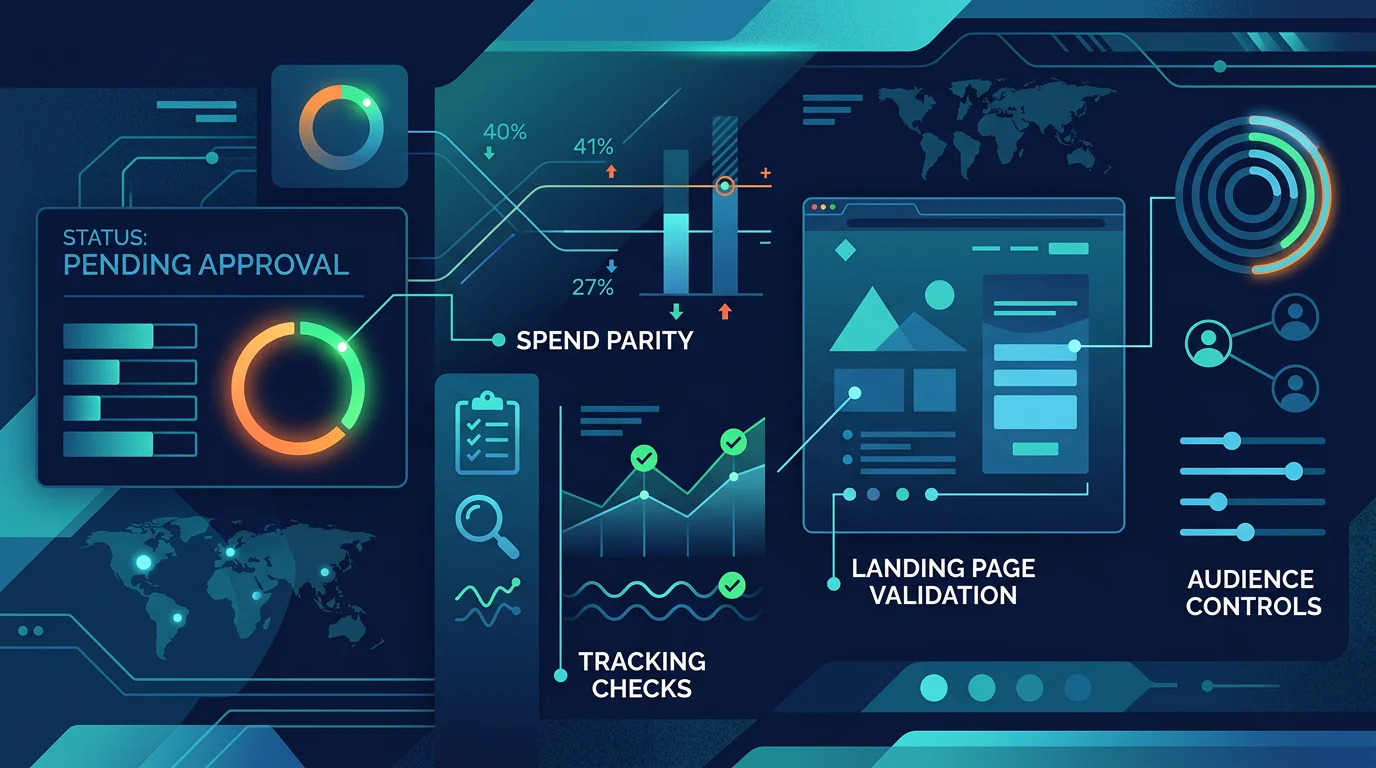
- Approval and delivery: Confirm every ad is approved, eligible, and receiving comparable opportunity to spend.
- Tracking integrity: Confirm the conversion event, URL parameters, and event receipt are working before the clock starts.
- Destination consistency: Keep the landing page, offer, inventory status, and checkout path stable unless one is the test variable.
- Spend parity: Investigate material differences in delivery before comparing creative outcomes.
- Qualitative context: Log warnings, comments, policy issues, and technical failures as explanatory evidence.
Set Rules Before Reading Results
We define the primary outcome, baseline, acceptable risk, and decision criteria before launch. We do not use a universal conversion threshold because event volume, baseline rate, target effect, and commercial risk differ by account.
Our testing framework separates an inconclusive test from a failed concept. A tracking failure, delivery problem, or underpowered result should not be stored as proof that an angle does not work.
We also preserve contextual evidence before it becomes hard to recover. That includes comments, warnings, landing-page issues, and other customer language that may explain why a result moved in a particular direction.
Which Signals Diagnose Performance, and Which Evidence Decides?
Early signals help us locate the problem. Delivery, CPM, hook retention, click-through rate, landing-page views, comments, and post-click behavior can reveal whether an ad is reaching people, earning attention, or creating a message mismatch. They do not automatically prove commercial value.
| Evidence Level | What We Read | What It Can Diagnose | What It Cannot Decide |
|---|---|---|---|
| 1 | AI and expert scoring | Hypothesis quality and risk | The winner |
| 2 | Delivery, spend, and CPM | Setup or auction constraints | Creative value |
| 3 | Retention, CTR, and landing-page behavior | Attention and message mismatch | Business impact |
| 4 | CPA, revenue, margin, or lead quality | Performance against the stated goal | Incrementality alone |
| 5 | Randomized lift evidence | Incremental business impact | The exact creative element without a clean design |
The hierarchy keeps us from mistaking a strong hook for a strong ad. We connect early behavior to the audience angle, then let purchase quality, CPA, revenue, or contribution margin make the final operating decision.
Format research can supply a worthwhile test hypothesis without becoming a promise. A Meta format study reported 34.5 percent lower cost per result for tested vertical video assets with audio and safe-zone messaging versus image ads. We would treat that as a reason to test the format in a specific account, not as a forecast of its outcome.
When evidence is valid, our weekly decisions are simple: launch a high-priority untested concept, continue a valid test that has not reached its decision point, revise a promising concept with a clear diagnostic weakness, stop a valid loser, or create a follow-up that isolates the next uncertainty. Our test stop rules make those calls explicit before teams spend more budget.
What Should a Creative-Test Memory Retain and Explain?
A test memory is not a folder of screenshots or a list of winners. We use it as a retrieval system for decisions: what we changed, which audience saw it, what happened, how confident we are, and what should happen next.
The memory must preserve the difference between a creative failure and a test failure. A concept may lose because the angle was wrong, but it may also appear to lose because tracking broke, delivery was uneven, the offer changed, or the audience was already saturated.
A useful failure taxonomy makes the record operational:
- Hypothesis Rejected: The valid result did not beat the control on the declared outcome.
- Inconclusive: The evidence was too limited or variable to support a decision.
- Technical Failure: Tracking, approval, delivery, or destination issues invalidated interpretation.
- Attention Without Conversion: The ad earned response but failed to produce qualified downstream action.
- Offer Or Destination Mismatch: The creative promise and post-click experience did not align.
- Changing Conditions: Saturation, seasonality, or market changes reduced transferability.
We record every valid result in our test memory with the creative ID, concept, audience, angle, hook, format, offer, destination, objective, dates, spend, diagnostics, outcome, control comparison, confidence, and decision.
Build Your Weekly Plan with Deepsolv
At Deepsolv, we help paid social teams replace a weekly scramble with a visible decision system. We bring concept notes, account outcomes, creative attributes, audience angles, feedback, and test history into one operating view, then show what evidence supports each next test. Our goal is not to tell your team that a synthetic score is certainty. It is to help us identify the highest-value uncertainty, launch a clean test, notice when delivery or tracking makes a result unreliable, and carry forward the learning when a result is valid. You keep control of the weighting, thresholds, and commercial definition of success. We help make every recommendation explainable to media buyers, creative leads, and finance. If your team needs a ranked weekly plan that connects hypotheses to observed outcomes, we can help you build it into your workflow without adding another opaque dashboard. Book a demo
FAQs on Meta Creative Test Planning
These answers address the decisions performance teams need to make before and after each Meta creative test. We keep the distinction clear between a useful prediction and evidence that can support a budget decision.
Can AI Predict Which Meta Creative Will Work?
AI ranks hypotheses using patterns, audience fit, and prior outcomes, but cannot see future auction conditions. We validate creative decisions with controlled in-market conversion evidence.
How Does AI-Powered Facebook Ad Test Planning Work?
We turn concepts into test cards, rank their priority, verify setup, monitor diagnostics, and update launch, revise, stop, or follow-up recommendations after valid evidence appears.
How Should Performance Teams Rank Weekly Creative Tests?
We weigh expected impact, existing evidence, novelty, production effort, and learning value. Our rankings show the evidence, uncertainty, and next action for every queued concept.
Which Meta Metrics Decide a Creative Test?
Hook retention, click-through rate, and landing-page behavior diagnose where an ad struggles. Purchase quality, CPA, revenue, or margin aligned to the objective determine the decision.
What Does a Creative-Test Memory Store?
Our memory records variables, audience, outcome, confidence, failure reason, and the next test. It preserves valid lessons without treating old results as universal in all contexts.