
Glossary
Meta Ads Best Practices
Meta ads best practices are Meta's own rules plus advertiser habits. Treat the rules as fixed and every habit as a hypothesis to test against your own results, rivals and customers.

By Sachit Sharma, CEO & Founder · Updated 23 Oct 2026
On this page
- 01Definition
- 02Quick facts
- 03What counts as a Meta ads best practice
- 04Why Meta ads best practices disagree with each other
- 05When a Meta ads best practice goes stale
- 06How much budget a best practice quietly assumes
- 07How to check a best practice before you adopt it
- 08How Deepsolv handles it
- 09Example
- 10Related terms
- 11Frequently asked
What are Meta ads best practices?
Meta ads best practices are platform rules and specs, delivery guidance from Meta, and advertiser habits such as ideal video length or how many creatives to launch. Only the habits are open to argument.
Key takeaways
- Adopt a best practice only after it passes a check against your own account.
- Many creative-count and test-length recommendations quietly assume a budget, so divide your weekly conversions by the number of creatives before you copy a number.
- Write the metric, budget and stop date before you spend.
Quick facts
- Fixed by Meta
- Platform rules and specs, such as ad policies and placement formats
- Open to argument
- Advertiser habits, such as ideal video length or how many creatives to launch
- Guides reviewed
- 13 guides from US search results, October 2026
- 20% text rule
- Removed by Facebook in September 2020
Meta's rules are fixed. Almost everything else sold as a best practice is a habit that worked in one account at one spend level. Recommended video length runs from 15 seconds or less to 60 seconds and more. Recommended creatives per ad set (the level where budget and targeting are set, containing one or more ads) run from 2 to 50 or more. Both ends of those ranges can be right, because the answer depends on your budget, your audience and your account.
A best practice is a default that someone else found useful. A few are rules Meta enforces. Most are habits that were repeated until they sounded like law.
The fix is not to ignore best practices. It is to check each one before it shapes your next test, and this page shows how.
What counts as a Meta ads best practice
The phrase means three different things that get treated as one. Platform rules and specs, such as ad policies and placement formats, are fixed. Delivery guidance from Meta, such as how the learning phase works, describes how the system behaves. Advertiser habits, such as ideal video length or how many creatives to launch, are heuristics.
Three kinds of best practice, one open to argument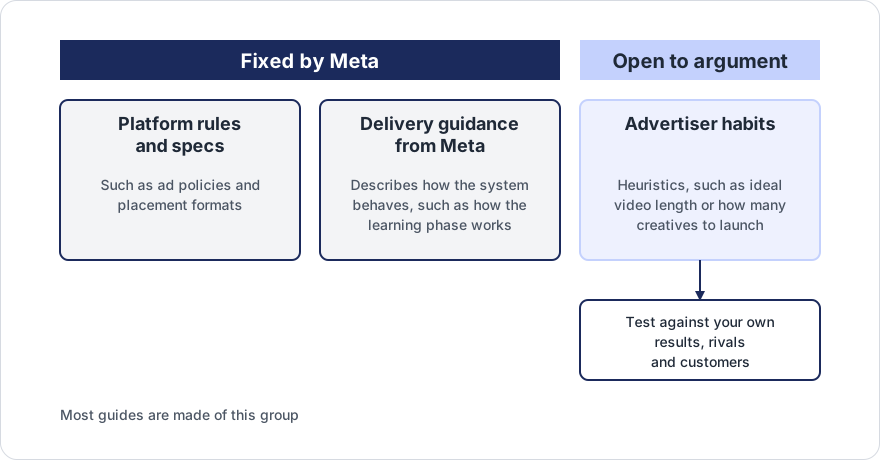
Only the third group is open to argument, and it is the one most guides are made of.
Related terms sit close by. The learning phase is the period when Meta's delivery is still calibrating, covered in the Meta ads learning phase guide. Creative iteration is a change to one element of an ad that already shows promise, covered on the creative iteration page.
Why Meta ads best practices disagree with each other
Each number was found in a different account at a different spend, and guides rarely say which. A review of 13 guides that appear in US search results for "meta ads best practices" and "meta creative best practices" in October 2026 recorded each recommendation as the page states it.
None of the 13 gives a full way to check its claim against your own account. Only Adstellar and The Optimizer give a partial one.
Even a platform's headline number is a group average. Meta reported that advertisers who had not used Advantage+ creative saw a 22% increase in return on ad spend (ROAS) after turning on its AI-driven targeting features (Meta Engineering, December 2, 2024). Meta does not publish the sample or period behind this figure. That tells you the feature is worth testing, not what your account will return.
- Parameter
- Ideal video length
- Range across the guides
- 15 seconds or less (Adsmurai); 6 to 15 seconds (Benly; Amplify Marketers for cold audiences); 15 to 30 seconds for Reels and Stories and 30 to 60 seconds for feed (LeadSync); 15 to 30 seconds by default and 60 seconds and above for retargeting or high-ticket offers (Wevion)
- Parameter
- Creatives per ad set or live
- Range across the guides
- 2 to 3 per test (AdLibrary); 3 to 5 (Keepers Digital; Benly for manual campaigns); 8 to 12 distinct concepts (The Optimizer); 10 to 20 for Advantage+, Meta's automated campaign and creative tools (Benly); 15 to 50 or more live (LeadsBridge)
- Parameter
- Minimum test
- Range across the guides
- 7 or more days (LeadsBridge, Keepers Digital, The Optimizer); 14 days for high-consideration products (The Optimizer); 25 optimization events (LeadsBridge); 50 conversions per variant (AdLibrary, Benly)
- Parameter
- Refresh or iteration
- Range across the guides
- Every 7 to 10 days (Billo); every 2 to 3 weeks (The Optimizer); every 2 to 4 weeks (97th Floor); every 3 to 4 weeks at under $5,000 monthly spend (Wevion)
When a Meta ads best practice goes stale
The 20% text rule is the clearest case. Facebook removed the 20% limit on image text in September 2020 (Search Engine Journal, September 23, 2020). As of October 2026, Meta's Help Center says there is no limit on image text but recommends short, concise text (About text in ad images). Adsmurai's guide still tells readers to keep image text under 20%.
Less text can still be a sound hypothesis. It is no longer a rule, so it belongs on your test list, not in your approval checklist.
How much budget a best practice quietly assumes
Every creative-count or test-length recommendation assumes a number of conversions per week. Two of the 13 guides, AdLibrary and Benly, ask for 50 conversions per variant, which multiplies the requirement if each variant is its own ad set.
The model, for tests where each variant is its own ad set: the daily budget needed for every variant to reach 50 conversions in 7 days is variants × 50 × cost per conversion (the average you pay for one chosen action, such as a purchase) ÷ 7. The costs per conversion are assumptions for illustration.
To run this with your own numbers, use the Meta ads budget and creative test calculator or the creative test capacity planner.
- Variants (each a separate ad set)
- 1
- At $30 per conversion
- $214 a day
- At $50 per conversion
- $357 a day
- Variants (each a separate ad set)
- 3
- At $30 per conversion
- $643 a day
- At $50 per conversion
- $1,071 a day
- Variants (each a separate ad set)
- 5
- At $30 per conversion
- $1,071 a day
- At $50 per conversion
- $1,786 a day
- Variants (each a separate ad set)
- 10
- At $30 per conversion
- $2,143 a day
- At $50 per conversion
- $3,571 a day
How to check a best practice before you adopt it
Run the claim through four tests and write the decision down before you spend.
- Own results. Split your last 90 days of ads by the variable in the claim, for example video length buckets. Pass: each bucket has at least 10 conversions and the better bucket wins in both halves of the period. Fail: fewer conversions or a flip between halves, which means no read yet. Ten conversions per bucket is a minimum for a directional read, not a significance threshold.
- Rival activity. Count how many rivals run the pattern in the Meta Ad Library, and for how long. Pass: at least 5 rival advertisers have run the pattern for at least 4 weeks. Fail: fewer than 5, or none for 4 weeks. This shows what rivals run, not what works for them, as explained in Meta Ad Library shows ads, not competitor results.
- Customer words. Look in your comments, reviews and direct messages for the premise behind the claim. Pass: at least 5 separate customer comments or reviews state it. Fail: fewer than 5.
- Decision. Choose adopt as a default, run as a test, or drop. Pass: you wrote the metric, the budget and the stop date before launch. Fail: any of the three is missing.
Passing the first three still does not prove cause. Patterns Are Not Proof in Ad Creative Analytics explains why only a controlled test can.
How Deepsolv handles it
Deepsolv gives you ranked tests in place of a list of habits. It combines ad-performance data, competitor activity, customer signals and past ad learnings into ranked weekly creative test plans and execution-ready creative briefs, so each recommendation arrives as a test to run.
Example
Take an account spending $100 a day at $30 per conversion. It makes about 23 conversions a week in total (7 × $100 ÷ $30). A guide advising 15 live creatives in one ad set would leave each creative about 1.5 conversions on average (23 ÷ 15), and the roughly 50-event planning figure applies to the whole ad set, not to each creative. Three creatives in one ad set would average about 8 each: the advice is not wrong, it was written for a different budget.