
Glossary
Creative iteration
Creative iteration is a change to one element of an existing Meta ad that keeps its concept. Meta may group look-alike versions as one creative, so near-copies can share a single read.

By Sachit Sharma, CEO & Founder · Updated 23 Oct 2026
On this page
- 01Definition
- 02What is creative iteration in Meta advertising?
- 03How do you tell a creative iteration from a new concept?
- 04How many creative iterations can your budget read?
- 05Why should iteration volume follow your purchase counts?
- 06What is creative iteration often confused with?
- 07How Deepsolv handles it
- 08Example
- 09Related terms
- 10Frequently asked
What is creative iteration in Meta advertising?
Creative iteration is a deliberate change to one element of an ad that already shows promise while the concept stays the same.
Key takeaways
- A change to the motivation or proof makes a new concept, not an iteration. Meta calls distinctly different ads for different personas or use cases creative diversification.
- Meta groups ads that share key visual and thematic attributes as variations of one creative, so near-copies may share a single read.
- Budget caps how many versions you can judge: one concept per five weekly purchases in the model below.
- Change one element at a time and log it, or you cannot say what worked.
A new headline over the same footage can cost a week of budget and teach you nothing new. A recolored button, a trimmed intro and a swapped thumbnail carry the same risk.
Iteration is the narrow, cheap move you make once an ad shows a signal. Following Meta's guidance on how it treats similar ads, it only teaches you something when the change is single, deliberate and different enough to be read on its own. The costly question is how many changes your purchases can judge in a week.
This page covers creative iteration in Meta paid social, not the art, design or programming senses of the word. It gives a definition, a three-question test to run before you build any version, and a worked budget calculation.
What is creative iteration in Meta advertising?
Creative iteration is a deliberate change to one element of an ad that already shows promise (the opening line, first scene, creator or offer wording) while the concept stays the same. The concept is the motivation, problem or proof the ad leans on. The aim is to learn which element moved the result.
Meta separates iteration from creative diversification, which builds distinctly different ads for different personas or use cases. In art and design, iteration means repeating make, review and refine. In ads it is narrower, because every version has to be readable in your data.
How do you tell a creative iteration from a new concept?
Answer three yes-or-no questions about every version before you build it. These questions are a recommended test, built on Meta's grouping rule.
Tweak, new visuals, or new concept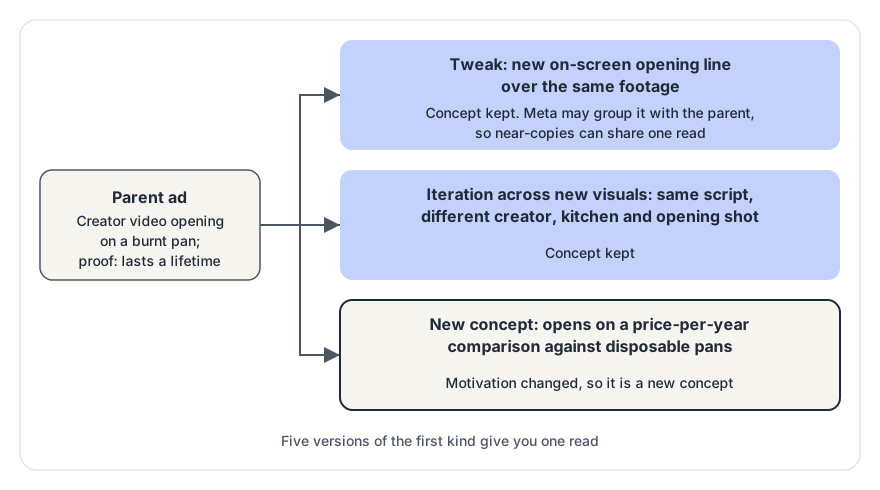
Keep a log with five fields per version: parent ad, the one changed element, the metric you expect to move, the read window (complete 7-day periods, per a test-analysis method) and the stop rule.
Choose the metric by where the parent ad leaks. If viewers leave in the first seconds, change the opening and watch hook rate (the share of viewers who watch past the first seconds). If they watch but do not click, change the offer wording. If they click but do not buy, the ad is probably not the lever. This mapping is a recommendation.
- Question
- 1. Does the version rest on the same motivation, problem and proof as the parent ad?
- Yes
- Go to question 2
- No
- New concept: plan and read it as its own test
- Question
- 2. Would a stranger scrolling past call the scene, creator, framing and format the same as the parent's?
- Yes
- Tweak: Meta may group it with the parent, so expect one shared read
- No
- Iteration across new visuals: it can be read on its own
- Question
- 3. Did exactly one element change from the parent?
- Yes
- Pass: log it and launch
- No
- Fail: split it into single-change versions, or you cannot say what worked
How many creative iterations can your budget read?
Your budget can read one concept per five weekly purchases. The model: concepts you can judge weekly = (weekly budget ÷ cost per purchase) ÷ 5, rounded down. The assumption is five purchases per concept, pooled across the concept's ads. That is half the 10-conversion threshold below which a test-analysis method labels results directional. This is a model, not a Meta figure.
Worked at an assumed $50 cost per purchase:
As of October 2026, Meta's learning phase help page says an ad set generally needs around 50 optimization events (such as purchases) in a 7-day window to exit the learning phase, the period while delivery is still calibrating. At $50 per purchase that is $2,500 a week, about $357 a day (daily budget = cost per purchase × 50 ÷ 7). See the learning phase guide. When your budget is below the line, judge early signals such as hook rate and click-through rate (CTR, the share of viewers who click) instead of purchases. A creative test capacity planner shows whether budget or production sets your weekly limit.
- Daily budget
- $50
- Weekly budget
- $350
- Weekly purchases
- 7
- Concepts you can judge
- 1
- Daily budget
- $100
- Weekly budget
- $700
- Weekly purchases
- 14
- Concepts you can judge
- 2
- Daily budget
- $350
- Weekly budget
- $2,450
- Weekly purchases
- 49
- Concepts you can judge
- 9
Why should iteration volume follow your purchase counts?
Iteration volume should follow your purchase counts because a version only teaches you something if enough purchases land on it to read it, and near-copies may share one read. Meta publishes no required number of variations or similarity threshold, so it is recommended to set volume from your own purchase counts.
What is creative iteration often confused with?
- Creative diversification: distinct ads for different personas or use cases. The difference is the concept, not the polish.
- Creative testing: the design used to compare versions. Iteration decides what you change, and testing decides how you compare.
- Creative brief: the document a creator works from, which can be built around one test, as in the ad creative brief template.
How Deepsolv handles it
We turn the iterate-or-replace call into a weekly ranked list. Our creative intelligence platform combines ad-performance data, competitor activity, customer signals and past ad learnings into ranked weekly creative test plans and execution-ready creative briefs. The plan includes test, improve and stop decisions. The improve decisions are your iterations, ranked against new concepts.
For pricing, see our pricing page.
Example
A cast-iron pan brand has a parent ad: a 20-second creator video that opens on a burnt pan and leans on "lasts a lifetime" proof. A new on-screen opening line over the same footage is a tweak that Meta may group with the parent, so five such versions give one read. The same script with a different creator, kitchen and opening shot is an iteration across new visuals, and opening on a price-per-year comparison against disposable pans is a new concept, because the motivation changed. This is an illustration, not account data.
Frequently asked
Sources
- 1.Meta, Demystifying creative diversification, Meta, December 16, 2025
- 2.Meta Business Help Center, learning phase, Meta