
Glossary · creative intelligence
Ad creative analytics

By Sachit Sharma, CEO & Founder · Reviewed 1 Oct 2026
Also called creative analytics or creative performance analytics
On this page
What is ad creative analytics?
Ad creative analytics is the practice of connecting ad-level performance data with observable creative features, such as format, hook, offer or call to action, to report results and identify patterns. It can generate hypotheses for the next test, but it cannot by itself establish what caused a business outcome.
Key takeaways
- Treat reported differences as observations until a suitable controlled test supports a causal conclusion.
- Use a consistent tagging taxonomy so that comparisons between hooks, formats, offers and calls to action remain meaningful.
- Turn a detected pattern into a written hypothesis with a primary success metric before changing spend or production priorities.
- Keep the decision owner, test conditions and result together so the next recommendation retains its evidence.
Four layers separate reporting from a decision
Ad creative analytics becomes clearer when each layer has a separate job. Reporting records what happened. Annotation creates a usable description of what was in the asset. Pattern detection identifies observed associations. Recommended action turns the association into a proposed next test.
A recommendation is useful when it preserves the evidence, states the hypothesis and makes the uncertainty visible. A recommendation becomes a decision only after the team defines the comparison and reviews the result.
- Layer
- Reporting
- Primary output
- Asset metrics and delivery outcomes
- What it cannot establish alone
- Why an outcome occurred
- Layer
- Annotation
- Primary output
- Labels for observable creative features
- What it cannot establish alone
- Whether a label caused an outcome
- Layer
- Pattern detection
- Primary output
- Observed associations across tagged ads
- What it cannot establish alone
- A universal winning formula
- Layer
- Recommended action
- Primary output
- A ranked hypothesis or next test
- What it cannot establish alone
- A final causal verdict
The causal boundary starts with test design
Google Ads advises teams to test one variable at a time because changing several variables makes it difficult to identify which element drove a better outcome. A defined success metric should be chosen before the test starts. Google Ads’ experiment guidance explains both practices.
TikTok recommends split tests with otherwise identical ad groups, one isolated variable and a run of at least 14 days. Its recommendation is platform guidance for that testing workflow, not a universal rule for every channel or campaign. TikTok’s test-and-learn guidance sets out the recommendation.
A traffic split also does not guarantee equal impressions or spend. Google Ads notes that auction dynamics, bids, Ad Rank and budget limits can change delivery between experiment arms. Google Ads’ custom-experiment documentation describes that limitation.
A 14-day result can create a better next question
Imagine a TikTok team running two otherwise identical ad groups for 14 days, changing only the opening of the ad. One group reaches 50 conversions. Reporting records the result, and annotation records the changed opening. The next action is a follow-up decision under the same stated rules, not a claim that the opening caused every conversion.
TikTok identifies 50 conversions as a significant learning-phase indicator, while its split-test guidance recommends at least 14 days. Those numbers help frame platform learning and test duration, but neither number removes the need to inspect the test design and compare the treatment with its control. TikTok’s learning-phase FAQ and TikTok’s split-test guidance provide the relevant platform guidance.
A recommended action should be a hypothesis, not a command
A sound recommended action names the proposed change, the control, the primary metric, the evidence being used and the condition that would change the decision. That record gives creative, media and growth teams a shared object to review rather than a dashboard conclusion to interpret separately.
The practical output is not “make more ads like this.” The practical output is “test this defined change against this control, using this metric, then decide whether to continue, revise or stop.” Seven Links Make a Meta Creative Recommendation Defensible explains the evidence record a recommendation needs.
A pattern becomes a decision only after a test
A report can show that a tagged feature appeared among stronger results. A controlled comparison is the step that tests whether the proposed change deserves a decision.
Observation, Test, Decision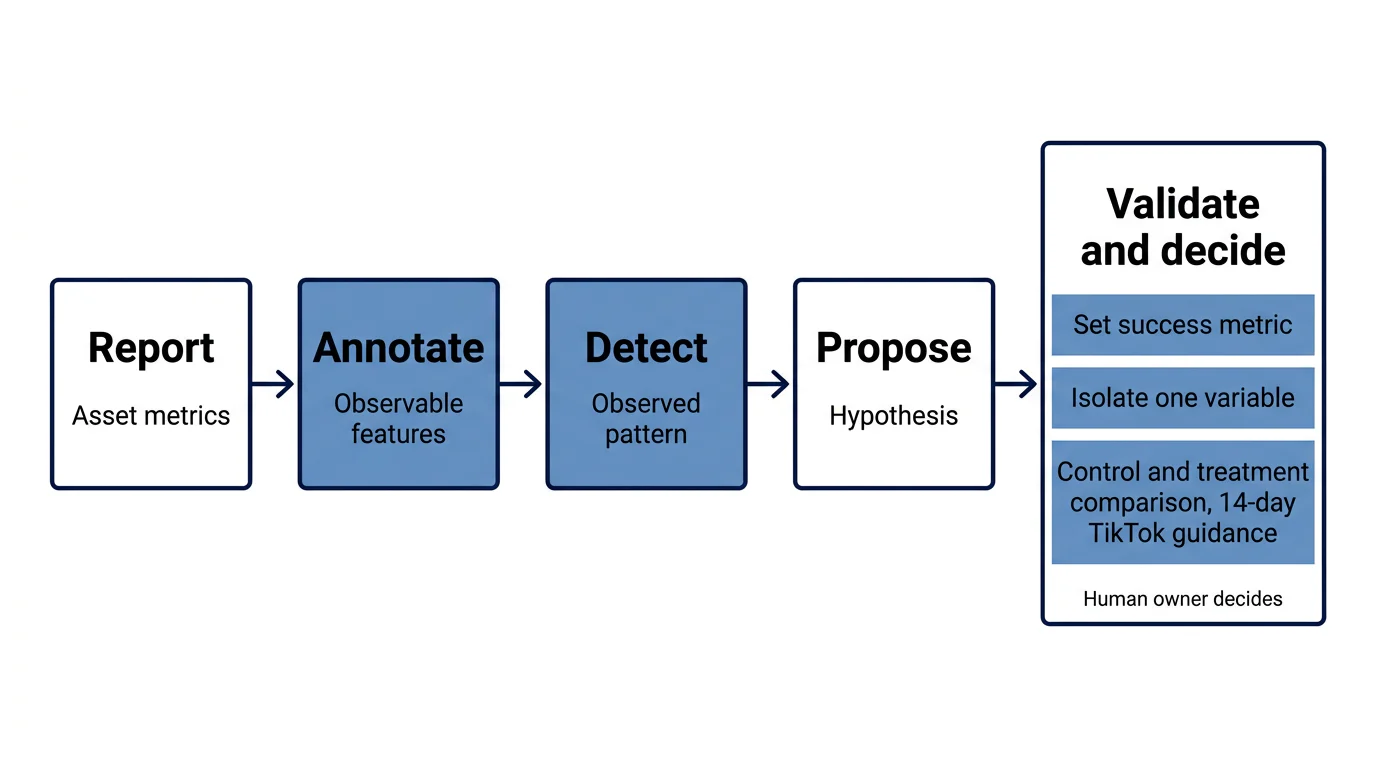
Example
A team sees that product-demonstration openings appear in stronger reported results. The team should label that as an observed pattern, define a demonstration-opening hypothesis, isolate that opening from other changes and choose the success metric before deciding whether the pattern should affect the next creative brief.
Frequently asked
Ad creative analytics can show that ads with a particular hook appeared alongside stronger reported outcomes, but it cannot establish that the hook caused those outcomes by itself. Audience, budget, bidding, placement, timing, landing pages and other changing conditions can affect the comparison.
Creative reporting presents performance metrics for ads, campaigns or assets. Ad creative analytics adds a consistent way to label observable creative features and compare reported outcomes across those labels, so a team can identify patterns that deserve a test.
Testing one creative variable at a time makes the result easier to interpret because a team can connect the outcome to the specific change being evaluated. Google Ads warns that changing several variables makes it difficult to identify which element drove the better outcome.
No. TikTok describes 50 conversions as a significant indicator of passing its learning phase, not as universal proof that one creative caused a business outcome. A team still needs a defined success metric, comparable delivery conditions and a controlled comparison before making a decision.
Sources
- 1.Test with confidence with the Experiments page, Google Ads Help, 2026
- 2.About custom experiments, Google Ads Help, 2026
- 3.How to test, learn, and scale your TikTok campaigns, TikTok for Business, 2024
- 4.Learning Phase FAQs, TikTok Ads Manager, 2025
Turn the next observed pattern into a testable decision
We turn authorised account performance, customer signals and documented tests into a ranked weekly test plan for Meta growth teams.
Explore Test Planning