
Seven Links Make a Meta Creative Recommendation Defensible

TL;DR
A defensible Meta creative recommendation is not a dashboard verdict. It separates market, customer and own-performance signals, makes one testable hypothesis, and preserves the outcome as team memory. Meta’s Ad Library can show public creative and delivery details, not an ordinary advertiser’s profitability.
A recommendation needs more than a performance readout
A defensible Meta creative recommendation is a seven-link record: market signal, customer signal, own-performance signal, hypothesis, test design, outcome and learning memory. The chain does not promote a visible competitor ad, a comment theme or a high-performing internal asset into proof before the relevant evidence exists.
The practical question is not “Which ad won?” It is “What do we know, what are we testing next, and what will this result let us decide?” That distinction is the difference between creative performance analytics and a recommendation a team can explain later.
| Link | What the record carries | What it cannot establish alone |
|---|---|---|
| Market signal | Observable message, offer, format, delivery date or placement, with its source | Another advertiser’s profitability or causal result |
| Customer signal | Permitted review, comment, direct message or conversation with source context | That the language will improve campaign outcomes |
| Own-performance signal | Authorised account metric, conversion context and comparison conditions | That one creative element caused the observed result |
| Hypothesis | A falsifiable prediction about a proposed creative change | That the prediction is already validated |
| Test design | Treatment, comparison, primary response and decision rule | Whether the result will be conclusive before the evidence is read |
| Outcome | Observed result and its limits | That the finding will generalise to every audience or period |
| Learning memory | The evidence, conditions, result and next decision retained together | A reason to repeat an unsupported interpretation |
Keep public visibility separate from commercial proof
Market research is useful when it stays in its lane. Meta’s Ad Library API documentation, 2026 says ordinary available-ad records include creative content, the associated Page, delivery dates and placements. Its additional spend and impression disclosures apply to specified political, issue, UK and EU contexts, not to ordinary advertiser profitability.
Treat a public ad as an observable market pattern. Capture what is visible, then ask whether the message, proof, offer or format is worth testing in your own account. For a fuller boundary between public ads and competitor results, see Meta Ad Library Shows Ads, Not Competitor Results.
Write the decision before the assets go live
A hypothesis should name the proposed change, the expected direction of the response and the reason the team thinks it is worth testing. A test design then names the treatment, comparison, primary outcome, held conditions, review window and the action for a positive, negative or inconclusive result.
NIST’s Statistical Engineering Handbook defines experimental design as planning controllable factors and measured responses in advance. Its glossary also defines the control group as the comparison point for an experimental treatment. Use that logic to select a creative control that makes the next change interpretable, rather than comparing two unrelated ads. Choose a Creative Test Control Ad That Sets a Fair Benchmark provides a practical next step.
The reason for this discipline is not academic theatre. A 2019 Marketing Science study of 15 US Facebook advertising experiments, covering 500 million user-experiment observations and 1.6 billion impressions, found that observational methods often did not reproduce randomised effects. Internal performance can identify a question worth testing. It should not be presented as causal proof when the comparison cannot support that conclusion.
From signal to reusable learning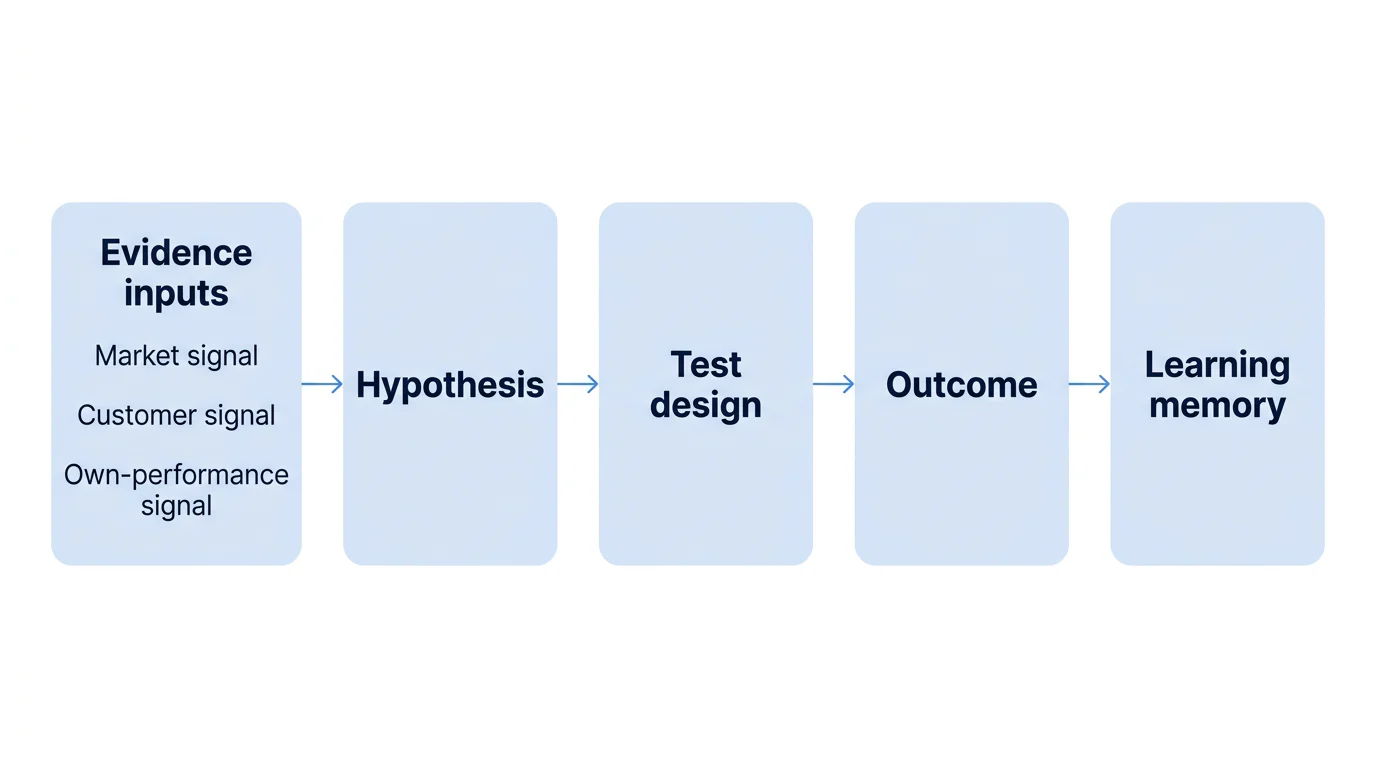
Retain the result that changes the next brief
Learning memory is not a gallery of winners. It is the record of what the team observed, what it changed, what comparison it used, what happened and what should happen next. A failed test can be useful memory when its conditions and limitation are visible.
We connect competitor activity, customer signals, historical performance and past experiments into ranked weekly test decisions, so a creative team can decide what to test, improve or stop. See how creative analytics differs from test planning when the team has reports but no accountable next experiment.
Keep reading



Frequently asked
A market signal is usable when the record keeps the original source, the observed message, offer or format, and the date and placement context. It can justify a hypothesis worth testing, but it cannot establish that another advertiser’s creative produced profitable results.
Choose one meaningful change that the team can describe plainly, such as the hook, proof, offer framing or format. Keep the comparison conditions as stable as practical, state the primary outcome before launch, and avoid treating a bundle of changes as one lesson.
Record the outcome as mixed or inconclusive rather than forcing a winner label. Preserve the comparison, metric, conditions and limitation, then decide whether the next test should narrow the question, repeat the comparison or stop the line of enquiry.
A result becomes reusable learning when the team retains the originating signals, hypothesis, control, treatment, outcome, conditions and next decision together. That record lets a later team understand what was tested and prevents a dashboard observation from becoming unsupported folklore.
Turn evidence into the next test your team can run
See how we turn competitor activity, customer signals, historical performance and past experiments into ranked weekly test decisions.
Book a demo