Glossary
Halloween Facebook Ads
Halloween Facebook ads are Meta ads built around the Halloween season. Read competitors' active ads for angle and format, score them, and run the top-ranked angle as your first test.

By Sachit Sharma, CEO & Founder · Updated 24 Oct 2026
On this page
- 01Definition
- 02Quick facts
- 03What are Halloween Facebook ads, and what do people confuse them with?
- 04When do consumers plan to shop, and what does that mean for your Halloween ads?
- 05What can competitors' Halloween ads tell you, and what can't they?
- 06How do you turn competitor Halloween ads into one ranked first test?
- 07How Deepsolv handles it
- 08Example
- 09Related terms
- 10Frequently asked
What are Halloween Facebook ads?
A Halloween Facebook ad is a paid ad on Meta's apps (Facebook, Instagram and others) whose angle, offer or look is tied to Halloween.
Key takeaways
- Choose its angle by scoring competitor angles, not by copying the most visible ad.
- Competitor ads give you hypotheses, not results.
- Score each angle 0 to 2 on four checks, add the scores, and test the highest total, changing only the angle.
- Test early next season. This week, a deadline-led ad is the practical move.
Quick facts
- Where rival ads are visible
- Meta Ad Library, the public search of active Meta ads
- Scoring scale
- 0 to 2 on each of four checks
- Best time to test
- August or early September
- Best angles in the final week
- Deadline and shipping
Competitor ads show you an angle, a format and a start date. They never show whether the ad sold anything. That gap is where Halloween ad planning goes wrong: a team sees a rival's ad running for weeks and copies it as if it were a result. The season is short, and a short season rewards a quick copy over a considered test.
A rival's ad may still be live because it works, or only because nobody switched it off. Public information cannot separate the two. What it can show is which ideas rivals are betting on, and how many of them are.
So treat what you see as a list of hypotheses, meaning testable guesses about which reason to buy will move your customers. Rank them against your own history and your own customers. Below you will find a logging sheet, a scoring table, a worked example, and where Halloween sits in the buying calendar.
As of 23 October 2026, with Halloween eight days away, run one deadline-led ad in your best format and log the result.
What are Halloween Facebook ads, and what do people confuse them with?
An angle is the reason to buy that an ad leads with: costumes, party hosting, candy, décor or a last-chance deadline. Two things get mistaken for it.
First, an organic "Happy Halloween" page post is not an ad. It reaches your followers, and nobody pays to place it.
Second, brand showpieces are a different job. Twix's "Zombie Claus" and Rivian's Ghostbusters reunion, covered in Adweek's 2026 roundup, are built to be remembered beyond October 31. A performance team running Meta ads needs angles it can test and measure in its own account.
When do consumers plan to shop, and what does that mean for your Halloween ads?
About half of consumers plan to start Halloween shopping in September or earlier, which leaves roughly half still to reach in October. In the NRF survey of 7,889 consumers (September 1 to 9, 2026), 49% plan to begin shopping for Halloween in September or earlier, up from 34% a decade ago.
Haunted Attraction Network reports that 57% of costume wearers begin in September or sooner. Consumers name discount stores (39%), Halloween stores (32%) and online (27%) as places they plan to shop.
The practical approach is to run the angle test in August or early September, so a proven angle can be scaled when the early group starts. In the final week, lead with deadline and shipping angles.
What can competitors' Halloween ads tell you, and what can't they?
Competitors' Halloween ads show the creative, copy, format and start date of each ad. Meta's Ad Library, the public search of active Meta ads, lets anyone search all active ads running across Meta products, but spend, reach and funding detail are limited to ads about social issues, elections or politics. For a US costume or candy advertiser, you will not see results.
So treat a long-running ad as "not turned off yet," which is weak evidence, not proof it works.
How do you turn competitor Halloween ads into one ranked first test?
Log each competitor ad on one row, score each angle on four checks, and test the highest total. This scoring rule is a recommended method, not an industry standard.
From competitor ads to one ranked first test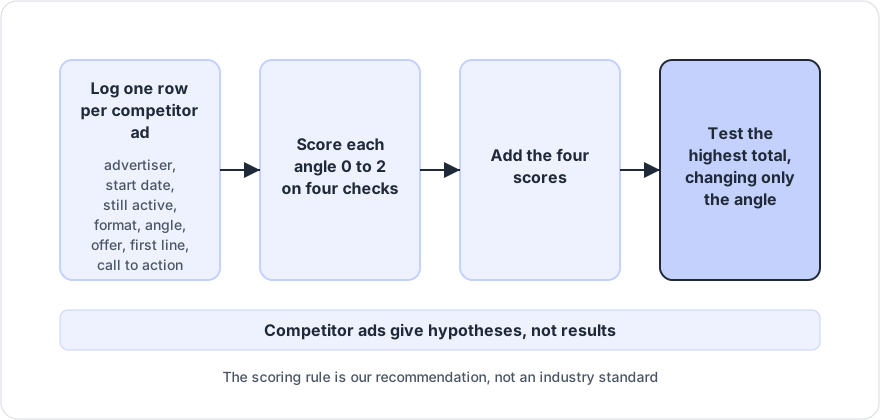
- Log one row per competitor ad. Record the advertiser, start date, still active (yes or no), format (static, video, carousel, creator-style, meaning a video that looks like a person's own), angle (costume, hosting, candy and gifting, décor, deadline, bundle, humor), offer, the first line or first three seconds, and the call to action.
- Score each angle, 0 to 2 per check, using the table below.
- Add the four scores and rank. Break ties by the lower production effort.
- Test the top angle in the format you already make best. Change only the angle, so any difference you see comes from it.
Repetition can mean "proven" or "crowded." The gap check keeps you from testing what you already know.
- Check
- Repetition: how many rivals run it
- 0
- One rival
- 1
- Two rivals
- 2
- Three or more
- Check
- Staying power: days live since start
- 0
- Under 7
- 1
- 7 to 14
- 2
- Over 14
- Check
- Gap: your own history
- 0
- Run in the same format in the last 90 days
- 1
- Run in the last 90 days in a different format, or run in the same format more than 90 days ago
- 2
- Never run
- Check
- Customer fit: reviews, comments or direct messages naming it
- 0
- No mentions
- 1
- One or two mentions
- 2
- Three or more separate mentions
How Deepsolv handles it
Deepsolv gathers the same inputs this scoring sheet uses (competitor ads, customer signals, past learnings) and turns them into ranked weekly test plans. Deepsolv is a creative intelligence platform for Meta advertising teams. It combines ad-performance data, competitor activity, customer signals and past ad learnings into ranked weekly test plans and execution-ready creative briefs.
Competitor tracking covers messaging, angles, offers and formats. Customer signals come from reviews, comments, direct messages (DMs) and Reddit discussions. For the brief that follows a ranked angle, see our ad creative brief template and our competitor research for creative briefs guide. The same logic carries into the Black Friday plan.
Example
For a costume-accessories seller (illustrative, not real ads), a creator-style try-on angle, "which look wins?", scores 7 (2 + 2 + 1 + 2), a last-chance shipping deadline scores 6, and a percentage-off bundle scores 3. The try-on angle is tested first, the deadline becomes the final-week ad, and the bundle waits.
Frequently asked
Sources
- 1.NRF, Halloween data and trends, 2026 survey, NRF
- 2.Halloween spending expected to reach $13.5B, Retail Dive, 2026-09-24
- 3.Halloween spending 2026, Haunted Attraction Network, 2026-09-25
- 4.Ad Library tools, Meta Transparency Center
- 5.The 2026 Halloween Ads Worth Screaming About, Adweek