Black Friday Facebook Ads: A 7-Week Plan Built on Real Costs
Black Friday Facebook ads pay off when creative is tested seven weeks early, locked two weeks out, and judged by cost per purchase against a break-even ceiling, not impression prices.

By Sachit Sharma, CEO & Founder · Updated 9 Oct 2026

Key takeaways
- 01Start seven weeks before Black Friday: two testing rounds, a creative lock 14 days out, a budget ramp from eight days out, and a cost check in the second week of December.
- 02Judge peak days by cost per purchase against your break-even ceiling, the most you can pay per purchase and still break even. CPM tells you the price of attention, not whether you made money.
- 03A discount cuts your ceiling. A product with $55 of profit per order at full price has $25 at 30% off, so a cost per purchase that was profitable in October can lose money.
- 04Test at normal prices. Our view is that an ad that cannot convert in October is unlikely to be rescued by Black Friday demand, though the data does not isolate why conversion rises.
In this article
- 1How should you plan Black Friday Facebook ads across the last seven weeks?
- 2Why does cost per purchase fall on Black Friday while CPMs rise?
- 3What is your break-even cost per purchase for Black Friday?
- 4How much should each Black Friday creative test cost?
- 5Which ads should you lock before Black Friday, and which do you refresh?
- 6How fast can you raise a Facebook ads budget before Black Friday?
- 7Are Black Friday clicks failing because of the ad or the store?
- 8Which week after Cyber Monday costs consumer brands the most?
- 9How does Deepsolv build a Black Friday test queue?
- 10Frequently asked questions
Cost per purchase fell on Black Friday 2025 even though ad prices rose. Biddyco, an agency, analyzed its own large US consumer-brand client accounts (number of accounts not disclosed). It found that the median account paid 42% less per purchase than in October while its CPM, the cost per thousand ad impressions, climbed.
That gap explains where Black Friday is won. Far more visitors buy, so a sale can cost less even when each impression costs more. The advantage goes to accounts that already know which ads convert before the auction gets crowded, and that know the most a sale can cost them before it loses money.
This page gives you a plan counted back from Black Friday, a way to calculate your break-even cost for a sale, and rules for when to raise spend and when to cut it. It also flags a week in December that costs more than Black Friday does.
How should you plan Black Friday Facebook ads across the last seven weeks?
Count back from Black Friday, the day after US Thanksgiving (the fourth Thursday of November). Test creative in two rounds, lock it 14 days out, ramp budget from eight days out, hold through Cyber Monday, and review costs in mid-December. Meta advises turning on Advantage+ placements (its setting that lets the system choose where ads appear) early, so campaigns exit the learning period before Black Friday.
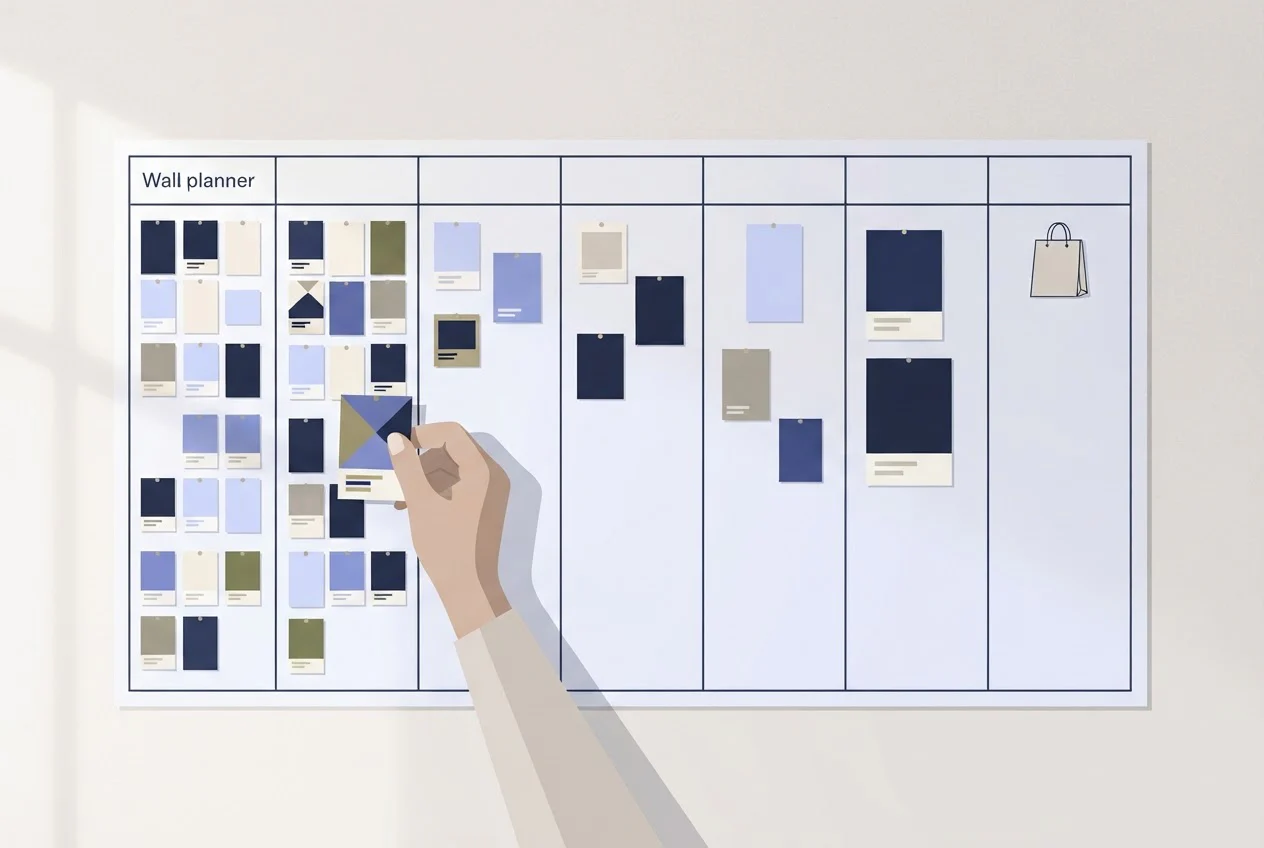
As of 9 October 2026, Black Friday 2026 is November 27 and Cyber Monday is November 30. Day 49 is October 9, day 35 is October 23, day 21 is November 6, day 14 is November 13 and day 8 is November 19. For 2026, the plan starts on October 9.
Two terms first. Retargeting means ads to people who already visited your store or engaged with you. Prospecting means ads to people who have not.
| Days before Black Friday | What you do | Pass or fail |
|---|---|---|
| 49 | Write your baseline (median cost per purchase over your last 30 days), average order value, and profit per order. Work out your ceiling (the most you can pay per purchase and still break even, defined below). Launch round 1 with 6 concepts. | Pass: baseline and ceiling are written down in dollars, and baseline × 0.58 is at or below the ceiling. Fail: it is above the ceiling, so fix price, bundle or costs before spending. |
| 35 | Read round 1. Cut any concept that spent 2x baseline with zero purchases. Launch round 2 with 6 variants of the survivors. | Pass: at least 2 concepts are at or under baseline cost per purchase. Fail: none are, so rework the angle, not the hook. |
| 21 | Read round 2. Pick 2 to 4 finalists. Build holiday versions of each: price and deadline text, one per format. | Pass: every finalist exists as vertical video, Stories, feed static and carousel. |
| 14 | Creative lock. Holiday versions are live. | Pass: no new concept launched since this day. |
| 8, 6, 4, 2 | Raise daily budget about 20% on each of these days. | Pass: cost per purchase stays under the ceiling after each step. Fail: two days over it in a row, so step back one. |
| 0 to 3 | Hold through Cyber Monday. Fund retargeting first. | Pass: daily cost per purchase is checked against the ceiling, not against CPM. |
| Dec 8 to 14 | Compare cost per purchase with baseline. | Pass: within 30% of baseline. Fail: above it, so cut prospecting (expected for most consumer brands; see the December section). |
The timings are our recommendation. The reasons follow.
Why does cost per purchase fall on Black Friday while CPMs rise?
Cost per purchase falls on Black Friday because far more visitors buy, which outweighs the higher cost of reaching them. Biddyco's analysis covers US consumer brands (food, supplements, pet, beauty, home and baby) among its own client accounts, each with at least $30,000 in October 2025 spend and about $6.9 million a month in combined spend. It reports medians against an October 2025 baseline, for October 2025 to January 2026.
| Day (2025) | CPM | Conversion rate | Cost per purchase |
|---|---|---|---|
| Thanksgiving (Nov 27) | +30% | +87% | -10% |
| Black Friday (Nov 28) | +57% | +226% | -42% |
| Cyber Monday (Dec 1) | +41% | +153% | -32% |
You can check this yourself. Cost per purchase (ad spend divided by purchases) is roughly CPM divided by 1,000 times click-through rate (CTR, clicks divided by impressions) times conversion rate (purchases divided by clicks). That is our model. With CPM at 1.57x and conversion rate at 3.26x, cost per purchase should be 1.57 ÷ 3.26 = 0.48 of October, or 52% lower. The reported figure is 42% lower, which closes if CTR fell by about 17% (0.48 ÷ 0.58 = 0.83). The analysis reports no CTR, so that 17% is our inference, and medians across accounts do not combine exactly.
Our inference is that the conversion lift comes from shopper intent and offers rather than from the ad itself. The data does not isolate the cause. The practical conclusion holds either way: conversion rate, not CPM, decides the cost of a sale.
What is your break-even cost per purchase for Black Friday?
Your break-even cost per purchase is your profit per order after the discount, before ad spend. Spend more than that per sale and each order loses money. Profit per order means price minus product cost, shipping and payment fees.
Our worked example (illustrative numbers, not a benchmark):
- Full price: $100. Product, shipping and fees: $45. Profit per order: $55.
- At 30% off: price $70, same $45 in costs. Profit per order: $25. Your ceiling is $25.
- Break-even ROAS (return on ad spend, revenue divided by ad spend) rises from $100 ÷ $55 = 1.8 at full price to $70 ÷ $25 = 2.8 at 30% off.
Now apply the consumer-brand median. If October cost per purchase was $40, a 42% drop gives $40 × 0.58 = $23.20, which is $1.80 under the ceiling. At full price the same $40 left $15 of profit per order. In this example the $1.80 of room is thin: with the same costs, a discount deeper than 30% would push the cost per purchase above the ceiling.
Calculate your own ceiling before you set budgets, and write it next to your baseline.
How much should each Black Friday creative test cost?
Spend about 2x your baseline cost per purchase on each concept in round 1, then 3x on each survivor variant in round 2. This is our rule of thumb, not a platform rule. With a $40 baseline, round 1 is 6 concepts × $80 = $480, and round 2 is 6 variants × $120 = $720, so $1,200 in total.
Know what a round 1 read can and cannot tell you. At $80 and a $40 baseline you expect about two purchases per concept, which is too few to rank concepts finely. Use round 1 to cut concepts with zero purchases at 2x baseline. Make survivors prove themselves in round 2.
Run the tests at normal cost conditions, which is why they start seven weeks out. Testing in the peak week means paying peak prices to learn what you could have known earlier. Compare every concept against one fixed benchmark; we explain how to choose a creative test control ad that sets a fair one.
Which ads should you lock before Black Friday, and which do you refresh?
Lock every winning concept 14 days out and change only offer and deadline text; replace an ad only when its CTR falls more than 30% while frequency (the average number of times each person has seen it) rises. A concept is the core idea of an ad: its hook, angle and format. Swapping in new concepts during the peak sends changed ads back into Meta's learning phase, the period in which delivery is still working out who to show an ad to and results are unstable. Those changes then happen at the year's highest prices.
Build the holiday versions before the freeze: price and deadline text, plus a separate version for vertical video, Stories, feed static and carousel. Not one asset with four crops. An ad creative brief template built around one test keeps each version tied to the idea it carries.
A CPM rise is not a reason to swap ads, because every advertiser's CPM rises at peak. Read wear-out separately, using Meta creative fatigue signals that show an ad is tiring.
How fast can you raise a Facebook ads budget before Black Friday?
Raise daily budget about 20% every two days, finishing two days before Black Friday. Steps compound: four steps give 1.2⁴ = 2.07x, and six give 1.2⁶ = 2.99x. To reach roughly 2x by Black Friday morning, start the ramp eight days out (days 8, 6, 4 and 2). For roughly 3x, start twelve days out.
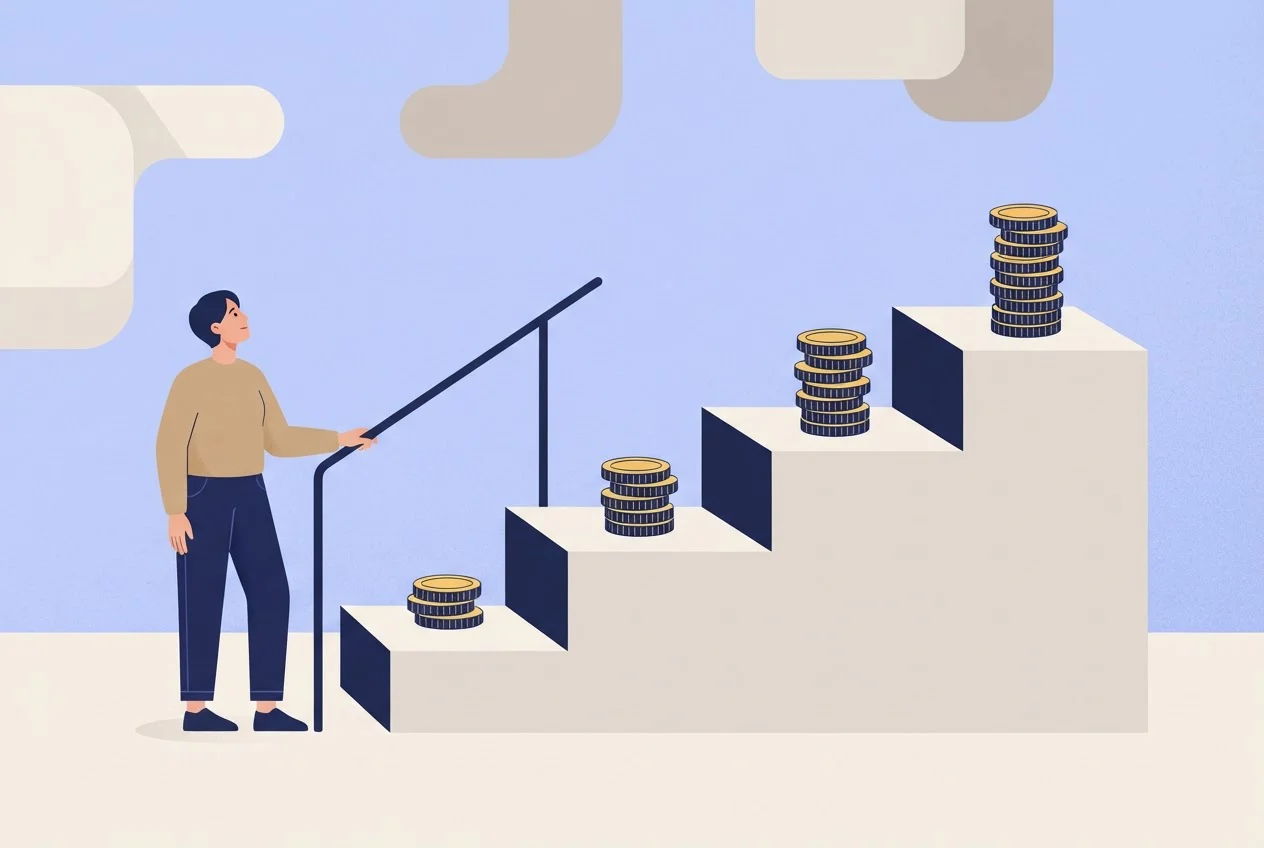
That pace is our recommendation. Large one-day jumps change delivery abruptly, and a Black Friday morning jump leaves no time to read the result. Step back if cost per purchase sits over your ceiling for two days in a row.
If the ceiling cannot take a 2x budget, spend less. A multiple is not a goal.
Are Black Friday clicks failing because of the ad or the store?
Compare with what Black Friday should look like, not with October. For consumer brands, purchases per click ran far above October on Black Friday (conversion rate +226% in Biddyco's data), so purchases per click at or below your October level means the problem is after the click: the landing page, the offer or checkout. A CTR drop of about 15 to 20% is plausible at peak (our inference above). A drop of more than 30% from your last 14 days, with frequency rising, signals wear-out.
Those thresholds are our rules of thumb. Small samples mislead. At a 2% conversion rate, 30 clicks are expected to give 0.6 purchases, so zero sales proves nothing. Wait for a few hundred clicks before calling a store broken, and make sure the landing page repeats the exact offer in the ad.
Which week after Cyber Monday costs consumer brands the most?
Among consumer brands in Biddyco's analysis, Dec 8 to 14 was the most expensive week per purchase: +39% against October, while CPM was only +6%. Black Friday week (Nov 24 to 30) was CPM +35% and cost per purchase -20%. Dec 22 to 28 was -26% and Dec 29 to Jan 4 was -24%.
Our inference is that shoppers are browsing for gifts rather than buying at Black Friday rates in mid-December; the data does not show why. The same analysis treats app and service accounts separately, and they behaved differently, so these weekly figures apply to consumer brands.
Most consumer brands will be above the 30% line in the second week of December (median +39%). Cutting prospecting then is intended; keep retargeting and restart prospecting in late December when costs fall.
How does Deepsolv build a Black Friday test queue?
We turn the two testing rounds into a ranked list. Our platform combines your ad-performance data, competitor activity, customer signals and past ad learnings into a ranked weekly creative test plan and execution-ready creative briefs. Round 1's six concepts come from that ranking, and round 1's results become the next week's learnings.
Our work ends before the budget decision. You still set the ceiling and the ramp. What we remove is guesswork about which six ideas to put into the first two weeks. To see it on your account, book a personalized demo with our founding team, and ask us about pricing there.
Build your Black Friday creative test queue with Deepsolv
Frequently asked questions
Black Friday converted better in Biddyco's data: cost per purchase was 42% below October on Black Friday and 32% below on Cyber Monday. Cyber Monday is the bigger spending day, though: Adobe recorded $14.25 billion online on Cyber Monday 2025 against $11.8 billion on Black Friday.
Sources
- 1.Meta Ads During Black Friday: What Happened to CPM and CPA in 2025 (Biddyco), Biddyco
- 2.Adobe: Cyber Monday hits record $14.25 billion in online spending, Adobe Analytics, December 2025
- 3.Meta publishes holiday marketing guides (Social Media Today), Social Media Today, August 2026