
ThruPlay on Meta: 6- vs 15-Second Counts, Cost, and Tests
ThruPlay on Meta counts a video play that reaches the duration chosen for the ad set: 15 seconds by default, 6 in Awareness and Engagement, or nearly all of a shorter video. It measures viewing, not buying, so use it to judge attention, not sales.

By Sachit Sharma, CEO & Founder · Updated 19 Nov 2026

Key takeaways
- Two ThruPlay numbers compare only when the duration (6 or 15 seconds), the denominator and the billing option all match.
- The 6-second goal is billed on CPM (cost per 1,000 impressions) only, so its cost per ThruPlay is a reported ratio, not a charge. The 15-second goal can also be billed per ThruPlay.
- ThruPlay is a delivery goal in Awareness and Engagement campaigns. Use it to judge attention, and use cost per purchase to judge sales.
- To test 6 against 15 seconds, change only the duration and let cost per purchase decide. If there are too few purchases to read, call the test undecided.
In this article
- 1What counts as a ThruPlay on Meta?
- 2The 15-second goal
- 3The 6-second goal (first reported Nov 16, 2026)
- 4Videos shorter than the threshold
- 5ThruPlay vs 3-second video plays: how do they differ from completions?
- 6Is ThruPlay a metric, a goal or a billing option?
- 7When is ThruPlay the right performance goal?
- 8What does a ThruPlay cost?
- 9Should you optimize for 6 or 15 seconds?
- 10When does ThruPlay mislead you?
- 11How do you test 6 seconds against 15?
- 12What should you check in your own account first?
- 13Why do data-backed creative decisions matter when Meta's metrics shift?
- 14Conclusion
- 15Frequently asked questions
Last checked: Nov 19, 2026
Two ad sets can report the same ThruPlay count and mean different things. ThruPlay on Meta now covers two thresholds, 15 seconds and 6, and Meta hasn’t said how reports in Ads Manager, its dashboard for building and reading ads, tell them apart.
So what a ThruPlay means depends on your settings. Two ThruPlay figures compare only when three things match: the threshold, the denominator (the number you divide by) and how the ad set is billed.
This guide is for paid social and creative teams who read ThruPlay numbers in Meta ad reports. It covers what counts as a ThruPlay, when it is the right goal, what it costs, when to pick 6 or 15 seconds, where the number misleads, and how to test the two settings against each other.
Our rule throughout: use ThruPlay to explain what viewers did, and cost per purchase to decide what to keep.
What counts as a ThruPlay on Meta?
A ThruPlay on Meta is a video play that reaches the duration chosen for the ad set: 15 seconds by default, 6 seconds if you choose the 6-second option, or nearly all of the video when it is shorter than that duration.
Meta's help page lists both the 6-second and 15-second goals, and PPC Land and JXT Group reported the new ThruPlay duration field in Ads Manager in mid-November 2026.
The 15-second goal
The 15-second goal is the default. Meta tries to show the ad to people likely to watch at least 15 seconds, and a ThruPlay is logged at that point, whether the video runs 20 seconds or 2 minutes. It is the only duration that can be billed per ThruPlay as well as on CPM.
The 6-second goal (first reported Nov 16, 2026)
The 6-second ThruPlay goal counts a play at 6 seconds, or nearly all of a shorter video. In Awareness and Engagement campaigns, the "Maximize ThruPlay views" goal shows a ThruPlay duration field with 6 and 15 seconds as choices, according to PPC Land's Nov 16, 2026 report on a LinkedIn post by Bram Van der Hallen.
Ads Manager describes the shorter length as a fit for Reels and Stories. We found no Meta announcement, and PPC Land notes the post gave no rollout date or market list.
Videos shorter than the threshold
On a video shorter than the chosen duration, a ThruPlay means the play covered nearly all of the video. That makes it close to a completion, which is why short ads reach it so easily; our hold rate page covers how to read the resulting rates.
ThruPlay vs 3-second video plays: how do they differ from completions?
A 3-second video play needs three seconds of playback, which autoplay can supply. A ThruPlay needs 6 or 15 seconds, or nearly all of a shorter video. A completion needs the end of the video.
| Measure | What Meta counts | What it tells you | Where it misleads |
|---|---|---|---|
| 3-second video play | 3 seconds of playback, or nearly all of a shorter video | The opening started a play | A play can start automatically, so a scroll-past can count |
| ThruPlay, 15-second goal | 15 seconds, or nearly all of a shorter video | Sustained viewing at a higher bar | On videos over 15 seconds it is not a completion |
| ThruPlay, 6-second goal | 6 seconds, or nearly all of a shorter video | A lighter form of sustained viewing | Not comparable with the 15-second count |
| Completion | A play to the video's full length | The whole message ran | Only the video's own length sets the bar |
Any ThruPlay rate also needs a stated denominator, because ThruPlays divided by impressions and ThruPlays divided by 3-second video plays give different percentages for the same ad; the formulas and a worked case are on our hold rate page and our hook rate formula page.
Is ThruPlay a metric, a goal or a billing option?
All three. ThruPlay is a count in reports, a performance goal that points ThruPlay optimization at people likely to watch, and, at 15 seconds only, a billing option. The goal and the billing choice are separate settings.
As of Nov 19, 2026, the two goals differ on ThruPlay billing:
| Goal | Billed on | Objectives |
|---|---|---|
| 15-second ThruPlay | CPM or per ThruPlay | Awareness and Engagement |
| 6-second ThruPlay | CPM only | Awareness and Engagement |
Source: ads.expert's ThruPlay glossary, checked Nov 19, 2026. Objectives are the goal you pick when creating a campaign; Meta's objective guide lists them.
When is ThruPlay the right performance goal?
Use the ThruPlay goal when watching is the job: a product demo, a creator explaining an offer, or a first introduction to a cold audience where the message needs time to land.
Meta describes the goal as reaching people more likely to watch your video, and offers it in Awareness and Engagement campaigns, so it asks Meta for likely watchers, not likely buyers.
If the campaign will be judged on purchases, our view is that ThruPlay belongs in the report as a diagnostic column, not as the performance goal.
What does a ThruPlay cost?
Cost per ThruPlay is amount spent divided by ThruPlays. Under CPM billing it is a reported ratio, not a charge, and it moves with the ThruPlay threshold, so a 6-second figure and a 15-second figure are different measures.
The example uses illustrative numbers, not account data. A 15-second ad set spends $600, serves 50,000 impressions and logs 3,000 ThruPlays. Our arithmetic:
- Cost per ThruPlay = spend ÷ ThruPlays = $600 ÷ 3,000 = $0.20.
- CPM = spend ÷ (impressions ÷ 1,000) = $600 ÷ 50 = $12.00.
- ThruPlay rate per impression = 3,000 ÷ 50,000 = 6%. Cost per ThruPlay = CPM ÷ (1,000 × rate) = $12.00 ÷ 60 = $0.20.
The second route shows what moves the cost: a higher CPM raises it, and a lower share of impressions reaching the threshold raises it.
Meta's own results show the CPM side moving: Meta's Q3 2026 results report that the average price per ad rose 14% year over year while ad impressions delivered rose 10%. That is a platform-wide average, not your CPM, so check your own CPM before blaming the creative when cost per ThruPlay rises.
Our inference: every play that reaches 15 seconds also passes 6 seconds, so with identical delivery a 6-second goal can only count the same number of ThruPlays or more. If 5,000 plays reached 6 seconds in the example, the same $600 would show $0.12 per ThruPlay.
That is a lower reported number from the same spend, not a better ad. Real ad sets won't deliver identically, because the goal changes who sees the ad, so the real gap can't be predicted from the count alone. Compare cost per ThruPlay only across ad sets with the same threshold and billing.
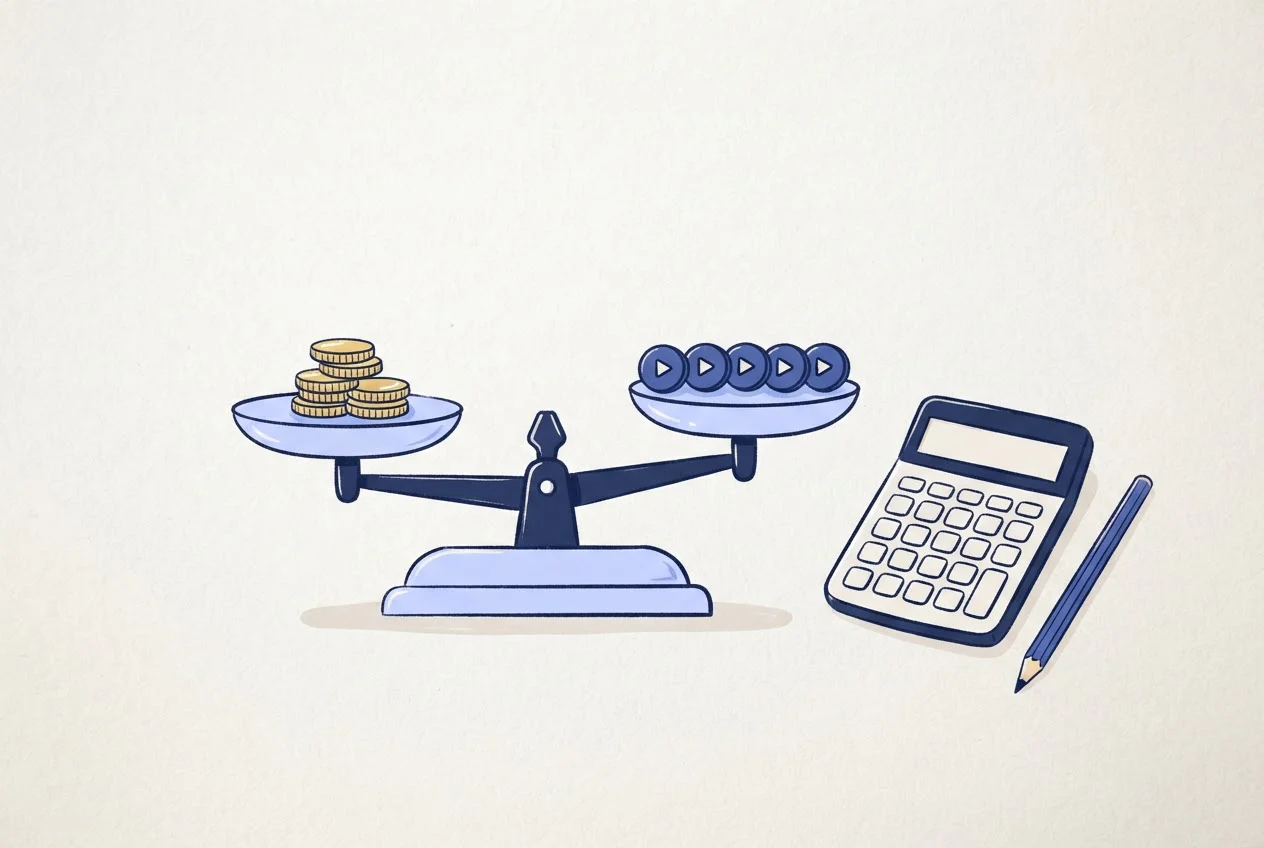
Should you optimize for 6 or 15 seconds?
Test it; don't assume. Ads Manager describes 6 seconds as a fit for Reels and Stories, and practitioners don't agree yet on when it fits. Treat each row below as a test, not a rule.
JXT Group suggests testing a 6-second ad set against a 15-second one and judging on reach and downstream results rather than cost per ThruPlay. Meta hasn't said how reports treat the 6-second view, including whether cost per ThruPlay follows the duration you select.
| Video length | Placement | What to test | What to check |
|---|---|---|---|
| Under 6 seconds | Reels, Stories | Probably little difference, since both durations count nearly all of the video (our inference) | Reach and cost per purchase, not the ThruPlay count |
| 6 to 15 seconds | Reels, Stories | A 6 second ThruPlay ad set against a 15-second one, same creative | Reach, cost per purchase, and whether the columns follow each ad set's duration |
| Over 15 seconds | Reels, Stories | The same pair; the 6-second set measures an earlier point in the video | Whether the extra plays turn into purchases |
| Over 15 seconds | Feed | Keep 15 seconds as the baseline and add 6 seconds only as a test ad set | Cost per purchase against the baseline |
When does ThruPlay mislead you?
ThruPlay misleads when you read it as buying intent, when short videos reach it at lower watch time, and when ad sets with different thresholds sit in one table. Each makes a cheap number look like a good ad.
Watchers are not buyers. A ThruPlay goal asks Meta to find people likely to watch. It says nothing about who buys, so a low cost per ThruPlay can sit beside a high cost per purchase. Our guide to attention versus conversion data covers which decisions each can carry.
Short videos finish easily. On the 15-second goal, a 10-second video reaches a ThruPlay after nearly all 10 seconds, while a 30-second video needs 15. Ranking ads of different lengths by ThruPlay rewards the shorter one.
Mixed thresholds blend two effects. A table that mixes 6- and 15-second ad sets, or compares before and after a switch, blends a change in viewing with a change in the bar. Meta hasn't said how billing or reports treat an account that mixes both.
How do you test 6 seconds against 15?
Duplicate one ad set, change only the ThruPlay duration, and let cost per purchase pick the winner. ThruPlay counts can explain the result; they shouldn't decide it.
- Pick a control: one creative that runs in Reels or Stories. Duplicate its ad set so placement, budget and creative match and only the duration differs. Run the pair through Meta's A/B test tool, or split non-overlapping audiences, so the two ad sets do not bid against each other. Give each the same budget and run both for the same dates. Our guide to choosing a control ad helps here.
- Name the threshold and denominator in every column, and compare only ads of similar length in one placement; our hold rate page shows the denominators.
- Compare reach, frequency and downstream results across the two sets. Do not compare ThruPlay counts or cost per ThruPlay across them, because the thresholds differ.
- Let cost per purchase decide. If either set logged too few purchases to read, call the test undecided; don't choose on cost per ThruPlay. Awareness and Engagement campaigns often log few purchases, so also track a downstream signal you can read (landing page views or add to carts) and label it as a proxy (our recommendation).
- Write one decision: the duration you keep, for which creative and placement, and the next test. Our guide to creative analytics versus test planning shows how to turn it into the next test.
What should you check in your own account first?
Five checks, each with a pass or a fail. Run them before you compare any two ThruPlay numbers.
Duration per ad set. Open each ad set's performance goal and read the ThruPlay duration field. Pass: every ad set in the comparison shows the same duration. Fail: any mix, or any ad set you can't read.
Objective. Pass: the campaign is Awareness or Engagement, where the ThruPlay goal is offered. Fail: any other objective; don't assume a 6-second setting exists.
Billing. Pass: each ad set's billing option is written beside its results, and no CPM-billed cost per ThruPlay is treated as a price charged. Fail: either is missing.
Columns. Pass: every ThruPlay column is named with its threshold and denominator. Fail: any column labeled just "ThruPlays".
Column behavior. Check whether the ThruPlay columns follow each ad set's selected duration. Pass: a label or Meta's help page says so. Fail: you can't tell, so compare on reach and cost per purchase only.
Why do data-backed creative decisions matter when Meta's metrics shift?
A count whose definition depends on a setting can't carry a decision alone; the decision needs downstream results and a recorded reason. That is the job of the Deepsolv Creative Intelligence platform.
We combine ad-performance data from a connected Meta Ads Manager account, competitor activity, customer signals and past ad learnings into a ranked weekly creative test plan and execution-ready creative briefs, with reasons for each recommendation.
Recommendations guide experiments; they don't guarantee profitable ads.
Conclusion
Treat every ThruPlay number as unfinished until it has a footnote. Before you compare two of them, write down the duration, the denominator and the billing option beside each one; if any of the three differs, the comparison isn't valid.
Then apply one rule: if cost per purchase has enough volume to read, it decides which ad set stays; if it doesn't, call the test undecided and run it longer rather than crowning the lower cost per ThruPlay. In the next 24 to 48 hours, open your video ad sets, record each one's ThruPlay duration, and flag any that mix the two.
That single audit tells you whether your current reports can be trusted while Meta's reporting of the 6-second view remains unexplained. To see how Deepsolv turns results like these into a ranked weekly creative test plan, book a demo with our founding team.
See what's working in your Meta creative, and what to test
Frequently asked questions
A ThruPlay is the same as a completion only on videos shorter than the chosen threshold, where the play must cover nearly the whole video. On longer videos it counts at 6 or 15 seconds, well before the end, so a high count does not mean viewers watched the video through; see Meta's ThruPlay help page for the 15-second definition.
ads.expert reports that replays within the same impression are not counted toward ThruPlay metrics, because Meta counts how much of the video played rather than elapsed time, so going back over the same seconds does not build a ThruPlay. Check Meta's ThruPlay help page before relying on it in a report.
Sources
- 1.About ThruPlay, Meta Business Help Center
- 2.How to choose the right ad objective in Meta Ads Manager, Meta Business Help Center
- 3.Six seconds can now count as a watched video ad on Meta, PPC Land, Nov 16, 2026
- 4.Google & Meta Ads Changes This Week (Nov 11-17, 2026), JXT Group
- 5.ThruPlay in Meta Ads: 6 and 15-Second Views, ads.expert
- 6.A Meta video "view" can be 3 seconds of autoplay, ads.expert
- 7.What Is ThruPlay?, OneCraft