Makeup Facebook Ads: Work Out Break-Even CPA First
Makeup Facebook ads pay off only when cost per purchase stays below order value times gross margin. Work that number out first, screen copy against Meta's rules, then rank your tests.

By Sachit Sharma, CEO & Founder · Updated 18 Nov 2026
Key takeaways
- A good cost per purchase for makeup Facebook ads is any figure below your break-even CPA: average order value multiplied by gross margin. Published benchmark CPA ranges cannot replace that number, because they ignore your order value and margin.
- Makeup is outside Meta's before-and-after image restrictions, but copy that tells the viewer what is wrong with their face is, in our view, the most likely cause of a rejected ad.
- No neutral source gives a clean video-versus-image split for makeup, so log your own competitors' ads for two weeks before you pick a format.
- Run the first four tests in this order: offer or order value, format, shade range, proof. Judge all four on one ratio: break-even CPA divided by actual CPA.
In this article
- 1What is a good cost per purchase for makeup Facebook ads?
- 2Why can't published benchmarks set your makeup ad target?
- 3What can makeup ads show on Meta, and which copy gets rejected?
- 4Which ad format should a makeup brand test first: video, image or UGC?
- 5What should a makeup brand's first four ad tests be?
- 6How does Deepsolv rank creative tests for makeup brands?
- 7Frequently asked questions
Most advice on makeup Facebook ads starts with the creative: film the swatch, hire a creator, show the application. Creative is the second decision. The first is arithmetic, and it decides whether any creative can pay for itself.
Makeup is a low-ticket category. A first order is often a single product at a modest price, so the profit on it is small, and an ad that wins that customer can cost more than the order earns. At e.l.f.'s $8 to $16 foundation prices (e.l.f. Cosmetics foundation page), a $15 order at a 71% gross margin (e.l.f. Beauty fiscal 2026 results) leaves $10.65 for acquisition. The check takes one line of arithmetic.
This page is for makeup brands buying Meta ads (the ad system behind Facebook and Instagram) at real budgets. It gives you a competitor tally to copy and one ratio, break-even cost per acquisition (CPA) divided by actual CPA, that judges every test the same way.
What is a good cost per purchase for makeup Facebook ads?
A good cost per purchase for makeup Facebook ads is any figure below your break-even CPA, which is your average order value (AOV) multiplied by your gross margin. CPA, cost per acquisition, is the ad spend it takes to win one customer's purchase. AOV is what a customer spends per order. Gross margin is the share of that revenue left after the cost of the goods.
Our model: break-even CPA = AOV × gross margin.
For margin, take e.l.f. Beauty, which reported a 71% gross margin for the twelve months to March 31, 2026 on net sales of $1,636.5 million (e.l.f. Beauty fiscal 2026 results, May 20, 2026). As of November 2026, its foundations list at $8 to $16, and orders of $35 or more ship free (e.l.f. Cosmetics foundation page). Applying the formula to order values at and around those prices:
| Order value (AOV) | Gross margin | Break-even CPA |
|---|---|---|
| $15 (one product) | 71% | $10.65 |
| $35 (the free-shipping line) | 71% | $24.85 |
| $50 | 71% | $35.50 |
| $70 | 71% | $49.70 |
Read it backwards to set a goal. To afford a $40 CPA at a 71% margin, your AOV must reach at least $56.34 ($40 ÷ 0.71). If you cannot move AOV, you must move the CPA, which is a creative and targeting problem.
Three limits apply. First, 71% is e.l.f.'s blended gross margin, which includes sales to retailers, so a brand selling only online should use its own figure. A direct-to-consumer (DTC) brand should use its contribution margin: revenue minus product cost, shipping, returns, fees and discounts. Replace 71% with your own margin after shipping, returns, payment fees and discounts. That figure is lower, so your real ceiling is lower than this table. Second, if customers reorder, you can accept a first-order CPA above break-even, but only up to the profit your own repeat data shows. Until you have that data, hold the line at first-order break-even. Third, the target return on ad spend follows from the same margin; our page on setting your ROAS line from margin covers it.
Why can't published benchmarks set your makeup ad target?
Published benchmarks cannot set your makeup ad target because a benchmark averages other brands' order values and margins, while your break-even CPA depends on yours. The same cost per purchase can be a profit for one brand and a loss for another.
Take an illustrative $20 CPA. On a $15 order at a 71% margin, break-even is $10.65, so each purchase loses $9.35. On a $50 order at the same margin, break-even is $35.50, so each purchase leaves $15.50 of headroom. The CPA is identical and the result is opposite.
A benchmark can tell you what other brands pay, never what you can afford. If your AOV is $30, a 71% margin leaves $21.30 for acquisition ($30 × 0.71). Then you do not have a benchmark problem; you have a pricing and bundling decision to make before any creative decision.
What can makeup ads show on Meta, and which copy gets rejected?
Makeup ads can show a full before-and-after look, because Meta's Health and Wellness advertising standard states that ads for "cosmetics, hair extensions, other similar cosmetic or non-permanent beauty products or digital editing apps aren't within scope of this policy" (Meta Transparency Center, Health and Wellness, last updated December 26, 2024, as of November 2026).
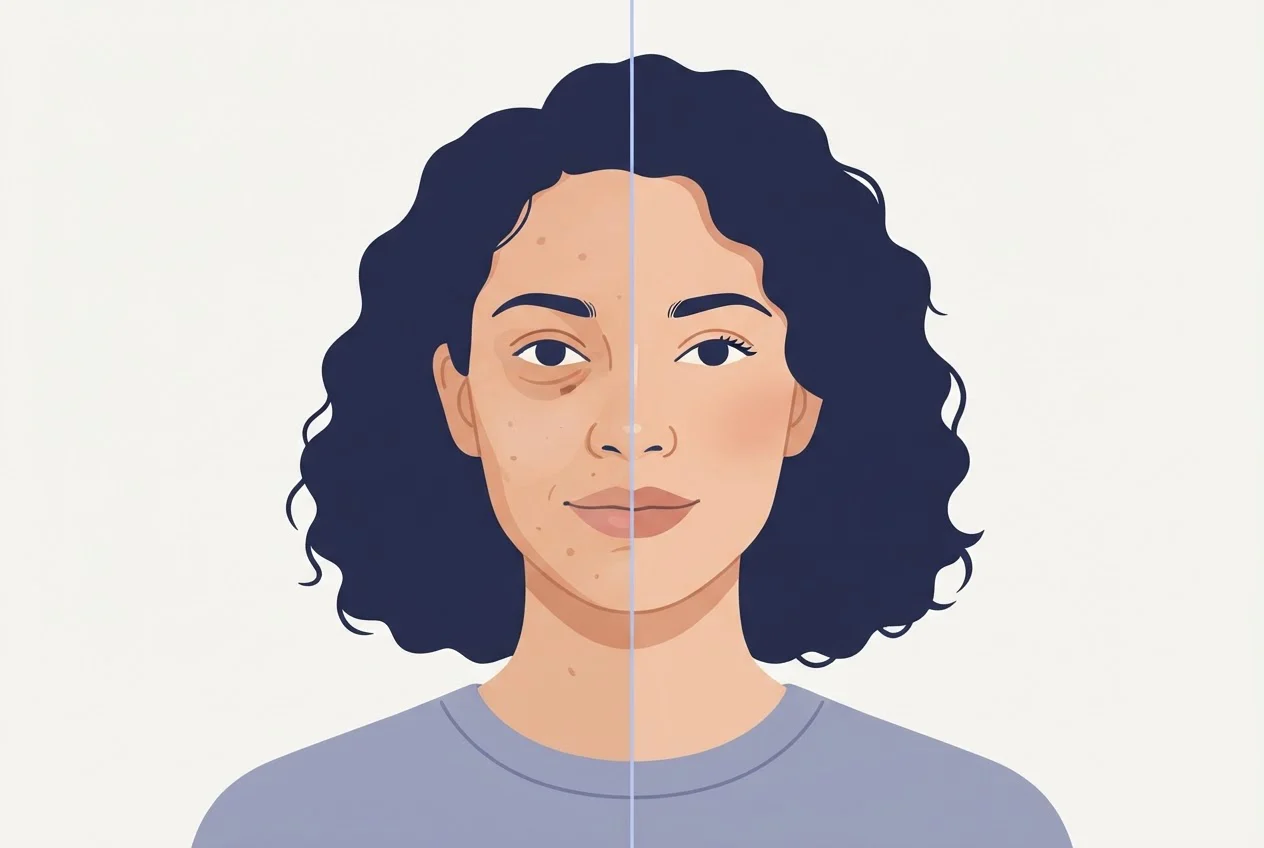
The risk sits in the words around the image. Meta's standard allows ads for cosmetics to display before-and-after transformation without employing negative self-perception tactics. Applying that test to your copy is our reading of that clause. Our recommendation is one test: the subject of the sentence should be the product or the look, never "you" plus a flaw.
| Risky wording (our examples) | Why it fails | Safer version |
|---|---|---|
| "Tired of looking tired?" | The viewer's face is the problem | "Concealer in [N] shades, shown on [shade]" |
| "Fix your dull skin" | Names a defect in the viewer | "A glow-finish skin tint, before and after, no retouching" |
| "Everyone wants flawless skin" | Sets one appearance to aspire to | "Medium coverage that lets freckles show" |
Pass: the sentence describes what the product does or looks like. Fail: it tells the viewer what is wrong with them. Rewrite every failed line.
Sun-protection claims are a separate test from copy wording, and a federal one. The US Food and Drug Administration (FDA) decides whether a product is a cosmetic or a drug by its intended use, and sun protection and acne treatment are on its list of claims that make a cosmetic a drug (FDA, "Is It a Cosmetic, a Drug, or Both?", updated September 11, 2024). Makeup marketed with sun-protection claims is therefore a cosmetic and drug product that must meet both sets of requirements. Our recommendation: leave the SPF claim out of the ad copy until a regulatory advisor has cleared it. Our hair care ads guide walks through that cosmetic-versus-drug screen. Our testimonial ads guide covers how to handle customer reviews in ads.
Which ad format should a makeup brand test first: video, image or UGC?
Test the format that two or more of your closest competitors are still running after two weekly checks, because no neutral source gives a reliable split for makeup. Two 2026 analyses of Meta's public ad archive disagree sharply. A Sprites.ai snapshot of 4,299 makeup creatives drawn from 179 brands and 43,955 active ads (October 5, 2026) puts video at 55%, carousel at 31% and static images at 14%. An Evolut hand-coded sample of 10 ads from each of 100 beauty brands chosen for creative testing volume (1,000 ads, published September 24, 2026) puts single images at 48.2%, video at 30.8% and UGC (user-generated content, meaning creator-style footage rather than studio work) at 21.0%.
The samples differ, one is makeup and one is all beauty, and they classify formats differently. Neither tells you what your competitors run, so count them yourself. The method needs only a spreadsheet and Meta's ad archive; our Facebook Ad Library guide explains what it shows for US commercial ads and what it hides. Copy these columns, one row per competitor ad:
| Brand | Ad link | Format (video, image, carousel, UGC) | Hook (first line or first three seconds) | Offer | Lightest and deepest shade on screen? (Y/N) | First seen | Still live at second weekly check? (Y/N) |
|---|---|---|---|---|---|---|---|
Check weekly for two weeks. Count a concept as a competitor pattern only when two or more brands run it and it is still live at your second weekly check; ignore the rest. Then use the first-seen column as a quick check: a pattern whose ads were first seen well before your first check has been running longer than your log covers, and one first seen during your log has only the two checks behind it. The shade column is our own addition. Makeup shoppers have to judge whether a product will suit their skin, so we would want to know whether competitors show their range before deciding to show ours. That is our inference, and the tally tells you whether it holds in your category.
To see where viewers look on a swatch or application shot before you spend, upload up to five images to our free attention heatmap; no signup.
For a faster first look, our US beauty trending-ads page lists live ads with Scaled, Rising and Long-running badges. It leans toward skincare, so use it for hooks and offers, not for a makeup format share.
What should a makeup brand's first four ad tests be?
Run offer or order value first, then format, then shade range, then proof. This is our recommendation, from the arithmetic above: the offer changes your break-even ceiling, while the other three only change how much you pay to reach it.
Judge every test on one ratio: break-even CPA ÷ actual CPA, using each variant's own AOV. Above 1.0, a first order pays for its ad. Same budget, same dates, one change per test. Our recommended rule for all four tests: let each variant reach at least 30 purchases or run 7 days, whichever is later. A variant passes only if its ratio beats the control's by 10% or more.
| Order | Test | Change only this | Pass if |
|---|---|---|---|
| 1 | Offer or order value | A set, bundle or free-shipping nudge against your current offer | The variant's ratio is above 1.0 and beats the control's by 10% or more |
| 2 | Format | Video, static image, or creator-style video, with the same hook and shade | The variant's ratio beats the control format's by 10% or more |
| 3 | Shade range | One shade on screen against the lightest and deepest side by side | The side-by-side ad's ratio beats the single-shade ad's by 10% or more |
| 4 | Proof | Real customer reviews against a product demo | The proof ad's ratio beats the demo ad's by 10% or more |
Fail: a variant within 10% of the control. Call that a tie and move to the next test instead of declaring a winner.
How does Deepsolv rank creative tests for makeup brands?
We rank makeup ad tests weekly from four inputs: your connected Meta Ads Manager performance data, competitor activity, customer signals, and what your past ads taught you. The output is a ranked weekly creative test plan with reasons for each recommendation, plus execution-ready creative briefs.
Customer signals come from product reviews, Instagram and Facebook comments and DMs, and Reddit. Shopify, Google Ads and Google Analytics also connect. For competitors, our proprietary modeling identifies winning ads and explains what makes them successful: hooks, messages, offers and formats, the same fields as the tally above, done continuously. We also explain why a test succeeded or failed and feed that into the next plan.
Recommendations guide experiments; they do not guarantee profitable ads. Your break-even CPA stays the pass line. We built the platform for mid-market and enterprise teams spending around $50,000 a month on Meta, and onboarding takes 1 to 2 weeks. To see how it works on a makeup brand, book a personalized demo with our founding team and ask us about Deepsolv pricing.
See how Deepsolv ranks makeup ad tests
Frequently asked questions
Sources
- 1.e.l.f. Beauty, Inc., "e.l.f. Beauty Announces Fourth Quarter Fiscal 2026 Results," May 20, 2026
- 2.e.l.f. Cosmetics foundation page, as of November 2026
- 3.Meta Transparency Center, Health and Wellness advertising standard
- 4.US Food and Drug Administration, "Is It a Cosmetic, a Drug, or Both? (Or Is It Soap?)"
- 5.Sprites.ai, makeup ads page
- 6.Evolut, "Beauty Advertising 2026"