Beverage Advertising on Meta: Pick Your First Test (2026)
Beverage advertising on Meta works best when it starts with a competitor read. Study rivals’ drink ads across five cuts, add your customers’ own words, then score each idea on four criteria. Test the top scorer first, without assuming any rival’s ad results.

By Sachit Sharma, CEO & Founder · Updated 16 Nov 2026

Key takeaways
Pick your first test with a score, not a hunch. Rate each idea from 1 to 5 on evidence strength, distinctness, product fit and production effort. Then test the top scorer, changing one variable at a time.
Treat ad age as a weak signal. Compare each rival’s days-run with that same rival’s own pattern. Then look for concepts that recur across several rivals.
Use two sources of evidence. Rival ads show what competitors chose to run. Reviews and comments show whether the same idea fits your buyers.
Substantiate every claim before it runs. If you borrow a health or function claim, you need your own evidence for it. Alcohol is a separate regulated category.
In this article
- 1What does beverage advertising on Meta cover, and what does this page leave out?
- 2Why should a drink brand read competitor ads before it tests?
- 3How do you run competitor ad analysis for beverage brands? Five cuts for drink ads
- 4Offer
- 5Angle and hook
- 6Format
- 7Landing page and CTA
- 8Creator share
- 9Put the five cuts on real rivals: a dated sample log
- 10Does a long-running drink ad mean it works? Why ad age alone is a weak signal
- 11How do customer reviews and comments improve a drink angle list?
- 12How do you rank a first beverage ad test? A scoring template
- 13What mistakes do drink brands make when copying competitor ads?
- 14What should a drink brand check on health claims and alcohol before running ads?
- 15Start with one hypothesis, not a bigger swipe file
- 16Frequently asked questions
A rival’s page in Meta’s Ad Library, the public database of ads running on Facebook and Instagram, can list dozens of active drink ads and still tell you nothing about what they earned. That gap is the central problem in beverage advertising on Meta. You can see what a competitor runs, how often it changes and where the button leads, but not what any of it returned.
So treat rival ads as evidence of what to test, not proof of what works. This guide gives you five cuts for reading drink ads, a way to read ad age against each rival’s own pattern, a method for adding customer language, and a scoring template that ends in one ranked first test. It is written for performance marketers and growth leads at non-alcoholic direct-to-consumer (DTC) drink brands, and the agencies that serve them.
What does beverage advertising on Meta cover, and what does this page leave out?
On this page, beverage advertising on Meta means paid Facebook and Instagram ads for non-alcoholic, direct-to-consumer drinks: energy, functional, sparkling, and coffee and tea. The broader query also covers television, outdoor, retail media and alcohol marketing. Those are left out. For packaged food and drinks together, see our glossary entry on Facebook ads for food; this page stays with non-alcoholic drinks.
Meta is the focus because a DTC drink brand can see rivals' live beverage ads there and test its own against them. Crowded claims such as less sugar, clean energy and gut health make the choice of concept matter more than the choice of budget.
Why should a drink brand read competitor ads before it tests?
A first test chosen without a competitor read is a guess, and guesses are costly when every idea needs new creative.
According to Circana's NCSolutions advertising research (May 2025), creative quality drives nearly half (49%) of the incremental sales that advertising delivers to consumer packaged goods brands, so the first concept you test deserves a real read.
More creative concepts. Creative fatigue is what happens when an audience has seen an ad so often it stops responding, so every active account needs a steady supply of new concepts, not only new edits of one. More distinct concepts means more learning per month, but only if each is genuinely different.
Decisions backed by evidence. Producing ads is now cheap and fast; choosing which to produce is the constraint, as our post on why knowing what ads to make is the hard part argues. A repeatable read of competitors, then of your own customers, turns "what shall we shoot next" into a ranked list with reasons.
How do you run competitor ad analysis for beverage brands? Five cuts for drink ads
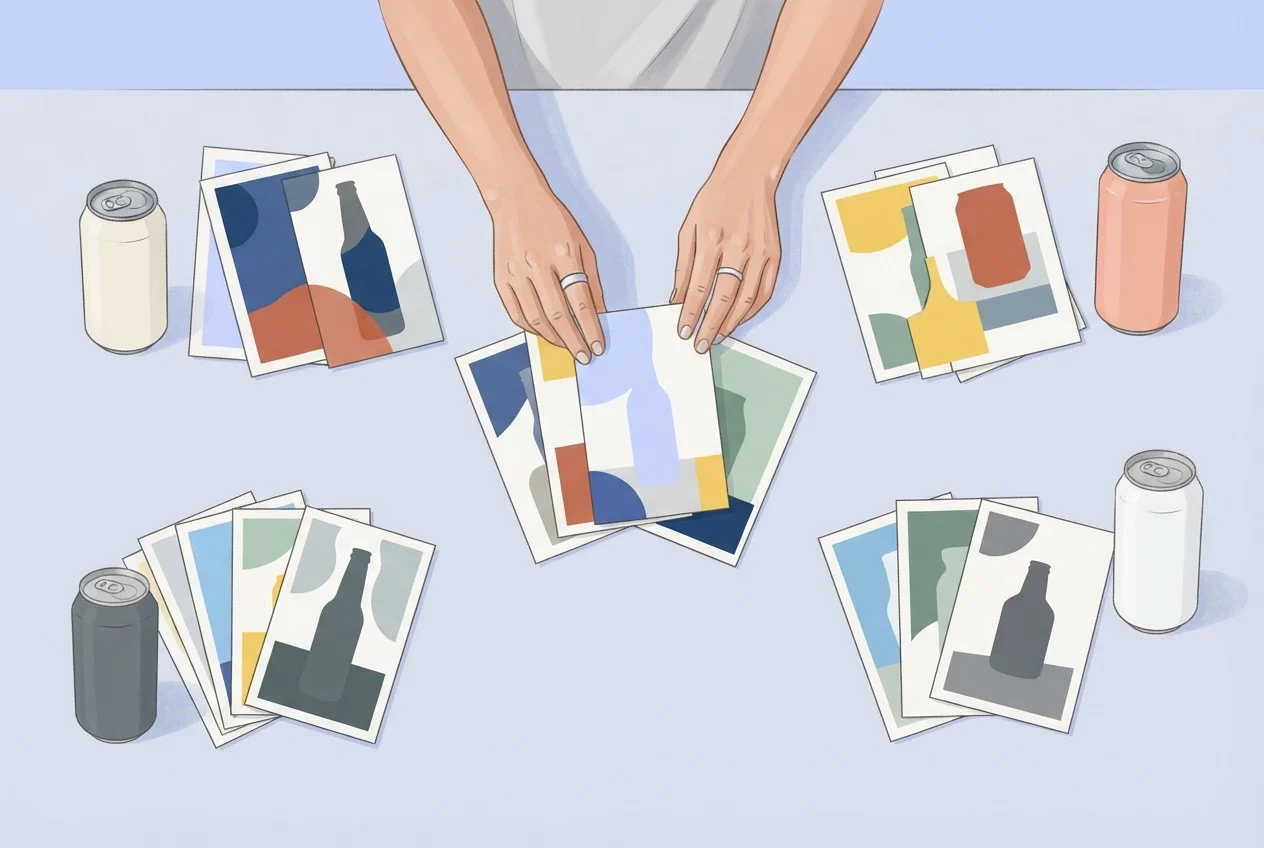
Read each rival's active ads on five cuts: offer, angle and hook, format, landing page and call to action (CTA), and creator share. Log what repeats across ads and rivals, not what looks best. For pulling the ads, use our guide to the Meta Ad Library; for the general steps, see our guide to competitor Facebook ad analysis.
| Cut | What to look for | Drink-specific question |
|---|---|---|
| Offer | Bundle size, variety pack, subscribe-and-save, first-order code, shipping threshold | Is the offer built for trial (variety pack) or repeat purchase (subscription)? |
| Angle and hook | The first line or first three seconds: problem, taste, function, identity | Which job does the drink claim: energy, calm, gut, hydration, soda swap or taste? |
| Format | Static, video or carousel; polished or creator-style; length | Is the drink shown being opened and consumed early, or is the can only displayed? |
| Landing page and CTA | Destination type, button label, whether the page repeats the ad's promise | Does the click go to a DTC checkout, a bundle, a quiz or a retailer page? |
| Creator share | Share of ads that are creator co-posts; type of creator | Is the creator a taste-tester, an athlete, a nutrition voice or a customer? |
Offer
Record the deal in each rival ad and the CTA, the button label under the ad, and whether the offer targets first or repeat purchase. Button labels differ from brand to brand. Our inference: a different button can mean a different route to purchase, so check where the click lands before copying.
Angle and hook
A hook is the first line or first three seconds of an ad. Beverage ad examples serve as pattern evidence only, so tag each rival ad by its lead promise:
- Energy drink ads: function (sustained energy, no crash, lower sugar) or identity (performance, lifestyle).
- Functional beverage ads: an ingredient or benefit explained, or taste first.
- Sparkling: soda swap, sugar comparison or flavor.
- Coffee and tea: replacing a routine, or an ingredient story.
Count how many rival ads share each tag; our list of hooks by psychological trigger helps name them.
Format
Log the static, video and carousel mix, and whether creative looks polished or creator-style. For what each of the Facebook ad formats involves and which to test first, see that page. Note whether the drink is opened, poured or consumed in the first seconds.
Landing page and CTA
Click through from each rival ad and note the destination: product page, bundle, quiz, store locator or retailer page. A first screen that echoes the ad suggests a deliberate concept; a generic page suggests an ad aimed at people who do not know the brand yet (a prospecting ad).
Creator share
Count creator or influencer co-posts against the rival's total active ads. Creator share varies from brand to brand, so treat each mix as that rival's habit, not a benchmark.
Put the five cuts on real rivals: a dated sample log
Run the five cuts on three named rivals before you trust any pattern. In Meta's Ad Library, set the country to United States, search each rival's Page, filter to active ads, and record up to 20 listings per rival on one dated day. Fill one row per rival.
| Rival Page | Listings sampled | Most common hook tag | Format mix | Offer type | Landing page type | Creator share |
|---|---|---|---|---|---|---|
[Rival 1] | [n] | [tag] | [static / video / carousel] | [trial / subscription] | [product / bundle / quiz] | [share of listings] |
[Rival 2] | [n] | [tag] | [static / video / carousel] | [trial / subscription] | [product / bundle / quiz] | [share of listings] |
[Rival 3] | [n] | [tag] | [static / video / carousel] | [trial / subscription] | [product / bundle / quiz] | [share of listings] |
Sample pulled [date] from Meta's Ad Library, United States, active ads only. Counts describe what rivals ran, not what the ads earned.
Read the table by rows first, then by columns. A tag or offer that appears in two or more rows is a candidate concept; one that appears in a single row is that rival's habit.
Does a long-running drink ad mean it works? Why ad age alone is a weak signal
No. Days running shows that an advertiser kept an ad live, not that it was profitable. For commercial ads delivered in the United States, the public Ad Library shows no spend, ROAS (return on ad spend) or CPA (cost per acquisition), and no targeting detail. For EU-delivered ads it shows location, age and gender targeting and reach, but still no spend or results. Ad age is a reason to look closer, nothing more; our post on whether long-running ads are profitable makes the longer argument.
Rivals also differ in how long they leave ads up, so a single threshold across rivals measures rival habits, not ad quality. Two further cautions:
- A start date belongs to one listing, not one idea. A refreshed creative appears as a new listing, so a young ad can carry an old concept.
- A Mozilla Foundation and CheckFirst audit, published in April 2024, found many cases where ads visible in the interface were missing from the ad libraries it tested, which included Meta's; check the library's current coverage before relying on counts.
Run this within-brand check (the thresholds are our recommendation):
- Pull 3 or 4 rivals' active ads.Pass: at least 20 listings per rival with start dates recorded. Fail: fewer, so use that rival for angle reading only.
- Compute each rival's own median days running.Pass: the ad runs longer than its own brand's median. Fail: shorter.
- Group passing ads into concept families (same promise, hook or offer).Pass: the family has at least two listings or refreshed versions. Fail: a single listing with no variants.
- Compare across rivals.Pass: the family appears at two or more rivals. Fail: one rival only, so treat it as that rival's habit.
How do customer reviews and comments improve a drink angle list?
Customer reviews and comments show the words your buyers already use for taste, function and occasion, so you can check a rival's hook against your own customers before you commit. Use them as an input that adjusts scores, never as a substitute for the competitor read.
Pull reviews of your product and comments on your own ads. Tag recurring words under four headings: taste, function, occasion and objection. Then mark which rival hooks match a tag. A rival angle that your customers also describe in their own words earns a higher evidence score; one that no customer mentions scores lower. For the next step, turning customer reviews into ad tests goes deeper on testimonial-style ads.

How do you rank a first beverage ad test? A scoring template
Score each candidate idea 1 to 5 on four criteria, apply the weights, and test the highest score first on one variable. The weights below are our recommendation, not an industry standard.
OBSERVE            PATTERN              HYPOTHESIS             RANKED TEST
rival ads    -->   what repeats    -->  "If we lead with  -->  score 1-5 on four
customer words     across rivals and    X, then Y, because     criteria, test the
                   in customer words    Z"                     top score
| Criterion | Weight | 5 means | 1 means |
|---|---|---|---|
| Evidence strength | 35% | Concept repeats at three or more rivals over four or more weeks and matches customer words | Seen once |
| Distinctness | 25% | Nothing like it in your last 20 ads | Near copy of your current best ad |
| Product fit | 25% | You can show it in the product and substantiate any claim | A claim you cannot support (disqualify) |
| Production effort | 15% | Static or existing footage, done in a day | New shoot with multiple approvals |
Weighted score = 0.35 × evidence + 0.25 × distinctness + 0.25 × fit + 0.15 × effort, out of 5.
Hypothetical example, with invented scores. A sparkling prebiotic soda brand scores four ideas:
| Idea | Evidence | Distinct | Fit | Effort | Score |
|---|---|---|---|---|---|
| Creator taste test | 5 | 2 | 5 | 3 | 3.95 |
| Gut-health explainer carousel | 3 | 4 | 4 | 5 | 3.80 |
| Soda-swap comparison static | 4 | 3 | 4 | 4 | 3.75 |
| "Replace your 3pm soda" ritual video | 2 | 5 | 3 | 2 | 3.00 |
The top three sit within 0.20 of each other, which hand scoring cannot reliably separate. Take the leader as the first test, queue the next two, and keep the fourth on a watchlist because it is distinct but thinly evidenced. The explainer's fit score of 4 holds only if the gut-health claim is substantiated (see below). The scores rank what to test, not what will win.
Write the hypothesis in one line before production: "If we lead with [angle] for [audience], we will compare [metric chosen in advance] against [current best ad], because [evidence]." Fix one attribution window for each creative test so the metric stays comparable. This is the logic of ad creative intelligence.
What mistakes do drink brands make when copying competitor ads?
The common mistake is copying a rival's surface instead of its reasoning.
- Copying a static-only system from a brand with a different audience. Do instead: check who the rival sells to and by what route, then test your own format mix.
- Copying an offer built for another sale route. Do instead: click through first and match the offer to your route.
- Copying a health claim you cannot support. Do instead: restrict yourself to claims with your own substantiation.
What should a drink brand check on health claims and alcohol before running ads?
Check that every health or body-function claim in an ad has evidence behind it before the ad runs, and treat alcohol as its own regulated category. This is not legal advice; confirm specifics with qualified counsel.
Health and function claims. As of November 2026, the Federal Trade Commission (FTC) health products guidance applies its substantiation standard to foods, dietary supplements, drugs and other health-related products. It states that "before disseminating an ad, advertisers must have adequate substantiation for all objective product claims" it conveys. See the FTC's health products compliance guidance; the underlying rule is Section 5 of the Federal Trade Commission Act. Claims such as "gut health" or "focus" are the ones to check first.
Alcohol. This page excludes alcohol. The Alcohol and Tobacco Tax and Trade Bureau (TTB) regulates alcohol advertising under Title 27 of the Code of Federal Regulations, which covers "any written or verbal statement, illustration, or depiction ... in, or calculated to induce sales in, interstate or foreign commerce"; the TTB advertising page says this applies in any media, including social networks. Meta's own alcohol ad policy requires compliance with local laws, industry codes, licenses and approvals, and bars targeting anyone under 18 at a minimum.
Start with one hypothesis, not a bigger swipe file
One ranked hypothesis, chosen with evidence, will teach you more than a larger folder of saved rival ads. Use three rules. If a concept repeats at two or more rivals and your customers describe it in their own words, score it first. If a rival's concept has no echo in your reviews and comments, keep it on a watchlist, not in the test queue.
If an idea needs a health claim you cannot substantiate, drop it, whatever its score. Then fix the metric and attribution window before launch, so even a flat result tells you something. In the next 48 hours, pull 20 active listings from three rivals and fill in the five-cuts table.
See how Deepsolv helps you understand what's working, why it's working, and what to test next. Book a demo with our founding team. Our recommendations guide experiments; they do not guarantee profitable ads.
Turn competitor ads into a ranked weekly test plan
Frequently asked questions
Sources
- 1.Meta, About the Meta Ad Library
- 2.Mozilla Foundation and CheckFirst, Full Disclosure: Stress testing tech platforms' ad repositories, April 2024
- 3.Federal Trade Commission, Health Products Compliance Guidance
- 4.Federal Trade Commission, Federal Trade Commission Act
- 5.Alcohol and Tobacco Tax and Trade Bureau, Alcohol Beverage Advertising
- 6.Meta, Advertising Standards: Alcohol
- 7.Circana, See How Mars' AI-Led Digital Strategy is Leveling Up Creative Quality, May 2025