Deepsolv Blog
Deepsolv Blog
Backed by






Creative Decision Intelligence for Meta growth teams. Know what to test next — before you spend on it.
Follow Deepsolv on InstagramFollow Deepsolv on LinkedInFollow Deepsolv on TwitterAll rights reserved © 2026 deepsolv.ai
5 min read
Published: 1/8/2026
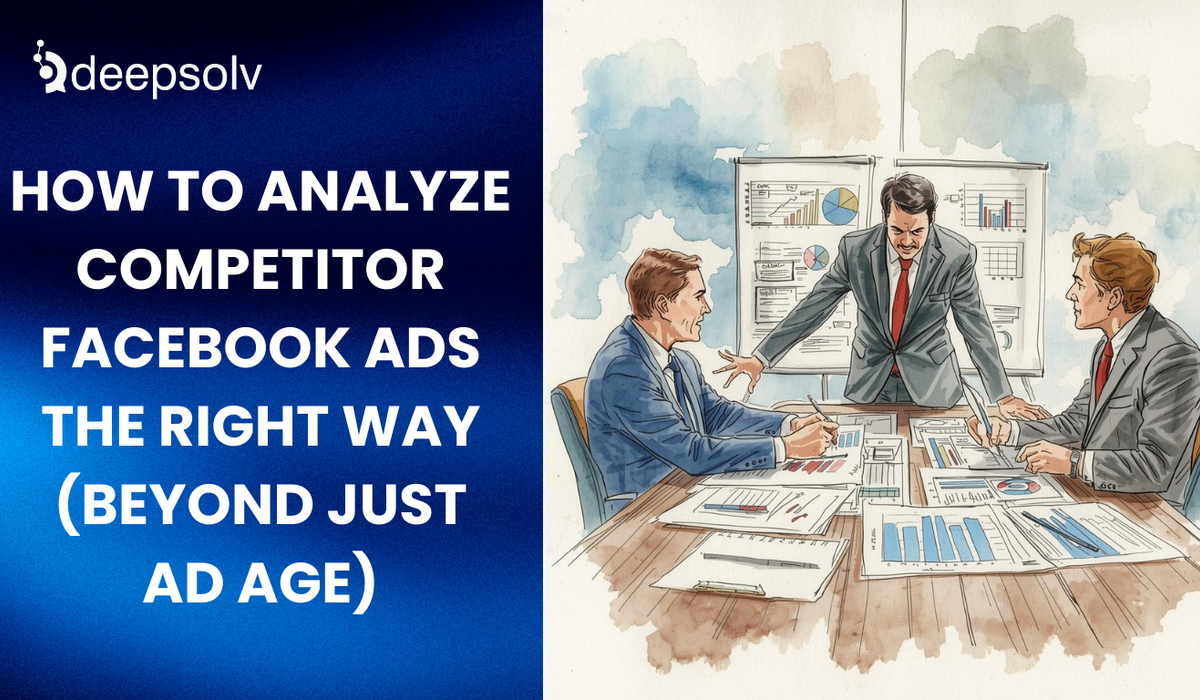
If you are analyzing competitor Facebook ads by scrolling the Ads Library, sorting by “active,” and screenshotting the oldest creatives, you are not doing competitive research.
You are collecting artifacts.
In 2026, that approach is not just shallow. It is actively misleading.
The Facebook Ads Library gives visibility, not understanding. And yet, most brands still treat it like a cheat code for performance, hoping ad age alone will reveal what is working.
It will not.
This blog breaks down how to analyze competitor Facebook ads the right way, what most brands get wrong, and how modern teams go beyond ad age to extract real, usable intelligence.
The default workflow looks something like this:
This feels productive. It is also lazy analysis.
The problem is not that brands look at competitor ads. The problem is what they think those ads represent.
Ads are not answers. They are signals.
Without context, those signals are easy to misread.
Ad age feels powerful because it implies survival.
“If an ad is still running, it must be profitable.”
But as discussed in the previous article, ads stay live for many reasons:
Longevity without interpretation tells you nothing about:
Analyzing competitor Facebook ads starts where ad age ends.
The first thing smart teams look at is not how old an ad is, but how much creative experimentation surrounds it.
Ask:
For example, when brands like Ridge Wallet find a message that works, they do not freeze. They rotate creators, visuals, and contexts aggressively while keeping the message intact.
That pattern tells you far more than ad age ever will.
A common trap in Facebook ads competitor analysis is obsessing over likes and comments.
Volume is cheap. Intent is rare.
When analyzing competitor ads, scroll the comments and ask:
Brands that understand this treat comment sections as intent data, not vanity metrics.
The Ads Library does not show spend, but behavior leaves clues.
Things to watch:
These patterns usually indicate:
On the other hand, a single ad running quietly with no variation often indicates controlled or limited scale.
Understanding how ads are deployed matters more than how long they exist.
Competitor ad analysis is incomplete without looking beyond the ad.
Click through (where possible) and observe:
Strong brands maintain message match: What the ad promises is exactly what the landing page delivers.
Weak funnels feel stitched together. That usually means the ad is not the true growth driver.
Not every competitor ad is designed to sell immediately.
Before copying anything, ask:
For example:
Context matters. Category matters. Audience maturity matters.
Let’s call these out clearly.
What works for them may fail for you due to brand trust, pricing, or audience sophistication.
A DTC skincare ad behaves differently than a SaaS or services ad.
Visuals are the least transferable part of an ad.
The real value lies in:
In 2026, the most advanced teams treat ads as behavioral evidence.
They ask:
This is where analysis moves beyond observation.
This is exactly where Deepsolv becomes relevant.
Instead of stopping at visibility, Deepsolv helps brands:
By automating comment analysis and response, Deepsolv turns competitor ads into living datasets, not static screenshots.
Brands no longer ask: “What ad should we copy?”
They ask: “What behavior should we respond to?”
That shift changes everything.
Anyone can see ads.
Very few can interpret them well.
In 2026, competitive advantage comes from understanding:
Ad age is a starting point.Conversation is the truth.
Analyzing competitor Facebook ads the right way is not about being clever.
It is about being honest.
Honest about what you know.Honest about what you do not.Honest about what signals actually matter.
If you are serious about growth, surface-level ad spying is not enough.
👉 Start a free Deepsolv trial and see how engagement intelligence helps you move from copying ads to understanding what actually drives conversions.