
Glossary
Facebook Ads for Food
Facebook ads for food are Meta ads that sell food or drink. For packaged brands, rank angles by rival breadth, customer signal, proof and claim risk, then test the top two.

By Sachit Sharma, CEO & Founder · Updated 23 Oct 2026
On this page
- 01Definition
- 02What are Facebook ads for food, and which kind does this page cover?
- 03Why are rival food ads weaker evidence than they look?
- 04How do you rank food ad angles before you spend?
- 05What can a food ad say without being rejected or misleading?
- 06How Deepsolv handles it
- 07Example
- 08Related terms
- 09Frequently asked
What are Facebook ads for food?
Facebook ads for food are paid Meta ads, shown on Facebook and Instagram, that sell food or drink.
Key takeaways
- Rank each angle on four scores (rival breadth, customer signal, proof you hold, claim risk), then test the top two against each other.
- Count distinct ads and distinct brands, not listings, because brands run the same ad several times.
- A feed's tags measure impression rank, not payback, so they cannot rank angles by profit.
- Check any health wording against Meta's health policy and the US Food and Drug Administration (FDA) definition of "healthy" before an angle goes into a test.
Many people who search this phrase run restaurants and want local orders. This page is for the other reader: a brand that sells packaged food or drinks online and has to decide which message to show strangers first.
The usual shortcut is to open a rival's public ad listing and copy whichever ads have run the longest. It feels like evidence. A listing only shows that a rival is running an ad. It does not show whether that ad pays back.
The sheet below turns rival ads and customer comments into one ranked first test. It is short enough to fill in during an afternoon.
What are Facebook ads for food, and which kind does this page cover?
A restaurant uses them to bring people through the door. A packaged food or beverage brand uses them to sell online. This page covers the second kind. Its central term is the angle: the reason to buy that an ad leads with, such as protein content, a price drop or a comparison.
Why are rival food ads weaker evidence than they look?
A rival's listing shows what it is running, not what it earned, and counting listings overstates activity because brands run the same ad several times.
As an illustration, a public trending-ads feed for Food & Beverages (Meta ads from India, last updated October 21, 2026) was read on October 23, 2026: the first 37 of its 40 cards, in page order, all from two brands, Two Brothers Organic Farms and The Whole Truth Foods. Listings with the same first 60 characters of text counted as one ad, and one reader tagged each ad with one angle.
The feed labels each ad with a tag, defined by impression rank. Scaled means the ad is placed highest in Meta's impressions ordering. Rising means it is gaining impression rank fastest, counting only ads already in the top 40%. Long-running means it has held the top 40% by impression rank on every daily check for 30 days. These tags describe how Meta's impressions ordering places an ad, not whether it paid back, so they cannot rank angles by profit.
- 11 of the 37 listings (30%) repeated an ad already counted, leaving 26 distinct ads.
- 33 listings were tagged Scaled, 2 Rising (cards 1 and 8) and 2 Long-running (cards 9 and 24). 89% of the set shares one tag.
Creator formats and comparisons look twice as common by listing as they are by distinct ad. This sample is two brands in one market on one day, so it demonstrates the method, not a US pattern.
A peer-reviewed comparison of Facebook's own large field experiments warns that observational estimates of ad effects can be severely biased. The study concerns measuring a brand's own ad effects, not reading rival listings, but it shows why exposure alone is weak evidence. The inference is that a rival's visible ads should seed a test and never replace one. A guide to turning competitor research into testable briefs covers the wider process, and the Meta Ad Library entry covers what the public listing can and cannot tell you.
- Angle
- Functional benefit (protein, low glycemic index, immunity)
- Listings (of 37)
- 8
- Distinct ads (of 26)
- 8
- Angle
- Price or offer
- Listings (of 37)
- 7
- Distinct ads (of 26)
- 6
- Angle
- Creator, recipe or humor
- Listings (of 37)
- 6
- Distinct ads (of 26)
- 3
- Angle
- Comparison or claim challenge
- Listings (of 37)
- 6
- Distinct ads (of 26)
- 3
- Angle
- Restock or seasonal
- Listings (of 37)
- 4
- Distinct ads (of 26)
- 2
- Angle
- Taste or ingredient proof
- Listings (of 37)
- 3
- Distinct ads (of 26)
- 2
- Angle
- Heritage
- Listings (of 37)
- 1
- Distinct ads (of 26)
- 1
- Angle
- No text captured
- Listings (of 37)
- 2
- Distinct ads (of 26)
- 1
How do you rank food ad angles before you spend?
Rank angles with a four-score sheet: tally distinct rival ads, tally your own customer comments, then score each angle out of 8 and test the top two.
Four scores that rank each ad angle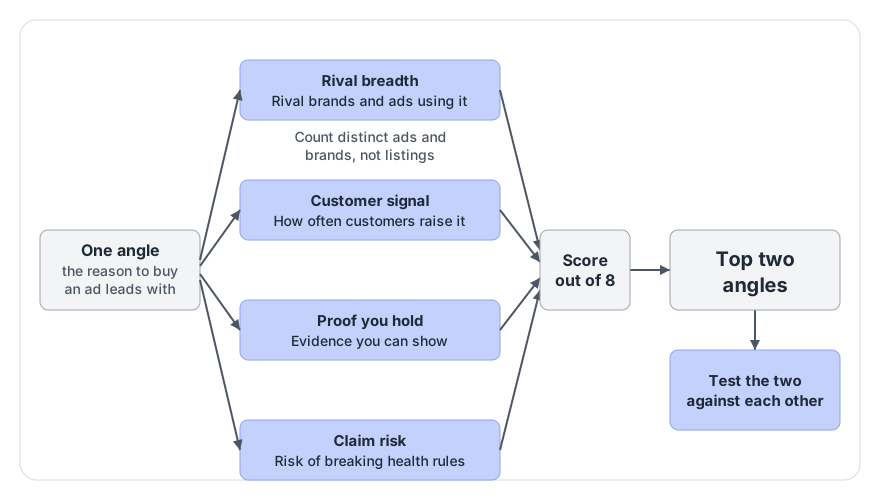
- Pull active ads from 3 to 5 direct rivals. Pass: at least 3 brands.
- Merge ads with identical opening text. Record distinct ads only. This stops one brand's repeated ad from inflating how committed that brand looks, which the breadth score below measures. Pass: no two rows share the same first 60 characters.
- Tag each ad with one angle: functional benefit, price or offer, comparison, taste or ingredient proof, creator or recipe, restock or seasonal, heritage. Pass: every ad has exactly one angle.
- Tag your last 100 reviews, comments and messages with the same list, using the reason the customer gives. Review mining explains how to collect them with permission. Pass: 100 items tagged, each with one reason.
- Score each angle (table below).
These thresholds are a recommendation, not an industry standard. Break ties on claim risk first, then customer signal.
- Test the top two against each other, changing one variable. Write one test card: observed pattern, hypothesis, creative variable, success measure, and the rule for stopping or scaling. A creative brief template can be built around exactly this card.
- Score
- Rival breadth
- 0
- One brand
- 1
- Two brands, or fewer than 3 distinct ads
- 2
- Three or more brands and 3 or more distinct ads
- Score
- Customer signal
- 0
- Fewer than 3 mentions per 100
- 1
- 3 to 9
- 2
- 10 or more
- Score
- Proof you hold
- 0
- You have no proof to state or show
- 1
- You can state it but not show it
- 2
- You can show it on screen (label, photo, test result, review)
- Score
- Claim risk
- 0
- Health outcome, timeframe promise or unchecked "healthy"
- 1
- Nutrient or ingredient fact checked against the label
- 2
- No health claim
What can a food ad say without being rejected or misleading?
Avoid health outcomes and timeframe promises, and check any "healthy" wording against the FDA's definition. Meta's health and wellness policy, updated July 22, 2026, limits dietary and weight-loss product ads to people 18 and older and prohibits "promises of specific outcomes within a set timeframe without disclaimers or qualifiers."
The FDA announced its final rule on the "healthy" claim on December 19, 2024. A food must contain a certain amount of food from at least one food group and stay within limits for added sugars, saturated fat and sodium. As of October 2026, the FDA's "healthy" rule has been effective since April 28, 2025, and food labels must comply by February 25, 2028, according to the Federal Register notice. The recommendation: score an angle 1 on claim risk only after the wording has been compared with the label. The supplement ads guide explains how Meta, the Federal Trade Commission (FTC) and the FDA each treat claims.
How Deepsolv handles it
Deepsolv's Creative Intelligence platform combines ad-performance data, competitor activity, customer signals and past ad learnings into ranked weekly test plans and execution-ready creative briefs. The sheet above is a manual way to do something similar. See its pricing, or book a demo with the founding team.
Example
An angle such as protein content scores 2 on rival breadth if three or more brands run it in 3 or more distinct ads. It scores 2 on customer signal if 10 or more of your last 100 comments give it as the reason, 2 on proof if you can show the label on screen, and 2 on claim risk if the ad makes no health claim. That adds up to 8 out of 8, so it goes into the test.
Frequently asked
Sources
- 1.Trending ads, Food & Beverages feed (India), updated October 21, 2026
- 2.Gordon, Zettelmeyer, Bhargava and Chapsky, "A Comparison of Approaches to Advertising Measurement: Evidence from Big Field Experiments at Facebook," Marketing Science 38(2), 2019
- 3.Meta Advertising Standards: Health and Wellness, updated July 22, 2026
- 4.FDA: Use of the "Healthy" Claim on Food Labeling
- 5.Federal Register: Food Labeling, Nutrient Content Claims, Definition of Term "Healthy," February 25, 2025