

TL;DR
We use early hook, hold, click, and cost signals to diagnose what an ad is doing, but we use conversion rate, CPA, and ROAS to make budget decisions. This guide gives paid-social teams account-specific evidence floors, a three-path diagnostic, a continue-revise-stop scorecard, and a seven-field memory template that preserves learning from every Meta hook test.
Meta Hook Testing: Hook Signals vs. Conversion Data
Meta’s ad-ranking systems continue to change. In Q4 2025, Meta reported a 3.5% lift in Facebook ad clicks and more than a 1% conversion gain on Instagram, which makes fixed creative benchmarks especially unreliable.
Meta hook testing should use early video and click signals to diagnose attention, but it should use conversion rate, CPA, and ROAS to make budget decisions. A weak opening can still produce efficient buyers, while a high-performing hook can conceal a mismatched message, weak offer, or obstructed landing page.
This guide shows which metrics belong at each funnel stage, how to set evidence floors, and how to preserve learning before another losing test consumes budget.
Which Meta Hook Testing Metrics Diagnose Attention and Which Prove Profitable Action?
The practical distinction is simple: early metrics tell us where an ad may be failing. Downstream metrics tell us whether it is earning the right to keep spending. Treating those jobs as interchangeable is how teams pause a viable angle or keep funding an expensive curiosity.
| Metric | Meaning | Earliest Useful Read | Limitation | Permissible Decision |
|---|---|---|---|---|
| Hook rate | Three-second video views divided by impressions | Early delivery | Teams must define it consistently | Revise the opening |
| Hold rate | Retained viewing after the opening | Early delivery | Calculation can vary by video length | Revise pacing or structure |
| Link CTR | Link clicks divided by impressions | Early delivery | Click intent is not purchase intent | Diagnose message appeal |
| CPC | Spend divided by clicks | Early delivery | Auction conditions can move it | Diagnose click efficiency |
| Conversion rate | Conversions divided by eligible clicks | After conversion data arrives | Includes site and offer effects | Diagnose post-click fit |
| CPA | Spend divided by conversions | After the evidence floor | Attribution is not incrementality | Continue, revise, or stop |
| ROAS | Attributed revenue divided by spend | After revenue is recorded | Depends on attribution settings | Continue, revise, or stop |
Meta’s metric glossary defines CTR, CPC, and ROAS in the same funnel logic. We use hook rate and hold rate as declared operating definitions, not as universal platform standards.
What Hook Rate and Hold Rate Can Reveal
A weak hook rate suggests the first moments are not earning attention from the audience receiving the ad. A weak hold rate suggests the opening earned curiosity but failed to sustain it. Neither finding proves that the angle is commercially dead.
What CTR and CPC Add
CTR and CPC tell us whether the message can earn a visit efficiently. They are useful when comparing a new opening against a matched control, especially when the landing page and offer stay unchanged. Our angle performance tracking approach keeps that comparison tied to the creative idea, not a blended campaign average.
Why Conversion Rate, CPA, and ROAS Own the Budget Decision
Conversion rate tests the continuity between promise and purchase. CPA tests whether the conversion cost fits the account’s economics. ROAS tests whether attributed revenue supports the spend. Those outcomes belong in the final decision because they are closest to profitable action.
Should Hook Rate or Conversion Data Decide a Meta Test?
Conversion data should decide the final budget action, while hook and click signals should decide what to investigate. A high CTR can mean an excellent promise, an overly broad promise, or a message that creates curiosity without qualified intent.
There is no defensible universal rule such as “pause every ad below a particular CTR.” NIST guidance explains that an experiment’s required sample depends on the baseline rate, meaningful change, significance level, and desired power. Those inputs differ across accounts.
| Decision Rule | Best Use | Can Decide | Cannot Decide |
|---|---|---|---|
| Attention-led | Video opening diagnosis | Whether to revise the first seconds | Whether to stop a profitable angle |
| Click-led | Message and CTA diagnosis | Whether the ad earns efficient visits | Whether the offer converts profitably |
| Conversion-led | Budget allocation | Whether to continue, revise, stop, or scale | Whether results are incrementally caused without a lift study |
Use a matched test control whenever possible. Keep the objective, audience context, offer, landing page, attribution setting, and primary event stable, then change one meaningful creative variable.
When Has a Meta Test Earned a Continue, Revise, or Stop Decision?
A test earns a decision when the team set the decision conditions before launch and the relevant evidence has arrived. That means defining the control, baseline, primary outcome, evaluation window, acceptable loss, and the minimum change worth detecting.
For controlled A/B testing, a Meta workshop recommends at least seven days, with longer windows for longer consideration cycles. That is a planning floor, not permission to ignore a clear tracking failure.
Set Account-Specific Baselines
Build baselines from comparable delivery conditions: prospecting versus retargeting, placement mix, creative format, objective, attribution setting, and offer. A product launch with a new price or landing page is not a fair benchmark for a mature evergreen campaign.
Use Evidence Floors Before Making Outcome Calls
| Decision | Evidence Floor | Action |
|---|---|---|
| Continue | Planned window complete, required sample or precision reached, and CPA or ROAS meets the economic guardrail | Preserve the angle and test one adjacent variable |
| Revise | Early diagnostic window complete, but outcome evidence remains insufficient or identifies a specific friction point | Change only the diagnosed hook, message, offer, or page element |
| Stop | Outcome evidence floor reached, data quality checked, and CPA or ROAS fails the pre-set economic guardrail | Stop delivery and retain the learning |
| Run A Lift Study | Incrementality claim requires a powered study; Meta guidance notes results begin after 100 conversion events | Treat lift results separately from routine creative tests |
The 100-conversion figure applies to a conversion-lift study, not every creative test. For everyday decisions, our stop policy starts with the account’s baseline conversion rate and the financial difference worth detecting.
Preserve the Learning from a Losing Test
A stopped test is useful when it leaves behind a precise finding. “Founder-led opening underperformed” is vague. “Founder-led opening held attention but converted poorly against the proof-first control” gives the next test a job.
What Explains a High-Hook, Low-Conversion Meta Ad?
A strong opening combined with weak conversion efficiency is usually a diagnostic clue, not a contradiction. The viewer may like the first seconds, then encounter a promise that does not match the product, price, proof, or landing-page experience.
Use this three-path flow before calling an angle dead:
-
Attention Fails: Low hook rate or hold rate versus a matched baseline points to the opening, visual proof, pacing, or first claim.
-
Clicks Pass But Conversion Fails: Acceptable CTR and CPC with weak conversion rate, CPA, or ROAS points to message mismatch, a weak offer, insufficient proof, or landing-page friction.
-
Results Conflict Or Deteriorate: Sudden performance changes can indicate delivery shifts, auction conditions, attribution changes, event loss, or checkout problems. Check delivery status and measurement before rewriting creative.
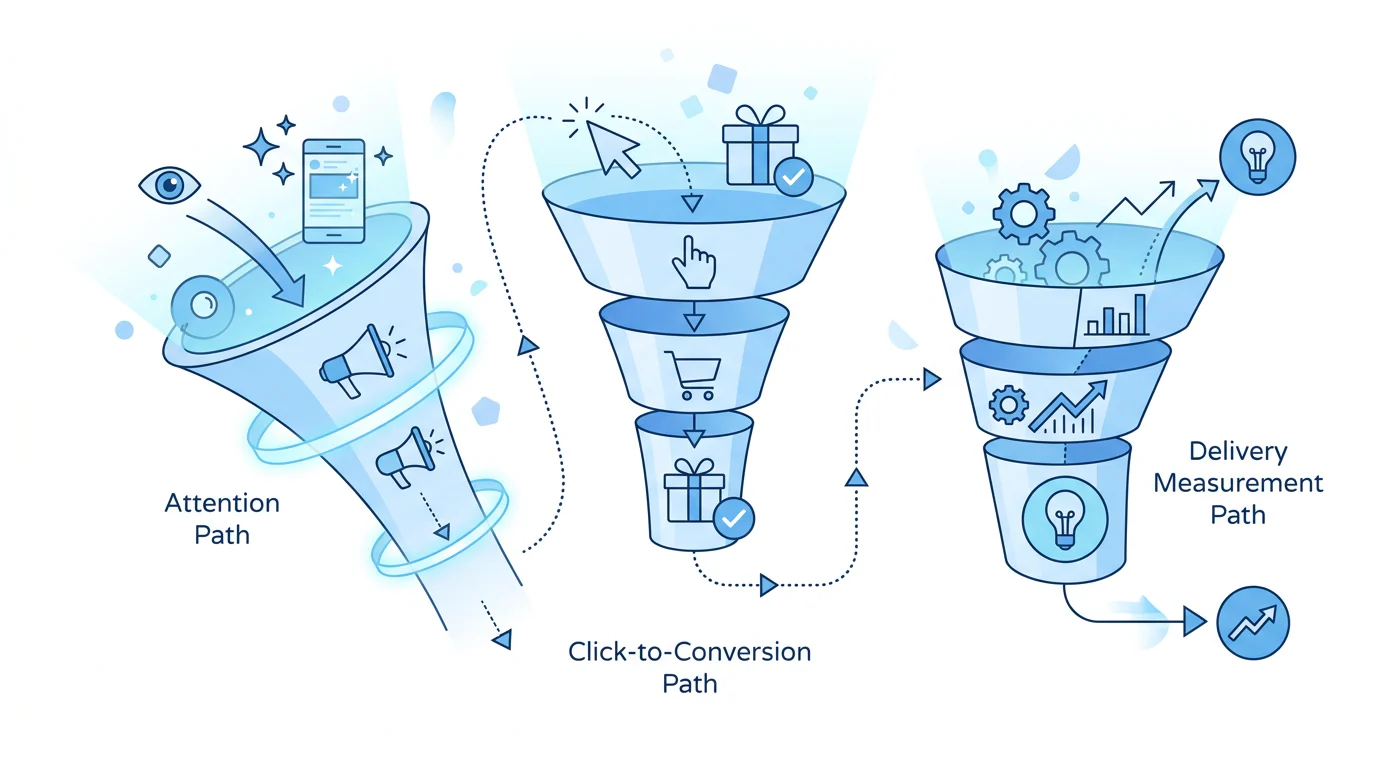
Consider an illustrative early read: Ad A earns a 30% hook rate and a 2.0% link CTR, but converts at 1%, producing a $100 CPA and 1.0 ROAS. Ad B earns an 18% hook rate and 1.2% CTR, yet converts at 5%, producing a $40 CPA and 2.5 ROAS. Ad A needs a message, offer, or page diagnosis. Ad B deserves continued evaluation, not rejection for its modest hook signal.
Teams can turn that diagnosis into a repeatable hook stop framework instead of rewriting every opening on instinct.
How Should Teams Use Competitor Hooks Without Mistaking Them for Evidence?
Observed market ads can be useful for generating hypotheses. They can reveal recurring objections, formats, proof patterns, opening structures, or offers worth investigating. They cannot show whether an idea produces efficient conversions in your account.
Meta’s Ad Library docs describe creative and delivery information, while detailed transparency fields vary by category and geography. That makes public observation directional research, not performance proof.
When we log a market pattern, we record the observable claim, format, date seen, likely audience problem, and our differentiated hypothesis. We do not label it a winner until our own delivery and downstream results support that conclusion. Our market signal comparison keeps external inspiration separate from owned performance evidence.
How Do Agencies Keep a Weekly Memory of Meta Hook Tests?
The fastest way to waste a testing budget is to rediscover the same lesson every month. A weekly memory turns each outcome, including a stopped test, into a sharper brief for creative, media, and web teams.
| Field | What To Record |
|---|---|
| Account Slice | Objective, audience type, placement context, and date range |
| Hypothesis | The audience problem and expected creative response |
| Control And Baseline | Matched control plus comparable historical performance |
| Changed Variable | The single hook, message, proof, format, or offer variable changed |
| Delivery Context | Budget, attribution setting, learning status, and tracking context |
| Evidence | Attention, click, conversion, CPA, and ROAS results against the floor |
| Decision And Next Action | Continue, revise, or stop, plus the next testable hypothesis |
We use test memory to make the decision legible after the campaign is no longer live. The result becomes more valuable when the next action is specific: retain the proof-first structure, test a shorter opening, or hold the creative constant while fixing the landing page.
A durable paid-social testing workflow gives teams one place to review live decisions, failed hypotheses, and the next angle queue without confusing market observation with conversion evidence.
Build a Better Meta Hook Testing System with Deepsolv
At Deepsolv, we help paid-social teams turn scattered creative outcomes into a repeatable decision system. We connect the question behind each new hook to its control, the delivery context, downstream performance, and the next test worth running. That means your team can see whether an ad needs a new opening, a clearer offer, a landing-page fix, or a clean stop, without pretending that a single CTR threshold knows your economics. We also make it easier to preserve rejected hypotheses, so the next weekly review starts with accumulated evidence instead of recycled opinions. If your team is spending heavily on fresh angles while winners fade after a few days, we can help you build a test queue that protects profitable delivery and records what each result actually taught you while keeping creative, media, and web teams aligned on the same evidence. Book a demo.
FAQs on Meta Hook Testing
Should Hook Rate or Conversion Data Guide Meta Testing?
Use hook metrics to diagnose attention. Use conversion rate, CPA, and ROAS to decide whether an ad earns more budget after the planned evaluation window.
How Much Data Is Needed Before Stopping a Meta Test?
Set the evidence floor from baseline conversion rate, worthwhile improvement, confidence standard, planned evaluation window, and the amount of budget your team can reasonably risk.
How Do Agencies Decide Which Ad Hooks to Keep Testing?
Use observed market ads to form hypotheses about framing or format, then keep testing only when matched delivery and downstream conversion evidence support the idea.