
How to Do Competitor Ad Analysis for Scalable Angles
Learn competitor ad analysis for scalable angles with a framework that turns observable signals into audience-led paid-social tests.

How to Do Competitor Ad Analysis for Scalable Angles
Creative testing gets expensive when a team mistakes activity for evidence. In an analysis of 15 split tests, a specific 9:16 video treatment with audio and safe-zone messaging delivered 34.5% lower cost per result than still images, which shows why format deserves disciplined testing.
To analyze competitor ads for scalable angles, track repeated hooks, offers, audience problems, formats, landing pages, and launch patterns over time. Longevity or engagement can suggest commitment, but neither proves conversion performance. The useful output is a documented hypothesis about which audience, problem, promise, proof, and offer combination deserves a controlled test in your account.
We will show how to capture the right evidence, classify it consistently, assess its confidence, and turn it into a fair paid-social test.
What Should You Observe in Competitor Ad Analysis for Scalable Angles?
Public ad libraries, saved-ad feeds, and paid dashboards answer different questions. We start with the evidence each source can actually provide, then avoid filling the gaps with assumptions about spend, profitability, or conversion rate.
The useful distinction is not free versus paid. It is whether a tool helps your team discover an ad, preserve its changes over time, or connect a market signal to your own outcome data.
| Tool Type | What It Records | Best Output |
|---|---|---|
| Ad-Spy Search | Visible ads, copy, formats, and destinations at a point in time | A discovery set for manual analysis |
| Competitor Monitoring | Repeated captures, launches, removals, variants, and page changes | A dated change log |
| Creative-Intelligence Analysis | Structured tags plus customer and first-party performance context | A prioritized test hypothesis |
The public transparency center supports platform-filtered searches for ads shown from September 4, 2023 onward. That is helpful discovery evidence, but it is not a complete record of another account’s budget or conversion economics.
We treat this as an operating system, not a one-off research task. Continuous tracking matters because a single screenshot captures an execution, while a dated history can reveal a recurring strategic bet.
How Do You Classify Ads into Audience-Specific Angles?
A creative execution is easy to save and hard to learn from. We classify ads so the underlying audience argument survives after the original thumbnail, actor, or edit style stops being useful.
What Belongs in the Nine-Field Worksheet?
Use the same fields for every observed ad. Preserve the original copy and destination beside the tags so another person can audit your interpretation.
| Field | Record As An Observable Fact |
|---|---|
| Audience | Who is explicitly shown, addressed, or problem-framed |
| Problem | The friction, fear, cost, or unmet need named |
| Promise | The stated outcome or transformation |
| Hook | The first visual, spoken, or written attention device |
| Proof | Demonstration, review, statistic, credential, or comparison |
| Offer | Discount, bundle, trial, guarantee, financing, or urgency |
| Format | Static, creator-led video, demo, testimonial, or comparison |
| CTA | The requested action and its urgency |
| Visual Style | Creator, studio, product-first, before-and-after, or screen recording |
How Is an Individual Ad Different from an Angle?
One ad is an execution. A creative concept is a reusable production device, such as a side-by-side product comparison. A messaging angle is the deeper audience, problem, and promise combination that can appear through multiple concepts and formats.
We do not call one visible execution a market pattern. We look for at least two independently observed executions that share the same audience argument before turning it into a hypothesis.
How Should Teams Keep Tags Consistent?
Controlled vocabulary prevents the same message being labeled “convenience,” “time-saving,” and “efficiency” by three different reviewers. Keep raw wording, capture date, market, format, destination, and confidence beside every tag.
This structure also makes creative angle tracking more useful: your team can compare a recurring promise with actual customer language and internal results instead of relying on a swipe file.
What Can Scaling Signals Actually Tell You?
Visible signals can be useful, but they are not a scoreboard. The right question is, “What does this observation reasonably suggest?” followed immediately by, “What does it still fail to prove?”
| Signal | Reasonable Interpretation | What It Cannot Establish |
|---|---|---|
| Longevity | The advertiser kept the ad active or available over time | Conversion rate, profit, or material spend |
| Engagement | The creative earned visible interaction or attention | Purchase intent or incremental sales |
| Variant Count | The advertiser appears to be testing several executions | Which version received budget or beat a control |
| Launch Cadence | There is a discernible production or testing rhythm | That every launch is successful |
| Landing-Page Changes | The payoff, offer, or message match changed | Why it changed or whether conversion improved |
| Channel Repetition | The message appears important enough to reuse | Equivalent audiences, economics, or delivery across channels |
For paid search, auction reporting exposes six competitive statistics, including impression share, overlap rate, and outranking share. It can show shared auction activity, but it cannot identify why another advertiser’s creative converted. Results may also be unavailable below a 10% impression-share threshold.
The practical rule is simple: write “suggests commitment” when an ad persists, “suggests testing” when variants multiply, and “suggests a new offer bet” when the landing page changes. Own performance versus competitor signals should remain distinct, because only your data can establish whether an angle earns more conversion value.
How Do You Validate a Market Pattern Against Your Data?
Market observation becomes decision-quality research only when it meets first-party evidence. We compare external patterns with the language customers use, the objections they raise, and the creative combinations that have already earned results in our own account.
That distinction reflects the direction of creative outcomes: creative evaluation is more useful when it is connected to brand and sales lift, rather than treated as an isolated attention signal.
Which First-Party Sources Should Challenge the Pattern?
Use reviews, comments, support conversations, survey answers, on-site search, and sales-call notes to verify whether the observed problem is real for your audience. Then use conversion, cost, and retention results to determine whether the promise deserves more budget.
Customer signals and performance data should agree often enough to form a testable theory, but they do different jobs. Customer language explains relevance. Account outcomes establish performance.
What Confidence Score Should Govern the Claim?
| Score | Label | Permitted Claim |
|---|---|---|
| 0 | Unsupported | Do not use as a performance claim |
| 1-2 | Direct Observation | The message, format, or page was visible on a documented date |
| 3-5 | Reasonable Inference | Repeated use suggests an active strategic bet |
| 6-8 | Test-Ready Hypothesis | Customer evidence and account history justify a controlled test |
| 9-10 | First-Party Validated | The defined test met its pre-agreed conversion threshold |
Score recency, repeated observation, cross-channel consistency, customer-language match, and first-party support. A high score does not mean “copy this.” It means the idea has earned a place in the queue.
What Does a Worked Example with Verified Campaign Data Look Like?
A verified benchmark can demonstrate the standard without making a claim about any outside advertiser. The 15-test format analysis cited above found a 34.5% lower cost per result for one defined video treatment, but we would not turn that into “video always wins.”
We would write a narrower hypothesis: for a specific audience, a native vertical demonstration may outperform a still-image control when the same problem, promise, offer, and conversion event remain fixed. The test result then updates the taxonomy with evidence from our account.
How Should You Prioritize Audience-Angle Tests?
The best next test is not always the most novel market pattern. It is the pattern with enough evidence, enough customer relevance, and enough strategic distance from what your account has already exhausted.
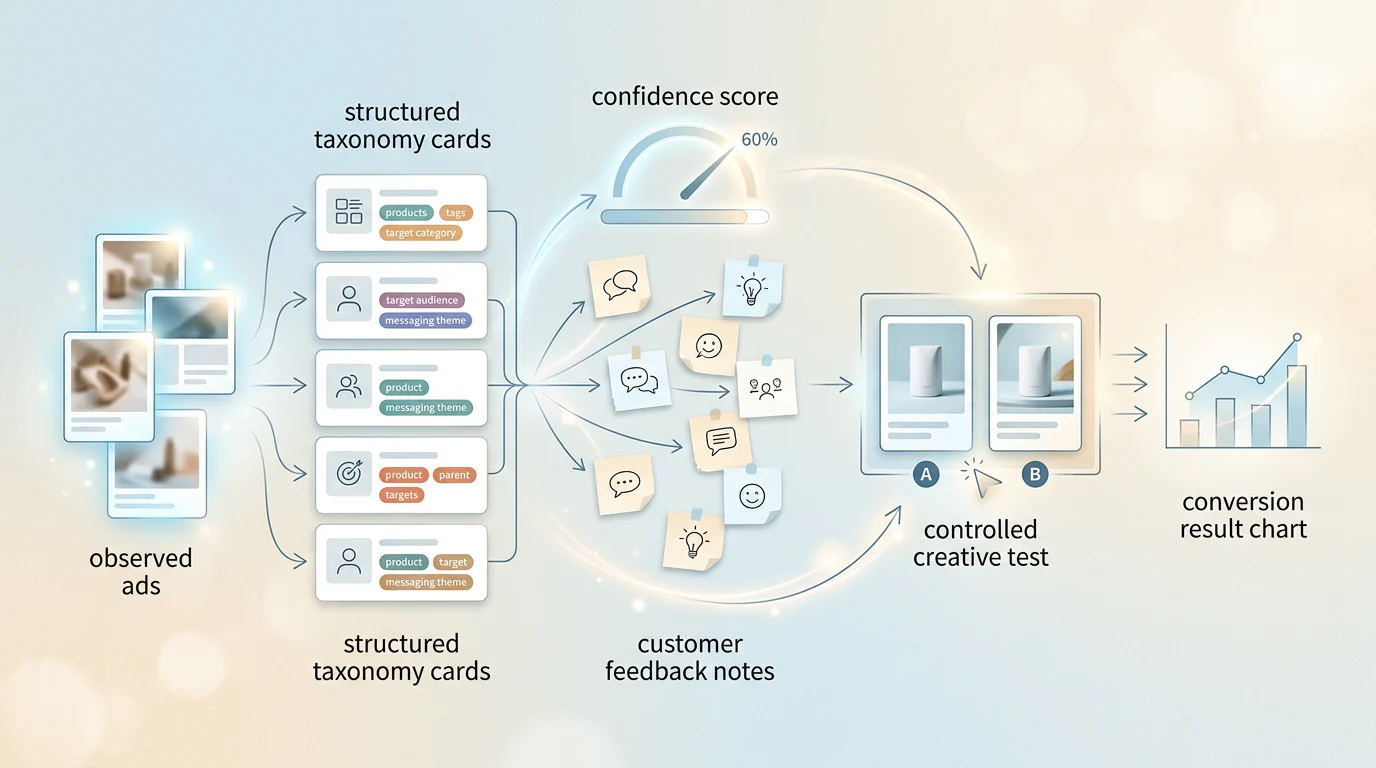
Start by grouping observed executions into angles, then identify where the market underuses a customer problem, proof type, or promise. A gap can be an opportunity, but it can also be a message nobody has made credible. That is why every gap needs a test brief, not a celebratory conclusion.
- State the audience, problem, promise, proof, and offer.
- Choose a representative test control ad.
- Change one major variable, usually the angle or proof.
- Define the conversion event, budget guardrail, and decision rule before launch.
- Record the result in the same taxonomy, whether it wins or loses.
Use test prioritization to keep high-confidence, customer-relevant hypotheses ahead of speculative ideas that only look interesting in a competitor feed.
How Do You Monitor Angles Without Rebuilding the Deck Every Week?
A high-volume paid-social team needs a recurring decision loop, not six hours of copying ads into presentation slides. The workflow should capture new executions, tag the nine fields, flag material changes, cluster recurring angles, and connect the result to customer and conversion evidence.
We recommend reviewing only meaningful movement: new audience problems, changed promises, fresh proof, revised offers, landing-page shifts, and messages that begin repeating across channels. The record should tell a strategist what changed, why it might matter, and what test could answer the open question.
A performance-connected system is most valuable when it automates tagging and monitoring without pretending it can see another account’s sales data. Centralized competitor data should stay separate from inferred performance, while still making it easy to compare an outside pattern with your own creative history.
Build a Better Test Queue with Deepsolv
Competitor research should leave your team with a clearer weekly test queue, not another deck full of screenshots. At Deepsolv, we help paid-social teams bring monitored competitor ads, customer feedback, and their own creative results into one decision workflow. Our goal is not to label outside ads as winners. We help you document the evidence, separate observed facts from inference, and turn the strongest audience-angle opportunities into briefs your team can actually test.
That means your strategists can review changing messages, analysts can apply conversion evidence, and creative partners can work from a shared learning record. We also keep the decision trail visible, so a new concept has a reason, a control, and a clear outcome to learn from. If your team wants a more disciplined way to decide what to test next, see how we make the workflow practical and book a demo
FAQs on Competitor Ad Analysis for Scalable Angles
These answers set evidence boundaries. They keep testing honest.
How Can I Tell Whether a Competitor Ad Is Converting?
You cannot verify another advertiser’s conversion rate from a visible ad. Treat longevity, engagement, and variants as hypotheses, then validate the idea through a controlled internal test.
What Does a Long-Running Ad Mean?
A long-running ad means an advertiser kept it active or available. It can suggest commitment, but it cannot establish spend, profitability, conversion volume, or incremental lift.
How Many Ads Establish a Messaging Angle?
One ad is an execution, not an angle. Look for at least two independently observed executions sharing an audience, problem, and promise before forming a test hypothesis.
What Tools Go Beyond Ad Library Scraping?
Look for tools that preserve historical snapshots, tag creative elements, flag landing-page changes, cluster recurring angles, and connect those observations to first-party conversion and feedback data.
How Do We Turn Research into a Fair Test?
Write one audience-angle hypothesis, select a representative control, change one major variable, define the conversion event and decision rule beforehand, then record the result in your taxonomy.