
How to Centralize Competitor Ads and Performance Data
Centralize competitor ads and performance data with a shared taxonomy, field matrix, and weekly workflow for Meta and TikTok teams.

Competitive creative research is now a system-design problem, not a browser-tab problem: Meta keeps political and issue ads in a seven-year archive, while commercial-ad transparency follows different rules.
Competitor ads and performance data can be centralized when public creative observations and private performance data stay in separate pipelines, then meet through a shared creative taxonomy. Public ads reveal what changed in the market; only your owned accounts, event streams, and commerce records support claims about spend, conversions, CPA, or revenue.
We will map the sources, show the fields that belong together, explain why spreadsheets fail, compare implementation paths, and give you a weekly workflow.
Can Competitor Ads and Conversion Results Live Together?
Yes, but the useful model is not one giant undifferentiated dashboard. We keep public observations on one side and owned performance evidence on the other, then connect them through creative attributes such as hook, offer, format, angle, and launch date.
Public data answers, “What is visible in the market right now?” Your accounts answer, “What happened when we ran this creative?” Treating those as the same dataset creates false certainty. Treating them as linked but distinct sources produces better test hypotheses.
TikTok’s Top Ads dashboard can filter high-performing examples by region, industry, objective, language, format, and time frame. That makes it useful for spotting patterns, but its visible signals are not a competitor’s private sales or media-buying records.
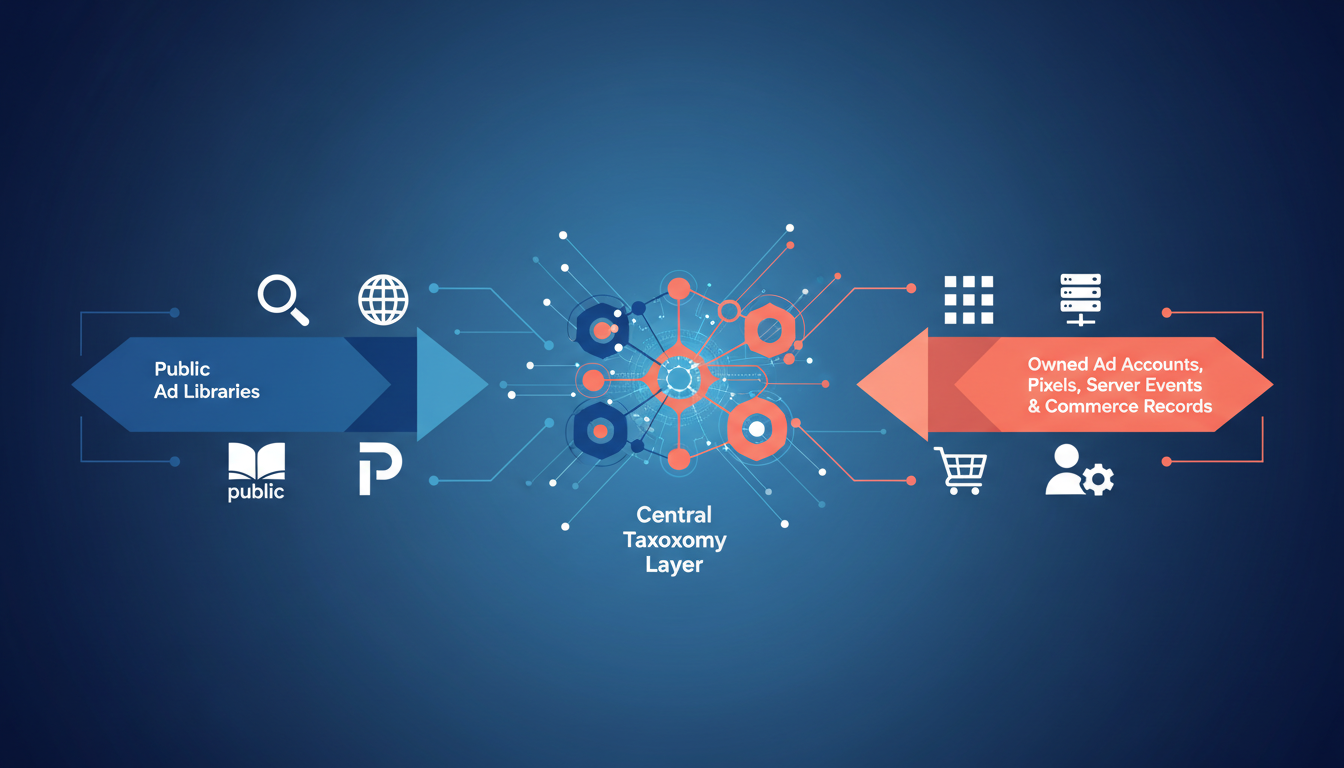
Our source-to-decision architecture looks like this:
- Public pipeline: Ad libraries, approved exports, and monitoring snapshots become tagged creative observations.
- Private pipeline: Owned ad accounts, pixels, server events, and commerce systems become performance evidence.
- Decision layer: Shared creative fields let us compare market patterns with our own historical outcomes, without claiming that a visible competitor ad converted.
For teams building a research habit from scratch, our competitor research framework helps establish the watchlist and evidence standard before automation enters the picture.
Which Fields Belong in Competitor Ads and Performance Data?
A central system works only when every record retains its source, ownership, refresh timestamp, and permitted use. We do not flatten public ads and private conversions into a single “performance” column because they are not equally reliable or equally available.
| Data Class | Typical Fields | Source | Ownership | Refresh Method | Reliability | Permitted Use |
|---|---|---|---|---|---|---|
| Competitor Creative Observation | Advertiser, copy, creative asset, format, visible CTA, status, observed date | Public ad library | Public platform data | Snapshot or approved export | Observed, not outcome-verified | Research and hypothesis building |
| Curated Market Example | Creative, category, region, format, relative engagement signal | Public creative center | Public platform data | Snapshot or approved export | Curated and relative | Inspiration and pattern analysis |
| Owned Delivery Data | Campaign, ad set, ad ID, creative ID, spend, impressions, CTR, CPA | Authorized ad account | Advertiser | API or scheduled export | Platform-reported | Budget and creative decisions |
| Browser Event Data | Event, timestamp, value, content ID, click identifiers | Pixel | Advertiser | Near-real-time | Implementation-dependent | Measurement and optimization |
| Server Event Data | Event ID, order value, CRM or offline event | Server event connection | Advertiser | Near-real-time or batch | Stronger when deduplicated | Measurement and reconciliation |
| Commerce Data | Order ID, product, gross or net revenue, refund status | Commerce system | Advertiser | Daily or near-real-time | Transactional record | Revenue reconciliation |
Server-side event connections can receive web, app, CRM, offline, and messaging information through one server-side measurement connection. That flexibility is valuable, but it also makes permission scope, consent, event definitions, and retention rules part of the architecture.
The table is the governance layer. It tells the team what can be used to identify a market pattern, what can be used to judge a test, and what must never be presented as proof. For a more useful decision layer, we connect this structure to angle tracking, rather than reporting on individual ads alone.
Why Do Spreadsheets Fail, and What Taxonomy Replaces Them?
Manual tracking fails because the work expands in more than one direction. A team adds competitors, channels, creative formats, owners, observation dates, campaign names, and metrics. The spreadsheet grows, but the meaning of each row becomes less consistent.
A simple illustration makes the problem visible: ten brands, two networks, and twenty new or changed ads each week create four hundred observations before tagging, ownership, and performance records enter the picture. The volume is manageable only when each observation has a canonical identity and controlled fields.
The Scaling Problem Is Multiplication
Spreadsheets rarely fail because the team cannot type fast enough. They fail because different people describe the same creative differently, files lose their source URL, and renamed ads break historical joins.
- Record loss: Screenshots often lack the source, observed date, platform, and active-status context needed to interpret them later.
- Meaning drift: “Founder story,” “testimonial,” and “proof” may describe one creative idea, but inconsistent labels prevent analysis.
- False certainty: A visible competitor ad can look persistent or polished without proving its spend, conversion rate, or profitability.
The Taxonomy Is the Join
We use one shared taxonomy across public observations and owned creatives: brand, source class, platform, angle, hook, offer, format, audience, launch date, creative identifier, parent concept, asset version, landing-page theme, and confidence level.
The point is not to force a public competitor creative to match an owned ad exactly. The point is to make pattern-level questions answerable: “Have we tested this offer with this hook?” “Which formats have helped this angle?” “What did we learn when a similar concept lost?”
A durable test memory preserves those answers so each weekly review builds on prior results instead of recreating them.
Owned Results Must Remain the Evidence
For historical conversions, match owned records first by platform ad or creative ID. If that identifier is missing, use an asset hash, internal version identifier, or documented launch-date fallback. When no trustworthy match exists, we mark the record unmatched rather than invent a join.
If browser and server events describe the same conversion, they need consistent identifiers. TikTok requires an event_id across Pixel and Events API for event deduplication, helping prevent overlapping events from inflating measurement.
Which Implementation Path Fits Your Team?
The right implementation depends on whether the immediate problem is collecting observations, connecting owned metrics, maintaining a taxonomy, or using creative intelligence to turn evidence into a weekly decision. We recommend choosing the smallest setup that can preserve source boundaries and survive the next planning cycle.
| Path | Best Fit | Setup Time | Maintenance | Analyst Dependency | Verified Cost |
|---|---|---|---|---|---|
| No-Code Automation And Governed Table | Small watchlist with approved exports and owned-account reporting | Fast when exports and account access already exist | Medium | Medium | Starts at $19.99 per month for an official pricing plan, with usage-dependent cost |
| BI Stack And Warehouse | Teams with an analytics owner and multi-account history | Depends on connector and data-model availability | High | High | Dashboard tooling can be no-cost; warehouse queries include 1 TiB monthly free, then $6.25 per TiB under warehouse pricing |
| Custom Pipeline | Bespoke governance, complex integrations, or proprietary models | Direct platform connections can take weeks | High | High | No fixed public implementation cost |
| Creative-Intelligence Platform | Teams needing monitoring, taxonomy, and weekly action in one workflow | Vendor-confirmed | Low to medium | Low to medium | Quote required |
For a two-week deadline and a $3,000 monthly ceiling, we would not begin with a custom pipeline. TikTok documents one to four weeks for direct Pixel and Events API setup alone, before a team adds warehousing, competitor snapshots, or a decision layer.
A governed no-code process is the safest fallback when a platform’s written scope cannot confirm the budget and launch date. If your team needs decisions, not just reporting, use continuous monitoring to evaluate whether the workflow turns the two data classes into a credible test queue.
How Should We Automate Weekly Competitor Tracking?
Automation should protect judgment, not remove it. We automate collection, timestamps, tagging assistance, and change detection. We keep human review for source confidence, taxonomy exceptions, and the decision to spend production time on a new concept.

Use this seven-step operating rhythm:
- Define a focused competitor watchlist and source-specific refresh cadence.
- Capture public ads with source URL, observation timestamp, platform, and source class.
- Sync owned media metrics by immutable ad and creative identifier.
- Sync browser, server, and commerce events, then deduplicate overlapping records.
- Apply the shared taxonomy and flag uncertain or unresolved joins.
- Detect new, paused, and materially changed competitor creatives, then compare patterns against owned creative outcomes.
- Publish a ranked test queue with evidence, owner, expected learning, and a result log.
Use weekly test ranking to turn the completed review into a repeatable production decision.
Freshness matters. Platform reporting, commerce records, and public libraries update on different schedules, so every decision should retain its source timestamp. Attribution settings matter too: TikTok’s documented attribution windows include click-through, engaged-view, and view-through options that can change how conversions appear in reporting.
This review should identify a credible pattern, test it in our own environment, and retain the learning. The goal is not to copy market activity.
Why Teams Use Deepsolv
At Deepsolv, we built our creative intelligence workflow for the point where research stops being useful unless it changes next week’s work. We keep public competitor observations distinct from your private performance evidence, apply one shared taxonomy, and turn the combined view into a ranked test queue. That means your team can see a new market pattern, check whether a related angle has helped or hurt your own conversion performance, and record the outcome without rebuilding the system in a spreadsheet. We do not treat public signals as proof of a competitor’s sales. We use them as context for sharper experiments, while your owned data remains the evidence behind budget and production choices. If your team needs the source-to-decision workflow running before the next planning cycle, we can help you define the fields, links, guardrails, and weekly decision rhythm. Book a Deepsolv demo
FAQs on Competitor Ads and Performance Data
These boundaries keep a centralized system useful: public signals generate hypotheses, while owned records determine performance, attribution, and the next test. They also set clear expectations for what can be automated quickly.
Can Public Competitor Ads Prove Conversions?
No. Public records can show creative, messaging, format, visible status, and timing, but they do not provide the advertiser’s private conversion, spend, CPA, or revenue reporting.
Does Creative Intelligence Software Use Both Data Types?
It should ingest public creative observations separately from your authorized account and event data, normalize shared creative fields, then use owned results to rank tests.
What If Historical Creative IDs Are Incomplete?
Start with platform creative IDs, asset hashes, and launch dates. When no trustworthy match exists, retain the history as unmatched instead of inventing attribution for it.
Can a Team Automate This in Two Weeks?
Use a smaller, governed setup first. It can meet a two-week deadline only when written scope confirms account access, onboarding, maintenance, total cost, and ownership.