
Glossary · Creative intelligence and Meta test planning
Creative performance analytics

By Sachit Sharma, CEO & Founder · Reviewed 2 Oct 2026
Also called creative analytics, creative performance measurement or creative effectiveness analytics
On this page
What is creative performance analytics?
Creative performance analytics is the practice of combining creative metadata, advertising performance data and customer signals to identify patterns in how ads perform. Its practical output is a testable decision, such as what creative variable to test, improve, scale or stop, rather than a dashboard alone.
Key takeaways
- Compare like with like, because an image asset and a headline do not answer the same performance question.
- Use customer language to form hypotheses about objections, desires and buying triggers, not as proof that an ad will perform.
- Treat competitor activity as market context, not proof of a competitor’s commercial results.
- Choose the changed variable and primary success metrics before launching a test.
- Separate a pattern worth investigating from evidence strong enough to make a causal claim.
Quick facts
- Core inputs
- Creative metadata, performance data and customer signals
- Test comparison
- Original version versus trial version
- Primary success metrics
- Up to 2 in Google Ads custom-experiment reporting
- Customer-review rule
- FTC rule effective October 21, 2024
Three inputs make the analysis decision-ready
Creative metadata describes what is in an asset, such as its type, headline, image, logo or video. Performance data shows how an asset or campaign performed. Customer signals add the language people use when they describe a problem, objection, desire or reason to buy.
Google’s asset-reporting guidance says assets can be compared across ads and campaigns, but assets should be compared by asset type. That makes the input model practical: use metadata to define the comparison, performance data to observe the result, and customer signals to suggest the next hypothesis.
- Input
- Creative metadata
- Examples
- Asset type, headline, image, logo, video
- Decision use
- Defines the elements being compared
- Input
- Performance data
- Examples
- Asset or campaign results
- Decision use
- Shows where a pattern may exist
- Input
- Customer signals
- Examples
- Objections, desires, buying triggers
- Decision use
- Suggests language or problems to test
A pattern is not yet a test decision
A pattern might show that ads with a particular message are associated with stronger results. That observation is useful, but it does not prove the message caused the result. Observational studies can identify associations but cannot establish causality without randomisation, as explained in a 2023 National Library of Medicine article.
A test decision adds discipline to the pattern: name the hypothesis, define one variable to change, retain an original version for comparison, and select the primary success metric or metrics. Google Ads describes this same original-versus-trial structure for custom experiments and allows up to 2 primary success metrics in reporting.
Worked example: from a customer objection to 2 versions
A team notices that customer feedback repeatedly raises a product-proof objection. The team does not conclude that proof is the cause of every conversion. Instead, it creates 2 versions of the same ad: an original version and a trial version that changes only the proof presentation.
Before launch, the team chooses up to 2 primary success metrics. After the comparison, the output is a decision: retain the original, iterate on the proof hypothesis, or scale the trial. That is creative performance analytics doing decision work, not merely reporting a pattern.
Where the method can mislead
Component-level figures can be misleading when they are treated as campaign totals. Google notes that app asset reports may show higher metrics because each component used in one impression is counted, and advises relying on campaign-level totals for accurate performance and spend tracking.
Public competitor ads also have limits. Meta’s Ad Library shows ads currently running across Meta technologies and typically reflects first impressions or changes within 24 hours, but public visibility does not establish ordinary commercial advertisers’ ROAS, conversion rate or profitability. Read more in Meta Ad Library Shows Ads, Not Competitor Results.
Use customer signals carefully
Customer feedback can improve the quality of a hypothesis, especially when it reveals a recurring objection or desired outcome. It is not a substitute for a controlled comparison, and it should not be presented as performance proof.
The FTC’s 2024 Consumer Reviews and Testimonials Rule guidance explains that reviews featured in advertising or marketing become testimonials. Teams should therefore distinguish insight gathering from using a review as promotional proof. For a test-planning extension, see Creative Analytics Is Not a Test Plan, Here’s the Missing Layer.
The decision path
Creative performance analytics becomes useful when evidence leads to a testable choice, rather than another dashboard. Start with three evidence types, form a hypothesis, then specify the variable and outcome that will decide the next action.
From evidence to a next test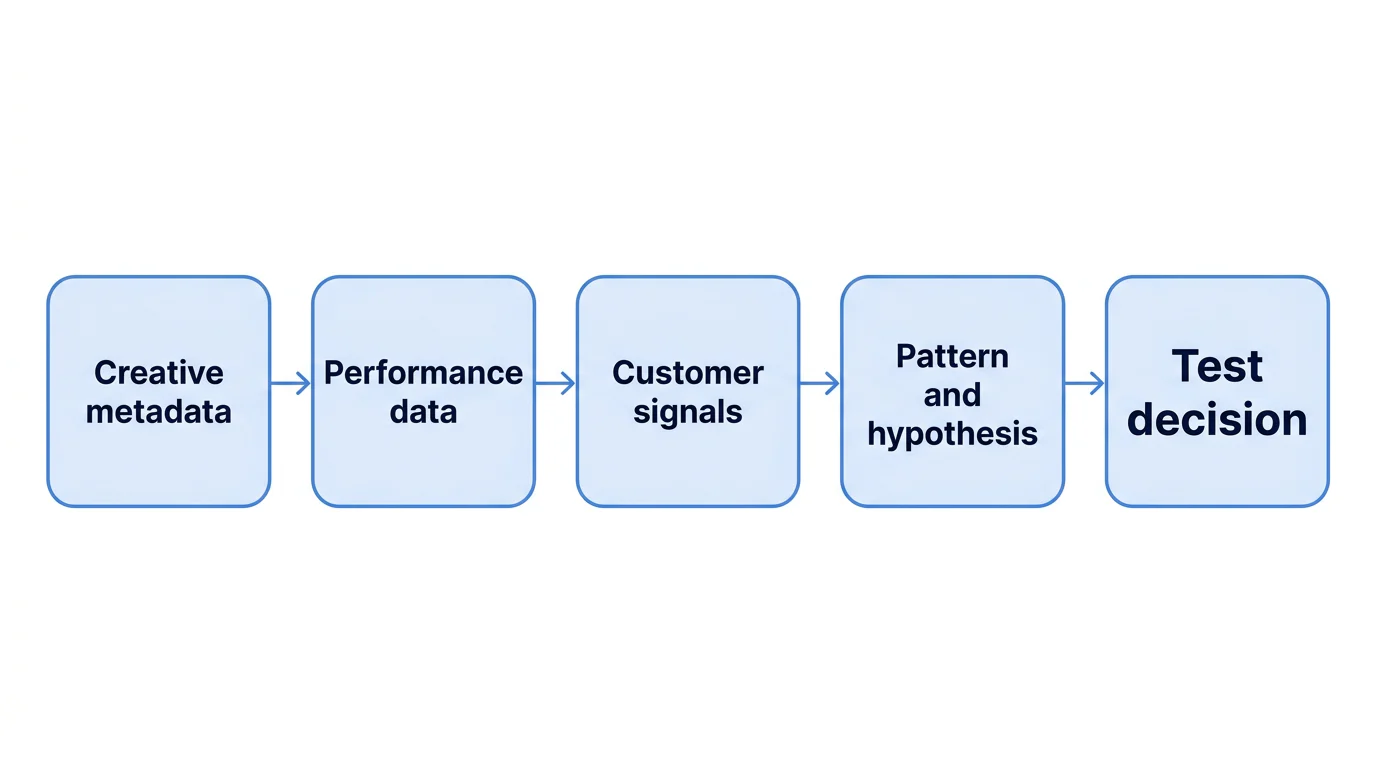
Example
A team sees a recurring product-proof objection in customer feedback. It keeps the original creative as one version, changes only the proof presentation in a trial version, selects up to 2 primary success metrics, then decides whether to retain, iterate or scale.
Frequently asked
Ad reporting shows performance measures for campaigns, ads or assets. Creative performance analytics adds structured creative metadata and customer signals so a team can identify patterns, form a hypothesis and choose what to test, improve, scale or stop.
No. A high-performing element can be associated with a result without causing it, because live advertising outcomes can also reflect audience, placement, delivery and campaign conditions. A controlled comparison provides stronger evidence for a causal decision.
Creative performance analytics needs creative metadata, such as asset type and creative elements; performance data at a suitable asset or campaign level; and customer signals, such as recurring objections, desires or buying triggers. Each input has a different job in the decision.
Turn the pattern into one hypothesis, change one defined variable between an original and a trial version, and choose the primary success metrics before the comparison begins. The result should determine whether the team iterates, scales or stops the idea.
Customer reviews can reveal language, objections and motivations worth testing in a creative hypothesis. If a business features reviews in advertising or marketing, the FTC treats them as testimonials, so the business must consider the applicable rules on deceptive or false testimonials.
Sources
- 1.About asset reporting for Display ads and campaigns, Google Ads Help, n.d., accessed 2026
- 2.About enhanced asset reporting for App campaigns, Google Ads Help, n.d., accessed 2026
- 3.About custom experiments, Google Ads Help, n.d., accessed 2026
- 4.Ad Library, Meta, 2026
- 5.Considerations When Writing the Paper From an Observational Study, National Library of Medicine, 2023
- 6.The Consumer Reviews and Testimonials Rule: Questions and Answers, Federal Trade Commission, 2024
Turn your evidence into a ranked next test
We combine competitor activity, customer signals and past ad learnings into weekly creative decisions.
Book a demo