Glossary
Thanksgiving Facebook ads
Run, test or pause Thanksgiving Facebook ads by comparing last year's Thanksgiving Day cost per purchase with your gross profit per order; below it, run, and above it, pause or cut.

By Sachit Sharma, CEO & Founder · Updated 24 Oct 2026
On this page
- 01Definition
- 02Three things hide behind this search
- 03Key takeaways
- 04What are Thanksgiving Facebook ads, and what gets confused with them?
- 05Is Thanksgiving Day a real shopping day for Meta ads, or just Black Friday's warm-up?
- 06How do you decide to run, test or pause Thanksgiving Facebook ads?
- 07Should a Thanksgiving Facebook ad thank people or sell to them?
- 08How Deepsolv handles it
- 09Example
- 10Related terms
- 11Frequently asked
What are Thanksgiving Facebook ads?
Thanksgiving Facebook ads are paid ads bought through Meta's auction (the bidding system that decides which ad a person sees) and delivered on Thanksgiving Day, the fourth Thursday of November.
Key takeaways
- Judge Thursday by your own account: last year's cost per purchase against gross profit per order.
- With fewer than 10 purchases last year, run a small test with one variable instead of a full budget.
- Test a thank-you ad against an offer ad by changing only the opening message.
- Have a Thursday offer approved and live before the morning, when sales peak.
Three things hide behind this search
Three different things hide behind this search. One is Facebook's own holiday commercial. Another is a Thanksgiving greeting post with a turkey on it. The third is a paid Meta ad bought for the fourth Thursday of November, and that is the only one a brand has to budget for.
Thursday deserves a real decision. Adobe Analytics counted $6.4 billion of US online sales on Thanksgiving Day 2025, up 5.3% on 2024, and 61.6% of it came from mobile devices (Digital Commerce 360).
Switching Thursday off, or scaling it like a small Black Friday, are both guesses without your own numbers. Your own account already holds the answer: last year's Thanksgiving Day set against your October baseline.
The rest of this page turns that into one comparison: what a purchase cost you on Thanksgiving Day last year against what an order earns you, then a decision to run, test or pause.
Key takeaways
- Thanksgiving Facebook ads are paid Meta ads delivered on Thanksgiving Day. Decide by comparing last year's Thanksgiving Day (November 27, 2025) cost per purchase with your gross profit per order.
- Thursday is a real but smaller shopping day: about 54% of Black Friday's online sales in 2025 (calculated from the Adobe figures below).
- A thank-you ad and an offer ad answer different questions. Test them against each other by changing only the opening message.
- As of October 2026, Meta advises starting ads by mid-October. If you have not started, begin with people who already know your brand this week.
What are Thanksgiving Facebook ads, and what gets confused with them?
A Page post is not an ad, because it is unpaid and has no cost per purchase to judge. Facebook's own Thanksgiving-season brand campaign, which Ad Age covered in 2025, is Meta advertising itself and is not something advertisers can buy.
Is Thanksgiving Day a real shopping day for Meta ads, or just Black Friday's warm-up?
Thursday is a real but smaller day. Adobe's Thanksgiving Day 2025 online sales are about 54% of Black Friday's $11.8 billion (calculation: 6.4 ÷ 11.8, both 2025 figures from Digital Commerce 360 and TechCrunch).
Two details shape how you run it. Growth slowed: Thanksgiving Day sales rose 5.3% in 2025 after 8.8% in 2024. And Adobe observed sales peaking between 10 a.m. and 2 p.m., not in the evening. Have a Thursday offer approved and live before the morning.
Black Friday is November 27 in 2026 (Social Media Today), so Thursday opens the run into it. For cost changes around the Cyber 5 (Thanksgiving through Cyber Monday) and a week-by-week budget, use Black Friday Facebook Ads.
How do you decide to run, test or pause Thanksgiving Facebook ads?
Compare last year's Thanksgiving Day (November 27, 2025) cost per purchase with your gross profit per order. Below it, run. Above it, pause or cut. Too few purchases to tell, test small. Four steps:
Run, test or pause: the cost-per-purchase rule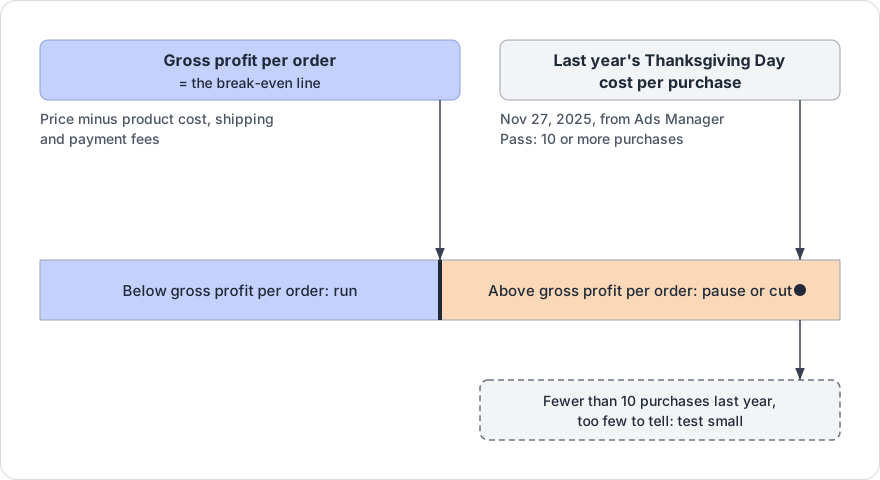
- Write down break-even. Gross profit per order is price minus product cost, shipping and payment fees. Pass: one dollar figure.
- Pull last year's Thanksgiving Day (November 27, 2025) from Ads Manager (Meta's ad dashboard): spend, purchases, CPM (cost per 1,000 impressions), CTR (click-through rate, clicks ÷ impressions) and purchase rate (purchases ÷ clicks). Pass: 10 or more purchases. With fewer than 10 purchases, one extra order moves cost per purchase by 10% or more, so treat the result as noise and go to the test row. This threshold is a rule of thumb, not a Meta rule.
- Divide spend by purchases. Below gross profit per order is a pass. Above it is a fail. Size the Thursday test with the Meta ads budget and creative test calculator.
- Find what moved. Cost per purchase = CPM ÷ (1,000 × CTR × purchase rate). Compare each term with your October average. Illustration only, with invented inputs: CPM up 50%, purchase rate up 100%, CTR flat gives 1.5 ÷ 2.0 = 0.75, a 25% lower cost per purchase than October.
If cost per purchase rose while purchase rate fell, look at the offer and landing page. If it rose while CTR or CPM moved, look at the ad and the auction. How to Analyze Facebook Ads and Choose Your Next Test covers that read.
Meta Ads Learning Phase shows how to check your budget.
- Last year's Thanksgiving Day
- 10+ purchases, cost per purchase below gross profit per order
- Decision
- Run: keep budget, add one test
- Last year's Thanksgiving Day
- Under 10 purchases, or no history
- Decision
- Test: small budget, one variable
- Last year's Thanksgiving Day
- Cost per purchase above gross profit per order
- Decision
- Pause or lower: cut audiences that have never visited your site or bought (cold audiences) first
Should a Thanksgiving Facebook ad thank people or sell to them?
Run both as a test: a thank-you ad against an offer ad, changing only the opening message. Keep audience, placement and product identical. Judge both ads by cost per purchase at equal spend, and keep the one with the lower cost per purchase once each has at least 10 purchases.
Write the single change into an ad creative brief before you build anything.
To see what rivals lead with, search "Thanksgiving" in Meta's Ad Library and note thanks versus discount openings. It shows ads, not results, so treat it as a hypothesis (Meta Ad Library Shows Ads, Not Competitor Results).
How Deepsolv handles it
At Deepsolv, ranking that choice is our weekly job. Our platform combines ad-performance data, competitor activity, customer signals and past ad learnings into a ranked weekly test plan and execution-ready creative briefs. The thank-you versus offer test sits in the ranking against every other test you could run that week, and each Thanksgiving Day result becomes a past ad learning for the following year.
Example
A brand pulls last year's Thanksgiving Day (November 27, 2025) from Ads Manager and finds 8 purchases. Because that is under 10, one extra order would swing cost per purchase by 10% or more, so the brand lands in the test row. It sets a small budget and runs a thank-you ad against an offer ad, changing only the opening message.