Glossary
Product Launch Ads
Product launch ads introduce a new product before it has any results. Build the first Meta test plan from rival ads and customer comments, then re-rank it weekly.

By Sachit Sharma, CEO & Founder · Updated 24 Oct 2026
On this page
- 01Definition
- 02Introduction
- 03Key takeaways
- 04What are product launch ads, and what are they confused with?
- 05What can rival ads and customer comments tell you before you have results?
- 06How do you turn those inputs into a ranked first test plan?
- 07How much budget does a launch test need before results mean anything?
- 08How do early results change the ranked plan each week?
- 09What do ad set, optimization event and learning phase mean on Meta?
- 10How Deepsolv handles it
- 11Example
- 12Related terms
- 13Frequently asked
What are product launch ads?
Product launch ads are paid ads that introduce a new product to people who have not seen it, run in the first weeks of its release.
Key takeaways
- Fill every evidence cell of the plan sheet with a start date, a quote with its source, or a dollar figure before a row ranks.
- Budget per ad set, not per creative: weekly spend is roughly 50 times your cost per event.
- Make changes as new ads or next week's rows, not edits to a running ad set.
- Treat a low-budget winner after 7 days as a lead to repeat, not proof.
Introduction
A new product has no click history, no purchase history and no winning ad to copy. Most launch advice fills that gap with a calendar: teaser, launch day, follow-up. A calendar says when to run ads. It does not say which ad to run first, and that choice decides how fast you learn anything.
A calendar-led launch spends its first weeks of budget with no ranking of what to test. You do have two inputs from outside your account. Rival brands have already shown what they run and when they started it. Customers have already said what they want and what worries them, in reviews and comments. The plan below needs only those two inputs, which exist on day one.
This entry defines the term, then gives a plan sheet that turns those inputs into ranked tests, a budget check against Meta's 50-event learning rule, and a weekly rule for re-ranking. It is written for teams buying Meta ads (Facebook and Instagram) for a consumer product.
Key takeaways
- Rank your first launch tests from rival ad activity and customer comments, because a new product has no account data to rank from.
- Meta's reference for stable delivery is about 50 optimization events (the action an ad set is set to chase, such as a purchase) in 7 days per ad set (the Meta level that holds budget and audience), so the weekly budget per ad set is roughly 50 times your cost per event.
- Rival ads show timing, format and message, never results, so treat each one as a hypothesis to test.
- Re-rank every week: leave running ad sets alone, promote clear leaders, drop clear laggards, and add a row when a rival starts a new wave.
What are product launch ads, and what are they confused with?
Product launch ads are paid ads that introduce a new product to people who have not seen it, run in the first weeks of its release, before you have results for that product. The launch is the whole release effort. The ads are the part you buy and measure.
Three mix-ups are common:
- Launch ads are not the launch campaign. Email, press, retail placement and organic posts belong to the campaign, not to the ads you buy.
- They are not automatically awareness ads. You can still point them at purchases.
- They are not retargeting. Retargeting (showing ads to people who already visited your site) needs people who already visited, and a new product has few of them.
What can rival ads and customer comments tell you before you have results?
Rival ads tell you what others are betting on and when they started, and customer comments tell you what buyers want and fear. Neither tells you what works. Meta's Ad Library shows commercial ads with their creative, page, delivery dates and placements (About the Meta Ad Library). Meta publishes spend, reach and funding entities only for social issue, election and political ads (Meta Ad Library tools). See what the Meta Ad Library does and does not show for the limits in full.
Start dates still carry a signal, but clusters of them are patterns to check, not confirmed launches. They show timing and format on a handful of listed ads, not performance.
For customers, read reviews of rival products and of your own earlier ones, and pull exact phrases. Review mining for Meta ad angles shows how.
How do you turn those inputs into a ranked first test plan?
Write one row per hypothesis, fill every cell with something you can point to, and rank rows by score. A workable sheet:
| Rank | Angle (one sentence) | Rival evidence | Customer evidence | One variable changed | Budget check | Decision date |
|---|---|---|---|---|---|---|
| 1 | Rivals running it, earliest start date, format | Quote and where it came from | Hook, format or offer | 50 × cost per event | Day 7 |
Score each row 0 to 3 on four things: strength of customer evidence, rival evidence, whether the budget can fund it, and how different it is from the other rows. Rank by total.
A row passes when each evidence cell holds a start date, a quote with its source, or a dollar figure. A row with an empty evidence cell stays below the line. The top row becomes the ad creative brief.
How much budget does a launch test need before results mean anything?
Plan for about 50 optimization events in 7 days per ad set. Meta's learning-phase guidance sets a minimum of 50 events over a 7-day period for an ad set (Meta Business Help Center, as of October 2026), and its developer guidance puts it as learning that "occurs on the ad set level" (Meta developers). An optimization event is the action the ad set is set to chase, such as a purchase. The model: weekly spend per ad set = 50 × cost per event.
At $5 a day you spend $35 a week, which at $10 per event buys about 3.5 events, not 50. Meta also warns that overlapping ad sets cannibalize data collection (Meta Business Help Center), so one ad set per angle spreads a small budget too thin. Put several angles as separate ads inside one ad set, or optimize for an earlier action such as add to cart. Its cost per event is typically lower, so check your own cost before relying on it. Spend then splits unevenly between ads, so read the result as direction, not a clean ranking.
The 50 events apply to the ad set, not each creative. In a default of 2 concepts, 2 variants, 7 days, $10 per event and $560 spend, 56 events spread over 4 creatives leaves 14 each. See also the Meta Ads learning phase.
- Cost per event
- $10
- One ad set, 7 days
- $500
- Three ad sets, 7 days
- $1,500
- Cost per event
- $25
- One ad set, 7 days
- $1,250
- Three ad sets, 7 days
- $3,750
- Cost per event
- $40
- One ad set, 7 days
- $2,000
- Three ad sets, 7 days
- $6,000
- Cost per event
- $60
- One ad set, 7 days
- $3,000
- Three ad sets, 7 days
- $9,000
How do early results change the ranked plan each week?
Re-rank on a fixed weekly rhythm, with five rules:
The weekly re-ranking loop for launch tests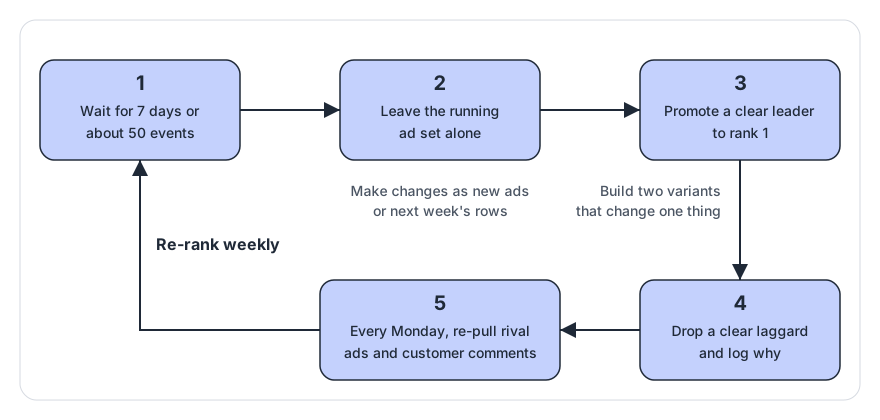
- Do not re-rank on clicks before the ad set has had 7 days or about 50 events.
- Leave the running ad set alone. Meta says changes can trigger a new learning period (Meta Business Help Center). Make changes as new ads or next week's rows.
- Move a clear leader to rank 1 and build two variants that change one thing, such as the hook or format. That is creative iteration.
- Drop a clear laggard and log why.
- Every Monday, re-pull rival start dates. A new wave adds a row.
At low budgets a "clear" winner after 7 days may be noise. Treat it as a lead and repeat it before scaling.
What do ad set, optimization event and learning phase mean on Meta?
An ad set is the Meta level that holds budget and audience, an optimization event is the action it chases, and the learning phase is the period of unstable delivery before about 50 events. That is why budgets are set per ad set and ad sets should not overlap.
How Deepsolv handles it
We build this ranking for Meta advertising teams. Our Creative Intelligence platform combines ad-performance data, competitor activity, customer signals and past ad learnings into a ranked weekly creative test plan and execution-ready creative briefs. For a new product, rival activity and customer signals are the inputs you have on day one, and the sheet above is the same logic done by hand.
On our beauty trending-ads page, updated October 22, 2026, we tallied the start dates listed per brand. Of the 12 Ordinary ads with listed start dates (the brand has 562 active), 9 began between August 31 and September 11, 2026, and 5 of those on September 1. All 15 listed Sol de Janeiro ads (406 active) began between October 1 and 12, 2026. The Ordinary's cluster is not tied to a named product, and Sol de Janeiro's ads promote its new Intense Perfume Mist, but many target European retail, so treat that cluster as a pattern to check, not a US launch.
Our sales route is a personalized demo with our founding team, where you can also ask about pricing. Book a demo.
Example
A team whose purchases cost $25 each needs about $1,250 per ad set for a week. With only $700 it would reach about 28 events, so it could use the cheaper add-to-cart event or put its angles as separate ads inside one ad set.
Frequently asked
Sources
- 1.Meta Business Help Center: About the Learning Phase, Meta
- 2.Meta developers: Understanding and optimizing your ad campaign, Meta
- 3.Meta Business Help Center: About the Meta Ad Library, Meta
- 4.Meta Ad Library tools, Meta
- 5.Deepsolv beauty trending ads, Deepsolv, October 22, 2026