Glossary
Facebook Ad Script
A Facebook ad script is the spoken and on-screen wording of a video ad. Put the claim in the first four seconds, because in one 2026 sample of 421 videos the median viewer watched about four seconds.

By Sachit Sharma, CEO & Founder · Updated 23 Oct 2026
On this page
- 01Definition
- 02Quick facts
- 03Key takeaways
- 04What is a Facebook ad script?
- 05How many words fit in a 15-second video ad?
- 06How much of a Facebook video ad do viewers actually watch?
- 07What should a video ad script pass before filming?
- 08How does a script differ from ad copy, a brief or a video sales letter (VSL) script?
- 09How Deepsolv handles it
- 10Example
- 11Related terms
- 12Frequently asked
What is a Facebook ad script?
A Facebook ad script is the written plan for what a video ad says aloud and shows as on-screen text, with timings for each beat.
Key takeaways
- Put who the ad is for and what it offers into the first four seconds, in speech and on-screen text.
- Budget words from seconds: a 15-second ad holds about 38 words and its first four seconds about 10.
- Run six pass/fail checks before filming, two of which come from Meta's ad standards and the FTC's testimonial rules.
- Make one claim and ask for one thing, so a test stays readable.
Quick facts
- Spoken pace used
- About 2.5 words per second (a model, not an official figure)
- Words in 15 seconds
- About 38, with about 10 in the first four seconds
- Words in 30 seconds
- About 75
Most viewers have left a video ad before its offer is spoken. Common templates split a 30-second script into equal beats, but viewers drop off fast, so the later beats are heard by far fewer people. The lines that explain the product, show proof and ask for the click sit at the back of the script, where fewer viewers are.
Search for a Facebook ad script and you get four different things: a template for a video's spoken lines, a headline-and-caption generator, a transcript of someone else's ad, and Python code for Meta's Marketing application programming interface (API), which lets developers automate account tasks. This entry covers the first.
Below you get the definition, a 15-second example script with a word budget you can recompute for any length, fill-in templates for 15 and 30 seconds, and six checks to run before anyone films. Two of the checks come from rules: Meta's advertising standards and the Federal Trade Commission (FTC)'s testimonial guidance.
Key takeaways
- A Facebook ad script is the spoken lines and on-screen text of a video ad, beat by beat. It is not the ad copy around the ad, a creative brief, or Marketing API code.
- Put who the ad is for and what it offers into the first four seconds, in speech and on-screen text. In a 421-video sample, the median viewer watched about four seconds, and that barely changed with video length.
- Budget words from seconds. At about 2.5 spoken words per second, a 15-second ad holds about 38 words and its first four seconds about 10.
- Run six pass/fail checks before filming. Two come from rules: Meta's ban on implying personal attributes and the FTC's rules on testimonials.
What is a Facebook ad script?
The primary text, headline and description around the ad are ad copy, which is a separate document. A beat is one job in the ad: hook, product in use, proof, or call to action.
How many words fit in a 15-second video ad?
Multiply the seconds in each beat by about 2.5 spoken words per second. That is a model, not an official figure. It assumes a speaking pace of about 150 words per minute with no long pauses; slow-paced or music-led ads need fewer words. A timed read-through by your own speaker should replace it. By this math a 15-second ad holds about 38 words (15 × 2.5 = 37.5), and its first four seconds hold 10.
Fitting words into a 15-second script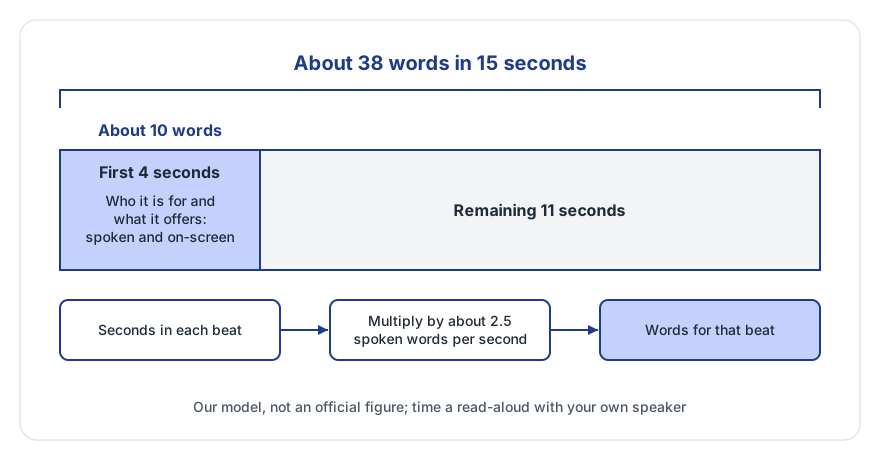
The example below is for a hypothetical water bottle brand. The claim and lines are placeholders, and any real claim needs substantiation first.
The script totals 34 words, under the 37.5 budget. Show "Locking lid. No leaks." on screen from the first frame, so the claim reaches a viewer who is not listening. Meta's ads guide recommends video captions and sound, though it lists both as optional.
Fill-in template for 15 seconds (about 38 words):
- 0 to 4 seconds, Hook: [who the ad is for + the claim], about 10 words
- 4 to 9 seconds, Product in use: [what it does], about 12 words
- 9 to 12 seconds, Proof: [one fact], about 7 words
- 12 to 15 seconds, Call to action: [one action], about 7 words
Fill-in template for 30 seconds (about 75 words, 30 × 2.5):
- 0 to 4 seconds, Hook: [who the ad is for + the claim], about 10 words
- 4 to 30 seconds (26 seconds, about 65 words): Product in use [what it does], Proof [one fact], Call to action [one action]
- Seconds
- 0 to 4
- Beat
- Hook
- Word budget
- 10
- Example line
- "Your water bottle leaks in your bag. This one locks."
- Words
- 10
- Seconds
- 4 to 9
- Beat
- Product in use
- Word budget
- 12.5
- Example line
- "Twist once and it seals. Turn it upside down. Nothing drips."
- Words
- 11
- Seconds
- 9 to 12
- Beat
- Proof
- Word budget
- 7.5
- Example line
- "Tipped over a towel. Still dry."
- Words
- 6
- Seconds
- 12 to 15
- Beat
- Call to action
- Word budget
- 7.5
- Example line
- "Tap Shop Now to see the lid."
- Words
- 7
How much of a Facebook video ad do viewers actually watch?
Most viewers leave within seconds: the median viewer in one 2026 sample watched about four seconds, and the average hook rate in another was 25.44%. Biddy's analysis of 421 Meta videos from 21 brands (collected July 6 to October 4, 2026, $10.3 million combined spend) found that median, and it barely changed with video length. It describes viewers who watched, not all impressions. Billo's analysis of 88,329 Meta video ads (January 1 to June 30, 2026) found an average hook rate of 25.44%, an average across ads.
Hook rate is 3-second video plays divided by impressions. By simple arithmetic (100% minus 25.44%), about three in four impressions never reach a 3-second play, on average across ads.
That is an inference, and the limits matter. Both studies are from 2026 and are published by businesses in this market. They measure different things. Biddy's brands each spent at least $50,000, so smaller accounts may differ. Still, a script that holds its offer and call to action until seconds 25 to 30 spends its most important lines where the fewest people are, so the claim is best put first. Whether a stronger opening also lifts conversions is a separate question, covered in Meta Hook Testing: Hook Signals vs. Conversion Data.
A template is a hypothesis, not a result: no script format has been shown to beat another without a controlled test.
What should a video ad script pass before filming?
A Facebook ad script should pass six checks before filming: four seconds, word count, one claim, personal attributes, testimonials and substantiation. Each has a pass and a fail.
Does the ad say who it is for and what it offers in four seconds?
Watch only the first four seconds, muted, with captions. Pass: you can say who the ad is for and what it offers. Fail: you see a logo, a greeting or a question with no claim.
Does the script fit the video length?
Count spoken words per beat against seconds × 2.5, then time a read-aloud. Pass: it fits the video length at natural pace. Fail: you must speed up to fit.
Does it make one claim and ask for one thing?
Pass: one claim and one call to action. Fail: two claims or two asks. This is a recommendation, and it keeps a test readable.
Does any line imply something about the viewer's personal attributes?
Read every line that addresses "you". Pass: none states or implies the viewer's health, age, religion, finances or another protected trait. Meta's advertising standards (page dated June 26, 2024) say ads "must not contain content that asserts or implies personal attributes" and list "Depression getting you down? Get help now." as a violation. Fail: any such line.
Is every testimonial real and disclosed?
If a customer speaks, pass means they are a real customer and any material connection is disclosed clearly. Pass also means an unusual result comes with what people can generally expect, unless you can show it is typical. The FTC covers this in its endorsement guides FAQ. The FTC's final rule on fake reviews and testimonials, announced August 14, 2024 and in effect since October 21, 2024, bans fake and AI-generated testimonials. Fail: an invented customer or an undisclosed paid endorser.
Is every claim backed before filming?
Pass: each claim has its proof on file before filming. The FTC FAQ states that an endorsement cannot be used to make a claim the marketer could not legally make. Fail: the proof is left to be found after filming.
How Deepsolv handles it
At Deepsolv, the script comes after the decision about what to test, and Deepsolv supplies that decision. Its creative intelligence platform combines ad-performance data, competitor activity, customer signals and past ad learnings into ranked weekly creative test plans and execution-ready creative briefs for Meta advertising teams. The writer or creator turns the brief into the script, then the six checks above apply.
Example
For a hypothetical water bottle brand, a 15-second script opens with "Your water bottle leaks in your bag. This one locks." (10 words in seconds 0 to 4), then shows the product in use, one proof line and a call to action. The script totals 34 words, under the 37.5-word budget, and "Locking lid. No leaks." shows on screen from the first frame.
Frequently asked
Sources
- 1.Biddy: How Long Should a Meta Video Ad Be? Data From 421 Ads, Biddy
- 2.Billo: Video Ad Hook Rate Benchmarks H1 2026, Billo
- 3.Meta Transparency Center: Privacy Violations and Personal Attributes, Meta
- 4.FTC: Endorsement Guides, What People Are Asking, Federal Trade Commission
- 5.FTC press release, August 14, 2024: final rule banning fake reviews and testimonials, Federal Trade Commission, 2024-08-14
- 6.Meta Ads Guide: Video, Meta