

TL;DR
Agencies need a decision workflow that turns public competitor signals and each client’s own results into approved, measurable creative tests, not another ad library or dashboard.
What Should Agencies Demand From Creative Intelligence?
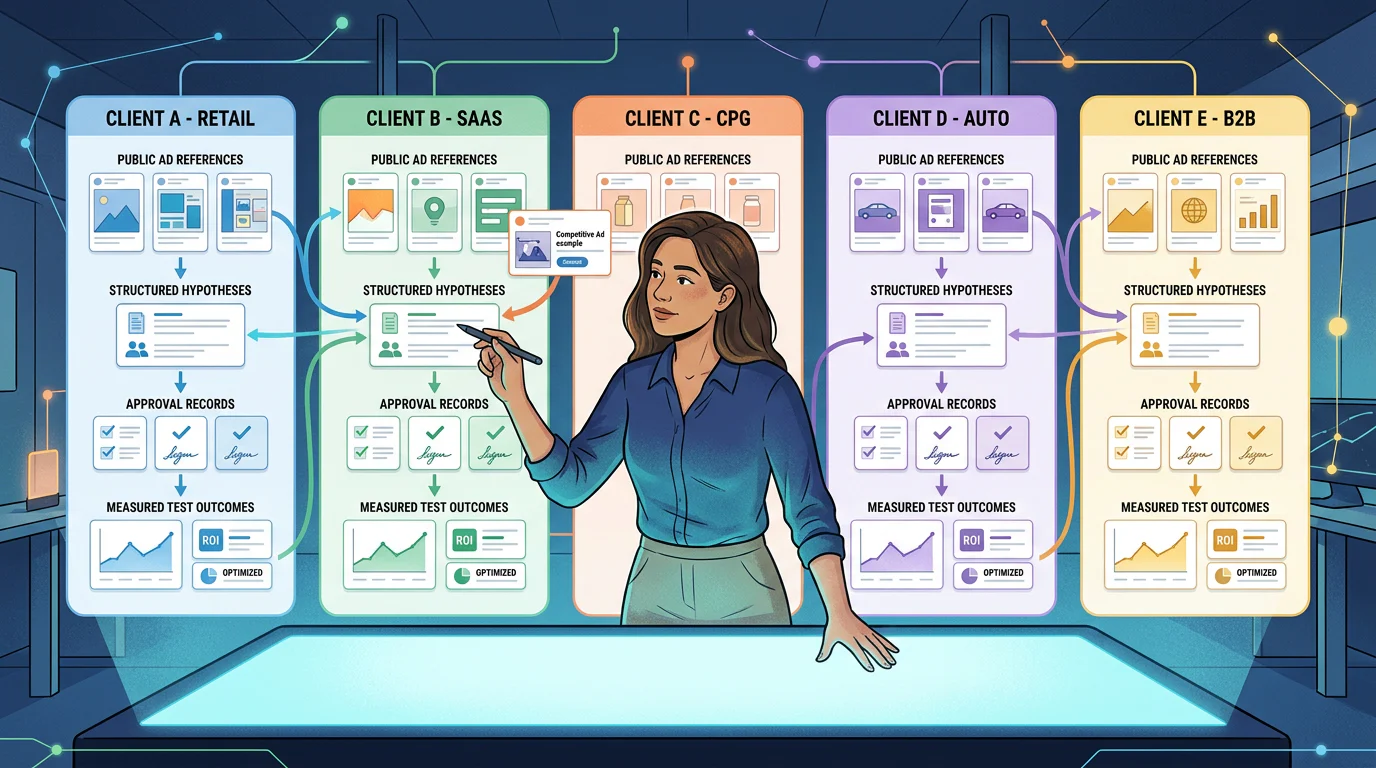
Agencies need creative intelligence that keeps client data separate while connecting competitor observations to each account’s test plan. The essential workflow is collect, classify, compare, recommend, and measure. A platform is a poor fit if it offers a large ad library but cannot preserve evidence, normalize creative attributes, support approvals, or show what a recommended test taught the team.
What Should an Agency Demand Before Buying Creative Intelligence Software?
Choose creative intelligence software only when it can isolate client evidence, connect dated public observations with authorized account inputs, and retain the decision through approval and measurement. For a lean paid-social team, the best fit is the category that closes its current gap, research, analysis, governance, production, or next-test prioritization, rather than a universal “best” platform.
Creative intelligence is the decision layer between competitor research and creative testing. It classifies observable creative attributes, such as hook, offer, format, visual treatment, or message, then compares them with a client’s own performance and past tests to identify a defensible next hypothesis. It can inform a test; it cannot make a public observation causal proof.
| System category | Multi-client fit | Competitor capture, archive, and tags | Own-performance inputs | Approvals | Test recommendations | Pricing basis to inspect | Evidence transparency |
|---|---|---|---|---|---|---|---|
| Research-only | Useful when collections and notes remain client-specific | Public-ad capture and tagging are central; verify dated archive retention | Usually limited | Often handled elsewhere | Usually manual | Users, monitored brands, saved items | Source, capture date, market, and original creative should remain attached |
| Performance analytics | Useful for account reporting | Usually limited; may classify an agency’s own creative | Core function | Usually review-level | Often needs strategist interpretation | Accounts, spend, connectors, seats | Metric definitions, attribution window, and date range should be visible |
| Generation and launch | Useful for production throughput | References may be added manually; asset history varies | May use supplied prompts or data | Required before publishing | Suggests variants, not necessarily controlled tests | Credits, assets, seats, usage | Separate model predictions from live account results |
| Testing and governance | Useful for controlled production and standards | May attach references and archive test assets | Depends on integrations | Often central | Helps define conditions and decision rules | Tests, markets, assets, implementation | Show control, changed variable, conditions, and decision rule |
| Decision support | Strong for ranked client test queues | Should retain dated captures, taxonomy, and prior evidence | Essential | Essential | Core function | Client accounts, seats, source scope, onboarding | Keep inputs, hypothesis, outcome, and retained learning together |
| Account automation | Useful for campaign operations | Usually secondary | Core function | Guardrails matter | May trigger account actions rather than explain a creative rationale | Spend, accounts, automation volume | Log actions, triggers, and reversals where applicable |
A platform can be strong in one category and weak in another. A research system may solve an agency’s scattered market inputs, for example, but not the stalled client review where nobody can defend the next test.
Use this weighted rubric before a demo or trial. Score each area 0 when absent, 0.5 when demonstrated but constrained, or 1 when demonstrated in the agency’s required workflow and confirmed in writing. Multiply that score by the weight, then sum the results; the maximum is 100 points.
| Evaluation area | Weight |
|---|---|
| Client isolation, permissions, and auditability | 20 |
| Competitor capture, historical archive, and tagging | 15 |
| Own-ad ingestion and creative-attribute normalization | 15 |
| Test recommendations and retained learning | 20 |
| Approvals, exports, and production handoff | 10 |
| Account limits, seats, usage caps, and onboarding | 10 |
| Method and evidence transparency | 10 |
| Total | 100 |
Ask the vendor to demonstrate one client workspace, one dated observation, one recommendation, one approval, and one handoff record. A feature list is not proof that those pieces remain connected.
Use this copyable decision record for every recommendation:
Client workspace:
Decision date and owner:

Public observation:
- Source:
- Capture date:
- Market:
- Ad details:
- Observable hook, offer, format, visual, or message:

Classification:
- Creative attribute:
- Why it may matter for this client:
- What the observation cannot establish:

Hypothesis:
- If we change:
- While holding constant:
- We expect:

Test design:
- Control:
- Single creative variable:
- Primary metric:
- Guardrail:
- Comparable delivery conditions:
- Scale, stop, or revise condition:

Approval:
- Approver:
- Due date:
- Handoff destination:

Measurement:
- Result window:
- Material delivery, offer, or measurement changes:
- Learning label: pattern observed / result / winner / retained learning
Which Competitor Signals Are Useful, and What Can They Never Prove?
Public competitor ads can reveal observable messaging, offers, formats, hooks, placements, and creative changes that an agency has captured over time. Meta’s public Ad Library supports advertiser and keyword research; dated agency captures, rather than an assumed complete public history, are what make change-over-time comparisons defensible.
Visible ads do not reveal a competitor’s private ROAS, CPA, margin, customer quality, attribution model, or causal reason for running an ad. A study comparing observational approaches with 15 US Facebook experiments found that observational methods often did not reproduce randomized effects. The study is a warning against causal performance claims from observed activity, not a creative-test template.
Set the label before the team discusses the finding:
- Pattern observed: Dated, attributable observations from a predefined review period that share a defined creative attribute. It records what appeared, not whether it worked.
- Result: An own-account outcome against a named comparator under recorded conditions. If delivery conditions differ materially, label it directional.
- Winner: A result that meets the client’s pre-agreed success threshold within its stated measurement window against a named control under comparable conditions.
- Fatigue signal: A pre-specified change against a stated baseline and comparison window after checking for audience, offer, budget, placement, delivery, and measurement changes.
- Recommendation: A proposed next action with named inputs, one hypothesis, one primary variable, an owner, a metric, and a scale, stop, or revise condition.
This vocabulary protects the agency in a client review. It separates a useful market signal from a claim that the agency can defend only after its own test. For a fuller research discipline, start with a testable Meta competitor brief.
How Does an Agency Turn a Competitor Pattern Into a Client-Specific Test?
Use the full collect-to-measure flow:
Collect public observations
→ Classify creative attributes
→ Compare with the client’s context and past tests
→ Recommend one hypothesis
→ Approve the test
→ Test under comparable conditions
→ Measure against the decision rule
→ Retain the learning
The following is an illustrative scenario, not a client result.
Client workspace: Client C
Decision date and owner: Weekly review — agency strategist

Public observation:
- Source: Public Meta ad capture
- Capture date: 12 and 14 September 2026
- Market: US
- Ad details: Three category ads open with a practical product demonstration,
  then introduce the offer.
- Observable attribute: Demonstration-first opening

Classification:
- Why it may matter: Client C’s current control opens with a claim before
  showing the product.
- What the observation cannot establish: Whether the observed ads are
  profitable, causal, or suitable for Client C’s offer.

Hypothesis:
- If we change: The opening sequence from claim-first to demonstration-first
- While holding constant: Offer, landing page, audience plan, principal format,
  and the agreed delivery conditions
- We expect: Improvement in Client C’s agreed conversion outcome without
  breaching the CPA guardrail.

Test design:
- Control: Current claim-first creative
- Single creative variable: Opening sequence
- Primary metric: Client C’s agreed conversion metric
- Guardrail: Client C’s agreed CPA threshold
- Comparable delivery conditions: Record material differences in delivery,
  audience, budget, placement, offer, or measurement.
- Scale, stop, or revise condition: Apply the client’s pre-agreed rule after
  its stated result window.

Approval:
- Approver: Named client owner
- Due date: Before production begins
- Handoff destination: Confirmed client-approved delivery route

Measurement:
- Result window: Client C’s pre-agreed test window
- Material changes: Record before applying a winner label
- Learning label: Pending test result
The competing advantage in this example is real: a demonstration-first opening may improve attention while attracting less-qualified clicks. If clicks rise but the agreed conversion outcome weakens, the next action is not to copy more competitor ads. Investigate message match, offer clarity, or audience response, and retain the result as a qualified learning.
Before approving a conclusion, use a fair creative test control. If the record cannot name one changed variable, a client-specific metric, and a way the hypothesis could fail, it is research, not a test recommendation.
How Should Five Client Accounts Move From Research to Approval Without Data Leakage?
An agency managing five accounts needs five separate decision trails, even when it uses one shared market taxonomy.
In this illustrative operating model, each client workspace has its own authorized account inputs, dated observations copied into that workspace, prior tests, approval record, and recipient-specific handoff permissions. The agency configures:
- Review cadence:
[review cadence] - Creative volume per account:
[creative volume] - Named agency and client stakeholders:
[stakeholder count]
A shared taxonomy can include labels such as “demonstration-first,” “founder story,” or “price objection.” It must not carry Client A’s private performance, notes, approval history, or failed-test rationale into Client B’s workspace.
At each review, the strategist records relevant observations in the correct client workspace, compares them with that client’s history, and presents one approved hypothesis per account. The next review records the outcome or reason for deferral before another recommendation enters that account’s queue. If an agency has capacity to run concurrent tests, it should document why the variables, audiences, and measurement conditions will still support a useful conclusion.
Before purchase, require the platform to demonstrate:
- Separate client workspaces or an equivalent enforceable separation.
- Permissions for who may view, edit, approve, and hand off each record.
- The exact fields that survive an export or handoff.
- Approval identity, decision date, and final test condition attached to the recommendation.
- A way to retain the outcome with the original evidence and hypothesis.
How Should Agencies Compare Categories, Commercial Terms, and Proof of Learning?
Price is an operating-cost question, not a headline subscription question. A low entry price can become expensive if five client accounts require additional seats, sources, archived observations, exports, onboarding, or support.
Ask for these terms in writing:
- How many client accounts, brands, workspaces, and users are included?
- Which roles can view, edit, approve, and export?
- Are competitor capture, historical archiving, and tagging capped?
- Which own-account connections and metrics are included?
- Does pricing change by account, seat, spend, asset, credit, source volume, or usage?
- What onboarding work is required before the first usable recommendation?
- Which fields survive the agreed handoff route?
- What happens to decision records, permissions, and retained learning when a client is added or leaves?
Evidence transparency is the final buying test. The agency should be able to trace a recommendation from the public observation and client inputs, through the hypothesis and approval, to the conditions and result. A recommendation need not win to be valuable; it must reveal whether to scale, revise, rerun, or deprioritize the direction.
How Deepsolv Helps?
Deepsolv fits agencies whose constraint is deciding which Meta creative hypothesis deserves production and media attention next. It combines competitor activity, customer signals, authorized performance data, and past experiments into ranked weekly decisions and decision-ready briefs. Current public materials use tailored workflow pricing; confirm client-account units, delivery method, exports, API access, permissions, and onboarding requirements in writing. Review the current agency pricing and integration questions.
The right creative intelligence platform for five accounts is the one that can demonstrate a defensible decision record for each account. If your agency needs to map that workflow to its live test queue, book a tailored workflow review.
What Else Should Agencies Ask Before Committing?
What Should Happen When A Client Revises An Approved Recommendation?
Keep the original recommendation and record whether the client accepted, revised, deferred, or rejected it. A revision should create a new version with its own changed variable, approval, and measurement conditions; otherwise the eventual result cannot be tied to the decision that actually entered production.
How Should An Agency Treat A Result When Delivery Conditions Differ?
Do not compare it as a clean winner against the original control. Record the difference, label the outcome directional, and decide whether to investigate the confounder or rerun the test under comparable conditions.
Can An Agency Compare Meta Results With Another Channel?
Only after aligning metric definitions, conversion events, attribution windows, audience conditions, and each channel’s role in the funnel. Another-channel result can inspire a Meta hypothesis, but it should not be merged into a Meta conclusion without that normalization.
What Must A Five-Account Pilot Demonstrate Before Contract?
The pilot should show separated client records, a dated input becoming a recommendation, the approval trail, the intended handoff route, and the full commercial scope. Confirm included accounts, seats, sources, onboarding work, usage limits, and any overage triggers before treating a pilot price as the operating price.
What If A Platform Cannot Hand Off The Full Decision Record?
Require a live demonstration and written scope for the exact destination, fields, permissions, retention, and delivery schedule your agency needs. If the route cannot preserve the evidence, hypothesis, owner, and decision rule, the team will recreate work elsewhere and lose traceability.
When Should A Shared Market Observation Enter A Client Workspace?
Only after it has a source, capture date, market, classified attribute, and a client-specific reason for review. The record should also state what the observation cannot establish, so a shared market signal never becomes shared client performance evidence.