6 Madgicx Alternatives for Meta Teams Focused on Creative Decisions
Madgicx alternatives are not interchangeable. This ranking places each product against the creative-workflow job it most directly addresses: deciding, automating, researching, analysing, generating, or activating.
- Fit for a distinct Meta creative-workflow constraint
- Current product capability documented during September 2026 research
- A current commercial route or public price available during research
- Clear trade-off relative to the other entries

By Sachit Sharma, CEO & Founder · Reviewed 20 Sept 2026
In brief
The right Madgicx alternative depends on the work your team needs to improve. Choose Deepsolv for ranked creative-test decisions, Bïrch for automation, Foreplay for research, Motion for analytics, AdCreative.ai for asset generation, or Meta Ads Manager for native activation.
Deepsolv
Creative decision intelligence for Meta growth teams.
Deepsolv is our product. Choose it when the bottleneck is deciding what to test, improve, or stop before production time and media spend are committed.
Pros
- Combines competitor activity, customer signals, historical performance context, and past experiments into ranked test decisions.
- Produces a weekly test plan and execution-ready briefs for Meta growth teams and agencies.
Cons
- It is not positioned as an editable image or video asset-production tool.
- It is not a campaign-automation system.
Bïrch
Rules and strategies for connected ad accounts.
Choose Bïrch when campaign rules and repeatable execution are the main reason to leave Madgicx.
Pros
- Bïrch documents automated rules and strategies for connected ad accounts.
- Its documented connected channels include Meta, Google, Snapchat, and TikTok.
Cons
- Campaign automation does not by itself establish which creative hypothesis should be tested next.
- Pricing depends on monthly spend across connected accounts.
Foreplay
Ad research, swipe files, competitor tracking, and briefs.
Choose Foreplay when the team needs to collect, organise, and share creative inspiration before production.
Pros
- Documents research across Meta, TikTok, and LinkedIn ad libraries.
- Its Basic plan includes swipe files, discovery, briefs, and competitor-tracking features.
Cons
- Observed ads remain market context rather than proof of performance or profitability.
- The Basic plan includes one user, with additional users priced separately.
Motion
Creative analytics for paid-social performance patterns.
Choose Motion when ads are already running and the team needs creative-level reporting to identify patterns in account performance.
Pros
- Documents creative analytics, ad leaderboards, AI tags, tasks, and creative analysis.
- Documents support for Meta, TikTok, YouTube, and LinkedIn ad-account connections.
Cons
- Its Starter plan is limited to up to $50,000 in monthly ad spend.
- Analytics after launch does not replace a pre-production research and prioritisation process.
AdCreative.ai
AI-generated ad creatives, copy, photos, and videos.
Choose AdCreative.ai when the immediate constraint is producing more ad-asset variations rather than determining the next strategic test.
Pros
- Documents generation of ad creatives, ad copy, product photos, and product videos.
- Offers a seven-day trial on its public product site.
Cons
- Generated assets still need an independent decision rule and performance test.
- Creative scores and competitor observations should not be treated as proof that a concept will perform for a different account.
Meta Ads Manager
Meta's native environment for placements, creative uploads, and tests.
Choose Meta Ads Manager when the team needs to activate creative, select placements, and run a controlled A/B test in Meta's native environment.
Pros
- Meta documents placement selection and creative upload at the ad level.
- Meta documents A/B testing as a way to determine the impact of creative choices.
Cons
- Ads Manager does not turn competitor observations and customer signals into a ranked creative-test queue.
- The team still needs a process to document what a result should change in the next test.
The rank is an editorial order of workflow fit, not a score or a claim of universal superiority. Prices were captured from the named providers' public pricing or product listings in September 2026. Competitor capability and price claims are attributed to the named providers without links. The Meta creative testing framework is useful for carrying any selected option into a controlled test.
The useful comparison is between jobs, not dashboards
Madgicx spans campaign optimisation, automation, creative generation, launching, and analytics. A replacement decision should therefore start with the blocked job, not with an all-purpose feature checklist. This ranking reflects fit for one of six creative-workflow jobs as of September 2026.
Meta says its Ad Library can show active ads, creative content, delivery dates, and where an ad appeared, but those observable fields do not reveal another advertiser's private ROAS, CPA, revenue, or profit. Treat competitor activity as a hypothesis source, then use your own account data and a creative test queue to decide what earns a test. Meta's Ad Library documentation describes the available ad fields and their limits.
Move from visible activity to a recorded test
A good workflow keeps market observation separate from performance proof. It also gives each proposed test an owner, a metric, and a decision rule before budget is committed. See how visible ads become testable briefs and how to choose a fair control ad.
Five inputs behind a test decision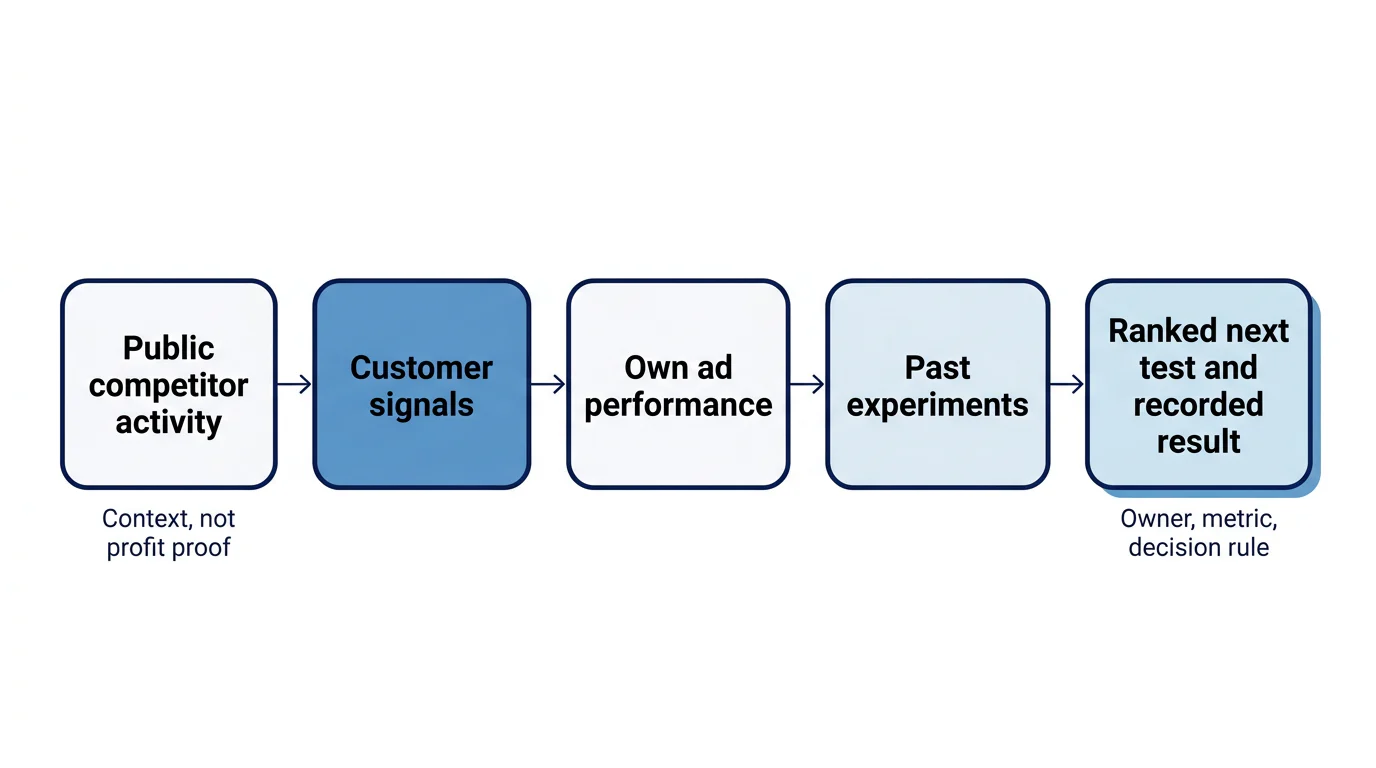
Keep reading



Frequently asked
A Madgicx alternative may replace only one part of the workflow, such as campaign automation, competitive research, creative analytics, asset generation, or native campaign activation. Teams should identify the delayed decision or execution task before switching tools.
Deepsolv fits teams whose constraint is prioritising creative work before production and media spend. Its stated workflow combines competitor activity, customer signals, historical ad-performance context, and previous experiments into a ranked weekly test plan.
No. Meta Ad Library information can reveal observable creative, delivery dates, and placements, but it cannot establish a competitor's private ROAS, CPA, revenue, profit, or causal lift. A team needs its own authorised account data to evaluate a similar idea.
Not necessarily. A team that values Madgicx's campaign-management workflow may keep it and add a specialised layer for research, creative analysis, or next-test decisions. Replacing a tool makes sense only when the new tool addresses the actual operating constraint.
Meta Ads Manager is the native place to select placements, upload ad creative, and run A/B tests. It is relevant when the team primarily needs campaign activation and controlled testing rather than an additional third-party workflow.
Bring the next Meta creative test into focus
Review the team, account, and source scope behind a ranked weekly test workflow.
Discuss your test workflow