What Is an Ad Angle? A Swap Test to Tell It From a Hook
An ad angle is the single argument an ad makes for why one specific person should buy, separate from its hook, concept, format and offer, and checkable with a swap test.

By Sachit Sharma, CEO & Founder · Updated 23 Nov 2026

Key takeaways
An ad angle is the one reason a specific person should care. Write each ad's argument as "[Person] should [act] because [reason]", with the hook, offer and format words removed. If two ads give the same reason, they share an angle.
- An angle sits above a concept and a hook, and format and offer are separate layers you can hold constant. Change the angle and the concept and hooks change with it. Change the hook and the angle stays put.
- Five top-ranking guides list between 5 and 10 year-round angle types and differ on most categories, so build your own list from customer language rather than copying one.
- Name every Meta test by the layer you changed. A hook swap is iteration, and a new angle is how you get ads that differ in substance.
In this article
- 1What is an ad angle, and how is it different from a hook or a concept?
- 2How do you tell whether two ads use the same angle?
- 3Which part of an ad line is the angle? An eight-line sorting exercise
- 4Why do lists of ad angle types disagree so much?
- 5Why does naming the angle change how you test on Meta?
- 6How do you write an ad angle brief?
- 7How do we find and rank angles at Deepsolv?
- 8Frequently asked questions
Two ads can have different headlines, images and buttons and still make the same argument. Two ads can look almost identical and make different ones. Teams that cannot tell which case they are in end up running tests that change one line of copy and then reporting that a "new angle" won or lost.
The word is used loosely. Some people use it for the opening line, some for the video style and some for the discount. That looseness is expensive on Meta (Facebook and Instagram advertising), because you can only learn from a test if everyone agrees on what was changed.
This page gives you a definition you can apply, a swap test that sorts any ad, a one-page brief card for writing an angle down, and an explanation of why published lists of angle types do not agree. The swap test lets you take any two ads and say, in one sentence each, whether they argue the same thing.
What is an ad angle, and how is it different from a hook or a concept?
An ad angle is the main argument an ad makes: why this person, with this problem or desire, should buy. It is a reason, not a line of copy. The other layers carry that reason to the viewer, and each layer can change without touching the one above it.
| Layer | What it is | Example (reusable water bottle) |
|---|---|---|
| Angle | The one argument for one kind of person | Stop paying for bottled water every day |
| Concept | The repeatable creative idea that dramatizes the angle | A week of bottled-water receipts next to one refill |
| Hook | The first line or first seconds that earn attention | "How much did you spend on water this week?" |
| Format | The container | 15-second vertical video, carousel or static image |
| Offer | The deal attached | Free shipping this week |
One angle supports many concepts, and one concept supports many hooks. A new angle forces a new concept and new hooks. A new hook leaves the angle alone.
How do you tell whether two ads use the same angle?
Run the swap test: write each ad's argument as "[Person] should [act] because [reason]", with the hook, offer and format words removed. If the two sentences give the same reason, the ads share an angle. If the reasons differ, they have different angles.
- Write each ad's argument in one sentence: "[Person] should [do something] because [reason]."
- Strip out every word that belongs to the hook, the offer or the format.
- Compare the two sentences. Pass: the reasons are the same, so the ads share an angle and a test between them is a hook or concept test. Fail: the reasons differ, so the ads have different angles.
- If you cannot fill the sentence, you have a feature or an offer, not an angle yet.
A common failure is a sentence with two reasons ("it saves money and looks great"). Treat that as two angles squeezed into one ad. When it wins or loses, you cannot say which reason did the work.
Which part of an ad line is the angle? An eight-line sorting exercise
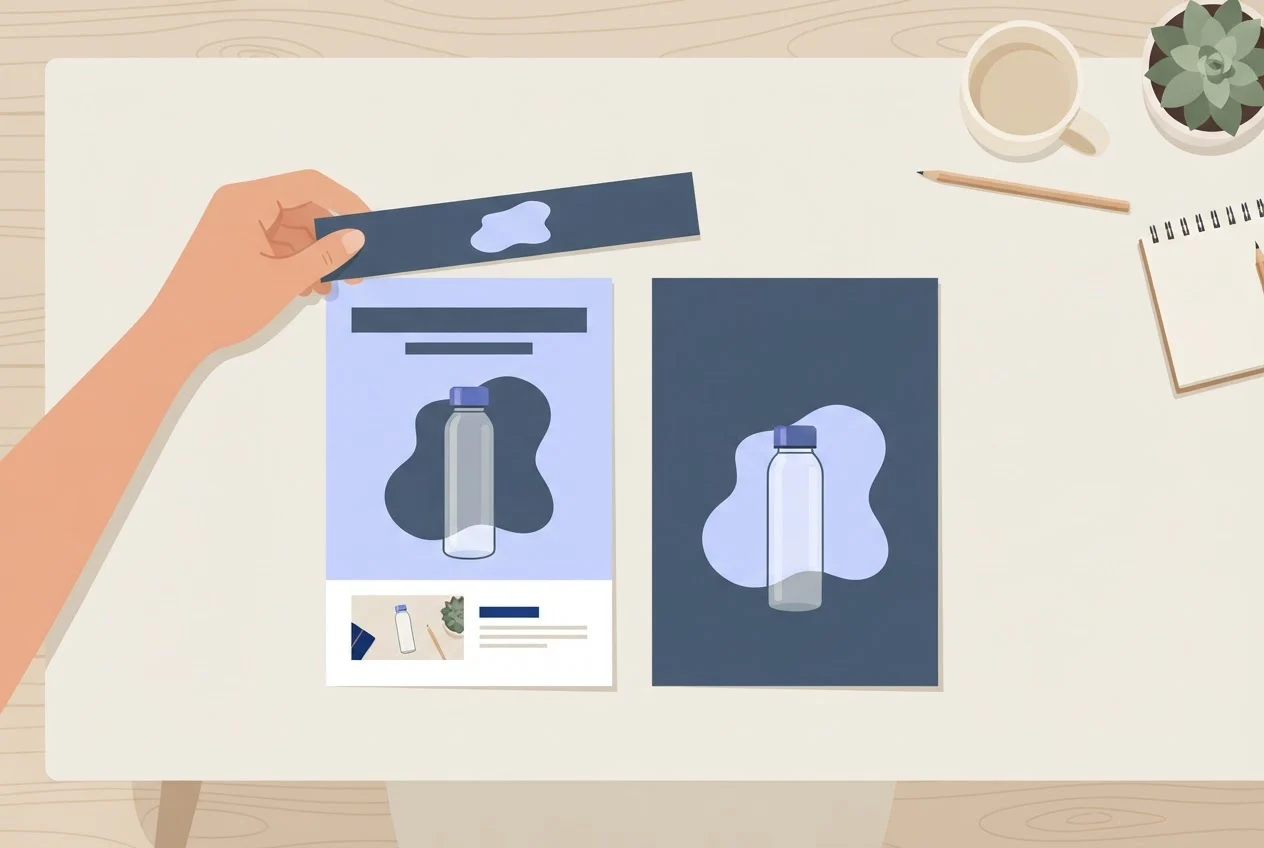
The angle is the line that gives a specific person a reason to buy. Offers, formats and features are not angles unless they carry one. Sort these eight lines for the water bottle above: cover the right-hand column and label each line before you check.
| Line | Label | Why |
|---|---|---|
| "Stop paying for bottled water every day." | Angle | A reason to buy, aimed at someone who buys bottled water |
| "Free shipping this week." | Offer | A deal, with no argument about why this person needs the product |
| "A week of bottled-water receipts next to one reusable bottle." | Concept | A creative idea that dramatizes the cost angle |
| "How much did you spend on water this week?" | Hook | The opening line that draws someone into the argument |
| "Keeps drinks cold all day." | Feature, not yet an angle | Add a person and a problem ("gym-goers whose water is warm by the second set") and it becomes one |
| "15-second vertical video filmed at a desk." | Format | The container |
| "Unboxing." | Format | A way of showing the product, with no argument by itself |
| "Fits the school-run lunchbox, so parents stop buying juice boxes." | Angle | A person (parents) and a reason (stop buying juice boxes) |
Features, offers and formats are the usual impostors. Each is useful, but none gives the viewer a reason to care. An angle does.
Why do lists of ad angle types disagree so much?
Published lists disagree because each author invents a taxonomy, and the categories are not a standard. We counted the named angle categories in five dedicated guides ranking in Google's US top ten for "what is an ad angle", reading each on 23 November 2026. We publish this page. Deepsolv sells Meta creative-intelligence software, and two of the five guides come from ad-intelligence vendors that sell overlapping tools.
| Guide | Angle categories listed |
|---|---|
| 5 | |
| 6 | |
| 7 | |
| 8 | |
| 10 year-round, plus 3 seasonal |
That is 36 year-round entries across the five. We matched categories by meaning, not by name, so the tallies below involve our judgment. Pain point and problem-solution counted as one category, as did testimonial and social proof, and comparison and us-versus-them. AdLibrary's "warning signs" was left unmatched to the problem category.
- Social proof or testimonial appears in all 5 guides.
- A problem or pain-point angle appears in 4.
- Comparison or us-versus-them appears in 3.
- Identity appears in 2.
- Most other categories appear in one guide only. AdLibrary's "new mechanism" and "failed-solution reframe" appear in no other guide.
Some entries on the longest list describe an offer or a format, not an argument. In our reading, Influee's "offer", "tutorial" and "unboxing" fall into that group, which is the mixing of layers the sorting exercise above is meant to prevent.
In our view, these five guides show there is no agreed list. Use any list as a prompt, then write your own categories from what your customers say, in their words. Reviews, comments, support tickets and your own post-purchase survey questions are better raw material than a template, and mining reviews for Meta ad angles shows how. Competitor ads are the other source: what US ads show in the Facebook Ad Library explains how to log them. A competitor running an angle shows they believe in it, not that it works.
Why does naming the angle change how you test on Meta?
Naming the angle tells you what a test can prove. Meta separates creative iteration, which it illustrates as "two ads with identical visuals, but different text CTAs", from creative diversification, assets "tailored to different potential customer personas or use cases" (Meta Business, Demystifying Creative Diversification, 16 December 2025).
In our view, a hook swap lands in the first group. A genuinely new angle is the most reliable way to reach the second, because it changes who the ad is for and why they should care.
Our practice for tests:
- Change one layer at a time and name the test after it. If the angle is the same and only the opening differs, call it a hook test. If the argument differs, call it an angle test.
- Hold the offer and the landing page steady across an angle test, so the angle is the only difference. Our page on matching a landing page to your ad angle covers the second half.
- Write the hypothesis before launch. Our A/B test hypothesis template gives the format.
- Log each ad with four tags: angle, concept, hook, format. Pool ads by angle, not by ad. Our guides to creative angle performance tracking and which Meta ad angles drive conversions cover pooling and metrics.
How do you write an ad angle brief?
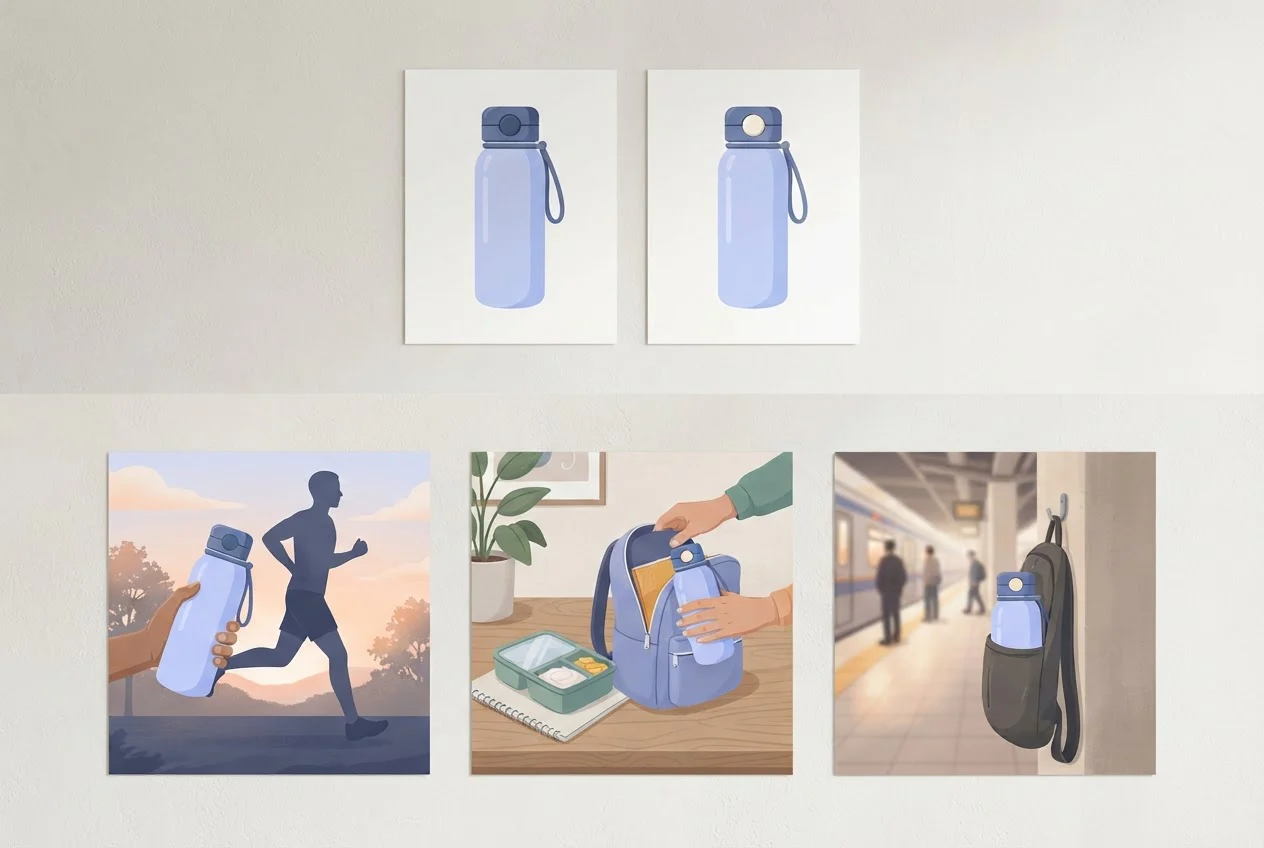
Fill in one card per angle before anyone designs anything. Each field has a pass-or-fail check, so a reviewer can reject a weak card quickly.
- Who it is for.
One named person or situation. Fail: "everyone", "shoppers".
- What they believe or struggle with now.
Pass: you can paste a real customer line (a review, comment or ticket) that shows it.
- The argument.
One sentence: "[Person] should [act] because [reason]." Fail: two reasons, or a reason that is only a feature.
- Proof.
A fact, demo or result you hold today. Pass: you can attach the proof (a review, a test result or a demo clip). Fail: a claim you cannot back up.
- Where it came from.
Customer language or a competitor ad. Fail: "brainstorm".
- Three hooks.
Pass: the three openings use different words and the one-sentence argument is unchanged. If it changes, you have written a second angle.
- Kill rule.
The target CPA (cost per acquisition, what you will pay for one purchase) and test budget, set before launch. Pass: the card states a target CPA, a test budget and a stop condition such as "stop at 2x CPA with no purchase". Fail: any of them missing.
Once you have draft concepts, our free AI Ad Attention Heatmap takes up to five images with no signup; AI heatmap generators for ads compared covers the options.
How do we find and rank angles at Deepsolv?
We combine the sources that feed angle writing into one weekly plan. Deepsolv is a creative decision intelligence platform for direct-to-consumer (DTC) and ecommerce brands scaling on Meta. It takes ad-performance data, competitor activity, customer signals and past ad learnings and turns them into ranked weekly creative test plans and execution-ready creative briefs, with the reasons behind each recommendation.
- Competitor ads. Our competitor winning-creative analysis uses proprietary modeling to identify which competitor ads are winning and what makes them work, so you see which angles a rival keeps running.
- Customer language. Our social listening combines Instagram mentions, comments, reviews and Reddit to surface angles you have not tried. The core platform connects to Reddit, product reviews, customer-support tickets, Instagram and Facebook comments, Shopify and Meta Ads Manager.
- Your own history. Our creative explainability and experimentation feedback loop explains why creatives and hypotheses succeeded or failed, and feeds those learnings into future test plans.
Recommendations guide experiments and do not guarantee profitable ads. We fit best with mid-market and enterprise teams spending around $50,000 a month on Meta. Below that, the swap test and the brief card above work without any software. Use the card on any plan you receive, ours included.
If you want to see how this works on your own account, book a demo with our founding team.
See how Deepsolv ranks your next Meta ad angles
Frequently asked questions
Sources
- 1.Meta Business, Demystifying Creative Diversification (16 December 2025), Meta Business, 16 December 2025
- 2.Adquisition
- 3.AdHeart
- 4.AdLibrary
- 5.Playad
- 6.Influee