Post-Purchase Survey Questions: 4 That Feed Meta Ad Tests
Post purchase survey questions work best as four: how the buyer first heard of you, what almost stopped them, why they chose you, and who the order is for.

By Sachit Sharma, CEO & Founder · Updated 6 Nov 2026

Key takeaways
- Ask four questions on the thank-you page: how they first heard of you, what almost stopped them, why they chose you, and who the order is for. Only the first needs a fixed answer list.
- Questions about delivery, packaging and product quality cannot be answered on the confirmation page, because nothing has arrived. Send them in an email after delivery.
- With 100 orders a week and a 30% response rate (our assumption), a month gives about 120 answers. A 30% channel share then carries a margin of about ±8 percentage points.
- A survey asks where a buyer first heard of you, while Meta reports clicks and views inside a window. Treat a gap between the two as real only when it is bigger than the margin.
In this article
- 1Which post purchase survey questions should you ask on the thank-you page?
- 2Why can't you paste the top-ranking survey lists onto a thank-you page?
- 3How many survey responses do you need before a channel share means anything?
- 4How do you compare survey answers with what Meta reports?
- 5How do you turn post-purchase survey answers into Meta ad tests?
- 6Where does the post-purchase survey go on a Shopify store, and why did mine disappear?
- 7How does Deepsolv turn customer language into Meta creative tests?
- 8Frequently asked questions
A post-purchase survey is a short set of questions shown to a customer right after they pay, usually on the order confirmation page. The lists that rank for this search give you dozens of questions. A buyer on the confirmation page has received nothing, so they can only answer about how they found you and why they bought.
The answers that earn a place are the ones that change what you make next. Those are the channel a buyer remembers, what nearly made them leave, and what finally convinced them. Satisfaction scores and delivery ratings belong in an email after the package arrives, because the buyer cannot rate something that has not shown up yet.
This page gives you the four questions with answer options you can paste in. It also gives the number of responses you need before a channel share means anything, and a decode sheet that turns each answer into a Meta ad test. Deepsolv publishes this page, and none of the lists we counted are ours.
Which post purchase survey questions should you ask on the thank-you page?
Ask four: how the buyer first heard of you, what almost stopped them, why they chose you over other options, and who the order is for. The first needs a fixed answer list. The other three can be short and optional, and they give you the exact words buyers use.
- How did you first hear about us? Pick one. Offer only channels you actually use or want to learn about: Facebook or Instagram ad, Facebook or Instagram post (not an ad), TikTok, YouTube, Google search, Reddit, Podcast, Friend or family, I've bought from you before, Other (write it in). Rotate the order for each visitor so the first option does not win by position.
- If they pick Facebook or Instagram, ask a follow-up: What did you see? Video ad, Image ad, Post from a creator, Message or post from a friend, Not sure. "Instagram" alone does not tell you which creative to make next.
- What almost stopped you from buying today? Optional open text.
- What was the main reason you chose us over other options? Open text.
- Who is this order for? Myself, A gift, Someone in my household.
Include "I've bought from you before" in question 1, so repeat buyers do not get counted as a discovery channel. Save every answer against the order number, so you can filter to first-time customers and match answers to the dates your ads ran.
Why can't you paste the top-ranking survey lists onto a thank-you page?
The ranking lists are written as question banks, not surveys. We counted six lists that rank for this search in November 2026 and found 226 questions between them, from 24 to 46 per list. We recommend four on a thank-you page, so most of those lists cannot be pasted in as written.
We counted the numbered or listed questions on six pages, opened in November 2026: Fairing, Formbricks, SurveyMonkey, Userloop, Qualaroo and Zonka. The counts were 24, 42, 38, 30, 46 and 46.
Three things stand out in the count:
- Four of the six include a question on how the buyer first heard of the brand, and three include "what almost stopped you". The Qualaroo and Zonka lists are near-identical, and neither has either question.
- Five of the six include a recommend-us question of the Net Promoter Score (NPS) type, which asks buyers to rate from 0 to 10 how likely they are to recommend you. That measures loyalty, not what to advertise.
- Several lists include delivery speed, packaging and product quality questions. A buyer on the confirmation page has received nothing, so they cannot answer them. Send those in an email after delivery.
The planning tables below assume a 30% response rate, which is our assumption and not a benchmark. Measure your own: answers received divided by the number of orders that were shown the survey, over the same dates.
How do you compare survey answers with what Meta reports?
Compare shares, not counts, and treat a gap as real only when it is larger than the survey's margin. The two measure different things. The survey asks where the buyer first heard of you. Meta credits an ad when someone clicked or viewed it within a window. As of November 2026, the default for new ad sets is 7-day click or 1-day view, where a click means a link click.
Build one row per channel for the same dates, using new customers only:
| Channel | Survey answers | Survey share | Margin (±points) | Meta share of new-customer orders | Gap | Act on it? |
|---|---|---|---|---|---|---|
| Facebook or Instagram | 36 of 120 | 30% | 8.2 | your figure | Meta share minus 30 | Only if the gap is larger than 8.2 |
Survey share is channel answers divided by total answers. The margin comes from the formula above. In the example row, 120 answers and a 30% share give 1.96 × √(0.3 × 0.7 ÷ 120) = 0.082, or ±8.2 points.
Our recommendation is to use the survey for discovery and angles (the single reason to buy that an ad leads with), and to keep budget decisions on your tracked results. In our judgement, three things can bias self-reported answers:
- Buyers name the most recent thing they remember, not the first.
- The first-listed option gets extra picks, which is why you rotate the order.
- They cannot always tell a paid ad from an organic post, which is why the follow-up question separates the two.
If a window mismatch is muddying your own tests, fix one attribution window per creative test.
How do you turn post-purchase survey answers into Meta ad tests?
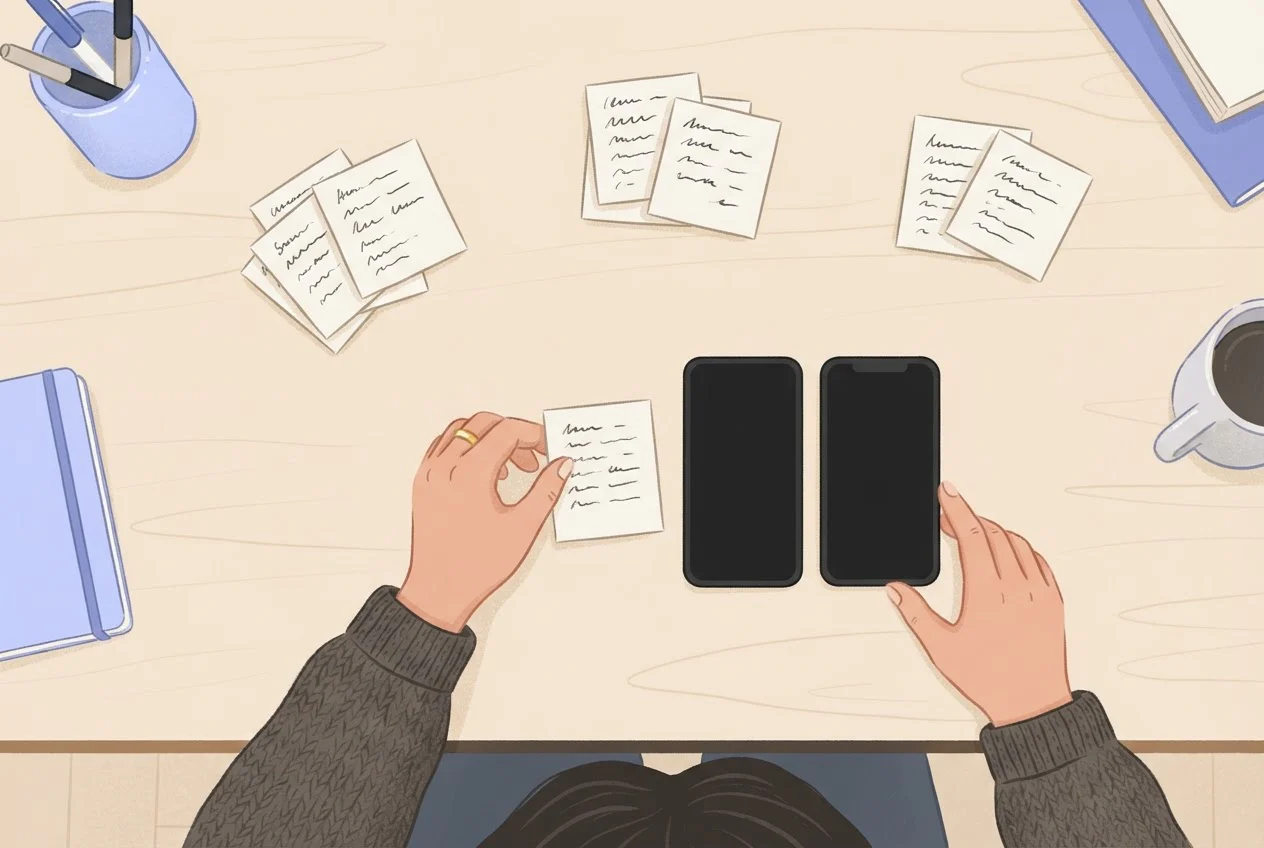
Read the open-text answers, tag recurring ideas, count them, and write each top idea into a hook (the opening line or first seconds of an ad) that you test against your current best ad. Each question maps to a test. Our ad hook testing framework covers how to run hook tests.
| Answer | What it tells you | Test to run |
|---|---|---|
| Q1: Facebook or Instagram, then "Video ad" or "Image ad" | The format buyers remember | Run the same angle as video and as static, same audience and budget |
| Q1: Podcast, friend, Reddit | Discovery that leaves no click trail | Write one ad in a recommendation voice and test it against your best ad |
| Q2: a repeated worry, such as fit, trust or shipping time | The objection your ads leave open | Put the answer to that worry in the first line of the ad |
| Q3: a repeated reason | The angle that closes buyers | Test each top reason as its own angle in the same format |
| Q4: gift vs self | Who you are speaking to | Test a gift-led ad against a self-use ad |
To code open text, read the first 100 answers and write a short tag for each recurring idea, such as price, fit, trust or delivery time. Count the tags, then quote the buyers' own words in the hook. As a starting rule of ours, a phrase that appears in 10 of 100 answers is worth a test.
Write the test as a hypothesis: "If we lead with [phrase from Q2 or Q3] instead of [current hook], then [metric] will rise among new customers, because [count] of [total] buyers named it." Our A/B test hypothesis template shows how to set the cost and the stopping rule. Our creative test capacity planner helps you size how many tests to run. If your answers are full of praise you can reuse, turn reviews into testimonial ad tests.
Where does the post-purchase survey go on a Shopify store, and why did mine disappear?
A Shopify post-purchase survey goes on the thank-you page (the order confirmation or order status page), through a survey app built for Shopify's Checkout Extensibility, the current way apps add blocks to checkout pages. Surveys that relied on the older script methods can stop showing.
As of 26 August 2026, Shopify no longer runs Additional Scripts, checkout.liquid customizations or script tags on the Thank you and Order status pages of non-Plus stores (Shopify's script tag blocking page and script tag deprecation page). Plus stores lost them on 28 August 2025 (Shopify changelog).
A Shopify Community thread walks through the fix. In the theme editor, go to Settings, then Checkout, then Customize, open the Thank you page and add the app block. The same step is repeated for the Order status page.
A test you can run: if the survey app does not appear in the "Add app block" list, it has not been rebuilt for Checkout Extensibility, and you should replace it. After any change, place a test order and confirm the survey appears and the answer saves against that order number.
How does Deepsolv turn customer language into Meta creative tests?
We turn customer signals into a ranked weekly test plan for Meta. Deepsolv is a creative intelligence platform that combines ad-performance data, competitor activity, customer signals and past ad learnings into ranked weekly creative test plans and execution-ready creative briefs.
If you already read reviews and comments for angles, we do that at scale as one input to the weekly plan; see review mining for Meta ad angles. By customer signals we mean what buyers write: reviews, comments, direct messages and Reddit discussions, which together make up the voice of the customer (VoC). We read them alongside your ad results and what competitors are running, and rank what to test next. We also keep what worked and failed from past ads, so next week's plan does not repeat last month's losing angle.
We sell through a personalized demo with our founding team. To see how a weekly plan would look for your brand, book a demo.
See your weekly Meta creative test plan
Frequently asked questions
Sources
- 1.Blocking script tags, Shopify
- 2.Script tag deprecation, Shopify
- 3.Extensibility is now available for Plus merchants on thank you and order status pages, Shopify Changelog
- 4.Thank You page upsell or widget gone after August 26? What changed and the 10-minute fix, Shopify Community
- 5.Change your attribution window for ad results in Ads Manager, Meta Business Help Center
- 6.American Community Survey Accuracy of the Data (2016), U.S. Census Bureau
- 7.24 of the Best Post-Purchase Survey Questions, Fairing, opened November 2026
- 8.40+ Post-Purchase Survey Questions, Formbricks, opened November 2026
- 9.Post Purchase Survey Questions: Strategy & Guide, SurveyMonkey, opened November 2026
- 10.30 Post-Purchase Survey Questions That Drive Revenue, Userloop, opened November 2026
- 11.Post-Purchase Surveys: What Is It, Methods and Questions, Qualaroo, opened November 2026
- 12.Post-Purchase Surveys: Examples, Best Practices, and Sample Questions, Zonka Feedback, opened November 2026