What a Creative Strategist Does, Counted From 9 Job Postings
A creative strategist chooses which ad idea gets tested next, writes the brief for it, and reads the results to pick the following test. Only one of nine postings read required editing.

By Sachit Sharma, CEO & Founder · Updated 3 Oct 2026

Key takeaways
- 01
A creative strategist decides which ad idea gets tested next, writes the brief that makes it producible, and reads the result to choose the test after. Judgment and writing matter more than craft.
- 02
In our October 2026 count of nine postings, seven named a testing plan, seven named reporting to clients or stakeholders and six named briefs. Only one required editing and only one named media buying.
- 03
The role ends where budgets and bids begin. Deciding what to test belongs to the strategist, and deciding where the money goes belongs to the media buyer.
- 04
A brief with one hypothesis, one changed variable and a stop rule written before launch is the strategist's main work product. A template is below.
In this article
- 1What does a creative strategist do day to day?
- 2What do employers actually ask a creative strategist to do?
- 3Where does a creative strategist stop and a media buyer start?
- 4Why do creative strategist tests so often teach nothing?
- 5What does a good creative brief look like?
- 6What does a creative strategist earn, and how much experience do employers want?
- 7How does software help a creative strategist run the weekly loop?
- 8Frequently asked questions
The job title sounds like a design role, but the postings read like a writing and analysis role. Employers spend more words on test plans, briefs and reporting than on editing software or ad budgets, and that gap trips up applicants and hiring managers alike.
Applicants practice design tools when they should practice writing a hypothesis. Managers hire a gifted editor, call the person a strategist, and get polished ads that teach the team nothing about what to make next.
The counts below come from a small set of postings we read in October 2026. They show what employers write down, not what interviews test. Treat the patterns as directional.
This page covers the work itself, where it ends and the media buyer's job begins, why tests so often fail, and what five employers pay. It closes with a one-page brief template and five pass-or-fail checks.
What does a creative strategist do day to day?
A creative strategist runs a loop of four steps: research the customer, write the brief for the next ad test, run the test with the media buyer who manages the ad budget, and record what the result means. The output of the job is a decision about what to make next, not an ad.
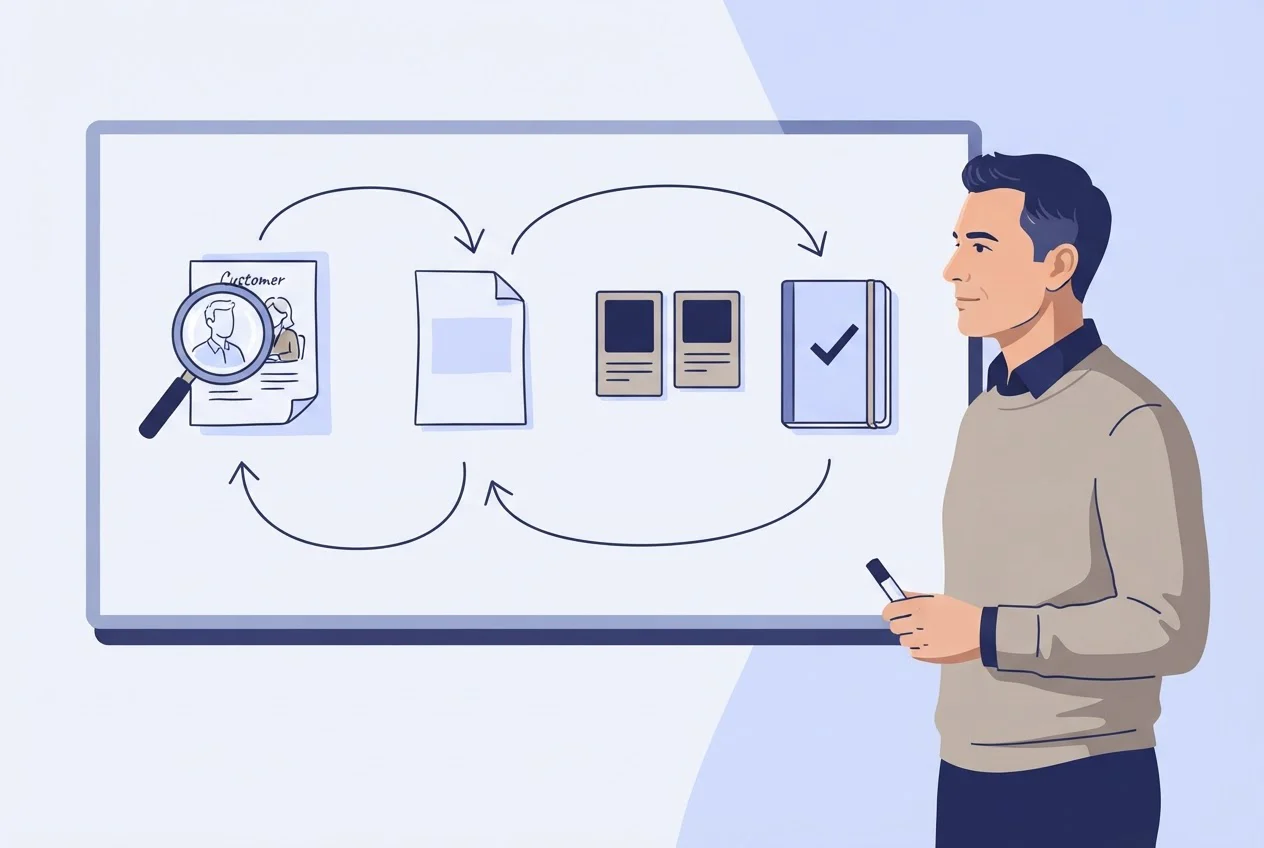
- Research the customer. Read reviews, comments, support tickets and competitor ads to find the words customers use for their problems and objections. Our guide to review mining for Meta ad angles covers this step.
- Write the brief. A brief is a one-page document that tells editors, designers or creators what to make and what the ad is supposed to prove. It states a hypothesis, which is a guess about what will happen and why.
- Run the test. Launch the new ad against the control (the existing ad the new one is compared against), usually on Meta (Facebook and Instagram) or TikTok, working with the media buyer. Agree a stop rule first: the metric, threshold and spend or days at which the test ends.
- Record the learning. Read metrics such as hook rate (how many viewers get past the opening seconds), click-through rate (CTR, clicks divided by impressions), cost per acquisition (CPA, ad spend divided by purchases) and return on ad spend (ROAS, revenue divided by ad spend). Then write down what the result changes about the next brief.
The fourth step is the one teams skip. A test whose lesson is never written down gets repeated six months later.
What do employers actually ask a creative strategist to do?
Employers most often ask for a creative testing plan, reporting to clients or stakeholders, and a written brief. In the nine postings we read, only one required hands-on video editing and only one included media buying.
We found the postings through web searches for creative strategist roles in paid social, which returned Built In listings, company job pages and recruiter boards. We kept those whose full text we could read and that described paid social creative work. All were remote, hybrid or on-site in US locations or US time zones. We counted a task only when the posting's own text named it, and anything merely implied did not count. It is a small, non-random sample. Three carried removal notices by the time we read them (Darkroom, Chief Detective and Power Digital, with removal dates from April 2025 to March 2026), so the table is a snapshot, not a current market count.
| Task named in the posting | Postings (of 9) |
|---|---|
| Meta named as a platform | 8 |
| TikTok named as a platform | 8 |
| Builds a creative testing plan, roadmap or framework | 7 |
| Reports results to clients or stakeholders | 7 |
| Writes briefs | 6 |
| Writes copy, hooks or scripts | 5 |
| Requires hands-on video editing or design software | 1 |
| Sets up campaigns, budgets or bids (media buying) | 1 |
The one posting that requires editing is Darkroom's, which asks for Figma (a design tool), Adobe Creative Suite (design software) and video editing. Brand Knew lists CapCut (a video editing app) and Figma as nice to have and says hands-on experience is welcome but not required. The one posting that includes media buying is a Meta agency client's role posted through Atomic, which asks the same person to research audiences and to "set up and manage Meta ad campaigns." At the other end, Power Digital's senior posting has the strategist lead paid social creative strategy for 8 to 10 clients and set the test strategy, with no buying duties.
The pattern: employers want a writer and analyst who can direct craftspeople, not a craftsperson.
Where does a creative strategist stop and a media buyer start?
A creative strategist decides what gets tested and why. A media buyer decides where the money goes: campaign structure, budgets, bids and audiences. When one person does both, the daily buying work tends to crowd out the thinking. The split below is how we would draw it. For the scoring side, see how a Meta creative scorecard separates strategy from media buying.
| Decision | Creative strategist | Media buyer | Creative director | Content strategist |
|---|---|---|---|---|
| Which angle or hook to test next | Owns | Advises | Advises | No |
| Writes the brief | Owns | No | Reviews | No |
| Look, feel and craft quality of the final ad | Advises | No | Owns | No |
| Budgets, bids, campaign structure | Advises | Owns | No | No |
| Reads results and picks the next test | Owns | Shares | No | No |
| Organic content calendar and search-led content | No | No | No | Owns |
A media buyer buys ad space. A creative director leads the look and execution of the work and the people making it. A content strategist plans organic content such as articles and posts. These are common definitions, and company practice varies, so read the responsibilities in a posting rather than the title.
If you are offered a hybrid role, ask what share of the week goes to buying. Our recommendation: protect a block of the week for research and briefing, because that is the work only this role does.
Why do creative strategist tests so often teach nothing?
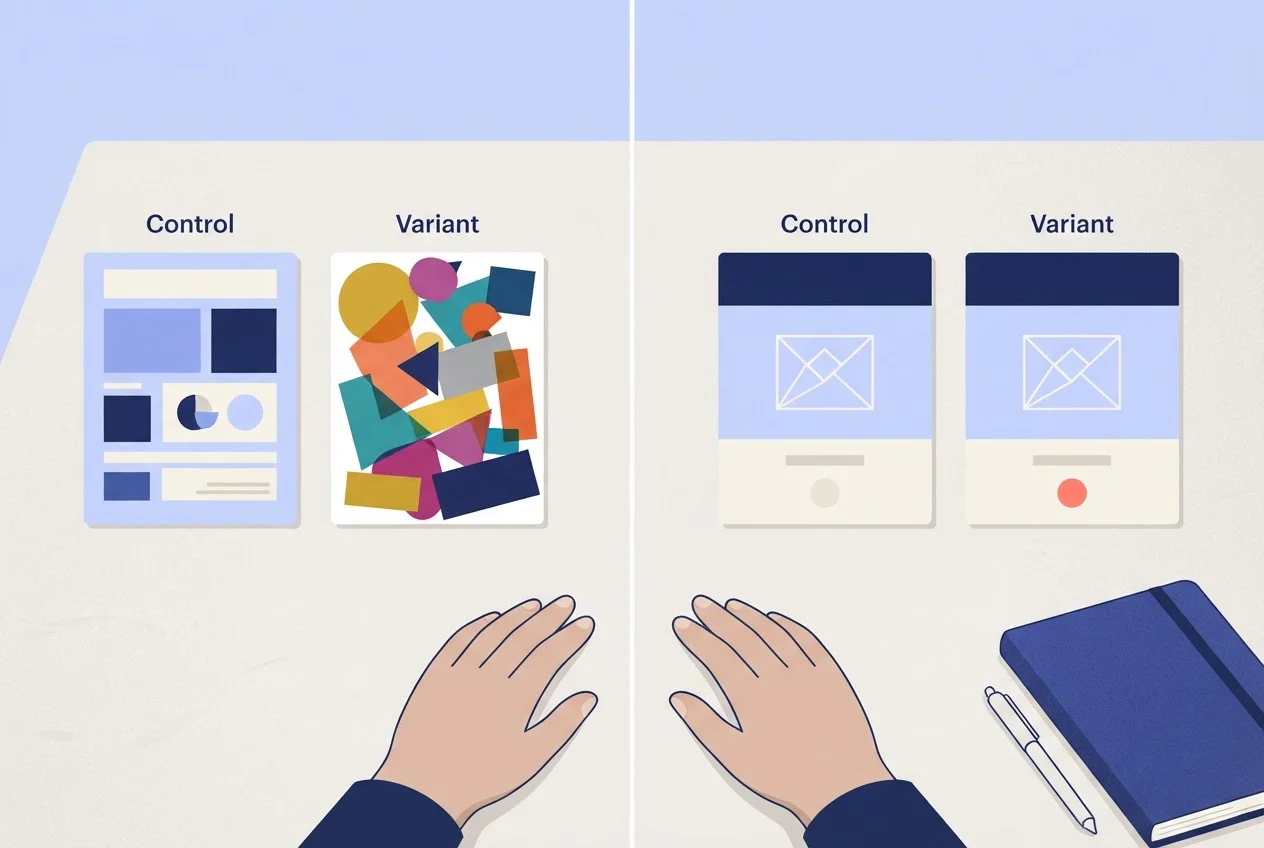
Tests teach nothing when the brief lacks a hypothesis, when the new ad differs from the control in several ways at once, or when nobody records the result. All three come from skipping the writing that a strategist is hired to do.
No hypothesis. A brief that says "make it feel fresh" cannot lose, so it cannot teach. A usable brief names the audience, the angle, and the evidence for believing it will work.
Too many changes. Meta's own guidance on A/B testing, which compares two versions that differ in one way, says that in an ad test only one variable should change while the rest of the setup and creative stays identical. If a new ad has a new hook, a new offer and a new format and it wins, nobody knows why. This holds for formal tests. In a live account with many moving parts, the rule is a target to aim for.
No memory. Without a record of what lost and why, the next strategist, or the same one next quarter, proposes the same idea. Our post on creative analytics versus test planning explains why a dashboard reports the dip but does not choose the next test.
What does a good creative brief look like?
A good creative brief fits on one page and states a hypothesis, one changed variable, a control and a stop rule before any money is spent. Use the template below, then run the five checks on it.
CREATIVE BRIEF
1. Audience:           who they are, and what they already believe
2. Customer words:     2-3 verbatim phrases from reviews, comments or
                       support tickets, with where each came from
3. Hypothesis:         We believe [audience] will [action] when we lead
                       with [angle], because [evidence].
4. Variable:           the ONE thing that differs from the control
5. Control:            the existing ad this is compared against
6. Hook options:       3 openings for the first seconds
7. Script / layout:    beats for the editor or designer
8. Stop rule:          metric, threshold, and spend or days, set BEFORE launch
9. Next step:          what we do if it wins, and what if it loses
Example (an illustration of the format for a hypothetical reusable water bottle brand, not real data). Audience: office workers who already own a bottle. Customer words: phrases from reviews about bags and leaking, each noted with its source. Hypothesis: we believe these buyers will click when we lead with leak-proofing, because the review language is about bags rather than hydration. Variable: the first-seconds hook only. Stop rule: written as a click-through rate and a spend cap before launch.
Run these five checks before you hand the brief over:
Evidence check.
Read line 3 with its evidence. Pass: the evidence is a customer quote or a past test result. Fail: "it is trending" or "competitors run it."One-variable check.
Put the control and the new ad side by side and list every difference. Pass: one difference. Fail: two or more.Stop-rule check.
Pass: metric, threshold and spend or days are all written before launch. Fail: any of them is decided after seeing results.Handoff check.
Give the brief to an editor who has not spoken to you. Pass: they can storyboard the ad without asking a question. Fail: they ask what the angle is.Learning check.
Pass: a win and a loss lead to different next briefs. Fail: the next step is the same either way.
What does a creative strategist earn, and how much experience do employers want?
Five of the nine postings state pay, from $66,300 to $110,000 a year, with an average midpoint of about $81,800. None asked for less than two years of experience. All figures are as of October 2026, from postings that state a range.
| Employer | Stated annual pay | Experience asked |
|---|---|---|
Uncommon Goods (Brooklyn, hybrid) | $90,000 to $110,000, plus bonus eligibility | 2 to 5 years |
Chief Detective (remote, 14 states) | $75,000 to $85,000 | 3 to 5 years |
Tinuiti (remote) | $70,000 to $85,000 | 3 to 5+ years |
Brand Knew (Los Angeles) | $72,000 to $80,000 | 3+ years |
DEPT (US remote) | $66,300 to $85,000 | 3+ years |
Two more postings state experience but no pay: Darkroom asks for 3+ years and Whatnot's senior role asks for 6+. Across those seven, the minimums are 2 years (Uncommon Goods), 3 years (Chief Detective, Tinuiti, Brand Knew, DEPT, Darkroom) and 6 years (Whatnot), so six of the seven ask for three years or more.
Our model for the average: take the midpoint of each pay range (100,000; 80,000; 77,500; 76,000; 75,650), add them (409,150) and divide by five, which gives about $81,830. Treat the $66,300 to $110,000 range as a starting point for conversation. The average midpoint is not a market rate, and five postings is a small sample that mixes agency and in-house employers.
How does software help a creative strategist run the weekly loop?
Software helps most with the steps that consume the week: gathering signals and deciding what to test. The strategist's judgment is still the job. We built Deepsolv for that step.
Deepsolv is a creative intelligence platform for Meta advertising teams. It combines ad-performance data, competitor activity, customer signals and past ad learnings into a ranked weekly test plan and execution-ready creative briefs, and it keeps past learnings so a lost test is not repeated by accident. Across the four steps (research, brief, test, record the learning), Deepsolv covers research, the ranking of what to test and the brief.
Our own view of the limits: competitor ads show what others run, not what works for your brand, so only your own controlled tests settle that. If you are weighing options, our write-up on an AI creative strategist for Meta ads shows where this kind of tool fits. To see how it fits your testing loop, book a personalized demo with our founding team.
Turn weekly ad signals into a ranked test plan
Book a personalized demo with our founding team to see how Deepsolv fits your creative testing loop.
Book a demoFrequently asked questions
No. In the nine postings we read in October 2026, only one required hands-on video editing, and another listed editing and design tools as nice to have. The core of the job is writing briefs, planning tests and reading results, then directing editors and designers.
Five postings that state pay, read in October 2026, ranged from $66,300 to $110,000 a year, with an average midpoint of about $81,800. Pay varies with seniority, employer type and location, so check ranges for your own market before negotiating.
Postings most often name Meta and TikTok as the platforms to work on. Darkroom requires Figma (a design tool) and Adobe, while Brand Knew lists CapCut (a video editing app) and Figma as nice to have. Our recommendation: keep a simple log of hypotheses and results, even if it is a spreadsheet.
Show three or four briefs, each with the hypothesis, the ads that were made, the result and the next decision. If numbers are confidential, show the reasoning and the decision instead. Our recommendation: a clearly recorded learning is worth more than a win with no explanation.
Build the proof employers ask for: briefs that state a hypothesis, and a log of tests with results, even from your own or a friend's ads. Our recommendation: roles in paid social support, copywriting or production are practical routes in.
Sources
- 1.Uncommon Goods, Performance Creative Strategist, October 2026
- 2.Darkroom, Creative Strategist, October 2026
- 3.Chief Detective, Creative Strategist, October 2026
- 4.Power Digital Marketing, Creative Strategist, October 2026
- 5.Tinuiti, Creative Strategist, October 2026
- 6.Meta agency client via Atomic, Creative Strategist (Paid Social), October 2026
- 7.Whatnot, Sr. Creative Strategist, Copy, October 2026
- 8.DEPT, Performance Creative Strategist, US Remote, October 2026
- 9.Brand Knew, Creative Strategist, Performance Marketing, October 2026
- 10.About A/B testing, Meta Business Help Center