
The Meta Creative Scorecard Separates Strategy From Media Buying

TL;DR
A Meta creative scorecard should separate creative strategy, media-buying context, market research and customer research. Meta’s auction combines bid, estimated action rate and ad quality, so a single account metric cannot establish that a creative element caused an outcome.
Meta’s auction makes a single creative score misleading
A creative scorecard should not collapse a creative idea, a media-buying condition and a market observation into one number. Meta’s 2023 explanation of its ad auction identifies advertiser bid, estimated action rate and ad quality as total-value components, and says pacing can adjust total value. Record those delivery conditions separately from the creative hypothesis and the account outcome.
Four Lanes That Keep Meta Decisions Honest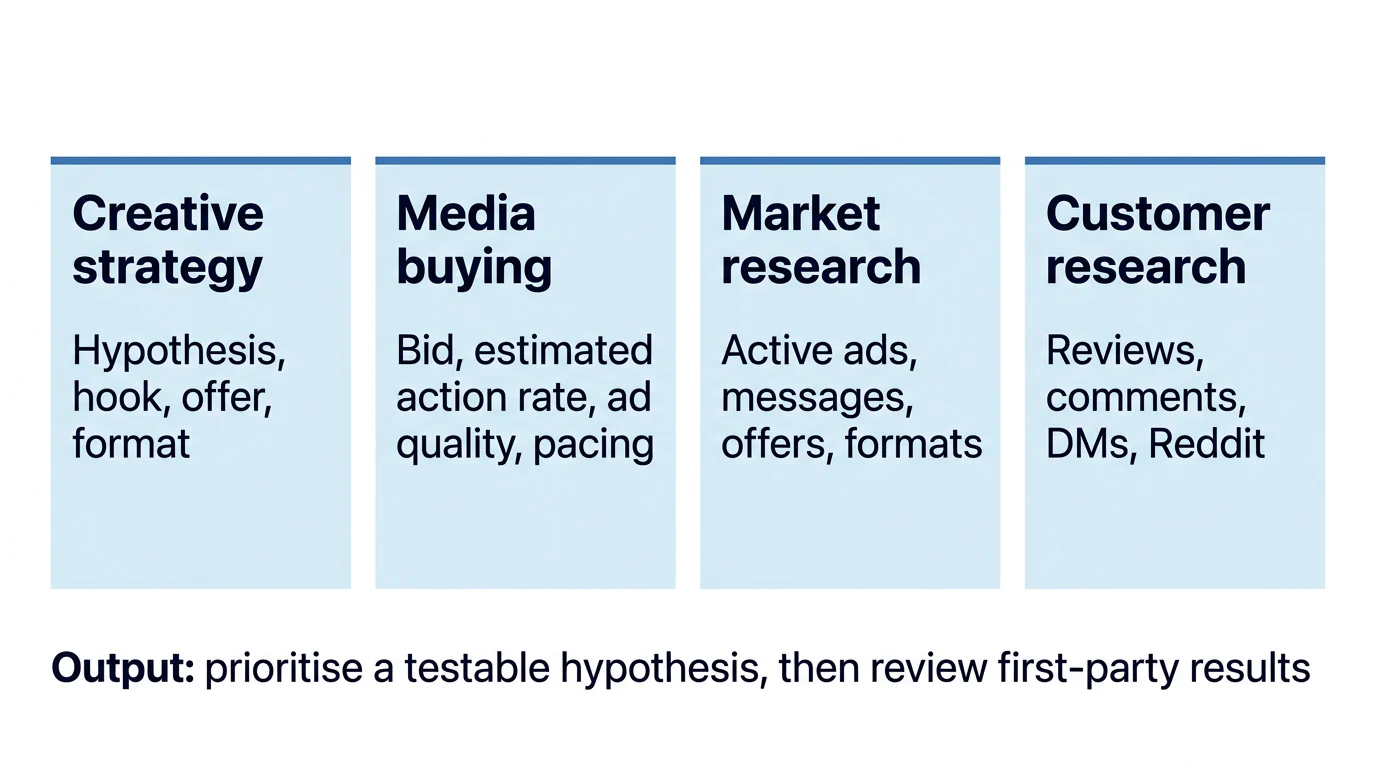
Use four evidence lanes before you call an ad a result
A Meta Ad Library observation belongs in market research because Meta makes active Page ads visible. Use it to identify what is observable, then keep it distinct from your own account data and from what customers say.
| Lane | Question it answers | Evidence to record | Decision it supports |
|---|---|---|---|
| Creative strategy | What should we test? | Hypothesis, hook, offer, format and brief | Choose the next concept |
| Media buying | How was the ad delivered? | Bid, estimated action rate, ad quality and pacing | Interpret delivery context |
| Market research | What can we observe in the category? | Active ads, messages, offers and formats | Find patterns worth testing |
| Customer research | What are buyers saying? | Reviews, comments, direct messages and Reddit discussions | Turn objections or desires into an angle |
Keep metrics and strategy statements in separate fields
Click-through rate, cost per click, add-to-cart rate, conversion rate and return on ad spend can all be useful in an account record. They should sit beside the creative hypothesis, not replace it. A customer quote is customer evidence. A visible competitor format is market evidence. A bid or pacing condition is media-buying context.
When a team labels each input before discussing performance, it can ask a tighter question: which hypothesis should receive the next controlled comparison? Use a control ad that sets a fair benchmark before turning an observed pattern into a scale or stop decision.
Make the weekly output a decision, not a dashboard
Use the scorecard in this order:
- Write one creative hypothesis.
- Log the delivery context that could shape the result.
- Save the market observation with its message, offer or format.
- Attach the customer language that makes the angle worth testing.
- Define the first-party result that will change the next decision.
This approach is not built for teams whose immediate constraint is autonomous bid changes, budget changes, campaign launches or high-volume asset generation. It is built for the earlier decision of what deserves production and media attention next.
Use a ranked plan when the signals are scattered
We combine competitor activity, customer signals, historical ad performance and past experiments into a ranked weekly plan for what to test, improve or stop. Our core access is scoped through a tailored quote for the team and workflow, including the account connections, source coverage and implementation requirements that support that plan. Explore our Meta growth-team features when your team needs a documented next-test decision rather than another reporting view.
Keep reading



Frequently asked
No. A high click-through rate records response in the conditions in which an ad was delivered. Meta’s auction also uses advertiser bid, estimated action rate and ad quality, so CTR alone cannot isolate the effect of a hook, visual or offer.
Put Meta Ad Library findings in market research. Active ads can reveal observable messages, offers, formats and category patterns, which are useful inputs for a hypothesis but do not establish an advertiser’s private revenue, CPA, ROAS or profit.
No. ROAS is an outcome from your own account, while competitor research is an observation of the market. Keep them in separate fields so a public pattern can inspire a test without being mistaken for evidence that it will produce the same result for your brand.
A useful weekly record contains one testable hypothesis, the media-buying context, the market observation that informed it, the customer language behind it, and the first-party outcome that will determine whether the team iterates, stops or tests another version.
Turn separated signals into your next Meta test
See how we combine market activity, customer signals, account performance and past experiments into a ranked weekly plan.
Explore Deepsolv features