
Paid Social Creative Test Prioritization: How Performance Teams Rank Creative Tests


TL;DR
We help performance teams rank paid social creative tests by weighing impact, confidence, urgency, learning value, and execution cost. This guide shows how we turn owned performance, fatigue signals, market observations, and past outcomes into a weekly queue with budgets, stop rules, owners, and reusable postmortems.
Only 22.2% of e-commerce advertisers in an observational survey ran at least one experiment, which makes a repeatable testing system a meaningful operating advantage for teams that spend every week on paid social.
Paid social creative test prioritization works when performance teams combine expected impact, evidence confidence, urgency, learning value, and execution cost. They turn owned performance, fatigue signals, market patterns, and prior learnings into a ranked weekly queue of one-variable hypotheses, each with a budget, owner, success rule, and stop condition.
This guide explains how we build that queue, separate useful evidence from guesswork, allocate budget, and preserve the learning that should shape next week’s decisions.
How Does Paid Social Creative Test Prioritization Work?
A test queue is not an idea backlog with scores attached. It is a commitment system that answers four practical questions before production begins: what are we testing, why now, what will it cost to learn, and what happens after the result?
We start with a shared card for every candidate. It records the funnel bottleneck, evidence source, one named variable, hypothesis, weighted score, owner, production dependency, launch date, review date, budget, and decision rule. That structure turns scattered observations into work a paid lead, analyst, and creative producer can all act on. Our signal-to-action workflow is built around the same handoff, because a useful insight has to survive the move from analysis to a live brief.
The queue also prevents a common failure mode: treating every new ad concept as equally urgent. A fresh idea may be interesting, but it should not displace a needed fatigue replacement or a high-confidence follow-up to a proven message without a clear reason.
Which Evidence Belongs in the Weekly Queue?
The strongest queue does not depend on one dashboard or one person’s taste. We use four evidence streams together, then label the strength and limitation of each before scoring the resulting hypothesis.
Owned Performance: Find the Bottleneck
Owned results tell us where attention, click intent, or conversion efficiency changed. A weak hook rate or click-through rate can justify a creative question, while solid clicks paired with weak landing conversion may point to message-to-page continuity instead. The first job is diagnosis, not producing more variants.
Fatigue Signals: Protect Live Spend
Frequency alone is not a fatigue verdict. We look for frequency rising alongside deterioration in an asset’s own attention, click, or conversion trend, then prioritize a replacement for the spend already at risk. Our ad fatigue guide shows how to compare those signals across Meta and TikTok without relying on a universal cutoff.
Market Patterns: Treat Visibility as a Lead
Public ads can reveal recurring promises, repeated formats, and underused objections, but visibility is not evidence of conversion. The official ad library shows ads that are currently active, not the commercial result behind them. We track these patterns over time to form a distinct hypothesis, then validate it in the account.
Prior Test Learnings: Block Repeats
Past outcomes increase confidence when conditions are comparable and block unchanged failures from returning to the queue. A failed proof-led angle should not reappear merely because it has a new thumbnail. It needs a meaningful new mechanism, audience, offer, or evidence source.
| Evidence Stream | What It Can Establish | What It Cannot Establish | Queue Action |
|---|---|---|---|
| Owned Performance | Where a KPI or asset trend changed | Why the change happened by itself | Diagnose the bottleneck |
| Fatigue Signals | Which live asset needs replacement urgency | A universal frequency threshold | Prioritize protective iteration |
| Market Patterns | Active messages and format patterns | Whether another advertiser’s ad converts | Form a testable hypothesis |
| Prior Learnings | Comparable wins, losses, and unknowns | Whether old evidence still applies unchanged | Boost confidence or block repeats |
How Should Teams Score and Separate Creative Tests?
Scoring should make the discussion sharper, not pretend that creativity is a spreadsheet exercise. We score candidates individually before debate, then challenge the evidence behind the number. That order prevents the loudest opinion in the room from becoming the queue.
| Scoring Factor | Weight | Question We Ask |
|---|---|---|
| Expected Impact | 30% | If right, how much could this improve the priority KPI? |
| Evidence Confidence | 25% | How directly do the available signals support it? |
| Urgency | 20% | Does fatigue, a launch date, or a worsening bottleneck make delay costly? |
| Learning Value | 15% | Will the result answer a reusable strategic question? |
| Execution Efficiency | 10% | Can we produce, approve, and measure it cleanly this cycle? |
Score Candidates Before Discussing Them
We score each factor from one to five, then calculate the weighted total. The weights are a documented operating policy, not an industry law. We revisit them against actual outcomes, because budget and experimentation decisions are brand-specific, as budget research has found.
A candidate also needs to pass readiness gates before it can rank: one named variable, a usable control, enough budget for a decision, no conflicting live test, and production capacity. Our concept prioritization work starts at the same point, with evidence before execution.
Separate the Test Layer
Each test needs a clear layer. Changing multiple layers can still be useful, but it should be labeled as a combined-experience test rather than a clean conclusion about one element.
- Concept Test: Compare broad strategic routes, such as product demonstration versus social proof.
- Angle Test: Compare the value proposition or objection within a concept.
- Hook Test: Change the opening attention device while holding the message route steady.
- Format Test: Compare the delivery form, such as static, creator-style video, or demonstration.
- Execution Test: Refine pacing, CTA treatment, visual proof placement, or a related detail after the larger idea has support.
See a Worked Queue
An illustrative queue might rank a new hook for a fatigued, high-spend control above a promising new market angle. The hook has stronger evidence and higher urgency, while the new angle offers high learning value but needs more production effort. Our creative intelligence approach connects those tradeoffs so teams can see why an item ranked where it did.
| Candidate | Impact | Confidence | Urgency | Learning | Efficiency | Score / 500 | Queue Decision |
|---|---|---|---|---|---|---|---|
| New Hook For A Fatigued Control | 4 | 5 | 5 | 3 | 4 | 430 | Launch First |
| New Proof-Led Market Angle | 5 | 3 | 3 | 5 | 2 | 380 | Brief Next |
| Production-Heavy Format Remake | 3 | 2 | 2 | 4 | 1 | 250 | Hold |
How Should Paid Social Teams Budget and Stop Tests?
Budget allocation should fund a decision, not distribute equal spend across every idea. If an account cannot support a clean comparison, the answer is a smaller queue, not thinner tests.
Meta advises advertisers to provide budget across at least seven days so delivery can learn, and its daily budget guidance allows spending to fluctuate within a weekly limit. Meta budget guidance is a planning constraint, not proof that every test becomes conclusive after a week.
| Budget Bucket | Default Share | Purpose | Entry Rule | Expected Output |
|---|---|---|---|---|
| Exploration | 10% | Test a distinct evidence-backed unknown | New angle or concept passes readiness gates | New strategic learning |
| Validation | 20% | Confirm a promising candidate | Clear control and sufficient decision budget | Promote, reject, or extend |
| Iteration | 70% | Extend proven messages and replace fatigue | Validated message has room to adapt | Rotation-ready asset |
We treat these shares as a starting policy. The actual number of test slots depends on available spend, historical cost per qualified outcome, audience volume, approval time, and production capacity. If the exploration budget cannot support one valid test, we protect learning quality by prioritizing iteration or evidence collection instead.
Declare Outcomes Before Delivery
Every brief states the primary KPI, guardrail metric, practical threshold, minimum evidence requirement, maximum spend, review date, and next action. “Winner” is not a sufficient outcome label.
A success meets the predeclared threshold without breaking guardrails. A failure reaches its decision window and misses the threshold. A stop occurs when delivery, policy approval, or a material external condition invalidates the test. An inconclusive result means the evidence did not support a decision, and we only extend it when the learning value warrants more spend. Our stop rules make those decisions explicit before a team launches.
How Does the Weekly Cadence Compound Learning?
A queue becomes valuable when it runs on a predictable rhythm. We use a weekly cadence that gives analysis, creative production, launch operations, and review a clear owner without turning planning into another meeting that produces no decisions.
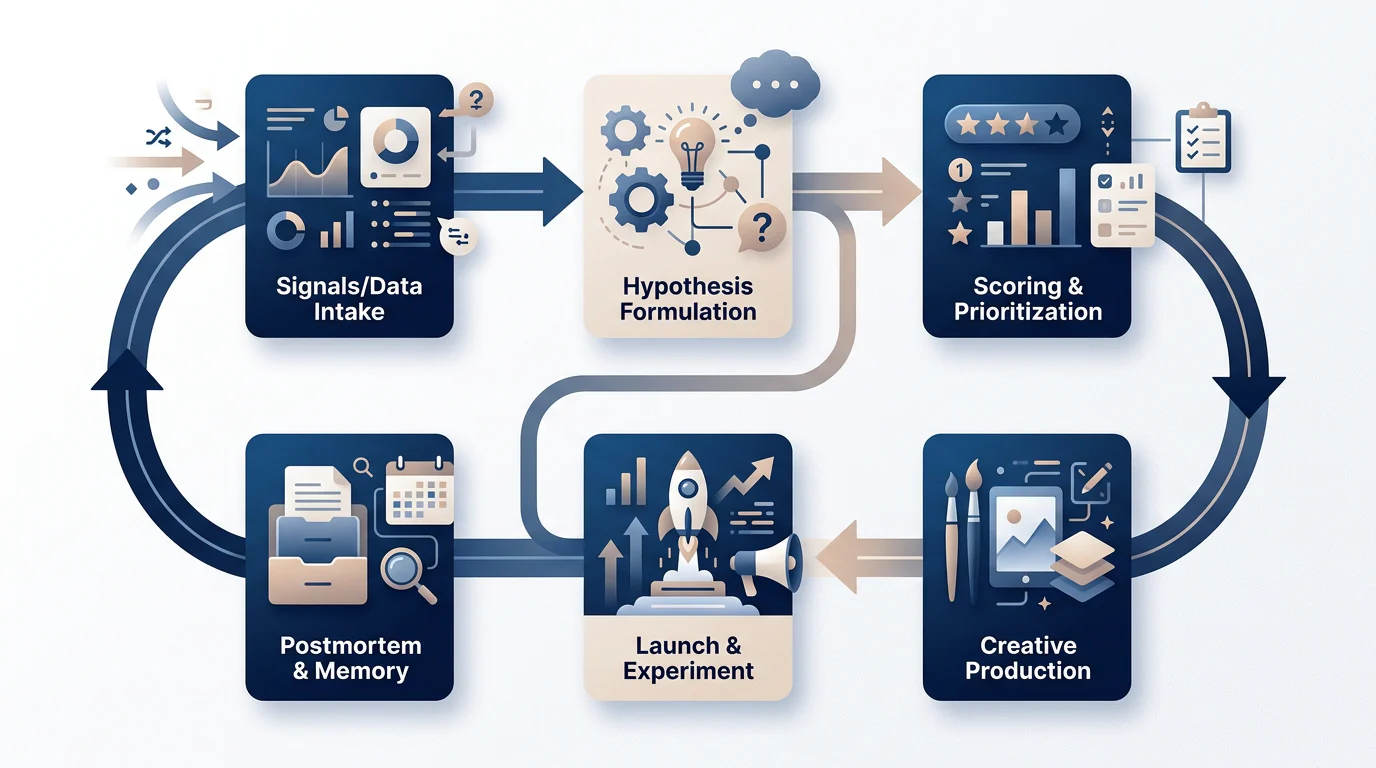
- Collect Evidence: Refresh owned performance, fatigue trends, market observations, and comparable past tests.
- Translate Hypotheses: Turn each observation into a one-variable claim tied to a funnel bottleneck.
- Score Independently: Apply the weighted model before group discussion begins.
- Commit The Queue: Assign budget bucket, owner, dependency, launch date, and review date.
- Launch And Monitor: Watch pacing, approvals, and predeclared stop conditions without moving goalposts.
- Decide And Remember: Classify the outcome, preserve the lesson, and update the next queue.
The postmortem should capture the result, data-quality caveats, conclusion, reusable lesson, follow-up test, and the condition under which a failed idea could return. Our testing memory keeps that work from disappearing into an old spreadsheet and gives the next brief a real starting point.
How Deepsolv Turns Signals into Decisions
At Deepsolv, we built our creative intelligence workflow for the moment after a dashboard spots a change: the team still has to decide what to test. We bring owned results, ad-fatigue signals, market creative observations, and prior test memory into one decision layer, then help teams turn evidence into briefs, ranked test queues, and clear next actions, with shared owners and deadlines that survive after launch. That means your paid social lead can see why a hook replacement is urgent, your creative team can see the exact variable to produce, and your analyst can preserve what the outcome means. We do not ask teams to choose between fast production and disciplined learning. We help make every approved test easier to explain, launch, review, and reuse across the next cycle. See how we can help your team build a sharper weekly queue: Book a demo.
FAQs on Paid Social Creative Test Prioritization
Quick answers follow.
How Do Performance Teams Rank Creative Tests?
Rank ideas with a weighted score for impact, confidence, urgency, learning value, and execution efficiency, then admit only hypotheses that pass readiness and budget gates.
What Should a Paid Social Team Test Next?
Start with the bottleneck, not the creative calendar. Pair a current performance or fatigue signal with prior learning, then choose the smallest test that can answer it.
How Should Fatigue and Competitor Research Affect Test Priority?
Treat visible market ads as research, not proof. They reveal recurring messages or format gaps, but only your own account can validate whether a hypothesis works.
How Do I Allocate Budget Across Paid Social Experiments?
Reserve a modest exploration share, fund validation only when a decision is feasible, and devote most budget to proven-message iteration and fatigue replacement when coverage is needed.