
TL;DR
We explain how Meta creative intelligence tools differ by evidence: public competitor ads, observed changes, authorized account performance, and permitted customer language. We also show what each source can support, how to prevent proxy claims from becoming conversion claims, and how Deepsolv connects research to test decisions.
Public Meta ad research is useful because it is observable. Meta says ads and updates can appear in its library within 24 hours, although that publication window cannot explain why an advertiser kept a creative live.
Some Meta creative intelligence tools use competitor signals, but their evidence depth varies. We separate public ads and observed changes from your authorized performance data and permitted customer language. Competitor activity can expose patterns and gaps, not conversions. The right workflow depends on whether your next decision needs inspiration, account-level performance evidence, or both.
We cover the evidence model, the limits of competitor research, and the workflow that turns inputs into a measurable creative test. We also show how teams can retain the learning from each decision.
What Evidence Do Meta Creative Intelligence Tools Use?
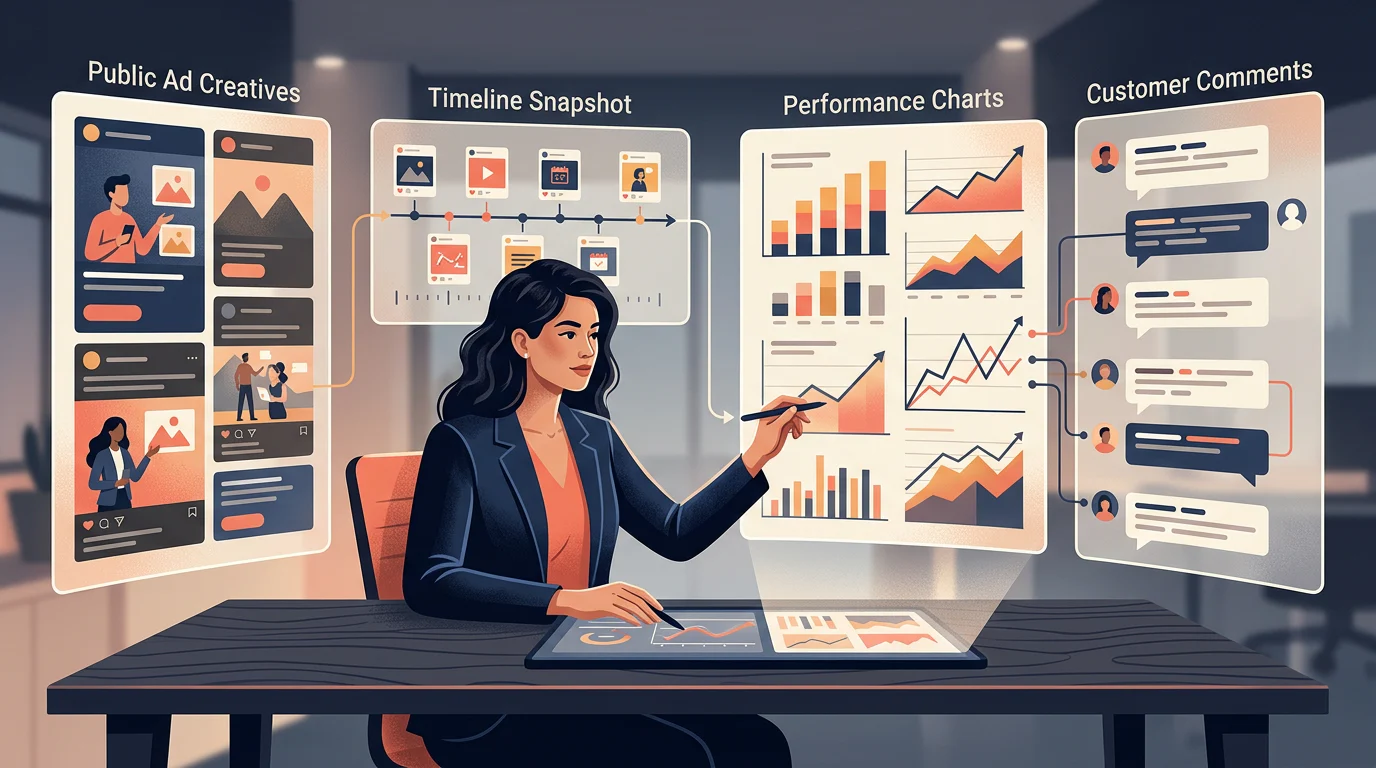
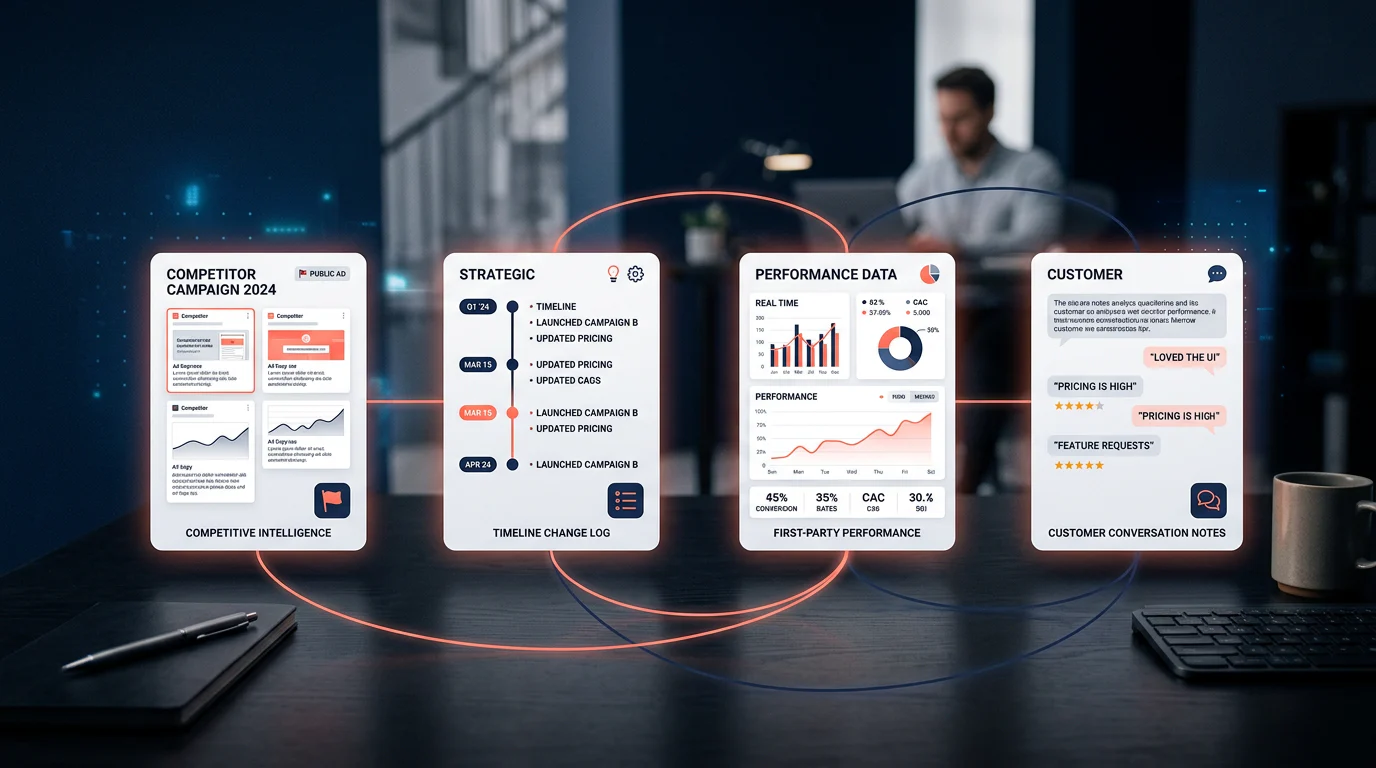
The useful distinction is not whether a tool can save ads. It is whether it can show where an observation came from, what it means, and what it cannot prove. We use four evidence categories: active competitor creative, observed historical change, first-party performance, and customer language.
A public ad library shows creative that is visible now. A monitoring workflow can retain snapshots over time. Account analytics can evaluate your own delivery and conversion metrics. A connected intelligence workflow can place those signals beside customer objections and prior test records without pretending that one source is another.
| Workflow Type | Competitor Activity | First-Party Performance | Customer Language | Historical Record | Supports |
|---|---|---|---|---|---|
| Public Ad Library | Active public ads | No | No | Limited by platform rules | External pattern research |
| Change Monitor | Observed starts, stops, and edits | No | No | Depends on snapshot cadence | Market-change tracking |
| Account Analytics | No, unless paired with research | Authorized metrics | Usually limited | Account-data dependent | Internal performance analysis |
| Manual Database | Manually captured | Manually imported | Manually imported | Only what the team records | Shared research memory |
| Integrated Decision Platform | Connected observations | Authorized metrics | Permitted inputs | Connected test history | Evidence-backed test planning |
Public library history has boundaries that matter. Meta retains social-issues, election, and political ads for seven years, while general commercial-ad visibility is not a universal archive of every prior competitor creative.
That is why continuous tracking should record its own date-stamped observations instead of assuming a public search result is a complete history. A research archive should preserve the exact ad, the context in which it was found, and the date it was captured.
What Can Competitor Activity Prove?
Competitor activity is valuable market context. It can reveal repeated offers, format shifts, fresh hooks, category conventions, and angles your own account has not tested. It cannot disclose another advertiser’s conversion event, margin, attribution method, customer quality, or incrementality.
What Observed Activity Can Tell Us
An ad that remains publicly visible can support a research note such as, “This advertiser continues to deploy this format and offer.” It can also justify a hypothesis about a message worth testing with your own audience. It does not justify calling the creative a winner.
We preserve that difference by labeling the source. “Observed” means the public ad or change was captured. “Reported” means a metric came from the advertiser’s systems. “Verified” means the source, time range, metric definition, and attribution method are documented.
Our own-performance comparison explains why those labels prevent false certainty. It also helps separate the question, “What is visible in market?” from the question, “What worked in our account?”
What First-Party Performance Can Tell Us
Your own account metrics can connect a creative to delivery and conversion outcomes, but only within the measurement setup used by that account. Access scope matters because Meta’s access rules distinguish permissions for ads, insights, messages, comments, and other Page activity.
A meaningful internal result records the audience, conversion event, attribution setting, date range, spend, and creative variation. Without those details, even a first-party metric may be too vague to guide the next test.
What Customer Language Adds
Comments, messages, reviews, and research interviews can supply the words customers use for objections, desires, anxieties, and trust gaps. That makes customer language especially useful when a public creative pattern needs a sharper angle or more credible proof point.
Customer-language evidence still has quality limits. The European Commission found that authorities could not confirm adequate review-authenticity safeguards on 144 of 223 sites in its 2021 review sweep. We therefore treat reviews as language evidence, not conversion proof.
What Claims Need a Higher Bar
“High converting,” “proven,” and “winning” are performance claims. They need evidence that matches the claim, rather than an inference from ad visibility. The FTC says material advertising claims need objective evidence and a reasonable basis before they run.
Our customer-signal guide shows how to retain useful customer context without treating a theme in feedback as a revenue result. The same standard applies whether evidence comes from a conversation, a review, or a creative report.
How Does the Source-To-Test Workflow Work?
A sound workflow makes the handoff from research to production visible. It starts with a market observation, adds the evidence your team controls, and ends with a test that has a defined measurement method. That sequence keeps a saved ad from becoming an unsupported claim about what will convert.
Capture the Source and Context
Record the advertiser, platform, geography, placement, capture date, offer, format, and hook. For repeated monitoring, record whether the creative is new, edited, or still observed. This turns casual browsing into a searchable record instead of an untraceable swipe file.
Tag the Creative Angle
Use a small shared taxonomy for format, hook, offer, customer problem, and campaign stage. Teams can then compare external patterns with their own test record through angle tracking, rather than relying on memory or aesthetic preference.
Add Customer and Account Evidence
Attach permitted customer language only when its source is clear. Attach first-party metrics only when the connected account, reporting range, and attribution settings are known. The result is a brief that distinguishes observed market activity from internal performance evidence.
Define the Next Test
Write the hypothesis before production: which customer problem, creative format, offer, audience, metric, and evaluation period will be used. The process gives every idea a source, a rationale, and a standard for interpreting the result.
| Claim Type | Evidence Required | What It Cannot Establish | Safer Wording |
|---|---|---|---|
| Public Ad Observation | Captured public creative and date | Conversion, profit, or audience quality | “Observed in market” |
| Repeated Activity | Dated snapshots over time | Spend level or causal effectiveness | “Continues to appear active” |
| First-Party Metric | Authorized reporting with settings | Incrementality without suitable measurement | “Reported in our account” |
| Customer Language Theme | Source, sample, and permission record | Product-market fit or revenue impact | “Recurring customer concern” |
| Test Result | Defined hypothesis and measurement record | Universal applicability | “Performed under this test setup” |
Our test prioritization framework helps teams turn this record into a documented sequence of decisions, rather than a queue of loosely related ideas. It also preserves why a concept was chosen before the outcome is known.
What Does Manual Research Cost to Maintain?
Manual research can begin with a shared workspace, folders, screenshots, links, and a simple taxonomy. Its financial cost may be low at first, but the ongoing cost is the time required to search, capture, label, deduplicate, audit, and retrieve work later.
The real comparison is not subscription price alone. It is whether the team can consistently retain source provenance, account access boundaries, customer-signal context, and the outcome of each test. When those records live in separate places, the research burden often reappears as rework.
A manual archive should make it possible to find the source, tags, decision, and result behind an idea months later. Our testing memory approach treats failed hypotheses as useful records, rather than work that disappears when a campaign ends.
| Team Context | Evidence Priority | Operating Work To Track | Record That Preserves Learning |
|---|---|---|---|
| Three-Person Team | Competitor patterns and a small test history | Weekly capture, tagging, and shared ownership | Source, hypothesis, and outcome |
| High-Volume Testing Team | Performance, history, and customer inputs | Governance, QA, access controls, and taxonomy maintenance | Test cells, attribution settings, and decision rationale |
| Research-Only Team | Public creative and change observations | Dated snapshots and structured search notes | Observation labels and source links |
A three-person team can keep a manual database useful when one person owns taxonomy decisions and every saved observation has a capture date. A higher-volume team needs to audit duplicates, missing source context, permissions, and inconsistent tags before the archive becomes difficult to search.
At higher volume, routine collection becomes a separate operating task. A competitor tracking workflow can preserve change observations and reduce repeated searching, while still requiring humans to distinguish a public proxy from a verified performance outcome.
Why We Built Deepsolv for Evidence-Led Decisions
At Deepsolv, we built our platform for teams that need a defensible answer to “what should we test next?” rather than another saved-ad folder. We bring together competitor activity, permitted customer feedback, your account performance, and the lessons from past experiments so your team can examine the evidence behind a creative brief in one place. Our goal is not to convert a public ad into a claim about revenue. It is to make the gap between observation, hypothesis, test, and measured result visible before production time and media budget are committed. You can use that record to preserve rejected ideas, explain why a concept was funded, and compare later outcomes against the original rationale. A demo can show the signals, access boundaries, and decision record in context. If your Meta growth team wants to see how our evidence-led workflow fits its current process, book a demo.
FAQs on Meta Creative Intelligence Tools
These answers clarify the practical limits of competitor research and connected performance data. They also keep public observations separate from verified outcomes.
Does Meta Ad Library Show Competitor Conversions?
No. It shows public ads and some transparency details, not a competitor’s spend, CPA, ROAS, revenue, conversion quality, audience makeup, or incrementality. Activity is context, not proof.
Can a Long-Running Ad Prove an Angle Works?
No. Continued activity may justify a hypothesis, but it cannot reveal the advertiser’s objective, audience economics, attribution settings, conversion quality, margin, or profit for that creative.
What First-Party Data Requires Permission?
Authorized access is required for account performance, Page insights, comments, messages, and ad metrics. Permission scope determines what a connected system can collect, retain, and analyze.
Are Customer Reviews Reliable Evidence?
Reviews can reveal language, objections, and themes, but source quality varies. Record their origin and verification status, and never present review patterns as conversion-performance proof.
How Often Does Meta Ad Library Refresh?
Meta says ads and changes may appear within 24 hours. That is a publication window, not proof that a research workflow contains complete historical snapshots.
Should Manual Research Be Archived?
Yes. A dated archive preserves hypotheses, tags, sources, decisions, and failed tests. Without it, teams repeat research and lose useful learning when people change roles.