


TL;DR
We show performance marketers how scheduled public Ad Library snapshots become deduplicated change alerts, without pretending public data reveals a competitor’s private performance. We also provide a five-step setup, event rules, an evidence-first weekly scorecard, governance guidance, and practical troubleshooting for multi-account teams.
Meta keeps issue, election, and political ads in its public archive for seven years, while ordinary commercial research is centered on ads currently active in the selected market. That makes a dated monitoring record more useful than a weekly folder of unstructured screenshots.
At Deepsolv, we automate Meta competitor ad tracking by capturing public Ad Library records on a schedule, comparing each verified snapshot with the last, and alerting teams to observed launches, material copy or creative changes, and disappearances. We cannot see a competitor’s private spend, bids, conversions, or ROAS.
This guide explains what a monitoring workflow can collect, how diffs become reliable events, how to connect observations to your own results, and how to run the system across multiple accounts.
What Does Meta Competitor Ad Tracking Actually Collect?
The first discipline is separating evidence from inference. Public records can show what a competitor appears to be running in a selected country, including visible creative, copy, offer framing, and destination details. They cannot reveal whether that creative is profitable, how much budget sits behind it, or which audience produced a conversion.
| Data Source | What We Can Use | What We Cannot Establish | How We Treat It |
|---|---|---|---|
| Public Ad Library records | Active creative, visible copy, advertiser identity, selected-country view, public start information | Private spend, bids, conversions, ROAS, or full targeting | Observable market evidence |
| First-party account reporting | Your approved account metrics, such as spend, conversion rate, CPA, and ROAS | Any competitor’s account performance | Private performance evidence |
| Derived enrichment | Angle, offer, format, creative similarity, and normalized copy labels | A verified claim that an ad is a winner | A reviewable hypothesis |
A useful system keeps those sources in separate columns, permissions groups, and conversations. We may observe a price-led offer or a burst of new variations, then ask whether our own account needs a defensive test. We do not claim the offer worked for another advertiser. That boundary makes angle performance tracking far more useful because it keeps the learning loop tied to evidence we actually own.
Country selection deserves the same care. An ad may be visible in one market and absent in another, and Meta notes that ad layouts can differ across its products in its country-view guidance. Every observation should therefore retain the Page ID, country, source URL, capture time, and reviewer.
How Do Scheduled Snapshots Become Reliable Signals?
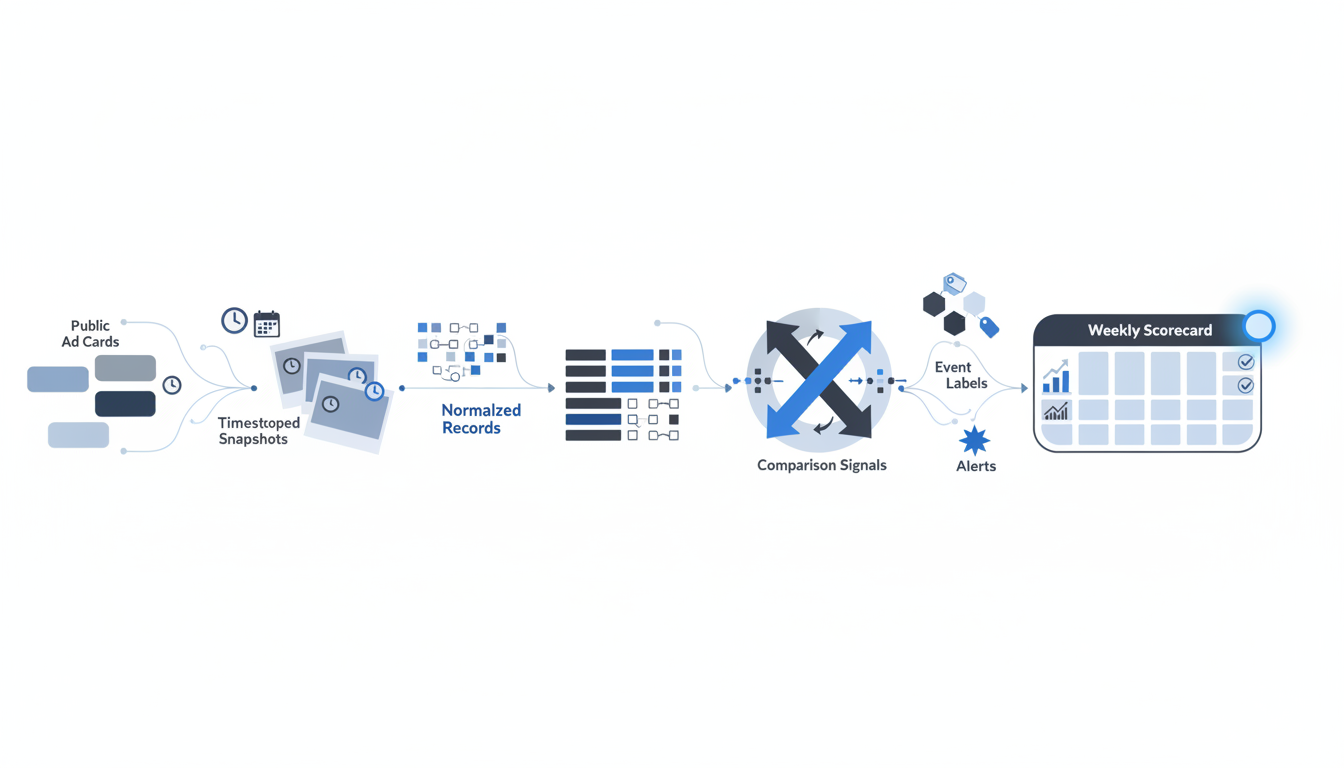
Continuous monitoring is not a live feed and it is not a person manually capturing a screen every day. It is a repeatable collection process: preserve a public record at a known time, normalize it, compare it with a previous verified record, and decide whether the difference deserves attention.
A workflow only becomes dependable when it records what changed and why it thinks the change matters. That is how we move from a wall of ad cards to an evidence trail a performance team can review together.
How Does Snapshot Capture Work?
We begin with verified competitor Pages, a defined country, and a scheduled capture cadence. Each capture gets a timestamp, source reference, collection status, and freshness label. Daily collection is a sensible baseline for many teams, while promotion-heavy accounts can use a faster cadence when an earlier signal would genuinely change a decision.
How Do We Deduplicate and Filter False Changes?
We retain the public identifier where available, then compare normalized copy, destination domain, visible media, format, and public start information. This helps prevent a reordered card, localized rendering, or minor interface change from becoming a false launch alert.
What Counts as a Material Event?
A material event is a new unique ad, a meaningful copy or offer change, a format change, a changed destination, or a repeated absence after a confirmation window. An unusual launch cadence can also matter when the count of new unique records exceeds that Page’s own trailing four-week observation baseline.
The language matters. We write “first observed” instead of “launched live,” and “no longer observed” instead of “stopped.” Public visibility can change for several reasons, and the distinction prevents a useful alert from becoming an unsupported story about a competitor’s strategy.
Why Do We Archive Every Observation?
Commercial ads may no longer be publicly searchable after they are inactive, so snapshots preserve the evidence behind a historical comparison. They also let a reviewer revisit the actual copy, creative, country, and capture time rather than relying on someone’s memory.
Custom collection requires policy review, too. Meta’s automated collection terms state that automated collection requires express written permission and impose conditions on security, use, and disposal. That is why we treat authorized collection, source controls, and retention as workflow requirements, not technical afterthoughts. The same evidence-first approach supports continuous competitor tracking without treating public data as unrestricted private intelligence.
How Do You Set up the Five-Step Workflow?
The fastest setup is not the one with the most alerts. It is the one that consistently delivers a small number of reviewable signals to the people who can use them in planning, creative development, and performance review.
-
Select Verified Competitors: Record the official Page, Page ID, country, market, brand owner, and why the account belongs on the watchlist.
-
Capture A Baseline: Take an initial dated record before alerts begin. Define collection frequency, retry behavior, quiet hours, and the freshness threshold that makes a result actionable.
-
Apply A Shared Taxonomy: Tag observable copy, creative angle, offer, format, destination, and campaign theme using definitions every account can follow.
-
Route Events By Importance: Send high-confidence offer or cadence events to the relevant owner. Batch low-confidence or cosmetic changes into a weekly digest.
-
Run A Weekly Evidence Review: Review patterns beside your first-party account data, choose a hypothesis, assign an owner, and log the decision that follows.
The fifth step is where the work compounds. Rather than copying a visible concept, the team can decide whether it reveals an untested territory, a seasonal offer pattern, or a need to differentiate. Use the monitoring record to rank weekly tests, then turn approved ideas into a focused test plan.
How Do You Turn Competitor Changes into Better Account Decisions?
An alert is not a recommendation. Its job is to surface an observable event quickly enough for a human to decide whether it belongs in the testing backlog, the promotional calendar, or nowhere at all.
The best weekly review places public observations beside separate first-party metrics. This preserves a clean line between what the market visibly did and what our own account measured.
| Week And Market | Competitor Observation | Launch Cadence | Active Duration Observed | Angle | Format | Offer | Our First-Party Response |
|---|---|---|---|---|---|---|---|
| Review week | New, changed, or no-longer-observed record | New unique records versus baseline | First and last observed dates | Problem, proof, identity, price, or lifestyle | Image, video, carousel, or collection | Discount, bundle, guarantee, or trial | Spend, CPA, conversion rate, ROAS, and decision |
This layout makes cause and effect harder to overstate. We can say a new discount-led message appeared in the market while our conversion rate changed during the same review window. We cannot say the public ad caused our result, or that the competitor’s message outperformed another one.
| Evidence-First Conclusion | Unsupported Conclusion |
|---|---|
| “A new offer appeared in the selected country.” | “The offer improved competitor ROAS.” |
| “The Page added more unique ads than its own recent baseline.” | “The Page increased budget.” |
| “Our CPA moved during the same period.” | “Competitor activity caused our CPA movement.” |
That distinction matters most when performance is under pressure. A visible pattern may be worth testing, but it should not replace diagnosis of fatigue, audience saturation, offer fit, or measurement quality. A structured AI test plan helps turn qualified observations into accountable experiments instead of reactive copying.
How Do You Govern Multi-Brand Monitoring and Troubleshoot Gaps?
Multi-account monitoring fails when every team invents its own labels, Page names, and definition of a launch. We use a naming convention such as brand-market-pageID-country-owner, then assign clear roles for viewing, taxonomy editing, account ownership, and administration.
The operating model should also define a retention policy, an evidence review process, and a correction path for false changes. When an event is disputed, the reviewer should be able to inspect the preserved snapshot, selected country, source status, deduplication logic, and previous observation before changing the record.
Use the following checks when an alert looks wrong:
- Confirm The Country: The selected market may explain a missing or different ad.
- Check Freshness: A late or failed capture should be labeled before it enters a weekly review.
- Review The Underlying Record: Compare normalized copy, destination, visible media, and public identifiers before accepting a copy or format change.
- Reclassify With An Audit Trail: Correct the taxonomy, retain the original event, and record why the classification changed.
Meta’s review process can consider text, images, video, targeting, and destinations before an ad runs, as described in its ad review guidance. The same traceability keeps public signals separate from internal diagnosis, including creative fatigue, rather than interpreting a public change as proof.
Put Deepsolv to Work for Your Team
Deepsolv gives paid social teams a durable way to turn scattered public observations into a reviewable creative intelligence workflow. We help you organize competitor pages, preserve time-stamped evidence, apply a shared taxonomy, and route meaningful changes to the people who own testing decisions. Your own account performance remains private and separate, so the conversation stays grounded in what the market visibly did and what your team actually measured. That separation helps operators avoid copying noise, crediting coincidence, or chasing a competitor’s presumed results. If your team manages multiple brands or accounts, we can help create the naming, permissions, scorecard, and review cadence that makes monitoring usable every week. Start by mapping the signals you need, the decisions they should inform, and the owners who will act on them. We can also make the resulting record clear enough for confident cross-functional planning and measurement. Then see Deepsolv.
FAQs on Meta Competitor Ad Tracking
These FAQs clarify workflow limits.
Does Meta Competitor Ad Tracking Pull Live Data?
No. We capture public records on a defined schedule, label each snapshot with its capture time, and report first observation, not a live delivery event.
Why Did a Competitor Ad Disappear?
Commercial Ad Library visibility focuses on active ads. An absence may reflect inactivity, country selection, a source gap, or removal, so we confirm it before acting.
Can We See Competitor Spend or ROAS?
No. We classify public creative and offer changes, while our first-party reporting connection only returns metrics available within the accounts your team has authorized securely.
How Often Should We Check Competitor Ads?
Start daily, then increase collection when promotions make faster awareness useful. Use our hook testing framework to set consistent follow-up decisions across accounts without treating more alerts as better evidence.