
Glossary
Customer Awareness Stages
Customer awareness stages are five levels of how much a buyer knows about a problem and your product. Ad comments and messages show which level your next ad test should target.

By Sachit Sharma, CEO & Founder · Updated 24 Oct 2026
On this page
- 01Definition
- 02Quick facts
- 03What are customer awareness stages?
- 04How do comments, reviews and messages show a buyer's awareness stage?
- 05Why do reviews miss the colder customer awareness levels?
- 06What do people confuse customer awareness stages with?
- 07How do you decide which awareness stage to test first?
- 08How Deepsolv handles it
- 09Example
- 10Related terms
- 11Frequently asked
What are customer awareness stages?
Customer awareness stages are five levels of how much a person knows about a problem and your product: unaware, problem aware, solution aware, product aware and most aware.
Key takeaways
- Sort comments and messages by stage with the table, then treat each reading as a hypothesis and let the ad test decide.
- Reviews come from people who already bought, so they say little about colder audiences.
- Stages describe where an audience stands, not a funnel buyers climb.
- Test one stage-matched ad against your best current ad and judge it on cost per purchase.
Quick facts
- Set out by
- Eugene Schwartz
- Source book
- Breakthrough Advertising
- Published
- 1966
- Number of levels
- Five
- Where the signals come from
- Ad comments, direct messages, reviews and search phrases
A review is written by someone who already bought, so it says little about the stranger scrolling past your ad. Yet reviews are often the first place a team looks for customer language. That leaves the colder audience unread.
Customer awareness stages are the way to sort that language. Eugene Schwartz set out five levels in Breakthrough Advertising, published in 1966, running from a buyer who does not know a problem exists to one who only needs the deal. Memorizing the levels is easy. Deciding which one a real audience sits at is the hard part, because nobody announces it.
The answer is in the words your audience already uses: ad comments, direct messages, reviews and search phrases. Each stage has a recognizable sound that a person can sort by reading.
What are customer awareness stages?
The level decides what an ad must do first.
Five awareness stages, from least to most aware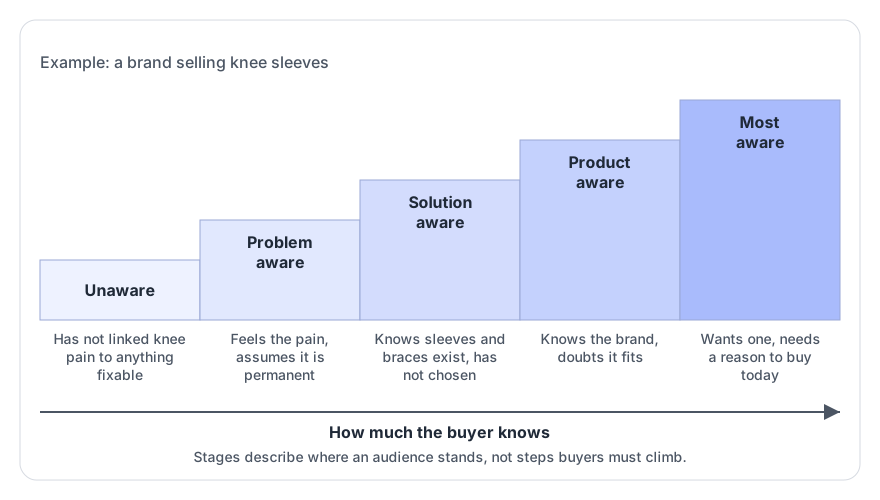
Take a brand selling knee sleeves. An unaware runner has never linked their knee pain to anything fixable. A problem-aware runner feels the pain and assumes it is permanent. A solution-aware runner knows sleeves and braces exist but has not chosen. A product-aware runner knows the brand and doubts it fits. A most-aware runner wants one and needs a reason to buy today.
How do comments, reviews and messages show a buyer's awareness stage?
Read the stage from what a person asks or does, not from who they are. Sort each comment, message or review by the second column, then run the test in the last.
Treat each reading as a hypothesis for the test to check.
- Stage
- Unaware
- What the signal sounds like
- Reacts to the story or format, asks who the ad is for, tags a friend, mentions no problem
- Where it shows up
- Comments on ads shown to cold audiences (people who have not dealt with your brand)
- Ad test
- A story or surprising-claim hook that names no product
- Stage
- Problem aware
- What the signal sounds like
- Describes the symptom in their own words, with no category in mind
- Where it shows up
- Cold-ad comments, forum questions
- Ad test
- Open with the customer's words for the pain, then hint it can be fixed
- Stage
- Solution aware
- What the signal sounds like
- Asks whether a type of product works, or which type to pick
- Where it shows up
- Comments, forum threads, search queries
- Ad test
- A mechanism ad: why this kind of fix works where others fail
- Stage
- Product aware
- What the signal sounds like
- Names your brand or a rival, asks if you are legit, raises a fit, shipping or returns objection
- Where it shows up
- Warm-ad comments, messages, support tickets
- Ad test
- A proof ad that answers the most repeated objection
- Stage
- Most aware
- What the signal sounds like
- Asks where to buy, whether a code exists
- Where it shows up
- Comments on retargeting ads (ads shown to people who have already dealt with your brand), messages
- Ad test
- An offer-led ad: price, bundle or guarantee first, no product explanation
Why do reviews miss the colder customer awareness levels?
Reviews come from buyers, so they hold almost nothing about what a stranger knew before seeing your ad. In one count of 20 reviews for a single brand, ten were about orders, delivery, subscriptions or service, 6 about the product, 3 about price and 1 about the company's direction. A review counted as about the product only if its main complaint or praise was the product itself. None of the excerpts described what the reviewer knew before buying. The excerpts were truncated and it is one brand, so this shows a direction, not a rate.
Collect from where cold audiences speak, which means comments on ads shown to people who do not know you, plus forum questions and search phrases.
What do people confuse customer awareness stages with?
Awareness stages get confused with the marketing funnel, with cold traffic and with market sophistication.
- Funnel. A funnel moves people through steps. Stages describe where an audience stands today, and a buyer can skip stages, for example by arriving on a friend's recommendation already product aware.
- Cold traffic. Cold means a person has not dealt with your brand. It says nothing about whether they know the category.
- Market sophistication. Schwartz's companion idea in the same book is how many similar claims the market has already heard. Awareness is about the buyer; sophistication is about the market.
How do you decide which awareness stage to test first?
Code your last 100 signals by stage, then test the stage with the most signals that has no ad written for it. If two tie, take the colder one, because a mismatched message costs most where people know least. This is a recommended method, not a published standard.
- Gather 100 recent comments, messages, reviews and forum questions, each with the ad it came from. One hundred is a working minimum.
- Code each with the table and drop any you cannot place. Have a second person code 30 of them. If they disagree on more than 10, merge the two neighboring stages they confuse.
- Count signals per stage and list the stages with a live ad written for them.
- Brief one ad from the table's test, using an ad creative brief template, and run it against your best current ad (the control) at equal budget with everything else held the same.
- Pass: the stage-matched ad beats the control on cost per purchase. Run both ads until each has at least 50 purchases or seven days, whichever is later, and apply your stop rules (when to stop a Meta ad test). That threshold is a recommendation. For an unaware ad, check hook rate (the share of impressions that watch the first three seconds of a video ad) first. Then iterate on the winner (creative iteration).
A win shows the message worked, not that the audience sat at that stage.
How Deepsolv handles it
We collect authorized comments, replies, reactions and business messages with the ad, placement and format they came from. We remove personal information and spam, cluster the themes, and have a person review them before anything is used. Our review mining groups feedback by intent, objection, question and desired outcome, ranks themes by frequency, relevance, recency, severity and testability, and turns the strongest into test cards. They feed our ranked weekly test plans and creative briefs, alongside ad-performance data, competitor activity and past ad learnings. Our comment analysis guide covers the workflow. To see it on your account and ask about Deepsolv pricing, book a demo with our founding team.
Example
A comment on a warm ad asks whether the brand is legit and whether it will fit. That names the brand and raises a fit objection, which the table reads as product aware. The matching test is a proof ad that answers the most repeated objection, run against the best current ad and judged on cost per purchase.