
Facebook Ads for Shoes: Break-Even ROAS After Returns
Facebook ads for shoes need a higher return on ad spend to break even than a no-returns model shows: 2.46 to 3.02 for a $120 pair at 50% margin, as returns rise.

By Sachit Sharma, CEO & Founder · Updated 20 Nov 2026

Key takeaways
- Break-even return on ad spend (ROAS) for shoes is one divided by what you keep per dollar of orders after returns. In our model, a $120 pair at 50% margin breaks even at 2.46 with 16% returns and 3.02 with 29%, against 2.00 with none.
- Use your own return rate, counted after your return window closes. The National Retail Federation's 19.3% estimate covers all online retail, so treat it as a starting point, not a shoe benchmark.
- Test one fit angle at a time. Call a winner on cost per purchase after spending three times break-even, and compare its return rate to your store average only once it has 30 orders with closed return windows.
- Shoe ads share the feed with scam ads, so state the business, the delivery time and the return terms before the click.
In this article
- 1What is the break-even ROAS for Facebook ads for shoes?
- 2Why does a good ROAS for shoes depend on your return rate?
- 3How does your return policy change what a shoe sale is worth?
- 4Which fit angles should shoe ads test first, and how do you call a winner?
- 5How do shoe ads stand out in a Facebook feed full of scam ads?
- 6How does Deepsolv help a shoe brand choose which fit angle to test?
- 7Frequently asked questions
A purchase in your Meta report is not yet a sale you keep. Shoes get sent back for fit, and each return takes the margin with it and adds handling cost, while the ad that earned the order still looks like a win.
The first number to set before you run Facebook ads for shoes is the most you can pay for one purchase once returns are counted, not the return on ad spend your dashboard calls good.
This page gives you the worksheet for that number, a table showing how it moves with your return rate, and five fit-based ad angles to test once you have it. It is written for brands that sell their own shoes.
Each angle targets a reason a buyer doubts a pair or sends it back: fit proof, width, exchanges, comfort and trust in the seller.
What is the break-even ROAS for Facebook ads for shoes?
Break-even ROAS for shoes is one divided by the contribution you keep per dollar of orders after returns. In our model, a $120 pair with 50% margin breaks even at 2.46 when 16% of orders come back and at 3.02 when 29% do, against 2.00 if none do.
Three terms first. ROAS (return on ad spend) is order value divided by ad spend. Cost per purchase is what Meta charged you for each order. Break-even cost per purchase is the most you can pay Meta for one order and still break even. Contribution is what is left of each dollar of orders after product cost, outbound shipping, payment fees and returns, before ad spend.
The formula is our model, not an official figure:
- Contribution per $1 of orders = (1 − r) × m − (r × h ÷ P)
- Break-even ROAS = 1 ÷ contribution
- Break-even cost per purchase = P × contribution
Here r is the share of orders returned, m is the margin on pairs you keep (the share of the price left after what the pair costs you to make, ship out and take payment for), h is your handling cost per returned pair (label, inspection, restocking) and P is the price. We assume every returned pair goes back on the shelf and resells at full price, and every return is refunded in full. We also assume the outbound shipping and payment fees paid on a returned order are recovered or ignored; if you lose them, add them to h.
Our worked example uses P = $120, m = 50% and h = $10.
| Return rate (r) | Contribution per $1 of orders | Break-even ROAS | Break-even cost per purchase |
|---|---|---|---|
| 0% (no returns counted) | 0.500 | 2.00 | $60.00 |
| 16% | 0.407 | 2.46 | $48.80 |
| 19.3% | 0.387 | 2.58 | $46.49 |
| 25% | 0.354 | 2.82 | $42.50 |
| 29% | 0.331 | 3.02 | $39.70 |
The 19.3% row is the National Retail Federation's estimate of the share of online sales returned in 2025 across all retail. The 16%, 25% and 29% rows are scenarios we chose around it, not published shoe benchmarks. Counting returns raises break-even ROAS by 23% at 16% returns (2.46 against 2.00) and by 51% at 29% (3.02 against 2.00).
To fill in your own row:
- Enter your price and your margin on a kept pair.
- Enter your handling cost per returned pair.
- Take your return rate from your own orders: orders returned divided by orders placed, counted only for orders whose return window has closed.
- Work out contribution and divide into 1 for break-even ROAS.
- Compare your break-even cost per purchase with your actual cost per purchase in Ads Manager. At or under: pass. Over: the ad loses money on every sale, whatever its reported ROAS.
If the revenue figure in your dashboard is already net of returns, the formula's return term double counts. Check which one your reporting uses before you compare.
Why does a good ROAS for shoes depend on your return rate?
A returned pair takes its revenue back while the ad spend stays spent, so the same reported ROAS can be profit for one shoe brand and a loss for another. The National Retail Federation and Happy Returns estimated that 19.3% of online sales would be returned in 2025, across all online retail.
That average hides your number. Shoes sell on fit, which a photo cannot prove, so in our view the return rate for a shoe brand is more likely to sit above that average than below it, and it can differ between one ad and the next. An ad that promises a looser fit than the shoe delivers can win the order and lose the sale.
So run the table at your own rate and at five points above it. If the second row puts break-even above anything you have seen in Ads Manager, fix the offer or the fit information before you spend more.
For the general method of setting a ROAS line from margin, see Good ROAS for Facebook Ads: Set Your Own Line From Margin. The same break-even logic applied to eyewear is in Facebook Ads for Sunglasses: Find Your Break-Even Cost First. For the wider plan around these ads, see Facebook ads for ecommerce and fashion Facebook ads.
How does your return policy change what a shoe sale is worth?
Your return policy sets two of the worksheet's inputs: who pays for the return label (your handling cost) and whether a refund can become an exchange (your return rate). Brands choose differently, and the difference moves break-even.
As of November 2026, Rothy's standard window is 30 days from delivery for refund or exchange, with no fee for mail-in exchanges and a "$7.99 fee will be charged for mail-in refunds only." Allbirds sets a 15-day window, makes customers responsible for return shipping, and offers return coverage at checkout so the label is free.
A fee on refunds and none on exchanges favors keeping the sale. Free returns pull the other way: the National Retail Federation reports that 82% of consumers say free returns are an important consideration when shopping online. Whether free returns lift conversion enough to cover the extra handling is something to measure in your own store, not assume. Change h in the worksheet when your policy changes, and re-read the table.
Which fit angles should shoe ads test first, and how do you call a winner?
Test five fit angles in this order, one at a time, each against your current best ad. A test passes when its cost per purchase is at or under your break-even cost per purchase after the ad has spent three times that amount. Compare an ad's return rate to your store average only once the ad has at least 30 orders with closed return windows; before that, record returns but do not call a winner on them. The 3× spend and the 30 orders are our rules of thumb.
Our rule of thumb is to spend at least three times your break-even cost per purchase on each ad before cutting it: $146.40 in the example (3 × $48.80). A $300 monthly budget therefore covers two ads (300 ÷ 146.40 = 2.05). To size your test budget, use the Meta ads budget and creative test calculator.
To match returns to ads, tie each returned order back to the ad that drove it in your store data.
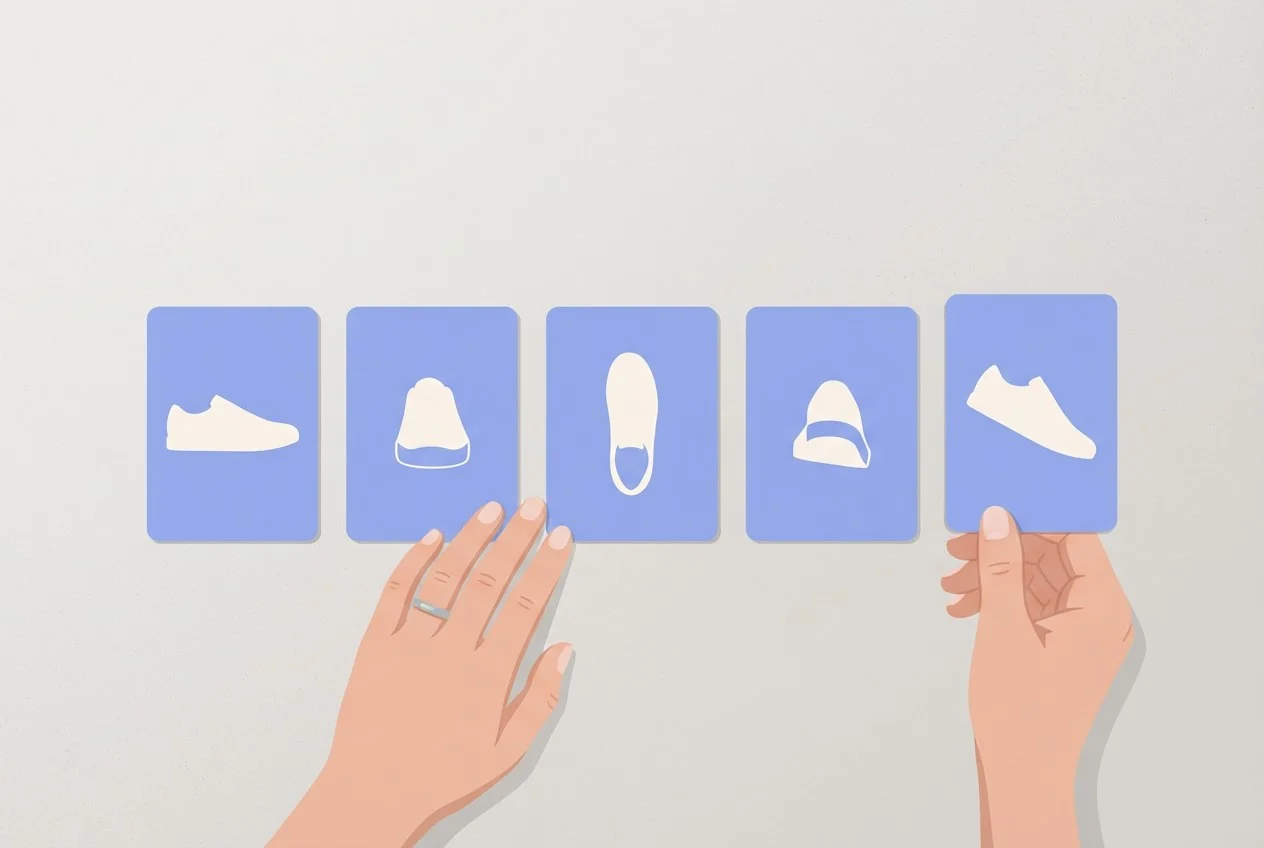
- Size proof
Put a real customer line about sizing in the ad, one you have the right to use. For turning reviews into tests, see Facebook Testimonial Ads: Turn Reviews Into Tests. Fail: cost per purchase above break-even cost per purchase after 3× spend.
- WidthIf you sell more than one width, say so in the ad and show the options. Skip this test if you do not. Same pass and fail rule.
- Exchange firstState a free size swap only if your policy gives one. Same rule, and also check that refunds fall as exchanges rise.
- Comfort in motionShow a first wear and a full day of wear on video, not only the pair on a white background. Same rule.
- A real business behind the adName the business, state the delivery time and put the return terms in the ad and on the landing page. The next section explains why this angle belongs on the list.
How do shoe ads stand out in a Facebook feed full of scam ads?
By stating what a scam avoids: who sells the shoes, when they arrive and how returns work. The Federal Trade Commission (FTC) reported on 27 April 2026 that more than 40% of people who lost money to a scam on social media said they ordered something they saw in a social media ad, and that Facebook cost people more than any other platform.
The same FTC release says that in 2025, nearly 30% of people who reported losing money to a scam said it started on social media, with reported social media losses of $2.1 billion. A real shoe brand buys the same feed placements as the scam seller, so a cold audience has reason to doubt you before they see the shoe.
There is also a rule behind the delivery promise. Under the FTC's Mail, Internet, or Telephone Order Merchandise Rule, set out in 16 CFR Part 435, you must ship within 30 days of a properly completed order when you advertise no time, and when you cannot ship on time you must offer the buyer the choice to consent to a delay or cancel for a prompt refund. Refunds are due within seven working days, or within one billing cycle if you extended the credit yourself. Our recommendation is to state a delivery time in the ad itself and keep to it.
How does Deepsolv help a shoe brand choose which fit angle to test?
Deepsolv is a creative intelligence platform for teams running Meta ads. Our platform reads reviews, comments, direct messages and Reddit threads to surface objections, desires and trust gaps, such as a review saying a shoe runs narrow, and ranks which fit angle to test next, with reasons.
Our platform connects to Shopify, Meta Ads Manager, product reviews, Instagram and Facebook comments and direct messages, and Reddit. Alongside competitor ads and your past ad learnings, those signals produce a ranked weekly creative test plan with reasons for each recommendation and execution-ready creative briefs. Brand Brain records what worked and what failed in earlier tests.
Recommendations guide experiments. They do not guarantee profitable ads, and the break-even number stays yours to set.
Our platform is a monthly or yearly subscription, built for mid-market to enterprise teams spending around $50,000 a month on Meta, with onboarding of one to two weeks, and you can import prior creative testing history. Ask about pricing when you book a demo with our founding team.
Find the fit angle your shoe ads should test next
Frequently asked questions
Our recommendation: start with short vertical video showing the shoe on foot over a full day (the comfort-in-motion angle) against your current best static ad. Add a carousel or catalog ad for retargeting visitors who viewed a size page. Keep whichever has the lower cost per purchase at or under break-even. Types of Facebook Ads lays out the options.
Sources
- 1.2025 Retail Returns Landscape, National Retail Federation and Happy Returns, 15 October 2025
- 2.New FTC Data Show People Have Lost Billions to Social Media Scams, Federal Trade Commission, 27 April 2026
- 3.Business Guide to the Mail, Internet, or Telephone Order Merchandise Rule, Federal Trade Commission
- 4.16 CFR Part 435, Mail, Internet, or Telephone Order Merchandise, Electronic Code of Federal Regulations
- 5.Returns, Rothy's, read November 2026
- 6.Return policy help page, Allbirds, read November 2026