Fashion Facebook Ads: Break-Even ROAS and What to Test First
Fashion Facebook ads pay off only when return on ad spend clears a break-even set by gross margin and the share of orders returned, so work that out before testing creative.

By Sachit Sharma, CEO & Founder · Updated 14 Oct 2026

Key takeaways
- Break-even ROAS for clothing is 1 ÷ (gross margin × (1 − return rate)). At a 55% margin and 25% of orders returned, you need 2.42x before shipping and fees.
- Returns are the input most fashion advertisers skip. The National Retail Federation estimated 19.3% of 2025 online sales would be returned, and your own rate for your hero product is the number that matters.
- Vendor-published apparel benchmarks put cost per acquisition anywhere from $10.95 to $31 and are not independently verified, so judge your account against its own break-even, not a benchmark page.
- Competitors' live ads show what brands chose to run, not what worked. Use them to build a list of ideas to test.
- Test one variable at a time on your hero product, in this order: format, angle, offer, then proof style. Read each result against cost per purchase and return rate.
- Write about the garment, never the viewer. Meta bans ads that imply you know a personal attribute of the person seeing them, and ads that attack someone's appearance.
In this article
- 1What ROAS do fashion Facebook ads need to break even?
- 2Why does a healthy-looking ROAS still lose money in fashion?
- 3What do fashion Facebook ads benchmarks say, and why do they disagree?
- 4How should you read what fashion brands are running on Meta?
- 5Which four fashion ad tests should come first?
- 6What can a fashion ad say without Meta rejecting it?
- 7How do we turn this into a weekly fashion test plan?
- 8Frequently asked questions
A fashion Facebook ad can look healthy in the dashboard and still lose money on every order. The platform counts revenue when the order is placed. Your gross margin and your returns decide how much of that revenue you keep.
As of October 2026, the National Retail Federation's latest estimate, from its 15 October 2025 Retail Returns Landscape report, is that 19.3% of 2025 online sales would be returned. The ad spend behind a returned order is not refunded, so every return raises the return on ad spend (ROAS, the revenue credited to ads divided by what you spent on them) that you need just to break even.
That makes the first useful question about fashion ads a financial one. Which ROAS do your margin and returns require, and does your account clear it? Once you have that number, every creative test has something to be measured against.
What ROAS do fashion Facebook ads need to break even?
Break-even ROAS for fashion Facebook ads is 1 ÷ (gross margin × (1 − return rate)). At a 55% gross margin and 25% of orders returned, you need 2.42x. At a 50% margin and 30% returns you need 2.86x. These are floors before shipping, payment fees and return handling, which all push the number up.
Gross margin is the share of the selling price left after product cost. Return rate is the share of orders refunded. This is our model, not an official figure. It assumes returned items go back on the shelf, refunds are full, and the platform reports ROAS on orders before returns.
| Gross margin | Return rate | Break-even ROAS |
|---|---|---|
| 55% | 0% | 1.82 |
| 55% | 19.3% (NRF estimate for all online sales, 2025) | 2.25 |
| 55% | 25% | 2.42 |
| 55% | 30% | 2.60 |
| 65% | 25% | 2.05 |
| 50% | 30% | 2.86 |
The NRF figure covers all online retail, not only clothing. The rate that matters is your own, pulled for your hero product, the one item you put most of your ad spend behind. Sized garments and one-size accessories can return at very different rates, so calculate each product separately.
A worked example, with our assumptions: an $80 order at a 50% margin, 30% returns and a reported ROAS of 2.9x. You spent $80 ÷ 2.9 = $27.59 on ads for that order. Kept revenue is $80 × 0.70 = $56, and gross profit is $56 × 0.50 = $28. That leaves $0.41 per order before shipping, fees and returns handling. With no returns, the same order leaves $12.41.
Why does a healthy-looking ROAS still lose money in fashion?
A reported ROAS looks healthy because it records revenue at purchase. A later refund does not reduce it unless your store sends refunds back to the platform, while the ad cost stays paid. The difference between reported and kept revenue is your return rate.
So the question "am I actually making money at 1.5x ROAS?" has a precise answer. At 1.5x you would need a gross margin above about 67% with zero returns to break even on the first order. Almost no apparel brand has that.
Repeat purchases can change the picture, because a customer who buys again lowers the real cost of the first order. Track repeat rate separately. It is a reason to be patient with first-order results. It is not a reason to skip the break-even check.
If your reported ROAS sits below your break-even, look at the offer, the size guidance and the product page before changing creative. New ads will not repair a fit or returns problem.
What do fashion Facebook ads benchmarks say, and why do they disagree?
Three 2026 apparel benchmark pages publish click-through rates from 1.95% to 2.84% and cost per acquisition from $10.95 to $31. They disagree because each uses its own sample and its own definitions, and some figures appear to be shared between pages, which is our inference. Treat the range as a warning, not a target.
Click-through rate (CTR) is clicks divided by impressions. Cost per acquisition (CPA) is spend divided by purchases.
Vendor-published figures, not independently verified:
| Benchmark page (2026) | CTR | Cost per click | CPA | ROAS |
|---|---|---|---|---|
| Ryze | 1.95% | $0.45 | $24.32 | 2.9x |
| ContentStudio | 2.8% | $0.45 | $31 | about 2.9x |
| 2.84% | $0.45 | $10.95 | 3.2x |
Our arithmetic on those published figures: $31 ÷ $10.95 is about 2.8x between the highest and lowest CPA, and 2.84% ÷ 1.95% is about 1.5x for CTR. All three pages give the same $0.45 cost per click. Exact matches across independently measured samples are unlikely, which is why we read the shared figures as likely copied.
Set the ROAS column against the break-even table above. A benchmark ROAS of 2.9x to 3.2x clears a 2.42x break-even, but it only just clears 2.86x. Your own last 30 days, set against your own break-even, are the only benchmark that includes your margin. To check your CTR against your own history, see what a good CTR for Facebook ads looks like.
How should you read what fashion brands are running on Meta?
Read competitors' fashion ads as a record of what brands chose to run, not of what worked. A live ad shows that someone is paying for it. It does not show their cost per purchase or their return rate. Use it to build a list of ideas to test, and let your own account decide.
Our public Fall Fashion feed, built from the Meta Ad Library (Meta's public database of active ads), ranks creatives by how many variants each brand is running. A brand running many variants of one creative is investing in it, which makes it a better lead than a one-off ad.
For ten ads in your category, record five fields and apply these tests:
- Format. Record whether the ad is a carousel, a video or a single image. Pass: you have all ten recorded, so you can see which format you have not tested.
- First line. Copy the first line of copy or the first three seconds of video. Pass: you can sort the ten into no more than three angles, such as fit, occasion or fabric.
- Offer. Mark whether the ad mentions a discount, code or free shipping. Pass: you know how many of the ten lead with price before you decide to.
- Run time. Note the start date. Pass: you treat an idea as worth testing only if it appears in at least three of the ten and has run for four weeks or more. This threshold is our recommendation, not a measured rule.
- Variants. Note how many versions of the creative are running. Pass: you can name the angle that gets the most variants.
Which four fashion ad tests should come first?
Test format first, angle second, offer third and proof style fourth, one variable at a time, on your hero product only. This order is our recommendation. It puts the cheapest decision first and keeps the discount test until you know what the ad can say without one.
| Order | Test | Compare | Read it with |
|---|---|---|---|
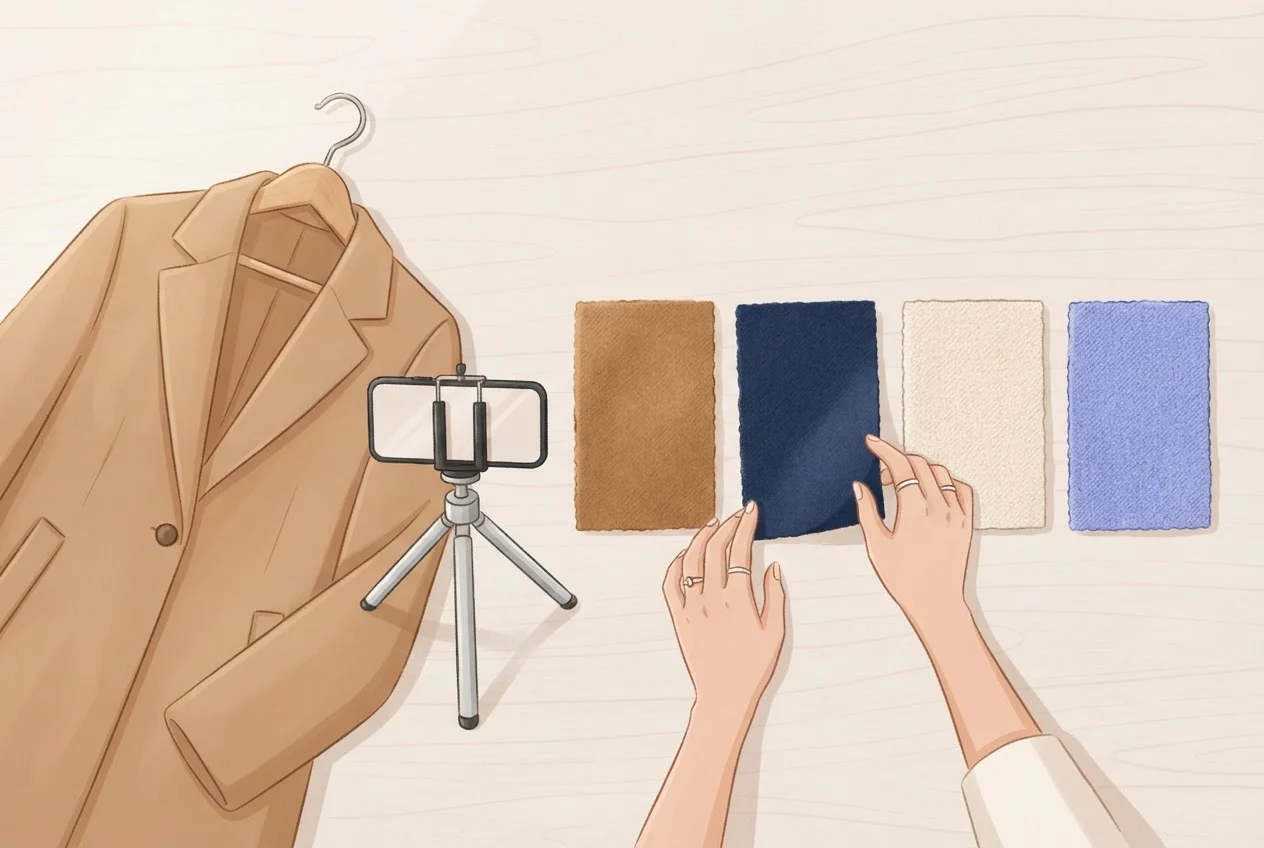
| 1 | Format | Carousel against a short fit-check video (front, side, back, fabric close-up), same product and offer | CTR and cost per purchase |
| 2 | Angle | Aspiration (how it looks and feels) against fit and trust (true to size, easy returns) | Return rate by ad, then ROAS |
| 3 | Offer | No discount against one fixed percent-off or code | Gross margin after the discount, using the break-even formula |
| 4 | Proof style | Customer-style video against studio video | Hook rate, the share of impressions that watch at least the first 3 seconds, then cost per purchase |
Our hypothesis for test 2, which the test is meant to check: aspiration ads draw more clicks, and fit-and-trust ads draw fewer returns. Judge it on return rate by ad where your store can report it, not on clicks.
Keep the audience, budget and landing page identical within each test. Write the hypothesis down before launch and decide in advance what result stops the test. A creative brief built around a single test keeps each round honest.
Start with two or three variants per test. Each variant needs enough purchases to read, so running twenty at once on a small budget leaves every one of them with too little data. That is our recommendation, not a measured threshold.
What can a fashion ad say without Meta rejecting it?
A fashion ad can describe the garment, the fit and the occasion. It cannot imply that the advertiser knows something about the person seeing it, and it cannot attack the viewer's appearance. Meta's personal attributes policy bans ads that "imply that the advertiser is aware of someone's personal attributes or the personal attributes of their family."
The policy lists race, ethnicity, religion, beliefs, age, sexual orientation or practices, gender identity, disability, physical or mental health (including medical conditions), vulnerable financial status, voting status, membership in a trade union, criminal record, and name. Meta's own example for apparel-type products: "We print customizable t-shirts and stickers with your name." is allowed, and "Billy Taylor, get this t-shirt with your name in print!" is prohibited.
Body and appearance claims fall under a second policy. As of 22 July 2026, Meta's Health and Wellness policy requires ads for dietary, health, weight-loss and weight-gain products and services to target people at least 18 years old. It permits before-and-after transformation images for general cosmetic products, procedures and surgeries when targeted to adults 18 and over. It bans "statements of inferiority about physical appearance," meaning terms, descriptions or questions that are negative and attack an individual's appearance, specific body parts or hygiene. That matters for shapewear, activewear and any fit claim.
Three checks to run on every line of copy before launch, as our recommendation:
- Garment or wearer? Pass: the line describes the product ("high-rise, stretch denim in a relaxed fit"). Fail: it describes the reader ("for your problem areas").
- Question about the viewer? Pass: no line asks the viewer about their age, body or health. Fail: any line does.
- Body or appearance claims. Pass: no line attacks or implies a flaw in the viewer's body, and any weight-loss or cosmetic before-and-after content is targeted to 18+ and meets the Health and Wellness policy. Fail: copy such as "hide your problem areas," or any body-change claim you have not checked against that policy.
How do we turn this into a weekly fashion test plan?
We build a ranked weekly test plan from four inputs: your ad performance data, competitor activity, customer signals and your past ad learnings. The plan lists which test to run next and why, and we turn the top ones into execution-ready creative briefs. Your break-even ROAS sets the bar each test has to clear.
For a fashion team, the four-test order above is a starting point, not a fixed script. Your account's own results decide whether format, angle, offer or proof style is the next gap. The competitor side uses public ad data like the feed above. The customer side reads what your buyers say, such as comments on size and fit, so the angle test starts from your customers' words.
The break-even math stays with you, because it depends on your margin and your returns. We rank what to test next, and you decide what result makes a test worth scaling. To size how many tests your budget can support, use our creative test budget calculator. Plans and prices are on our pricing page.
If you want to see this on your own ads, book a demo with our founding team.
See a ranked fashion test plan on your own ads
Frequently asked questions
Use the Meta Ad Library filtered to your country and to active ads, or browse a category feed such as our Fall Fashion feed. Note each ad's start date, and remember that a live ad shows spend, not results.
Sources
- 1.National Retail Federation, 2025 Retail Returns Landscape
- 2.Meta Advertising Standards, Privacy Violations and Personal Attributes
- 3.Meta Advertising Standards, Health and Wellness (last updated 22 July 2026)
- 4.Deepsolv Fall Fashion feed, built from the Meta Ad Library
- 5.Foundry CRO, Facebook Ads Benchmarks by Industry 2026