Deepsolv Review: Does Your Team Need a Weekly Test Plan?
A current Deepsolv review for Meta growth teams: required inputs, weekly test-plan workflow, data handling, trade-offs, and alternatives by job.

By Sachit Sharma, CEO & Founder · Updated 2 Sept 2026

In brief
Deepsolv suits Meta growth teams that can act on a ranked weekly test plan built from performance history, customer evidence, and competitor activity. It is not an asset-generation tool, a simple saved-ad library, or proof that a competitor’s creative drove revenue. Use a demo to validate the evidence trail, data connections, onboarding process, and governance for your workflow.
In this article
- 1The useful question is whether your next constraint is prioritisation
- 2Three evidence sources make the weekly plan useful
- 3Match the tool to the job that is actually blocked
- 4Visible competitor ads are clues, not revenue evidence
- 5Treat data access and retention as part of the rollout
- 6Frequently asked questions
The useful question is whether your next constraint is prioritisation
Deepsolv is worth evaluating when a Meta growth team already has creative ideas and needs a repeatable way to choose the next test. Its current product is a decision layer: it weighs performance history, competitor moves, customer signals, and past experiments to produce a ranked weekly test plan. Deepsolv’s current product page describes that output as guidance on what to make, skip, improve, or stop.
The trade-off is plain. This is not the right starting point for a team whose immediate problem is asset production, a lightweight swipe file, or proof of causal lift. Deepsolv says its workflow supports decision-ready briefs rather than asset generation, and its own materials distinguish attributed account results from causal evidence produced by a controlled experiment. Its creative-testing guidance makes that boundary explicit.
Three evidence sources make the weekly plan useful
A ranked recommendation is only as useful as the evidence behind it. Before a demo, name the owned performance history available to the team, the category competitors whose visible ads provide context, and the customer evidence the team is authorised to use. The practical aim is not to collect every signal. It is to make one next-test decision easier to defend.
Start by writing one decision in operational terms: which customer tension, angle, hook, offer, or format should enter the next test batch, and what result would change that choice? Then separate own ad performance from competitor signals so public market activity remains research context rather than a substitute for the brand’s own conversion evidence.
A team should also nominate who can interpret a result and who can commission the next creative. Without that hand-off, a weekly plan becomes another report rather than a testing decision.
Evidence before a weekly test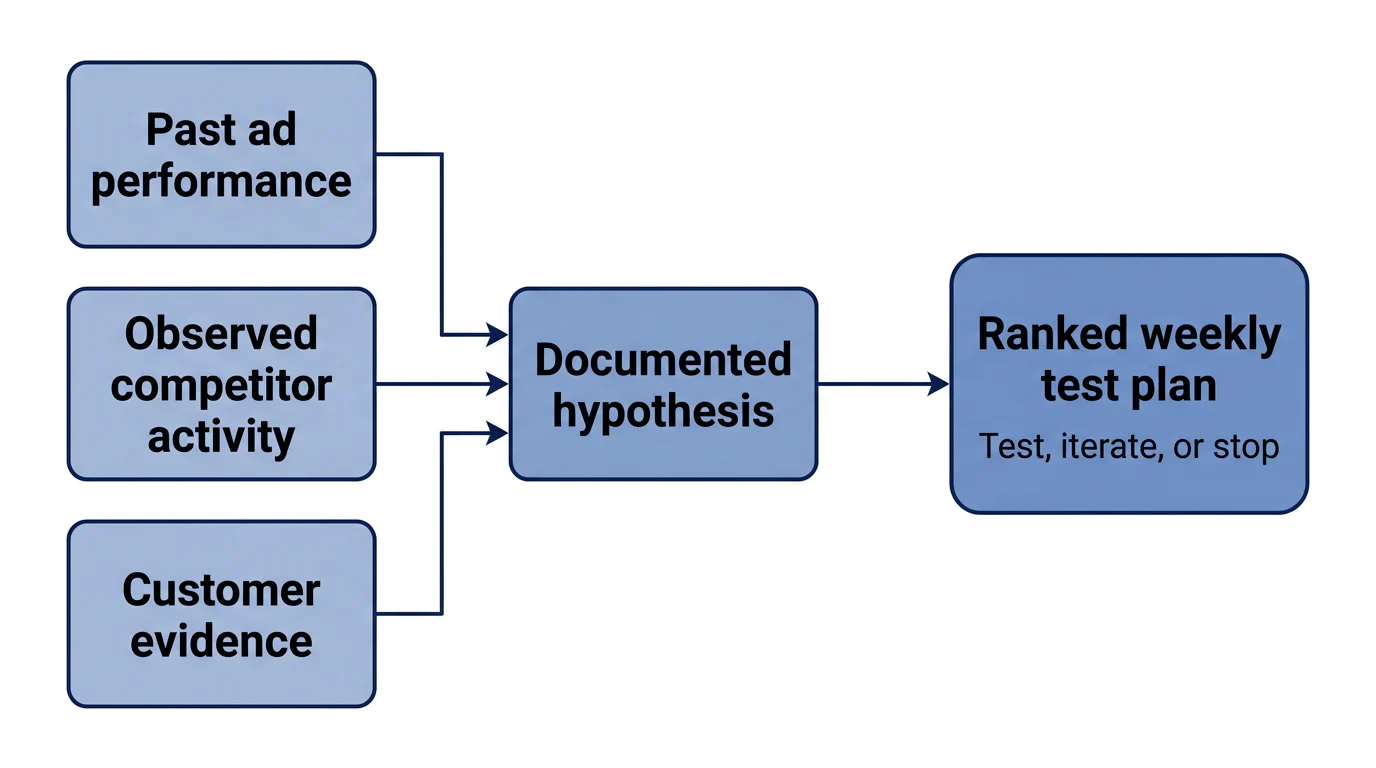
Match the tool to the job that is actually blocked
| Immediate job | Tool or workflow to examine | What to verify |
|---|---|---|
| Find occasional active Meta ads | Meta Ad Library | Use it for visible current ads and dated observations, not private competitor conversion results. |
| Save examples, monitor competitors, and organise briefs | Saved-ad research and briefing platform | Verify whether it supports the research sources, organisation, sharing, and briefing workflow your team needs. |
| Analyse performance after ads launch | Post-launch creative analytics platform | Verify which connected ad accounts, creative attributes, performance metrics, and reporting views the team needs. |
| Produce more editable assets | AI creative-generation workflow | Check whether the production bottleneck is text, image, video, format adaptation, or feed-based variants before selecting a generator. |
| Establish causal budget impact | Controlled experiment | Use a valid experiment when the decision requires incremental conversions or revenue rather than attributed performance alone. |
These categories can be complementary. A saved-ad workflow can surface references, post-launch analytics can explain account patterns, generation can create variants, and a decision layer can document why a specific test was funded. The buying question is which missing step currently delays or weakens the next test.
Visible competitor ads are clues, not revenue evidence
A public competitor ad can show what is observable in market, including creative activity, messaging, format, and offers. It cannot establish the advertiser’s private CPA, ROAS, attributed revenue, or profit. Meta says its Ad Library searches ads currently running across Meta technologies, with separate retention rules for issue, election, political, EU, and UK ads. Meta’s Ad Library also says an ad normally appears within 24 hours of its first impression.
Ask the demo team to show the evidence trail behind one recommendation. The review should make clear which part came from a public observation, which part came from the team’s connected performance context, and which part remains a hypothesis to test. That standard prevents a long-running competitor creative from being treated as proof of commercial efficiency.
Treat data access and retention as part of the rollout
Rollout should begin with an evidence and access review, not with a feature tour. Confirm which connected accounts and customer sources are in scope, who owns access, what questions the team wants the weekly plan to answer, and how recommendations move into creative production. Deepsolv says product setup is confirmed during onboarding and that its pricing is scoped to the team and workflow. Its conversion-ranked intelligence guide also states that no public self-serve price is listed.
For data governance, Deepsolv’s privacy policy says customer data is retained during an active subscription and for a default six months after termination unless otherwise agreed. The policy says customer deletion requests remove records from active systems within 28 days, subject to stated obligations, and operational logs are retained for up to 30 days by default. Read the privacy policy alongside the team’s own security and procurement review.
The rollout is ready to progress when the team can name the signals it will connect, the decision owner for the weekly plan, the creative hand-off, and the rule for calling a result testable, inconclusive, ready to iterate, or ready to stop.