
Deepsolv vs AI Creative Generation for Creative Testing
Compare an AI creative testing workflow with creative generation for weekly test plans, failed-test memory, fatigue signals, and stop decisions.

Creative volume matters, but it does not resolve the harder question of what deserves the next dollar. In a 2025 study of 8,000 heavy TikTok users, 51% preferred brands with varied content, which makes disciplined variation more useful than endless cosmetic change.
Choose a production-first platform when the bottleneck is creating more assets. Choose Deepsolv when the bottleneck is deciding which ideas to test, repeat, or stop. Our AI creative testing workflow connects historical outcomes, fatigue signals, market evidence, and active hypotheses so failed formats do not return as nearly identical experiments.
Below, we compare the two workflows, show what a defensible stop decision retains, and turn a crowded creative backlog into a ranked weekly plan.
What Separates Generation from an AI Creative Testing Workflow?
A generation platform begins with a prompt, template, feed, or brand asset, then creates and adapts creative. Our workflow begins with a decision: what customer tension, angle, or execution is worth testing next, and what evidence would change that decision?
| Decision Factor | Deepsolv Workflow | Generation Platform |
|---|---|---|
| Primary Job | Rank and document creative-test decisions | Create, adapt, score, and launch assets |
| Inputs | Performance, customer evidence, hypotheses, controls, fatigue, and market context | Prompts, brand assets, templates, feeds, and connected account data |
| Outputs | Funded queue, test card, evidence trail, and continue, iterate, or stop decision | Text, images, video, variants, exports, and pre-launch scores |
| Historical Memory | Keeps a hypothesis, variable, result, and next action connected | Public materials describe performance feedback into generation, but a hypothesis-level test record needs confirmation |
| Failed-Test Handling | Separates failed angle, execution, format, delivery issue, and inconclusive result | Public materials describe scoring and dashboards, but an explicit stop-rule workflow needs confirmation |
| Fatigue Signals | Reads delivery, attention, conversion quality, and market signals together | Confirm fatigue workflow during evaluation |
| Market Context | Treats observed market activity as context, not performance proof | Confirm vertical-benchmark workflow during evaluation |
| Asset Generation | Supports decision-ready briefs, not asset generation | Generates text, image, video, and feed variations |
| Workflow Fit | Decision-constrained in-house paid-social teams | Production-constrained creative teams |
| Verified Pricing | We scope pricing to the team and workflow | $14 monthly for 50 generations, $55 monthly for 250, enterprise pricing is custom |
The distinction is not that production tools lack useful data. Current vendor materials describe account-connected dashboards, creative scoring, direct launch options, and a 0 to 100 performance score. Those capabilities help teams make and select assets. We built our creative decision platform for the next layer: tracing why a test was funded, whether it received a fair read, and what that result should prevent or prioritize next.
Which Workflow Fits a Production-Constrained Team?
The right choice depends on the actual constraint. A team that cannot produce enough editable assets has a production problem. A team that can produce plenty but cannot agree on the next three valid tests has a prioritization problem.
-
Choose generation first: Your designers need more text, images, video, format adaptations, or feed-based versions. Current public plan details show 50 monthly generations at $14 or 250 at $55, with annual billing at $11 and $44 respectively.
-
Choose a decision workflow first: Your backlog contains repeated angles, failed formats that reappear under new styling, or fatigue refreshes selected by instinct instead of evidence.
-
Use both in sequence: First rank a distinct hypothesis, its control, and its decision rule. Then generate the executions required to test that hypothesis. This prevents asset volume from becoming a substitute for learning.
For a mature in-house team, the useful comparison is not “Which tool has more AI?” It is “Where does our weekly process break?” Our concept prioritization approach starts with evidence strength, strategic relevance, novelty, feasibility, brand fit, and learning value before anyone commissions another variation.
What Should a Stop Decision Remember About a Failed Test?
A stop recommendation should not be a black-box label attached to an ad. It should be a compact argument that lets the next planner see what was tested, whether the result is interpretable, and exactly what should stop.

How Do We Separate a Failed Angle from a Failed Execution?
An angle is the underlying customer promise. An execution is how that promise appears in a particular hook, visual treatment, creator delivery, placement, or format. If a vertical video fails because the product is hidden in the opening seconds, that does not prove the customer tension is weak.
We preserve the hierarchy, from insight to angle to hypothesis to concept to hook, format, and execution. That lets us stop one weak version without needlessly retiring a strategic idea that deserves a cleaner test.
What Evidence Should a Stop Recommendation Show?
A useful record identifies the audience, objective, control, isolated variable, attribution setting, exposure, leading signals, business outcome, and confounders. It also assigns a confidence level and a next action. TikTok’s auction guidance says ad groups should achieve approximately 50 conversions before leaving the learning phase, a reminder that insufficient volume is not the same as failure.
| Test Record Field | Illustrative Entry |
|---|---|
| Hypothesis | A product demonstration first will improve qualified response against the testimonial control |
| Variable | Opening sequence only |
| Result | Weaker early attention and no compensating conversion-quality signal |
| Validity Check | Same audience, offer, objective, and placement policy retained |
| Confidence | Moderate, exposure cleared the agreed evidence floor |
| Decision | Stop this execution, retain the objection-handling angle |
| Next Eligible Test | Test the same angle in a proof-led carousel |
Our test memory keeps that evidence attached to the decision. It means “failed” is not a dead-end label, it is an instruction about what should not be repeated.
When Should a Team Call a Result Inconclusive?
We classify a result as inconclusive when delivery was skewed, the offer or landing page changed, tracking failed, attribution has not matured, or the test never reached its agreed evidence floor. Inconclusive does not mean “keep spending.” It means repair the condition that blocked learning, then decide whether the question is still worth funding.
That distinction matters when teams create dozens of close variations. Our stop rules protect budget without pretending that every weak early read is a permanent verdict.
How Do Fatigue and Market Signals Change the Next Test?
Fatigue is a pattern, not a universal frequency threshold. We look for a decline in an asset or message family, then compare delivery, attention, conversion quality, audience access, offer changes, and measurement conditions before deciding that the creative itself is worn out.
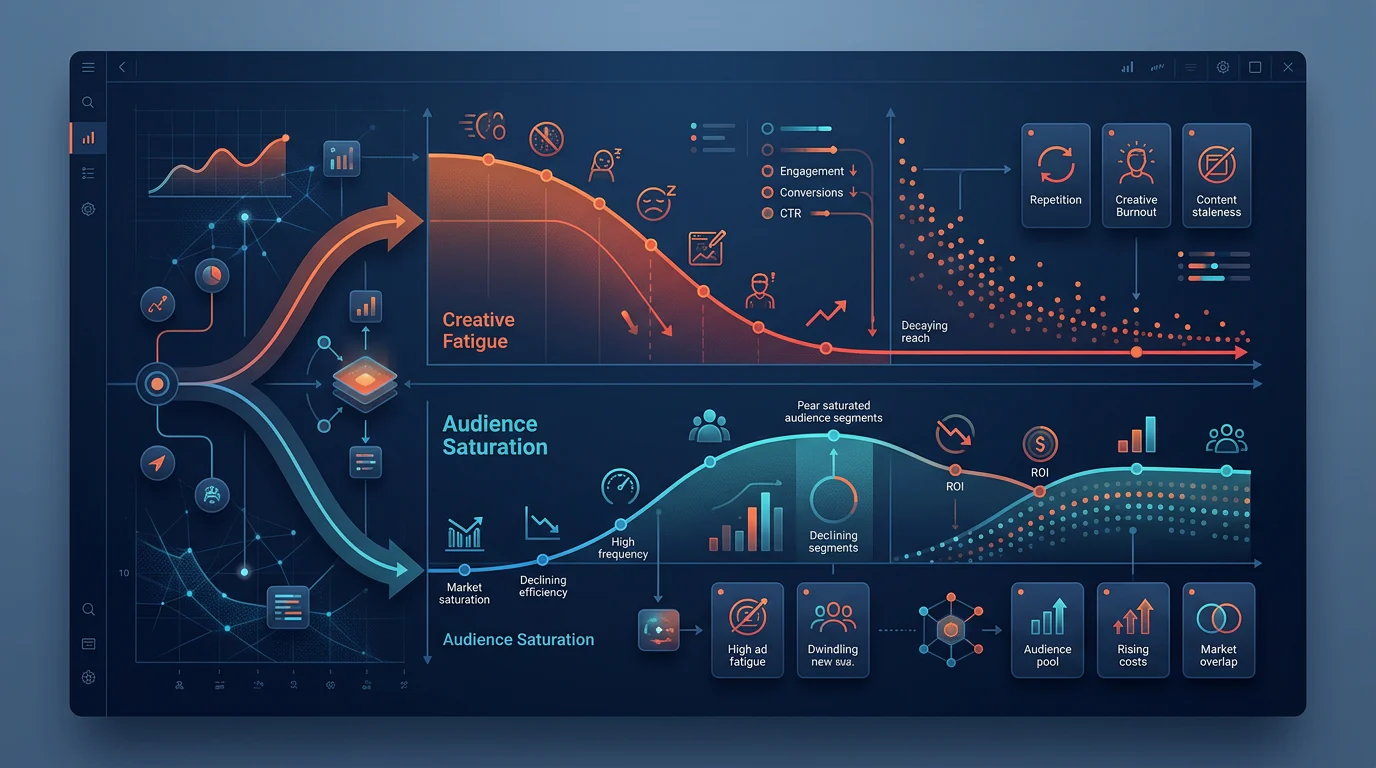
What Does Creative Fatigue Look Like?
A specific execution is more likely fatigued when its hook rate, hold rate, CTR, or downstream efficiency declines while fresher concepts still work for the same audience. Audience saturation is more likely when reach stalls and several distinct creative approaches weaken together.
| Signal | More Consistent With Creative Fatigue | More Consistent With Audience Saturation |
|---|---|---|
| Response | One hook, format, or message family weakens | Multiple fresh concepts weaken |
| Reach | Other assets can still reach responsive people | Reach growth slows across the audience |
| Refresh Test | A new execution restores performance | Fresh executions do not restore performance |
| Next Action | Change the execution or message | Test audience, offer, or delivery conditions |
Our fatigue diagnosis prevents a familiar mistake: producing more assets to solve an audience or offer problem. It also keeps the planning conversation focused on a specific cause, rather than treating a rising frequency figure as sufficient proof that every asset needs replacement.
The TikTok research also found that ads with early brand recognition generated 57% more happiness and 19% less attention decay. Those creative fatigue findings support variation, but they do not make every fresh execution strategically distinct.
What Can Market Evidence Actually Establish?
Observed market ads can show message patterns, formats, offers, creative timing, and visible category shifts. They cannot reveal causal performance, profitability, targeting logic, conversion quality, internal budgets, or the experiments another team has already ruled out.
That gap is why we place market activity beneath first-party outcomes in the evidence hierarchy. A live ad may signal that a category message is worth investigating, while your own results determine whether it earns a funded test. We also keep the observation tied to a concrete hypothesis, rather than treating a visible format as a recommendation to copy.
Our market evidence approach uses observed activity to raise or lower exploration priority, never to claim that an observed asset is a winner. Your own controlled result remains the strongest evidence for your next decision.
How Should Fatigue Affect the Queue?
When an active winner shows credible fatigue, we do not automatically order a new background, headline, or crop. We ask whether the angle still holds, whether the audience has changed, and whether a new format, opener, proof point, or offer is the smallest meaningful next test.
How Do We Build a Ranked Weekly Test Plan?
A weekly plan should fund hypotheses, not requests for “three more ads.” We turn customer language, account history, active-market context, and production capacity into a short queue that everyone can inspect before work begins.
Start by collapsing duplicates. Five visual variations of the same claim are not five independent learning opportunities. Then reserve a relevant control, estimate whether the planned cells can receive enough exposure, and rank the remaining ideas by evidence, expected impact, novelty, feasibility, and learning value.
| Weekly Priority | Test Type | Why It Ranks Here | Planned Decision |
|---|---|---|---|
| 1 | Proven-angle validation | Strong customer evidence, new proof execution | Continue or refine the proof |
| 2 | Fatigue replacement | Current winner shows a credible response decline | Refresh execution or reassess the angle |
| 3 | Exploration | New audience objection with meaningful upside | Learn whether the objection changes qualified response |
| Deferred | Cosmetic variation | Repeats an answered hypothesis | Do not fund without a distinct variable |
| Repair | Inconclusive rerun | Previous result was invalidated by a confounder | Fix the condition before relaunch |
We also make production reality visible. A brilliant hypothesis that cannot be produced, approved, and measured this week should not outrank a valid test that can. Our weekly plan system keeps creative, paid, and brand teams working from the same rationale rather than separate dashboards and memories.
Why Teams Choose Deepsolv for Decision-Ready Testing
At Deepsolv, we built our workflow for the moment after the creative review, when a team must decide what earns another week of budget. We bring performance signals, customer evidence, active-market context, controls, and documented outcomes into one decision trail. That gives paid, creative, and brand leaders a shared reason to fund a hypothesis, refresh a tired execution, or stop repeating it. Our approach does not promise that a model can know causal lift before valid exposure. It makes the evidence, uncertainty, and next action visible, so the next weekly plan starts from learning instead of amnesia. If your in-house team can create plenty of assets but keeps retesting ideas that have already failed, we can help turn its backlog into a defensible queue and its results into durable memory. Start now with a scoped working session at Deepsolv.
FAQs on AI Creative Testing Workflow
Can Predictive Scoring Replace a Controlled Test?
Scoring prioritizes assets before launch, but it cannot prove causal lift. We require comparable exposure, a control, outcome metrics, and documented confounders before deciding safely.
Should a Failed Format Kill an Underlying Angle?
A failed format does not retire the angle. We record format, execution, hook, offer, delivery, and audience, then test the angle through another controlled execution.
Can Market Ads Benchmark Performance in a Vertical?
Market ads reveal messages, formats, and offer timing, not causal performance, profitability, targeting, conversion quality, or internal history. We use them to form hypotheses only.
What Makes a Stop Recommendation Safe?
A safe recommendation names the tested variable, evidence floor, comparison, outcome signals, delivery checks, confidence, and next action. It stops an execution, not strategy automatically.