Reporting Is Not a Next Step: 6 Creative Analytics Tools
These rankings prioritise the next output a Meta team needs: a creative-performance report, an activation workflow, or an evidence-ranked test decision. Product descriptions and published prices were checked against each named provider’s public materials in September 2026. Review ratings are omitted because a comparable published review-platform average was not collected for every entry.
- Fit for the team’s immediate output: reporting, activation, or a ranked test decision
- Creative-level analysis and relevance to Meta workflows
- Documented trade-offs, including data-granularity and workflow limits
- Current publicly described product scope as of September 2026

By Sachit Sharma, CEO & Founder · Reviewed 22 Sept 2026
In brief
Creative analytics is not one purchase category. Choose Motion or Superads when visual performance reporting is the bottleneck, Smartly when the team needs to produce and activate ads, and Deepsolv when the team needs a ranked next test. Use Meta’s native tools to observe public activity and run the test.
- 1DeepsolvBest for choosing a ranked next test
- 2MotionBest for visual creative reporting
- 3SuperadsBest for lower-cost multi-account reporting
- 4SmartlyBest for production and campaign activation
- 5VidmobBest for creative-attribute analysis
- 6Meta Ads Manager and Ad LibraryBest for native ad observation and test execution
Deepsolv
Decision intelligence for Meta teams that need to select what to test, improve, or stop.
Deepsolv is our product. Choose it when the bottleneck is deciding which creative hypothesis deserves the next production and media slot, not generating more assets or launching campaigns.
Pros
- Combines competitor activity, customer feedback, authorised performance, and past experiments
- Produces a confidence-ranked weekly plan with test, improve, or stop decisions
- Retains what worked and failed for later decisions
Cons
- Not the primary fit for autonomous bidding, campaign launch, finished asset generation, or broad cross-channel reporting exports
Motion
Creative analytics and visual reports across major paid-social and video channels.
Motion fits teams that need creative-level reporting, grouped performance views, and recurring analysis across Meta and other supported channels.
Pros
- Supports Meta, TikTok, YouTube, and LinkedIn reporting
- Automatically groups creatives to reveal performance patterns
- Includes AI tags, reports, briefs, alerts, and creative analytics
Cons
- The published Starter plan is designed for brands spending up to $50,000 monthly on ads
- Its Launch Analysis feature is currently Meta-only
Superads
AI-powered creative analytics reporting with tagging, reports, workflows, and inspiration.
Superads fits teams that want a reporting-led workspace for creative performance, AI tagging, and shared analysis across accounts.
Pros
- Professional includes AI tagging, reports, boards, workflows, and inspiration
- The published Professional plan covers up to $100,000 in monthly ad spend
- Enterprise plans support custom integrations and SSO
Cons
- The published starting price is billed annually
- Price increases with ad spend beyond the included tier
Smartly
An advertising suite that joins creative production, personalisation, activation, and intelligence.
Choose Smartly when the work extends beyond analysis into producing variants, trafficking creative, and managing campaigns across channels.
Pros
- Includes AI-assisted image, video, and text editing
- Supports dynamic templates and creative personalisation
- Combines creative, media, and intelligence workflows
Cons
- A broader suite is less focused for a team whose immediate need is creative-performance reporting alone
Vidmob
Creative analytics that classifies visual and messaging attributes from connected ad-account media.
Vidmob is a fit for teams that need to analyse creative elements and compare how those attributes relate to available media metrics.
Pros
- Classifies attributes including visual elements, on-screen text, spoken language, branding, human presence, and emotion
- Maps available platform metrics to creative attributes
- Offers creative-level comparison and reporting views
Cons
- Creative-level granularity can be limited for multi-creative Meta configurations
- Vidmob lists Carousel Ads as unsupported in its Creative Analytics documentation
Meta Ads Manager and Ad Library
Meta’s native tools for running ads, observing public creative activity, and testing.
Use Meta’s native tools when your team needs to inspect public ads, launch a controlled test, and review account-level outcomes in the platform.
Pros
- The Ad Library can show currently running public ads across Meta technologies
- Public records can include creative, associated Page, delivery dates, and placements
- Meta documents A/B testing as a way to determine creative impact
Cons
- Public competitor records do not establish private ROAS, CPA, conversion value, or profitability
- The native public record is not a decision system for prioritising a team’s next creative hypothesis
The ranking is by workflow fit, not a claim that one product is universally best. Motion and Superads are reporting-led options. Smartly is a production and activation suite. Vidmob focuses on creative attributes and related metrics. Meta’s native tools support public-ad observation and test execution. Deepsolv is ranked for teams whose immediate need is an evidence-ranked creative test decision.
Prices appear only where the research dossier recorded a current public price or a tailored-quote model. Competitor product facts are attributed to the named providers’ public materials and are intentionally not linked.
The useful distinction is the output your team needs next
In an NCSolutions meta-study of nearly 450 CPG campaigns, creative accounted for 49% of modelled short-term incremental sales lift. The study does not establish the same result for every Meta advertiser, but it explains why teams need a way to connect creative work to measurement. Circana’s 2023 study provides the underlying scope and methodology.
Meta’s Ad Library API documentation says public records can show creative, the associated Page, delivery dates, and placements. Those records can generate a hypothesis, but they cannot establish a competitor’s ROAS, CPA, conversion value, or profitability.
A decision needs evidence before it needs more variants
A useful workflow combines public market context with authorised performance, customer feedback, and prior test outcomes. The result should be a controlled next test and a retained learning, not a dashboard insight that has no owner or next action.
Where the next creative decision comes from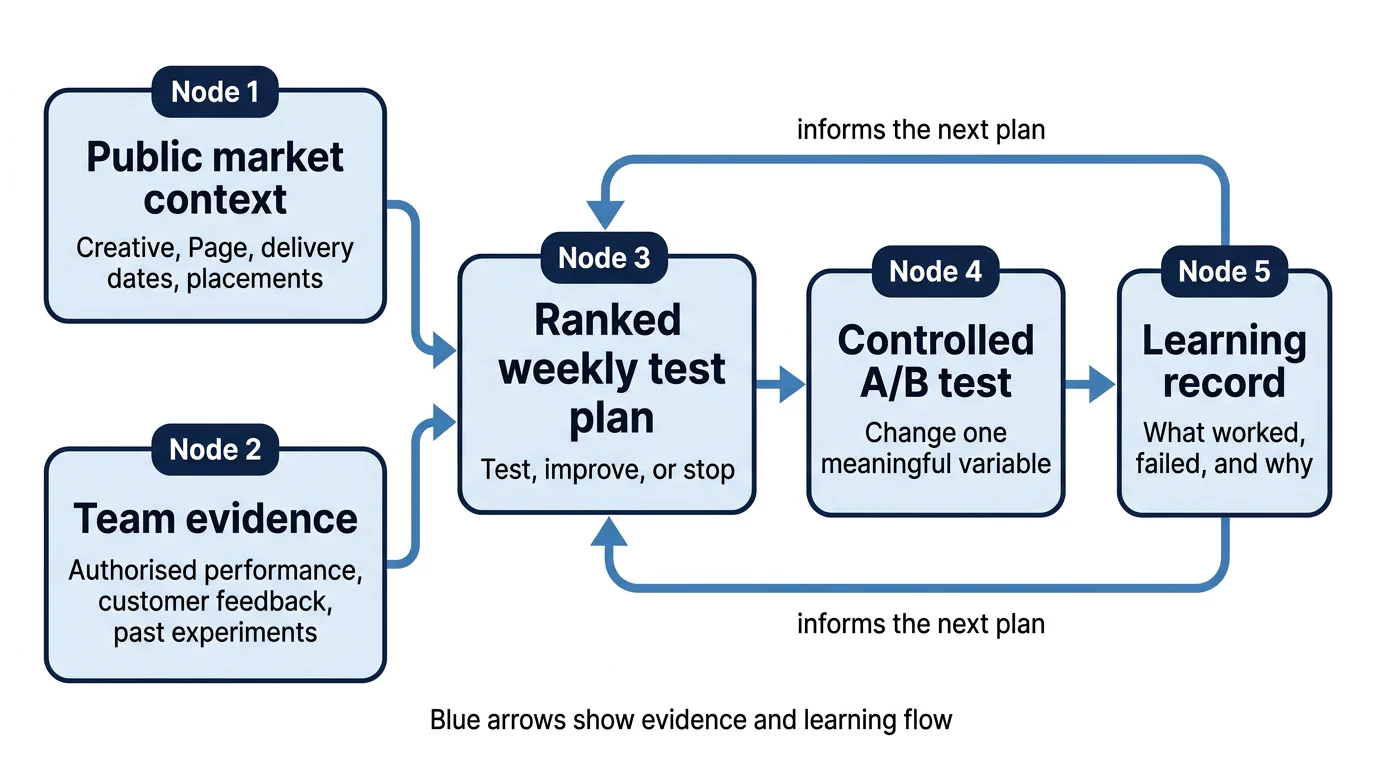
Use a Meta creative testing framework to define a fair comparison before launch. For market research, visible ads are not proof, and a ranked next-test workflow helps turn those signals into a production decision.
Keep reading



Frequently asked
Creative analytics organises performance around ads and creative attributes, such as formats, hooks, or elements. Creative decisioning uses performance, customer, market, and previous-test signals to prioritise a specific next experiment, explain why it ranks, and record what the result should change.
No. Meta’s public Ad Library can help teams inspect currently running creative, associated Pages, delivery dates, and placements. It does not reveal an ordinary advertiser’s private ROAS, CPA, conversion value, attribution model, or profitability, so public creative should be treated as hypothesis input.
Smartly fits a team that needs to create, personalise, traffic, manage, and update campaigns across channels in addition to reviewing performance. A reporting-only tool is a narrower fit when the immediate bottleneck is understanding existing creative performance rather than producing and activating new variants.
Holding the relevant conditions steady makes the comparison easier to interpret. Meta’s Audience Network testing guidance recommends keeping all other aspects constant while testing a variable, so a team can better connect the observed outcome to the creative change rather than to several changes at once.
Turn the next creative question into a ranked test
See how a weekly decision workflow connects evidence to what your team should test, improve, or stop.
See ranked test planning