MY DAUGHTER PULLED ME OVER ON HIGHWAY 49 LAST APRIL… NEITHER OF US KNEW IT YET
I hadn't seen her since she was two.
Her mother took her and disappeared 31 years ago.
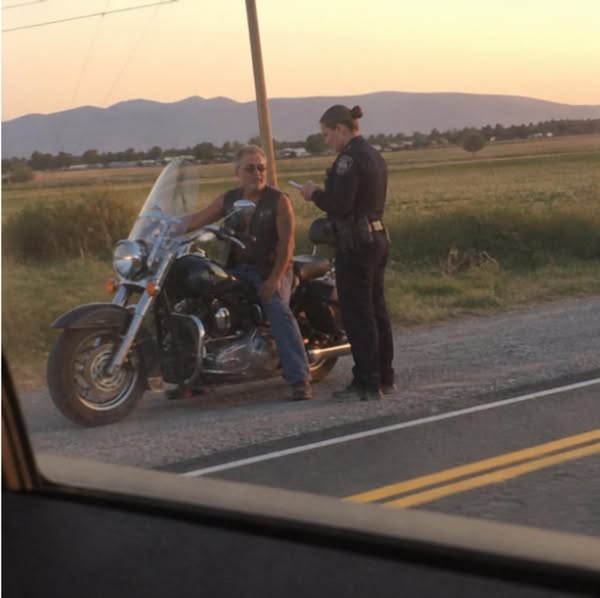
Now she was a cop writing me a ticket for a broken taillight, and she had the same birthmark below her left ear that I used to kiss goodnight.
She didn't recognize me.
I didn't expect her to.
Amy would have changed it.
Changed everything.
That was the whole point of leaving.
"Sir, are you aware your left taillight is out?"
"No. I wasn't."
My voice didn't sound like my voice.
My hands were shaking against the gas tank.
She had my mother's eyes.
Brown with gold flecks near the center.
My nose.
The jaw she got from Amy's side… the stubborn one.
She wrote the ticket.
I watched her hand move across the pad.
Steady… professional.
She had no idea who I was.
"Drive safe, Mr. McAllister."
She walked back to her cruiser.
I sat on my bike in the gravel shoulder of Highway 49 and watched her pull away.
Her taillights disappeared around a curve and I sat there for eleven more minutes.
I know because I looked at my phone when I finally started the engine and my hands had stopped shaking enough to grip the throttle.
Her name was on the ticket.
Officer S. Chen. Sarah.
Amy named her Sarah because I asked her to.
It was my grandmother's name.
I didn't know if Amy had kept it.
She kept it.
I rode home.
Parked in the garage.
Sat in the dark with the engine ticking.
Held the ticket under the dome light and read her badge number, her precinct, her name. Read it again.
Folded the ticket and put it in the inside pocket of my jacket, against my chest, where it stayed for the next three weeks.
I didn't sleep that night.
Didn't try.
Sat on the edge of my bed with the lights off and my boots still on and thought about every choice I'd made since the morning I woke up and the apartment was empty.
I spent four years looking. Burned through every dollar I had.
Hired a guy who said he could find anyone.
He couldn't find them.
Filed police reports.
Called Amy's family… they said they didn't know where she was.
Maybe they were telling the truth. Maybe not.
After four years I stopped looking.
Not because I stopped caring.
Because the looking was killing me.
Every dead end was another funeral for the same person.
So I became the nickname.
Ghost.
I'd gotten it in my twenties because I'd disappear on long rides.
Weeks sometimes.
Just me and the road and the sound of the engine drowning out everything I didn't want to hear.
After Sarah disappeared, the nickname stopped being funny.
I was a ghost.
I haunted my own life.
I went to work.
Welded pipe.
Came home.
Rode with the club on weekends.
Drank too much.
Ate whatever was closest.
Stopped going to the doctor because what was the point.
Stayed alive out of habit, not intention.
Thirty-one years of that.
And then a broken taillight on Highway 49.
It took me three weeks to go back.
Not to the precinct — I couldn't walk into a police station looking like me and ask to see an officer I claimed was my daughter.
I'd end up in a holding cell.
So I found her.
I'm not proud of how.
I sat in a parking lot across from the precinct for two days until I saw her leave in her personal vehicle.
Followed her to a coffee shop.
Sat in the parking lot for forty minutes convincing myself not to leave.
Then I went inside.
She was in a booth by the window.
Reading something on her phone.
A cup of coffee in front of her.
Her jacket over the back of the chair.
Off duty.
Smaller than she looked in uniform.
I walked up to her table.
She looked up.
Cop eyes — assessing, measuring, already cataloging my description in case she needed it later.
"Can I help you?"
"You pulled me over three weeks ago. Highway 49. Broken taillight."
Her expression didn't change.
"I pull over a lot of people."
"My name is Robert McAllister."
Nothing.
"Your mother's name is Amy Chen. She was Amy McAllister when I knew her. You were born on March 14th, 1993 at St. Joseph's Hospital. You weighed six pounds eleven ounces. You had a birthmark below your left ear shaped like a crescent moon and I used to kiss it every night before I put you in your crib."
Her face went white.
Not slowly… All at once.
Like someone pulled a plug.
"You need to leave."
"Sarah…"
"You need to leave right now."
"I have a photo."
She stared at me.
I could see her deciding.
Cop brain running the threat assessment.
Man. Large. Biker.
Knows personal details.
Possibly delusional.
Possibly dangerous.
Possibly telling the truth.
"One photo," she said.
"Then you leave."
I pulled it out.
I'd carried it in my wallet for 31 years.
The edges were soft.
The color had faded.
But you could see it clearly — me at 26, holding a baby girl in a hospital room.
The baby had a crescent moon birthmark below her left ear.
The man had the same nose she saw in her mirror every morning.
She looked at the photo.
Looked at my face.
Back at the photo.
Then she touched the birthmark below her own ear.
Unconsciously.
The way you touch something that suddenly means something different than it did a minute ago.
She didn't say anything for a long time.
"My mother told me you left," she finally said.
"She said you didn't want us."
My chest caved in.
"I woke up and you were gone. Both of you. I spent four years looking. I spent everything I had."
"She said you were dangerous."
"I wasn't."
"She said a lot of things."
She was quiet for a minute. Then:
"She told me you hit her. That's why she left. She said she was protecting me from you."
I put my hands flat on the table.
The hands she could see.
The hands that have never hit anything that wasn't metal.
"I never touched your mother. Not once."
She looked at my hands on the table. Then at my face. And I watched thirty-one years of someone else's story crack down the middle of her expression like ice on a spring river.
We sat in that booth for two hours. She told me what Amy had told her. I told her what happened. The two stories didn't match.
She knew they didn't match — she'd known for years, she said. There were holes in Amy's version she'd been sticking her fingers into since she was old enough to ask questions.
She didn't call me Dad. She called me Robert. That was fine. Robert was more than I'd had in thirty-one years.
Over the next two months, I learned who she was. Bits at a time. Coffee became dinner. Dinner became weekends. She had two kids. Ethan, seven. Lily, four. My grandchildren.
The first time I saw them I was standing in Sarah's doorway and Ethan was hiding behind her leg looking up at me. I'm a big man. Leather jacket. Grey beard. I look like exactly what I am — a guy who's spent thirty years on motorcycles and pipeline work. I could see him trying to figure out whether I was safe.
"Ethan, this is Robert. He's my father."
"Your dad?"
"Yes."
"How come I never met him before?"
Sarah looked at me. I looked at her. Neither of us had a good answer for a seven-year-old.
"I was lost," I said. "Your mom found me."
He accepted that. Kids do.
Lily didn't care about any of it. She walked up to me, pointed at my beard, and said "fuzzy." Then she went back to her coloring book.
That night I sat in my apartment and cried for the first time in twenty years. Not because I was sad. Because I could feel how close I'd come to never knowing they existed.
Every day since has felt borrowed. Like someone reached into the machinery of my life and rerouted something at the last second.
But borrowed time has a price.
You have to be alive to spend it.
More than that.
You have to be able to see it.
I'd been a welder for thirty years. Pipeline work, custom fabrication, some structural. You spend thirty years behind a welding hood and your eyes take a beating even when you do everything right. The arc throws UV that punishes you through the lens if the shade rating is off by a grade. Spatter. Flux smoke. The sustained, brutal brightness of a sustained arc.
I'd also spent thirty years with unmanaged type 2 diabetes, because when you don't care if you live or die, managing a chronic condition is not high on the list.
I'd known the diagnosis for eight years. Took the metformin when I remembered it. Mostly I didn't remember it. Watched what I ate when a doctor scared me into it, then stopped watching. My blood sugar was what it was. I was what I was. A ghost doesn't worry about his long-term health outcomes.
But I wasn't a ghost anymore.
And that was the problem.
Because the damage I hadn't been paying attention to for eight years was still there. Just waiting for me to have a reason to notice it.
The noticing started small.
I was at Sarah's kitchen table helping Ethan with a school project — he was building a model of the solar system and everything needed to be labeled. He handed me the marker and the little foam ball that was supposed to be Venus.
I held it at arm's length and the letters on the label blurred. I moved it closer. Still blurred. Moved it another inch. Found the spot where it clarified. Wrote "Venus" in a handwriting that was too big for the ball.
Ethan stared at it.
"That's kind of big."
"It's art."
He accepted that. Kids do.
But I'd noticed.
The next Sunday I watched Ethan run across the back yard toward me. He'd been playing in the far corner by the fence and Sarah called him in for dinner and he came sprinting. I could see him running. His shape, the way his arms pumped. But his face, at that distance — blurry. Like a photograph that didn't quite develop.
He slammed into my legs and looked up at me, and from that distance I could see him clearly. Big eyes. Messy hair. The same jaw Sarah has.
But those ten seconds while he was running toward me, when his face should have been visible —
I filed it away. The way men do. Put it in a drawer and didn't think about it.
Two weeks later I was running a bead on a pipe joint. Routine work. Quarter-inch fillet, mild steel, horizontal position. Work I've done so many times I can feel when it's right before I see it. The arc, the sound of the puddle, the way the metal moves when the heat is dialed in.
I pulled the hood up to inspect the bead and something was wrong.
The weld looked fine. The bead was consistent, the tie-ins were solid. But the edge of my vision — the right side, where the light from the shop window came in at an angle — had a spot in it. Not a floater exactly. Something darker. Like a thumb smudge on a lens, but inside the eye.
I blinked it away. Or tried to. It faded when I looked straight ahead but came back when the light hit that angle again.
I went back to welding. Told myself it was eye strain. Thirty years of arc, it catches up with you.
That night at Sarah's, Lily climbed up next to me on the couch while I was watching TV with the sound low. She pressed her face close to mine the way she does when she has something important to say.
"Robert. You smell like your motorcycle."
"I know. Sorry about that."
"I like it."
I looked at her face from four inches away. The freckle on her left cheekbone. The gap in her front teeth. The crescent birthmark below her left ear, smaller than Sarah's but in the same exact place.
From four inches away I could see everything.
I thought about Ethan running across the back yard.
I thought about the smudge in my right eye.
I thought: I need to go to a doctor.
And for the first time in eight years, I meant it.
The ophthalmologist was a compact woman named Dr. Patel who did not waste words. She dilated my eyes, ran me through the machines, looked at my retina with a light that felt like she was interrogating the back of my skull.
Then she sat across from me with the scan images on a screen.
"Mr. McAllister. You have diabetic retinopathy. Moderate stage, both eyes. Left eye more advanced than right."
She pointed to spots on the image. Small red marks scattered across the retina like a leak on a circuit board.
"These are microaneurysms. Your blood vessels inside the eye have weakened and some are leaking blood into the retinal tissue. This is what's causing the blurring. The spot you described in your right eye is a small hemorrhage — a vessel that leaked more than the others."
I stared at the scan.
"What do we do about it?"
"For your level of progression, I'd like to start you on anti-VEGF injections. We'd begin with a loading dose — three injections over three months — and then maintenance appointments every six to eight weeks."
"Injections where?"
"Into the eye. Directly into the vitreous. It's a standard procedure. Takes about fifteen minutes. The injection itself is painless for most patients — we numb the eye first."
She kept talking. Something about VEGF factors and new vessel growth and the clinical evidence.
I sat there thinking about Cord.
Cord Wilkins. Rode with our club for twelve years. Ran his own auto body shop and did the kind of custom paint work that made people drive four states to find him. He had a diabetic eye diagnosis three years before mine.
His doctor said the same thing mine just said. Injections. Every six to eight weeks.
I watched Cord on that schedule for two years.
He'd come to the Saturday rides straight from the eye center sometimes, still wearing the paper sunglasses they give you after dilation. He'd joke about it. The guy who paints cars for a living, walking around in paper sunglasses. Ha ha.
Except it wasn't funny.
The appointments kept coming. Every six weeks, clockwork. First one eye, then the other. He drove himself to the first year of them. Then he stopped driving to them — he said the dilation made the ride back hard. His wife started taking him.
And the whole time, through two years of injections on a six-week cycle, his vision kept declining.
Not dramatically. Not all at once. But at every ride I could see it. He stopped commenting on bikes from across the lot. Started asking me to read off the menu at Callahan's. Stopped making the fine detail calls at pool that he used to nail from six feet away.
He was on the treadmill. Getting on it every six weeks, going nowhere, getting off when the dilation wore off, coming back in six weeks to do it again.
I sat across from Dr. Patel and thought about Cord in his paper sunglasses.
"What does the injection actually do?" I asked.
"It blocks a protein called VEGF — vascular endothelial growth factor. This protein drives the formation of abnormal new blood vessels. The injection suppresses that process and reduces the leaking."
"But the vessels that are already leaking — the injection doesn't fix them?"
She paused. Measured.
"The anti-VEGF reduces the leaking by suppressing the growth factor. It's not a structural repair."
"So the vessel walls are still weak."
"We address the downstream effects of that weakness."
I looked at the scan.
"And if I skip a maintenance injection — if I go ten weeks instead of six — the leaking picks back up?"
"Potentially, yes."
"So I'm on this schedule forever."
"Managing retinopathy is an ongoing process."
I looked at the scan image. My own eye. The red spots. The little hemorrhage in the right side that had put a smudge in my vision while I was running a bead.
"I'll think about it," I said.
She nodded. The measured nod of a doctor who has learned not to argue in the first appointment.
I drove home. Sat in the garage with the engine ticking. Thought about Cord's wife driving him to a six-week needle appointment forever while his vision kept going.
I thought about Ethan running across the back yard.
The blurry face coming toward me across the grass.
I wasn't being stupid about it. I wasn't in denial. I'd seen what the injection treadmill looked like from the outside — I'd watched Cord on it. And I'd watched his vision decline while the injections kept coming and the doctor kept saying they were managing it.
I don't care about managing it.
I care about being able to see my grandson's face from twenty feet away.
I need to see the bead line to do my job.
I need to drive at night to get to Sarah's house on Sundays.
Managing it, to me, meant losing one of those things per year until there was nothing left to manage.
But I also knew: if I ignored this, I'd lose them faster.
So I did what I always do when I'm stuck between two bad options. I went to a man who might know a third one.
There's a guy in the club named Ruiz. Real name Marco Ruiz. Retired paramedic — twenty years on ambulances in a county where the calls were never easy. He never talks about the job unless you ask, and most people don't ask because the stories have a weight to them that stays.
I found him after the Tuesday meeting. Told him about the eye doctor. Showed him the scan printout Dr. Patel had given me.
He looked at it for a long time.
"You go on the injections?"
"No."
He nodded. Like that was what he expected.
"What do you know about your retinal vessels?"
"They're leaking."
"Do you know why?"
I told him what Dr. Patel had said. VEGF. Abnormal growth. Suppression.
Ruiz set the printout down. Pulled out a pen. Asked the guy at the next table for a napkin.
"The injection story is true," he said. "VEGF is real. The leak is real. But it's the second problem. It's not the first one."
He drew a thin line on the napkin. Then a cylinder around it.
"This is a blood vessel inside your eye. Tiny — maybe the width of a hair. And wrapped around every one of them is a sleeve. A structural casing that keeps the vessel firm so it doesn't bulge under pressure."
He tapped the sleeve.
"High blood sugar attacks that sleeve. Strips it away, bit by bit, over years. Parts of the vessel go bare. Soft. Weak."
He drew a small bubble on the bare section of the vessel.
"Your blood pressure keeps pushing on the soft spot. With nothing holding it firm, it balloons out — like a bubble on an old tire. Then the bubble gets too thin."
He made a small X on the bubble.
"It leaks. That's the blood spot on your scan. That's the little hemorrhage in your right eye that put the smudge in your vision."
I looked at the drawing.
"So the spot isn't the problem."
"The spot's the warning sign. The problem is the soft vessel underneath. The sleeve that's gone."
He pointed at the scan printout.
"The injection doesn't fix the sleeve. It addresses one consequence of the soft vessel — the VEGF response, the abnormal new vessel growth. But the underlying vessel wall? Still bare. Still weak. Still ballooning. They just leak somewhere else later. Different spot on the scan. Same mechanism. Six more weeks, another appointment."
I stared at the napkin.
"Cord," I said.
"What?"
"Guy I know. Two years of injections. Vision still declining."
Ruiz nodded. "Because nobody fixed the sleeve."
"Can you fix it?"
He set the pen down.
"Two things. Bilberry extract — specific compound, has to be the real standardized extract, not some store-brand herbal capsule — firms the vessel walls. It's the only compound ever actually tested on diabetic retinal vessels that were actively leaking. Not just 'good for eye health.' Tested specifically on the thing that's happening inside your eye right now. And it helped. The vessels firmed. The leaking slowed."
He paused.
"But that's only half the job."
He drew a second diagram on the napkin. A circle. Then a shaded area at the center.
"While those vessels are leaking — while they're soft and ballooning and not doing their job — they stop feeding the cells they're supposed to feed. The most important cells in your eye sit right here." He tapped the center of the circle. "The center. The bullseye. The exact spot where you need the sharpest vision for reading, for faces, for seeing a bead line."
He drew an X over the shaded center.
"Those cells are being starved right now. And while you're fixing the vessel — firming up the balloon — those cells need a shield. Something protecting them while they recover."
"What kind of shield?"
"Your eye builds it out of three pigments. Like a natural sunscreen for the center cells. But the rarest one — the one that sits right in the absolute bullseye — is called Meso-Zeaxanthin."
He spelled it out on the napkin.
"Here's the thing nobody tells you. Your body can barely make it on its own. You can't eat it — it's not in any food in meaningful amounts. And almost every eye supplement on the market leaves it out completely."
"Why?"
"Because it's expensive to source and most eye pill companies aren't building their formulas around what diabetic eyes actually need. They're building them around what sells on a label. Lutein sells on a label. Meso-Zeaxanthin doesn't. So it gets left out. And the center of your vision — the exact cells that got starved while your vessels were leaking — have no shield."
He tapped both diagrams.
"Fix the vessel. Protect the center. That's the whole job. Almost no supplement does both. Most injections address neither."
I looked at the two napkin drawings for a long time.
Then I thought about Lily pressing her face against mine to tell me I smelled like my motorcycle.
Four inches away. Clear as anything.
Twenty feet away. A blur where her face should be.
"Where do I find this stuff?"
"I'll text you what to look for."
I went home and ordered bilberry extract off Amazon that night. First brand that came up with decent reviews. Figured bilberry was bilberry.
I also figured I'd been careful enough with my diet and my medication since Sarah came into my life that I could ease up a little. The supplement would handle the structural stuff. I'd start it and see.
Took the capsules every morning for six weeks.
By week three I thought I was feeling something. The afternoon eye fatigue — the burning, strained feeling I got by 2 PM that made me want to close my eyes for five minutes just to keep working — was slightly better. Not gone. Better. I told myself that was progress.
At week six I went back to Dr. Patel for a follow-up.
She looked at the scans. Compared them to the ones from my first visit.
"Mr. McAllister. There are new microaneurysms since your last scan."
I stared at her.
"New ones."
"Yes. The condition has progressed."
"I've been taking a supplement. Bilberry extract."
She nodded carefully. "There's some research behind bilberry. But the dose and formulation matter significantly. And if you have active progression, we really do need to discuss — "
"I know. The injections."
I left. Sat in the parking lot. Called nobody. Just sat there with the printout on the passenger seat and the new spots on the new scan and thought about six more weeks.
That night I texted Ruiz.
Went back for the follow-up. New spots on the scan. The bilberry isn't working.
Three minutes. His response:
What brand did you order?
I sent a photo of the bottle.
Two minutes.
That's the problem. Come find me Saturday.
Saturday after the ride, Ruiz and I sat at the far end of the bar at Callahan's. He took the bottle and read the label like a man reading a legal document.
"Ghost. This is a general herbal supplement. 500 milligrams whole berry powder."
"That's what it says."
"The research on diabetic eyes uses standardized bilberry extract. Not whole berry powder. Not just 'bilberry.' A concentrated extract standardized to 36% anthocyanins. That's the active compound — the one that actually firms the vessel walls. This bottle has no standardization. It might have 36% anthocyanins. It might have 3%. There's no way to know."
He set the bottle down.
"You've been taking an unknown amount of the active compound for six weeks while new spots developed on your scan."
He took a drink.
"But here's the bigger problem."
He drew two small boxes on a fresh napkin. Labeled them Step 1 and Step 2.
"What I told you is a two-step job. Firm the vessel — that's Step 1. Shield the center cells — that's Step 2. You've been trying to do Step 1 with the wrong product. And you weren't doing Step 2 at all."
"The Meso-Zeaxanthin."
"It's not in that bottle. It's not in most bottles. And without it, even if your bilberry had been the right extract at the right dose — you're still leaving the center cells of your vision completely unprotected."
He wrote a name on the napkin. Pushed it across the bar.
Neurobella.
"That formula has both. Standardized bilberry extract — actual concentrated anthocyanins, not whole berry powder. Vitamin C, which gives the body what it needs to build the wall material in the first place — most formulas skip it. And all three macular pigments at clinical doses, including the meso-zeaxanthin. Third-party tested. Not a label claim — the ingredients are in there at the doses they say they are."
"You've used it?"
He looked at me straight.
"I've had early retinal changes since I was 52. I'm 58 now. My last three scans have been stable. Not progressing. Stable." He tapped the napkin. "That's what stable looks like."
I took the napkin home.
Looked up the product that night. Read the label — all fifteen ingredients, each dosed and listed. Found the third-party testing certificate on their site. Compared it to the clinical research Ruiz had mentioned. The bilberry extract matched the standardized concentration in the studies. The meso-zeaxanthin was there. The vitamin C was there.
It was not cheap.
I ordered three bottles.
The first tablet dissolved faster than anything I'd used before. I took them with breakfast the way the label said — with a meal containing healthy fats, because the macular carotenoids are fat-soluble and they need the fat to absorb properly.
I didn't expect to feel anything immediately.
By day three the afternoon eye strain was different. Not slightly better — actually different. The 2 PM burning I'd been managing with eye drops and short breaks for two years didn't show up. I got through my full shift at the shop and drove home without my eyes burning.
I didn't mention it to anyone. I'm not a man who gets excited about supplements.
Week two. I was running a bead on a vertical pipe joint — harder than horizontal, gravity pulling the puddle, you have to feel the speed and let the metal tell you when to move. I pulled the hood up to check my progress.
The bead was straight. Clean tie-ins. Consistent face. Exactly what it should be.
But what I noticed was the edge of my vision. The right side — where the thumb-smudge had been sitting for months, the small hemorrhage that Dr. Patel had pointed to on the scan. The smudge was smaller. I blinked at it a few times. Tilted my head. Smaller, not gone. But smaller than it had been in months.
I set my torch down. Stood there in the shop. Just noticing.
Week four. Sunday dinner at Sarah's. After we ate, Ethan dragged me outside to show me something he'd built in the back yard — a "headquarters," which appeared to be two lawn chairs connected by a jump rope with a cardboard sign that said PRIVET. I told him it was a good sign. He told me it was spelled right.
He ran back to the house to get Lily.
He ran the whole way.
I watched him go. His shape. His arms pumping. His face.
His face.
From twenty feet away, I could see it.
I stood there at the edge of the yard for a moment.
Ethan came sprinting back with Lily running behind him, short legs going as fast as they could, her hair bouncing. I watched them both come across the grass toward me. Their faces, clear and distinct, from twenty feet and then fifteen and then ten —
Lily hit my legs first and grabbed on.
"Headquarters," she announced.
"Best one I've ever seen," I said.
I wasn't talking about the lawn chairs.
Three months in, I went back to Dr. Patel.
She ran the imaging. Pulled up the scans. Compared them to the ones from my first visit and the six-week follow-up.
She didn't say anything for a moment.
"Mr. McAllister. The hemorrhage in your right eye has resolved."
I sat up.
"The new microaneurysms from your follow-up — they're stable. There are no additional new spots."
She scrolled through the images.
"The leaking has stopped."
"Stopped."
"For now. With retinopathy, we can't predict — "
"I understand."
She looked at me across the desk.
"What did you change?"
"A supplement."
The measured expression doctors get when you say that word.
"Bilberry extract," I said. "Standardized. Vitamin C. All three macular carotenoids at clinical dose, including the meso-zeaxanthin."
She wrote something down. Whether she was going to look it up later or just humoring me, I don't know.
"Your retinopathy isn't gone. But the progression has stopped. Whatever you're doing — keep doing it. Come back in three months."
No injection appointment.
No six-week treadmill.
Come back in three months.
I walked out. Sat in the truck. Called Sarah.
She picked up on the second ring.
"Hey."
"No new spots. The hemorrhage is gone. No injections."
Silence.
"What?"
"The scan. No progression. No injections."
I heard her breath catch. That sound I'd heard once before — in a coffee shop booth when she looked at a photo of a man holding a baby with a crescent moon birthmark and touched her own ear.
"Robert."
"I'm okay, Sarah. My eyes are okay."
She didn't say anything for a while. I could hear her breathing. The sound of someone loosening a grip they'd been holding tight.
"Come to dinner Sunday. Ethan wants to show you the new addition to headquarters."
"What addition?"
"He found a flashlight. Apparently that makes it a 'night ops facility' now."
"I'll be there."
"Robert?"
"Yeah?"
"Thank you. For doing this."
A pause. Quieter.
"I'm glad you can see us, Dad."
The word hung there.
Neither of us corrected it.
Sunday I rode to Sarah's house. Parked the bike. Knocked on the door.
Ethan opened it. His face at door-height, looking up at me.
Clear as anything.
"Night ops facility is operational," he said.
"I'll need a briefing."
"I know. Come on."
He grabbed my hand and pulled me through the house. Past Sarah in the kitchen, who looked at us with the expression she gets when she's trying not to cry in front of children. Past the dining table set for four. Through the back door.
We walked across the back yard. The full length of it.
I didn't squint once.
Lily was already at headquarters, sitting in one of the lawn chairs with a stuffed rabbit in her lap, pointing the flashlight at the sky.
"Stars," she announced.
"It's 5 in the afternoon," Ethan said.
"Stars," she repeated.
We sat out there for an hour. The three of us. The autumn light going long and orange across the grass. Lily eventually climbed from the lawn chair into my lap, flashlight still in hand, pointing it at whatever caught her eye.
She pointed it at my face.
"Still fuzzy," she said.
"Still me," I said.
She leaned back against my chest and within ten minutes she was asleep. Small and warm and entirely trusting, the way sleeping children are — the boneless, absolute way of a person who is not afraid of where they are.
I sat there in the lawn chair at the night ops facility with my granddaughter asleep against my chest and watched the light go low over the yard.
Thirty-one years I was a ghost.
I haunted my own life. Ignored my body because there was no one to stay healthy for. Let my blood sugar run unchecked. Let my eyes take whatever the arc and the years and the bad diet threw at them. Didn't go to the doctor because what was the point.
Then a broken taillight. A crescent moon birthmark. A woman with my mother's eyes.
And two small kids who needed me to stick around.
I almost didn't make it to that lawn chair. Not because of an accident. Because my own body — the body I'd neglected and punished and ignored for thirty years — was quietly destroying the most delicate structures in my eyes, year by year, while I called it living.
I watched Cord on the injection treadmill for two years and never connected it to myself. Never thought: that's where I'm going. That's the schedule I'm walking toward. Every six weeks, a needle, a readout, a "managing it," and a drive home with paper sunglasses on while my vision keeps declining.
I care now.
If you're someone who's been letting this go — not because you don't know better, but because you stopped seeing the point — I hear you. I was you. Thirty-one years on that edge.
But if there's a face you want to keep seeing clearly — a grandkid running across a yard, a daughter who just started calling, someone you thought you'd lost — your eyes can't be the thing that takes them from you.
And if your doctor is pushing injections and something in you knows there's a question they're not answering — why are the vessels still soft, why does the leaking come back, why is the schedule forever — you're not wrong to ask it.
The sleeve is the answer.
Fix the sleeve. Protect the cells that got starved while it was gone.
That's the whole job.
Neurobella does both. Standardized bilberry extract at the clinical concentration. Vitamin C. All three macular carotenoids including the meso-zeaxanthin that almost no eye supplement bothers to include.
Two capsules with breakfast. That's it.
I can't give you back the years you weren't paying attention. Neither can I.
But I can tell you what stopped the spots from spreading.
Link is below.
— Robert "Ghost" McAllister
P.S. — Ruiz told me something after I sent him the scan results. He said: "Ghost. You spent thirty years not caring what happened to your eyes. Now you've got something worth seeing. Don't let the wrong fight cost you it." The wrong fight is a six-week treadmill that addresses the leak without fixing the wall. The right fight is the sleeve. Neurobella fights the right fight. 90-day money-back guarantee — if your next scan doesn't show stabilization, you've lost nothing except the time you would have spent in a needle appointment anyway.
P.P.S. — Get the standardized extract. Don't make the mistake I made with the Amazon capsule. The label needs to say standardized bilberry extract and it needs to list the meso-zeaxanthin specifically. If it just says "bilberry" or "eye vitamins," it's not the right product. Neurobella lists every ingredient at every dose. Check it before you order anything else.
P.P.P.S. — For the women reading this who are trying to get someone stubborn to go to the doctor: Sarah is the reason I went. She didn't yell. She said, "I just found you. I'm not watching you lose your sight because you're too hardheaded to sit in a waiting room." If your husband has been ignoring his eye appointments, that's the sentence. Not the clinical explanation. Not the statistics on diabetic blindness. Just: I just found you. That one got through.


 Image