

TL;DR
We track ad fatigue at scale by comparing each asset’s recent trajectory with its own fresh-period baseline, then validating attention decay with delivery and conversion signals. Our framework separates fatigue from audience saturation, auction pressure, weak creative, and post-click problems, then turns evidence into configurable alerts and accountable next actions.
Running 40 or more variants does not automatically create clarity. TikTok’s published guidance uses a fatigue index where 0.6 signals reduced ability to reach new users and drive results, which is useful evidence that fatigue is a pattern, not a single bad day in Ads Manager. TikTok guide
We track ad fatigue at scale by comparing each asset’s recent performance with its own fresh-period baseline, then validating the change with delivery and conversion signals. Falling hook rate or CTR warns early; rising frequency, slower reach, and worsening CPA or ROAS provide context. No single threshold should pause an ad without enough delivery data.
Here, we show how we organize asset-level tracking across Meta and TikTok, diagnose the real cause of decline, build safer alerts, and choose the next action.
How Does Ad Fatigue Tracking at Scale Work?
At scale, we do not ask whether a campaign is healthy. We ask whether each live asset is healthy in its own delivery context. Campaign averages can make a portfolio look stable while one high-spend video is losing attention, or while a fresh winner conceals several fatigued variants.
Our operating view gives every asset a record: platform, account, campaign, ad group, audience, placement, angle, format, launch date, spend, and daily performance. That creates an evidence trail from the first delivery day through the decision to refresh, rotate, or pause. For cross-platform teams, our cross-platform fatigue guide helps keep the diagnostic logic consistent while respecting platform-specific reporting.
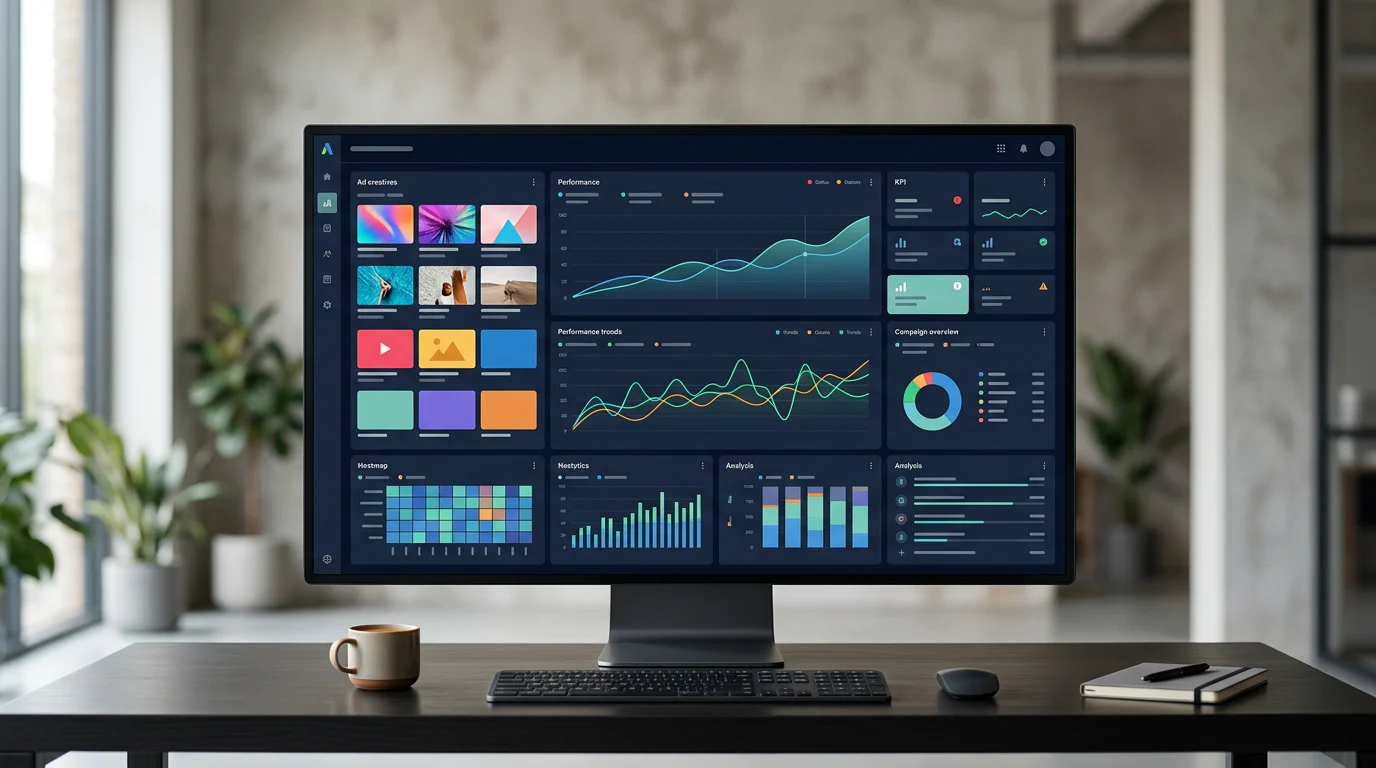
TikTok supports reporting by campaign, ad group, ad, and placement, plus multi-account reports, scheduled delivery, and trend lines. Those features make an asset-level portfolio view practical, even before a team adds its own decision layer. TikTok reporting
We set a fresh-period baseline only after an asset has meaningful, stable delivery. Then we compare the recent rolling period with that asset’s own starting range. A 0.8% CTR may be excellent for one asset and a serious decline for another that opened at 4%, which is why account averages and universal benchmarks produce bad stop decisions.
Which Metrics Lead and Which Confirm Fatigue?
The fastest signals are usually attention signals, but they are not final verdicts. We read a sequence: attention first, delivery context second, commercial outcome third. This order helps us spot decay before CPA rises without confusing every performance wobble for fatigue.
Which Metrics Provide Early Warning?
For video, we track a consistent first-seconds measure as the hook rate, then a deeper retention measure as hold rate. TikTok defines focused views around 6-second and 15-second viewing behavior, giving teams a useful platform-native way to watch early attention. Focused views
CTR is the clearest click-intent warning when it falls meaningfully below the asset’s fresh baseline. CPC can reinforce that finding, but neither metric identifies the cause by itself. We connect these signals to creative angle performance tracking so a team can see whether an execution is tiring, or whether the underlying message is also losing traction.
| Metric Tier | Metrics | What We Learn | Typical Use |
|---|---|---|---|
| Early Warning | Hook rate, hold rate, CTR | Whether attention and click intent are decaying | Watch state |
| Delivery Context | CPC, CPM, frequency, reach | Whether delivery is becoming more repetitive or expensive | Diagnose cause |
| Business Confirmation | CPA, ROAS, post-click conversion rate | Whether the decline affects the business outcome | Refresh, rotate, or pause |
| Eligibility | Spend, creative age, learning status | Whether there is enough stable evidence to act | Suppress false alerts |
Which Metrics Explain Delivery Pressure?
Frequency and reach belong together. Frequency shows repeat exposure, while reach shows whether delivery is still finding new people. Rising frequency with weakening incremental reach makes a CTR decline more suspicious. CPM adds auction context, but we do not treat a CPM increase as proof that a creative is tired.
Spend and creative age are safeguards. An ad that has barely spent, recently changed, or remains in learning can move sharply for reasons unrelated to audience response. We retain those conditions with the alert so the person reviewing it can see what the model cannot safely assume.
Which Metrics Confirm Business Impact?
CPA and ROAS confirm the commercial effect after the relevant attribution window has matured. We also compare post-click conversion rate, because stable CTR with falling conversion rate points toward the offer, landing page, checkout, or tracking rather than the creative itself.
This hierarchy prevents a common error: pausing an ad because its CTR moved before we have enough evidence that the change is persistent, attributable, and economically meaningful.
Is It Creative Fatigue, Saturation, or Something Else?
A good fatigue system must diagnose, not merely flag. The same CPA increase can come from repeated exposure, a constrained audience, auction changes, a weak launch, or a post-click problem. We separate those patterns before routing creative work.
A useful rule is simple: real fatigue has a trajectory. The asset first performs, then attention deteriorates against its own baseline, while delivery and outcome signals support that reading. Meta notes that performance is less stable and CPA is usually worse during learning, which is why we exclude learning-state volatility from automatic conclusions. Meta learning
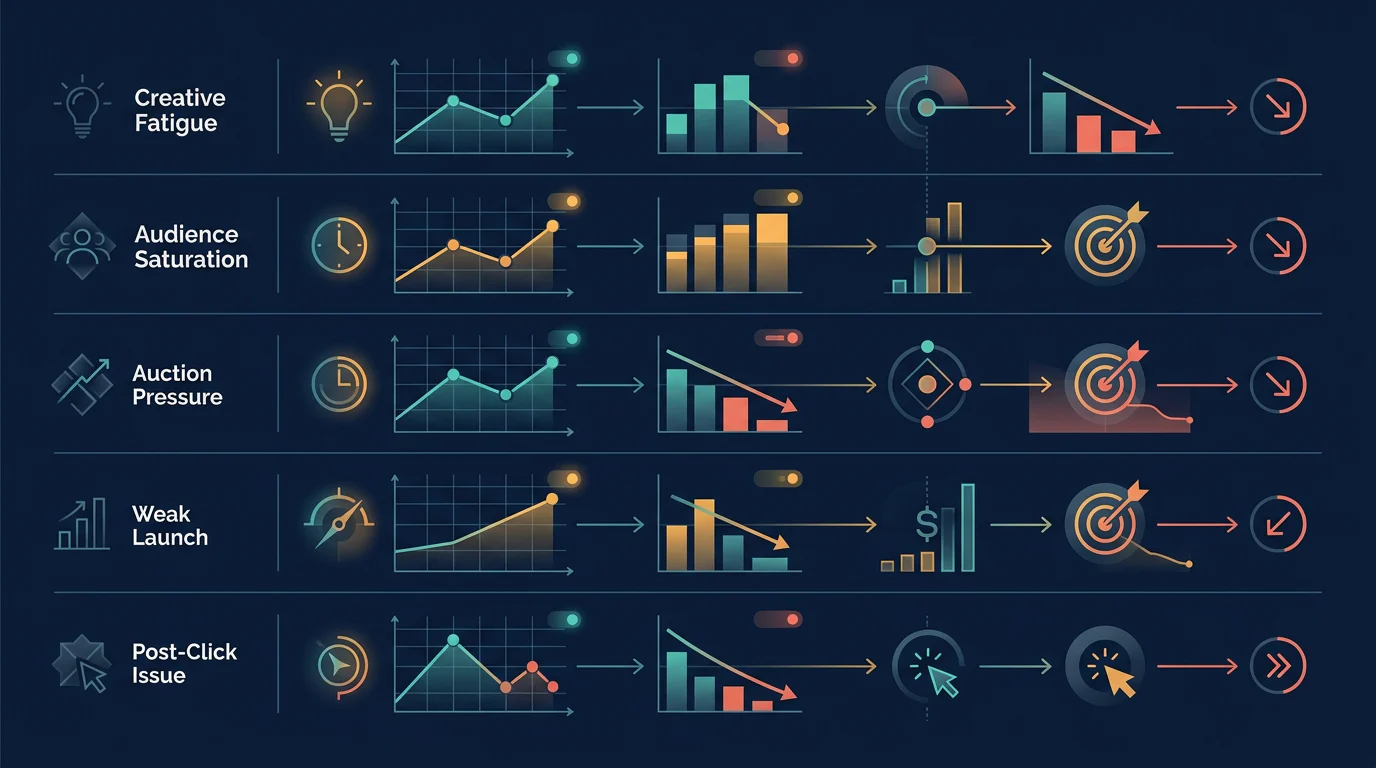
| Diagnosis | Typical Pattern | Cross-Asset Check | Best Next Action |
|---|---|---|---|
| Creative Fatigue | Previously strong hook rate or CTR falls, frequency rises, CPA worsens | Similar execution weakens first | Refresh execution or change angle |
| Audience Saturation | New and old assets decline in the same audience | Reach slows across several assets | Rotate or broaden the audience |
| Auction Pressure | CPM rises while hook rate and CTR remain comparatively stable | Multiple ads become costlier together | Review bids, placements, budgets, and timing |
| Weak Initial Creative | Low attention and click intent from the start | No strong fresh baseline exists | Stop the test and log the learning |
| Post-Click Problem | CTR holds while conversion rate and CPA worsen | Creative performance remains stable | Investigate landing page, offer, checkout, or tracking |
For a deeper version of this decision tree, use our fatigue versus saturation framework. It keeps teams from treating a new asset as a cure when the underlying constraint is audience availability.
How Should Automated Alert Logic Work?
Automation should surface evidence early, not create a reflexive pause machine. We use it to compare time windows, identify repeatable change, collect delivery context, notify the right owner, and preserve a decision log. The final action can remain human-approved when spend, attribution lag, or a limited creative bench makes automatic pausing risky.
How Do We Build the Fresh-Period Baseline?
We start with three to five eligible delivery days, then calculate a baseline using the median daily rate for hook rate, hold rate, CTR, CPC, and relevant conversion metrics. The median reduces the influence of one unusually good or bad day. TikTok’s Smart Creative documentation also describes observing differentiated videos for three to five days before fatigue-related refresh behavior. Smart Creative
We then compare a recent rolling window with that baseline. The useful output is a relative change, not a universal benchmark: current CTR compared with this asset’s own fresh CTR, current frequency compared with its recent delivery pattern, and current CPA or ROAS compared with mature outcomes.
Which Safeguards Reduce False Alerts?
We suppress high-consequence alerts when an ad is still learning, has had a material edit, lacks minimum account-configured spend or impressions, or is waiting for attribution to mature. We also require a state to persist across configured checks before it becomes fatigued or stop-worthy.
The thresholds belong to the account because audiences, conversion cycles, creative formats, and budgets differ. Our creative test stop rules approach keeps the policy explicit: what evidence is required, who approves an action, and what happens if no replacement is ready.
IF an asset has sufficient eligible delivery
  AND is not learning
  AND has no material recent edit
  AND its recent attention metric falls below its fresh baseline by the account threshold
THEN classify the asset as Watch

IF Watch persists for the configured number of checks
  AND frequency rises or new reach weakens
  AND CPA worsens or ROAS declines after attribution maturity
THEN classify the asset as Fatigued.

IF Fatigued
  AND a replacement is ready
  AND the owner approves the action
THEN classify the asset as Stop and pause it
What Do the Four Alert States Mean?
The states make alerts operational. Healthy ads do not need attention. Watch ads need evidence review. Fatigued ads need a replacement decision. Stop ads need a documented action and a next test, not a dead end.
| State | Evidence | Automation | Owner Action |
|---|---|---|---|
| Healthy | Performance remains within the asset’s baseline range | Log only | Continue |
| Watch | Early attention decay after sufficient delivery | Notify | Review placements, audience, and execution |
| Fatigued | Persistent decay plus delivery context and weaker efficiency | Create task | Refresh execution or change angle |
| Stop | Confirmed deterioration, safeguards passed, replacement approved | Pause under policy | Log learning and reallocate deliberately |
We route this queue through a signal-to-action workflow so notification, ownership, creative production, and decision logging remain connected across accounts.
What Action Should Follow Each Alert State?
The right response depends on the diagnosis, not on the alert label alone. A watch state may only require a review and a production brief. A fatigued creative may deserve a new hook or format. Saturation can require a different audience plan, while a post-click issue should send work to the landing-page owner instead of the creative team.
TikTok recommends refreshing creative when delivery results show a consistently declining trend or daily new users are low. It also recommends adding new creative to an existing ad group in many cases, which can help preserve a stable operating structure while testing a replacement. TikTok refreshes
- Healthy: Continue delivery, preserve the baseline, and maintain the next creative in the bench.
- Watch: Review the asset by placement and audience, then prepare a refreshed execution before performance damage becomes material.
- Creative Fatigue: Keep the useful angle where evidence supports it, but refresh the hook, opening frame, format, proof, or pacing.
- Angle Exhaustion: Change the message, not just the surface treatment, when several executions of the same angle weaken.
- Audience Saturation: Rotate audience strategy, revise exclusions, or expand qualified reach before replacing a healthy asset.
- Weak Initial Creative: End the test under the agreed policy and retain the learning for the next concept.
- Post-Click Problem: Investigate the landing page, offer, inventory, checkout, and measurement path before changing creative.
Our account-calibrated stop-loss framework is useful when a team needs to set those policies without relying on a generic frequency cutoff. That keeps the decision tied to the account’s own risk tolerance, conversion cycle, and available creative bench.
How Deepsolv Turns Fatigue Signals into Decisions
At Deepsolv, we help paid-social teams make the next decision, not merely collect another report. Our workspace brings asset, angle, audience, spend, and conversion signals into one operating view, so a creative strategist sees the same evidence as the media buyer. We can surface baseline-relative deterioration across Meta and TikTok, route a watch-state notification to the right owner, and retain the outcome after a refresh, audience change, or pause. That decision memory matters because it stops the team from repeating a rejected hook or misreading a landing-page issue as fatigue. We also connect the evidence to a practical weekly rhythm: review the queue, choose the next replacement, assign production, and record what happened. The result is faster creative learning with fewer reflexive pauses across every account while keeping human approval at each consequential step. See how book a Deepsolv demo
FAQs on Ad Fatigue Tracking at Scale
These questions address the practical edge cases that determine whether an alert system becomes a useful operating model or another noisy dashboard.
Can a CTR Drop Prove Creative Fatigue?
A CTR drop alone cannot prove fatigue. We compare it with fresh performance, frequency, reach, CPM, conversion behavior, delivery status, and related asset evidence too.
What Is a Good Frequency Threshold?
Frequency alone is not a threshold. We use each audience’s baseline and check whether engagement, incremental reach, and conversion efficiency decline together after stable delivery.
How Long Should the Fresh Period Be?
We start with three to five eligible delivery days, then compare a recent rolling window. Learning, material edits, low spend, and attribution delay can postpone eligibility.
Can We Auto-Pause Fatigued Ads?
Not by default. We use automation to detect and route evidence, while pause permissions require safeguards, attribution maturity, a replacement option, and accountable human approval.
What Should a Multi-Account Dashboard Log?
Log account, platform, asset, audience, placement, age, spend, baseline, recent change, alert state, diagnosis, owner, action, replacement, and delivery exceptions that influenced the reviewed decision.