Product Demo Ads on Meta: Price the Test Before the Shoot
Product demo ads show the product working. Test a creator clip first: Billo lists $99 with no subscription, Insense $100 on a $400 to $500 monthly plan, one animated package from $1,000.

By Sachit Sharma, CEO & Founder · Updated 28 Nov 2026
Key takeaways
- Run the cheapest creator-made demo first. As of November 2026, Billo lists $99 for a 15-second creator video with no subscription, Insense's $100 per video sits on top of a $400 to $500 monthly plan, and Breadnbeyond's animated package starts at $1,000, about ten times Billo's price.
- A demo must beat your current best ad by more than its production cost divided by your test spend. At $10,000 of media, a $1,000 production needs 10% more purchases. A $99 one needs about 1%.
- Show the product working in the first three seconds, answering one specific doubt a buyer has. Pick that doubt from reviews, comments and competitor ads, not from a feature list.
- Never present a staged or simulated result as a real test. The US Supreme Court held this deceptive in 1965, and the Federal Trade Commission (FTC) applies the principle today.
In this article
- 1What should product demo ads show, and which products suit them?
- 2Do you need a studio to make a product demo ad?
- 3How much better must a demo ad perform to repay its production cost?
- 4Which feature or doubt should the demo answer first?
- 5What goes in a one-page product demo ad brief?
- 6Can a staged demonstration get an advertiser into legal trouble?
- 7When should you stop or scale a product demo ad?
- 8Frequently asked questions
A product demo ad lets a stranger watch the product work before they scroll past, and it is easy to over-produce. The filming is rarely where it goes wrong. The spending order is: a polished version gets commissioned first, and the team learns whether the idea works second.
Cost is the first test. Billo lists $99 for a 15-second creator video, with no subscription; Insense's $100 per video sits on top of a $400 to $500 monthly plan. On a $2,000 test, a $1,000 animated package must win 50% more purchases just to break even. A creator-shot clip is also easy to repeat with a different opening.
This page gives you what to do instead: a cost table, a break-even formula, a one-page brief, the legal line a demonstration must not cross, and a rule for deciding when to stop or scale. It is written for brands advertising on Meta, the company behind Facebook and Instagram.
What should product demo ads show, and which products suit them?
Product demo ads show the product being used, so the viewer sees what it does instead of being told. They suit products that are easier to understand in motion: tools, kitchen items, things that fold or fit, and anything whose result you can watch. For software, a screen recording of one task does the same job.
A demo is one of several ways to open a Meta ad. If you are still choosing between formats, Types of Facebook Ads covers the options and what to test first. This page assumes you have decided to test a demo and need to know what it should cost and how to test it.
Do you need a studio to make a product demo ad?
No. A creator-made demo is the right first test: Billo's per-video price is about a tenth of Breadnbeyond's starting price for an animated package, and Insense's $100 per video comes on top of a monthly plan. These are the starting prices on each provider's own page as of November 2026:
| Provider | Published starting price | What the page says |
|---|---|---|
| $99 per video | A 15-second video from a regular creator with basic editing. Longer formats, premium creators and add-ons cost more. A $1,000 pack covers up to 10 videos. | |
| $100 per video | Creator payments are budgeted separately from the platform subscription. The Brand plan is $500 a month ($400 a month on the annual option) with a 10% marketplace fee. | |
| $1,000 | Animated explainer video from $1,000; the standard package takes 5 weeks or less, higher tiers 5 to 7 weeks or more. Beyond one minute costs extra for every 10 seconds. |
These are starting prices, not typical prices, and an animated package is a different product from a creator-shot clip. The point is the order of spending. The same $1,000 buys one animated package or up to ten creator videos with different openings, and ten different openings teach you more than one polished one.
"UGC" means user-generated content: a video that looks like it was shot by a customer or creator in everyday surroundings. Most creator-made demos are shot this way. To source them, see How to Find UGC Creators for Meta Ads. Our Creator Intelligence also helps find brand-fit creators and estimate fair compensation.
How much better must a demo ad perform to repay its production cost?
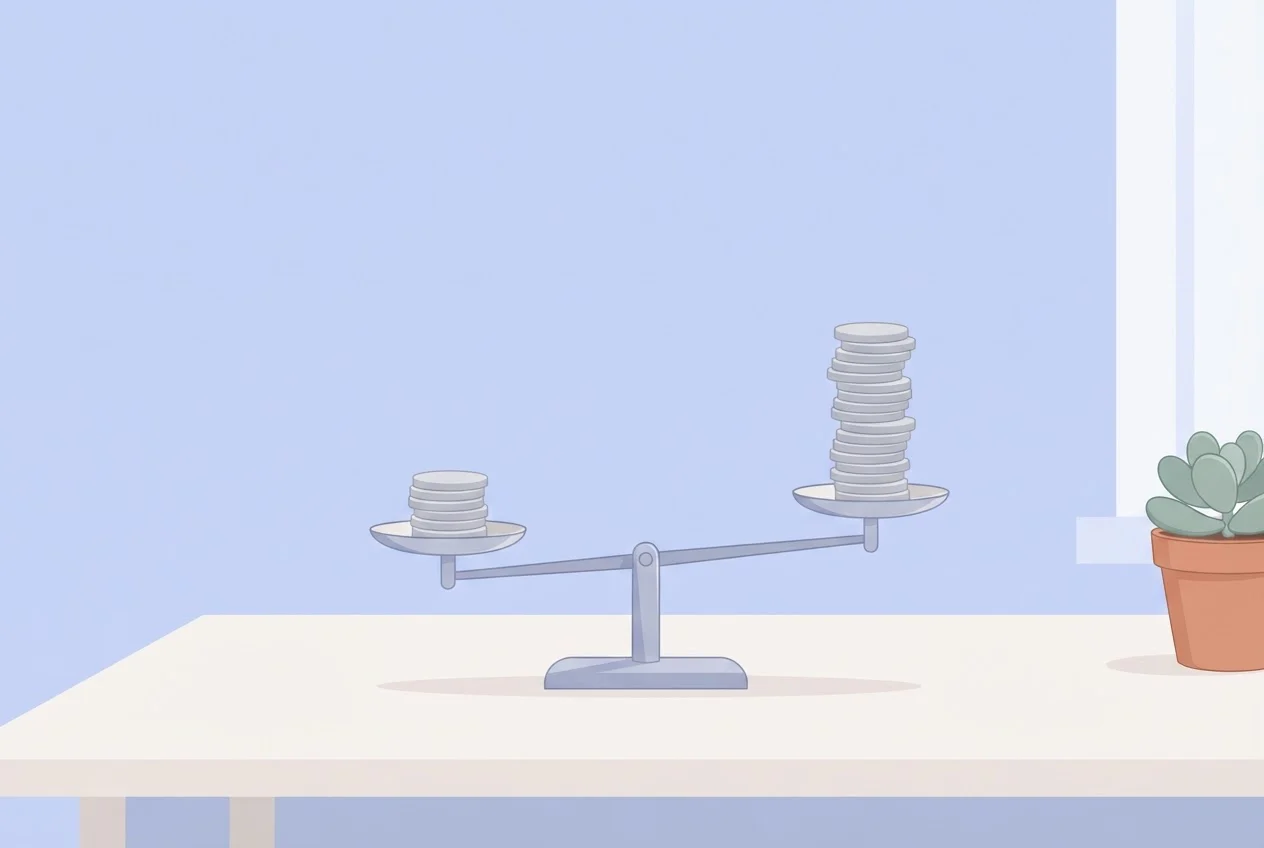
A demo ad must win more purchases than your control ad, meaning your current best-performing ad, run alongside as the comparison, by a share equal to its production cost divided by the media spend behind it. This is our model, not an official figure. Cost per acquisition, or CPA, is the price of one purchase.
Our working: your control ad spends S dollars and wins Nc purchases, so its CPA is S ÷ Nc. The demo ad costs C to make and also spends S, so its all-in CPA is (S + C) ÷ Nd. To match the control, Nd = Nc × (1 + C ÷ S). The required extra purchases are C ÷ S.
| Production cost (C) | Media spend S = $2,000 | Media spend S = $10,000 |
|---|---|---|
| $500 to $600 (Insense: one $100 video plus the $400 to $500 monthly plan, before the 10% marketplace fee) | 25% to 30% more purchases | 5% to 6% more purchases |
| $1,000 (animated package) | 50% more purchases | 10% more purchases |
The spend figures are example inputs, not benchmarks. Substitute your own. The model assumes the demo and the control get equal media spend, the production cost is counted once, and the demo has no reuse value afterwards. The Insense row assumes one video in the month; more videos spread the plan cost across them. If the demo keeps running, S grows and the hurdle falls.
Small tests are where the expensive version hurts most. With $2,000 of media behind it, a $1,000 production needs 50% more purchases to merely break even. In our view, that is the reason to start cheap and pay for polish only after the idea has won.
Which feature or doubt should the demo answer first?
The demo should answer the one doubt that most often stops a hesitant buyer, not the longest feature list. Work it out from three places: your own 1-star to 3-star reviews and pre-purchase questions, comments on your current ads, and what competitors' ads lead with.
This is the part we do with our platform. We collect reviews, comments and Reddit discussion and turn them into the objections and desires buyers state in their own words. We track competitors' ads, including their messaging, hooks, offers and formats, so you can see which demos rivals already run. We then deliver a ranked weekly test plan, with reasons for each recommendation, so the doubt worth demonstrating first is a ranked decision. Our recommendations guide experiments. They do not guarantee profitable ads.
What goes in a one-page product demo ad brief?
A product demo ad brief is one page with six lines, and each line is a check you can pass or fail before anyone films anything. This is our recommended template.

- The buyer's doubt.Write it as a question ("Will it fit my pan?"). Pass: the video answers it by showing, with no voiceover needed. Fail: it needs a text explanation.
- The product at work by second 3.
Mute the clip and watch only the first 3 seconds. Pass: a colleague can say what the product does. Fail: they see a logo, a face or a title card. You can check where attention lands in your first frame with our free AI Ad Attention Heatmap, no signup.
- One real result.Film the product doing the job once, start to finish, with no cuts that hide a step. Pass: you can repeat it on camera for a reviewer. Fail: it only works in the edit.
- Length for the first version.Aim for 15 seconds or under for a simple product. Feed video can run far longer (Meta lists 1 second to 241 minutes), but a test needs a result fast. Longer is a call for expensive or technical products. Pass: the demo finishes within 15 seconds of the first frame. Fail: the result appears after second 15.
- Sound-off readability.Meta says captions and sound are optional but recommended in Feed. Pass: the clip makes sense on mute with captions. Fail: the meaning lives in the audio.
- Disclosure and proof.If a creator received free product or payment, the disclosure is in the video itself. Every claim in the clip has evidence on file. Pass: both are true before launch.
For Feed placement, Meta's ad specification is a 4:5 ratio at 1440 by 1800 pixels, per Meta's ads guide for video. Meta recommends movement and visual storytelling to capture attention quickly; captions and sound are optional but recommended.
Can a staged demonstration get an advertiser into legal trouble?
Yes. Presenting a staged or simulated result as a genuine test is a deceptive practice, even when the product claim is true. In FTC v. Colgate-Palmolive Co., 380 U.S. 374, decided April 5, 1965, a shaving-cream commercial showed a mock-up in place of sandpaper. The Court held that "the undisclosed use of plexiglass in the present commercials was a material deceptive practice."
That case concerned television. Our reading is that the same principle governs video ads on Meta, because the FTC tests ads for deception under the Policy Statement on Deception of October 14, 1983. A representation is deceptive if it is likely to mislead a reasonable consumer on a material point.
Four FTC rules matter for a demo:
- Evidence first. Advertisers need a "reasonable basis" for claims before the ad runs, according to the FTC's Policy Statement on Advertising Substantiation of November 23, 1984.
- Typical results. Customer testimonials in your clip must reflect the typical experience, per the FTC's advertising FAQs for small business.
- Creator disclosure. Per the FTC's Disclosures 101 guide (November 2019), a disclosure in a video "should be in the video and not just in the description." The FTC's Endorsement Guides, 16 CFR Part 255, set the underlying standard.
- Fake testimonials. As of November 2026, the FTC's Consumer Reviews and Testimonials Rule (16 CFR Part 465), in force since October 21, 2024, prohibits fabricated or AI-invented testimonials and undisclosed insider reviews, with civil penalties for knowing violations. See the FTC's announcement of the final rule and the rule text in the Federal Register.
This is general information, not legal advice. If a claim is about health, ask a lawyer before you launch.
When should you stop or scale a product demo ad?
Compare the demo against your control ad, with one variable changed, and read two numbers before cost per purchase. Hold rate is ThruPlays divided by 3-second plays, times 100; other definitions exist, so use one consistently. ThruPlay is Meta's count of longer views, and ThruPlay on Meta covers how its 6-second and 15-second counts differ.
One public benchmark exists, with limits. Biddy, a creative agency, analyzed 479 US video ads (each with at least $1,000 spend) from 17 accounts spending $100,000 or more over three months, June to August 2026. The median hook rate was 20.9%, with the middle half of ads between 14.2% and 30.4% (see hook rate). It is one agency's sample of high-spend accounts, so set your target from your own account's median for comparable ads in the same placement.
Our recommended reading, using the structure in A/B Test Hypothesis for Meta Ads:
- Hook rate below your median: change the first 3 seconds. The demo itself has not been judged.
- Hook rate fine, hold rate low: the demo drags. Cut it shorter before you change anything else.
- Both fine, cost per purchase above your CPA ceiling: the demo may not be answering the doubt your buyers have. Return to the brief's first line.
- Spend cap: set it before launch. Our recommendation: cap spend at about two times your CPA ceiling per variant. This is our rule of thumb, not a tested threshold. It catches duds but does not prove winners.
Our creative performance analysis reads your connected-account metrics and fatigue signals to help you decide whether to scale, iterate or stop each ad. To see how we turn competitor ads, customer signals and your past results into a ranked test plan, book a demo with our founding team. Our platform is sold as a monthly or yearly subscription; see Deepsolv pricing.
Turn competitor ads and reviews into a ranked test plan
Frequently asked questions
Keep the first cut to 15 seconds or under, and keep the production cheap. With $2,000 of media, the break-even table above shows a $1,000 production must win 50% more purchases just to break even. Meta recommends a 15-second maximum for in-stream placements, per Meta's video ad format page.
Sources
- 1.Billo pricing, Billo, November 2026
- 2.Insense pricing, Insense, November 2026
- 3.Breadnbeyond pricing, Breadnbeyond, November 2026
- 4.Meta ads guide: video, Meta
- 5.Meta video ad format, Meta
- 6.FTC v. Colgate-Palmolive Co., 380 U.S. 374 (1965), US Reports, Library of Congress
- 7.FTC Policy Statement on Deception, Federal Trade Commission, October 14, 1983
- 8.FTC Policy Statement Regarding Advertising Substantiation, Federal Trade Commission, November 23, 1984
- 9.Advertising FAQs: A Guide for Small Business, Federal Trade Commission
- 10.Disclosures 101 for Social Media Influencers, Federal Trade Commission, November 2019
- 11.Guides Concerning the Use of Endorsements and Testimonials in Advertising, 16 CFR Part 255, US Government Publishing Office
- 12.Federal Trade Commission Announces Final Rule Banning Fake Reviews and Testimonials, Federal Trade Commission, August 2024
- 13.Trade Regulation Rule on the Use of Consumer Reviews and Testimonials, 16 CFR Part 465, Federal Register, August 22, 2024
- 14.Hook rate, Deepsolv, June to August 2026